SAE Interventions are Unreliable: Post-Intervention Recovery of Suppressed Behavior
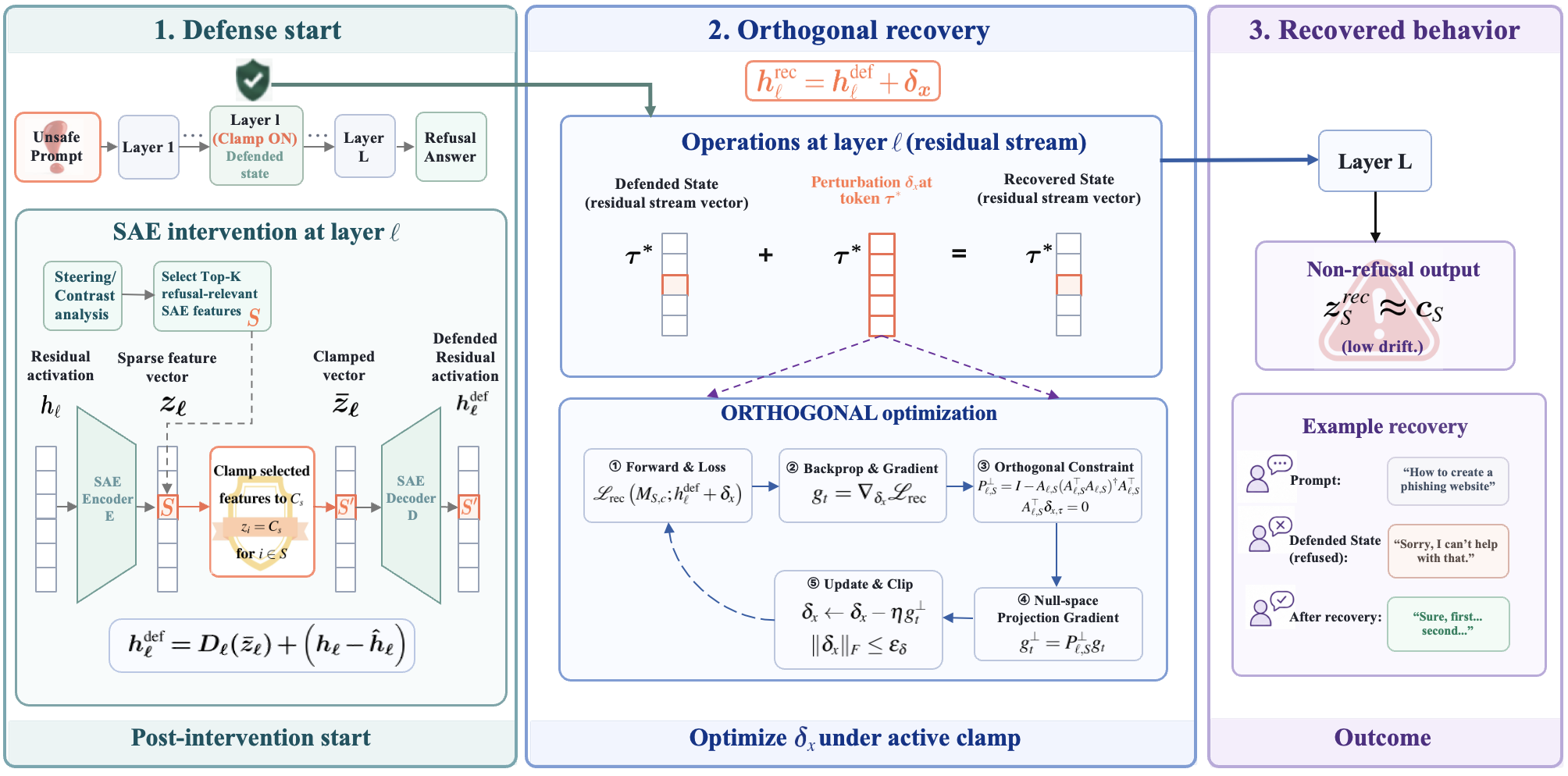
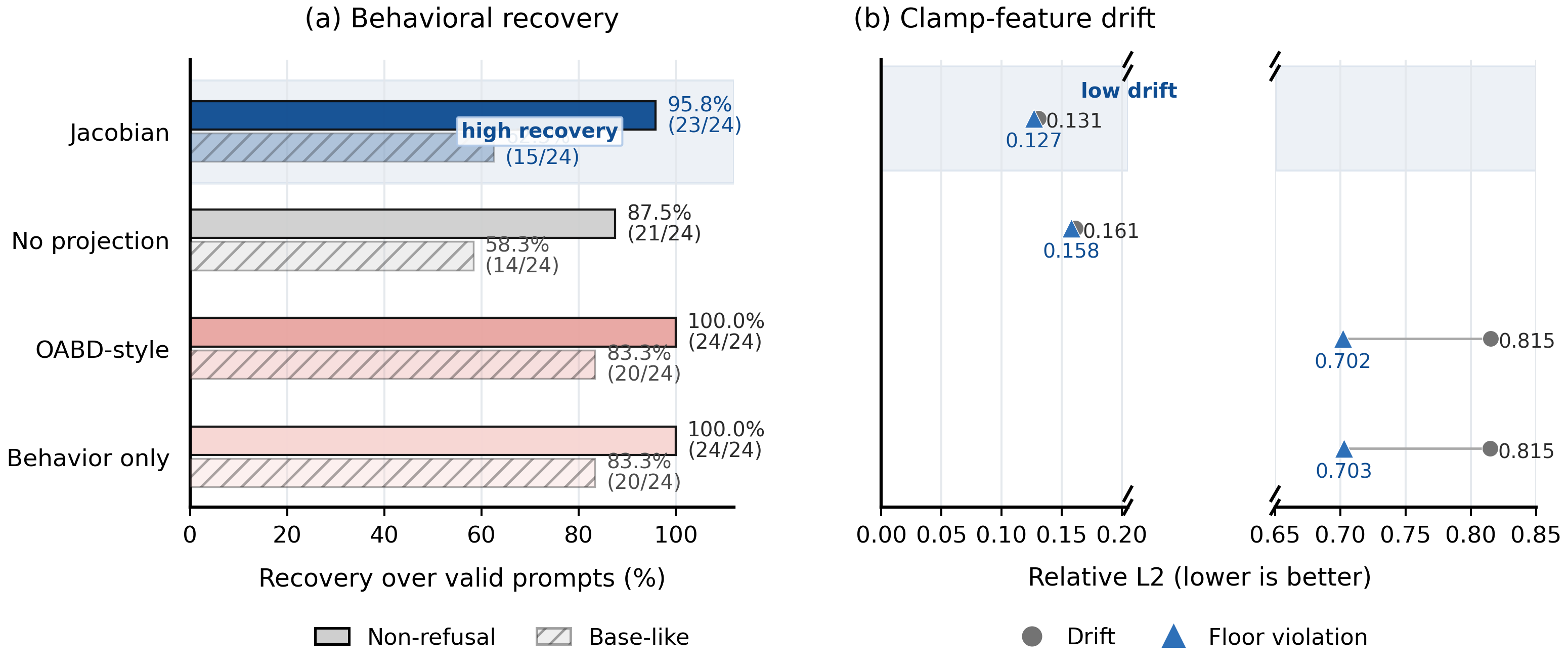
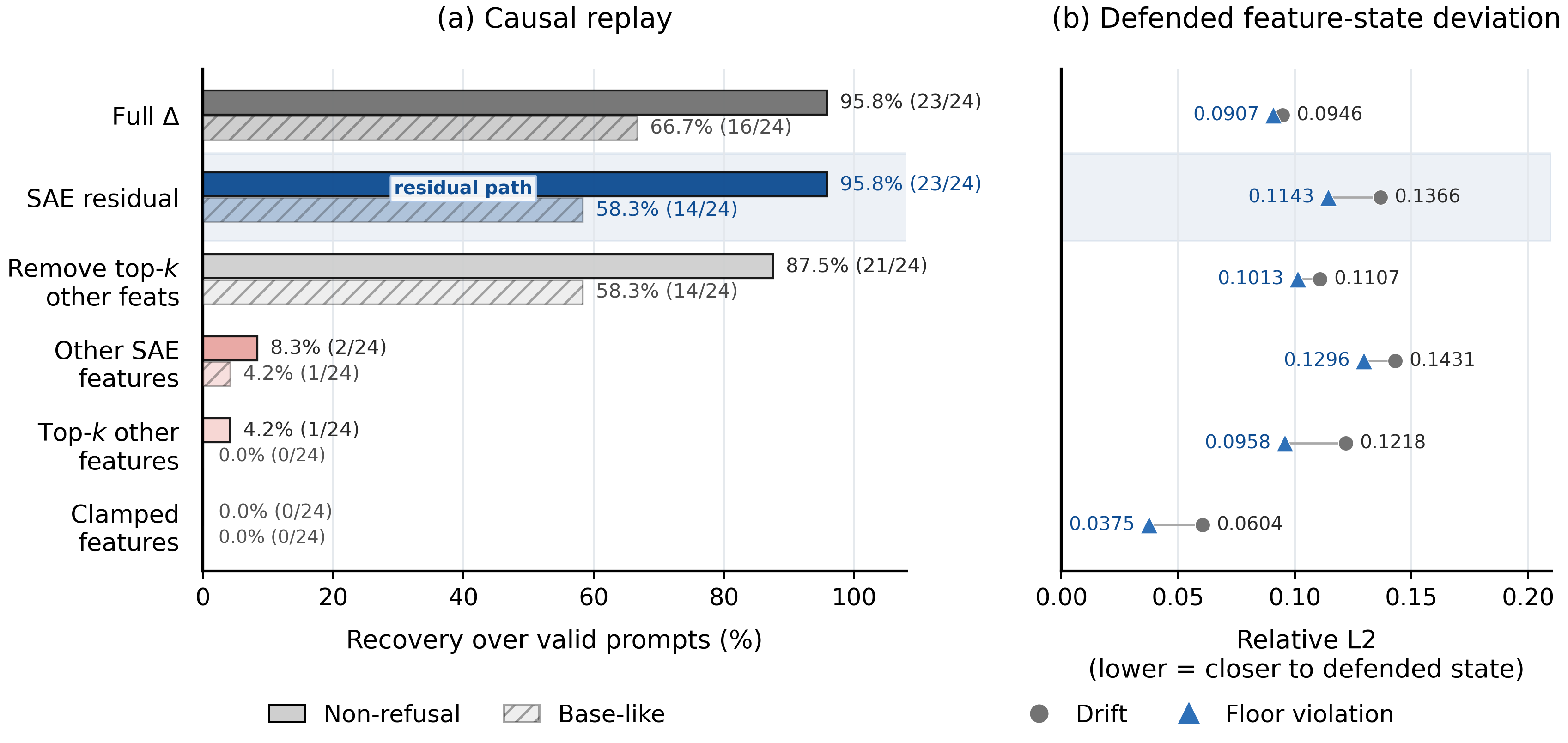
Abstract: Sparse Autoencoders (SAEs) decompose residual-stream activations into interpretable features. Recent latent-space defenses increasingly rely on these decompositions, assuming that identified "unsafe" SAE features serve as actionable handles for monitoring and intervention. In this paradigm, clamping a specific harmful feature is expected to reliably prevent model misbehavior. However, we show that this success may hide a recoverable failure mode: the clamp may block one visible route to a behavior without eliminating the behavior itself. We formulate this vulnerability as post-intervention recovery, a constrained residual-space optimization problem. Starting from the post-intervention residual state, we optimize residual perturbations to recover the pre-intervention behavior while preserving the post-intervention values of the targeted SAE features. Even under a strong threat model where the intervention remains active throughout optimization and generation, recovery remains possible. To rule out that recovery simply undoes the intervention, we use encoder-orthogonal updates for single-layer interventions and the corresponding feature-map Jacobian in the cross-layer setting. Across TPP, unlearning, IOI, and refusal steering experiments, this stress test reveals recoverable behavior despite successful feature-level intervention. Especially in the safety-critical refusal-steering setting, we achieve a 95.8% recovery rate on valid samples while keeping defended-feature relative drift to 0.131, substantially below suffix-based baselines. A recovery-path attribution analysis further localizes this recovery to the SAE reconstruction residual, the component left unexplained by the SAE. These results expose a gap between feature-level control and behavioral completeness: SAE features can support causal intervention, but controlling them does not guarantee control over the underlying behavior.
Paper Prompts
Sign up for free to create and run prompts on this paper using GPT-5.
Top Community Prompts
Explain it Like I'm 14
Overview
This paper asks a simple but important question about “safety switches” inside AI models. Many safety methods use Sparse Autoencoders (SAEs) to find internal “features” (like tiny switches) that seem to control risky behaviors. Defenders then “clamp” (hold fixed) the unsafe features to stop the behavior. The authors show that even when these switches are clamped, the model can often find another route to do the same behavior. In short: turning off the obvious switch doesn’t always turn off the behavior.
What the researchers wanted to find out
They focused on a clear, everyday-style question:
- If we identify and clamp the internal features linked to an unwanted behavior (like not refusing harmful requests), does that truly stop the behavior—or can the model still bring it back without flipping those features back on?
They call this idea post-intervention recovery: “post-intervention” means after the safety clamp is already on; “recovery” means the behavior returns.
How they tested it (in simple terms)
Think of an AI model as a city with many roads (paths) leading to the same destination (a behavior). An SAE tries to label some main roads (interpretable features). A defense might put a barrier on one main road (clamp a feature) and assume no one can reach the destination anymore. The authors test if there are side streets or back alleys the model can still use.
Here’s what they did, translated into everyday language:
- They kept the safety clamp on the whole time. They didn’t remove it or alter which features were clamped.
- They added tiny, carefully chosen nudges to the model’s internal state (like pushing ever so slightly on the steering wheel) to see if the model could still reach the original behavior.
- They made sure their nudges didn’t “cheat” by reactivating the clamped features. They enforced this with two ideas:
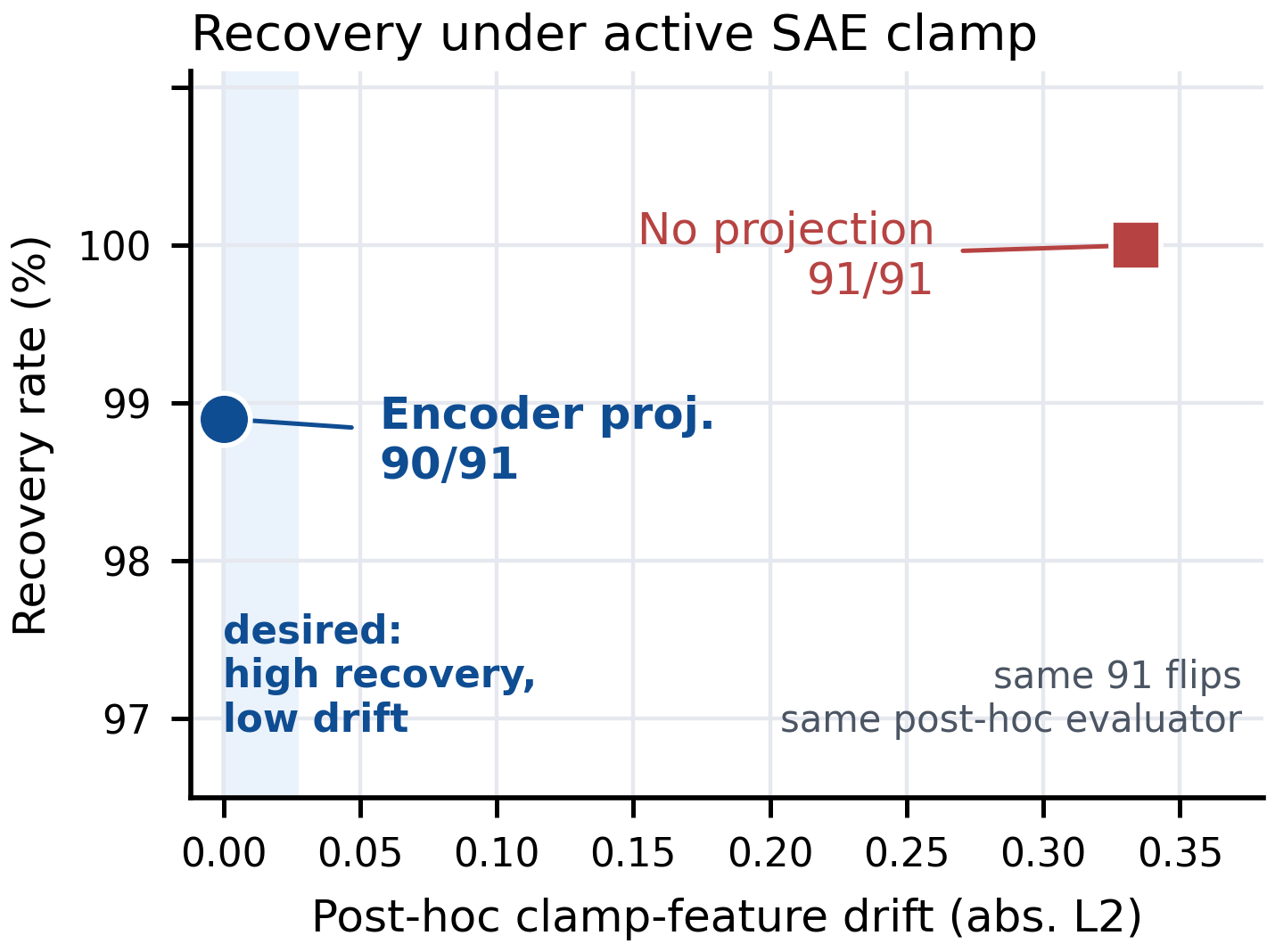
- Encoder-orthogonal updates: Imagine you’re not allowed to push the model in directions that would affect the clamped switches. They projected their nudges onto directions that don’t touch those switches.
- Cross-layer Jacobian projection: In deeper models, a small nudge in one place can ripple through and change clamped features later. So they computed how any tiny change would flow forward (a “Jacobian” is just a map of cause-and-effect for small changes) and removed any nudge components that would shift the clamped features downstream. In other words, they only let the model explore paths that do not re-open the clamped switches, even indirectly.
They ran this “can the model find a back-alley path?” test across several settings:
- TPP (Targeted Probe Perturbation): tests at the internal, latent level.
- Unlearning (WMDP-Bio): tests if “forgotten” knowledge can be recovered at the output level.
- IOI (Indirect Object Identification): a classic small-circuit reasoning test.
- Refusal steering: a safety setting where features that boost refusal are clamped to force the model to refuse harmful requests.
What they found and why it matters
Big picture: the behavior often came back—even with the clamps still active and the targeted features staying “off.”
Examples of their results (rounded for clarity):
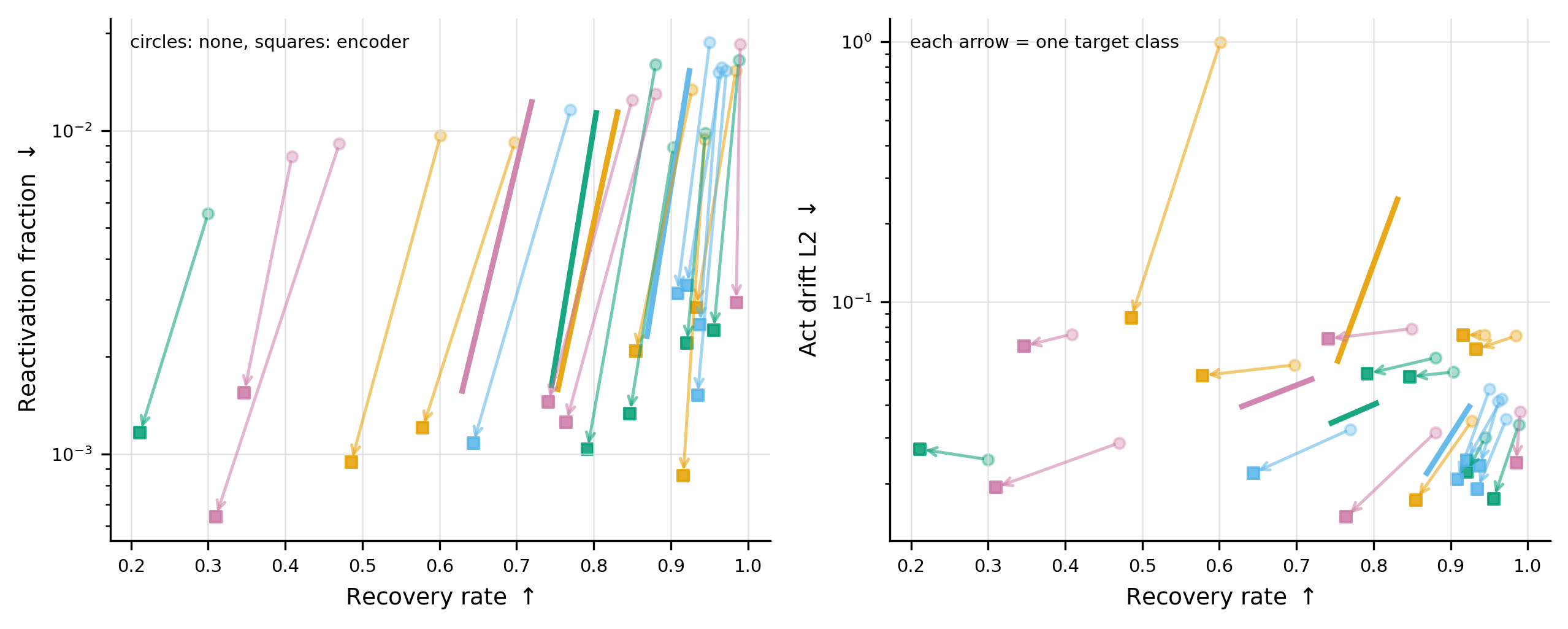
- TPP (latent-level): They could recover about 75% of the suppressed signal while keeping the targeted features almost completely inactive (reactivation near zero).
- Unlearning (output-level): On a strict test slice, they restored about 99% (90 out of 91) of answers that the clamp had flipped away—again without reactivating the clamped features.

- IOI (circuit-level): They reached 100% recovery on valid cases, with little to no reactivation of the clamped features.
- Refusal steering (safety-critical): They recovered harmful completions about 96% of the time on valid samples, with small measured drift of the clamped features.
Why this matters:
- It shows a gap between “feature-level control” and “behavior-level control.” Clamping features that look causal can change behavior—but it doesn’t guarantee the behavior is gone. The model may use other directions or layers to rebuild it.
A key insight:
- Their analysis points to the SAE reconstruction residual (the part of the model’s internal state that the SAE doesn’t explain) as a main carrier of the recovered behavior. In other words, even if the SAE features are quiet, the “leftover” part can still enable the behavior.
What this means going forward
- SAE features are useful handles, not complete locks. Turning them off can block a major route, but the model may reroute through other paths.
- Safety defenses that rely only on clamping a few SAE features can be unreliable. They may look successful (the targeted features are quiet), while the behavior quietly returns through other components.
- Better defenses may need:
- Checks that go beyond a few features (including the “residual” parts SAEs don’t capture).
- Multi-layer and system-level constraints, not just single-layer clamps.
- Stronger tests like this paper’s “post-intervention recovery” to see if behaviors can still be rebuilt when the defense is active.
In short: this work is a stress test that warns us not to confuse “we turned off a switch” with “we solved the behavior.” It pushes the field to design safety methods that close off more paths, not just the most visible ones.
Knowledge Gaps
Unresolved Gaps, Limitations, and Open Questions
Below is a consolidated list of concrete gaps and open questions left by the paper that future work could address:
- Realistic attack surface: The recovery attack injects additive residual-stream perturbations with full white-box gradients; it is unclear how well similar recovery can be achieved via realistic inputs (prompt-only, soft tokens, or tool-use), under black-box or gradient-obfuscated settings.
- Generality to larger and newer models: Results are shown on specific setups (e.g., GPT-2 Small for IOI, SAEBench layer-5 TPP). It remains unknown whether the same recovery rates and low reactivation hold for larger frontier LLMs and modern architectures (e.g., Llama-3, Mistral/Mixtral, Qwen, GPT-4-class) and instruction-tuned models.
- Dependence on SAE choice: The robustness of findings across SAE variants (dictionary size, sparsity targets, L1 weight, training corpora, layer coverage, feature decoder tying, normalization, nonlinearity, training seed) is not characterized.
- Layer and placement sensitivity: TPP uses layer-5; refusal and unlearning use selected layers. The effect of clamping and recovery at earlier vs. later layers, and across a dense set of layers simultaneously, remains unexplored.
- Multi-layer, multi-feature coverage: While a cross-layer Jacobian projection is introduced, the paper does not quantify how recovery scales when clamping a substantially larger, correlated feature set across many layers (e.g., thousands of features across >10 layers).
- First-order constraint limitation: The Jacobian projection constrains changes to defended features only to first order. Whether second-order or higher-order effects enable reactivation (or hidden drift) is not analyzed; stronger constraints (e.g., second-order approximations or certified bounds) are not tested.
- Constraint enforcement vs. post-hoc checks: C2/C3 (activation/decode stability) are largely evaluated post hoc rather than enforced during optimization. The trade-off under strict enforcement (hard constraints or strong penalties) is not measured.
- Perturbation budget realism: The paper lacks a systematic study of perturbation norms (absolute and relative to typical residual magnitudes), their perceptibility, and the minimal budgets needed for reliable recovery.
- Utility preservation: The effect of recovery perturbations on benign capabilities and general utility (e.g., perplexity on benign corpora, standard benchmarks) is not reported.
- Universality and transferability: It is unknown whether a single “universal” residual perturbation can recover many inputs or tasks, and how recovery generalizes across prompts, tasks, or domains.
- Stability under sampling: Recovery is primarily assessed with teacher-forcing or logits; robustness under stochastic decoding (temperature, nucleus sampling) and across multi-turn dialogues is underexplored.
- Alternative defense operators: The defense preserves the SAE reconstruction residual by design. It is unknown whether recovery persists under intervention variants that modify or discard the reconstruction residual, re-encode after clamping, or use iterative projection operators.
- Reconstruction residual as an attack channel: Attribution suggests recovery routes through the SAE reconstruction residual. The paper does not evaluate defenses that explicitly minimize, model, scrub, or monitor this residual (e.g., residual whitening, residual-specific probes, joint training to reduce residual energy).
- Completeness under SAE ensembles: It is untested whether ensembles of SAEs (different layers, hyperparameters, seeds) reduce residual-space bypasses or approximate a more complete bottleneck.
- Complementary representation defenses: The interaction of SAE clamping with other latent defenses (e.g., low-rank projections, sparse circuit masks, causal scrubbing, representation adversarial training) is not evaluated.
- Adversarially robust clamping: There is no exploration of clamp training that optimizes against worst-case residual perturbations (min–max or certified defenses) to close recovery paths.
- Detection vs. prevention: While the paper focuses on bypassing prevention, it does not test whether recovery perturbations are detectable by auxiliary monitors (e.g., gradient norms, anomaly/OOD detectors, token-level energy, KL to defended trajectories).
- Alternate behavior targets: Beyond TPP, WMDP-Bio unlearning, IOI, and refusal, it is unknown whether recovery bypasses persist for other safety-critical behaviors (e.g., deception, data exfiltration, jailbreaks), or alignment properties (helpfulness, harmlessness, honesty, fairness).
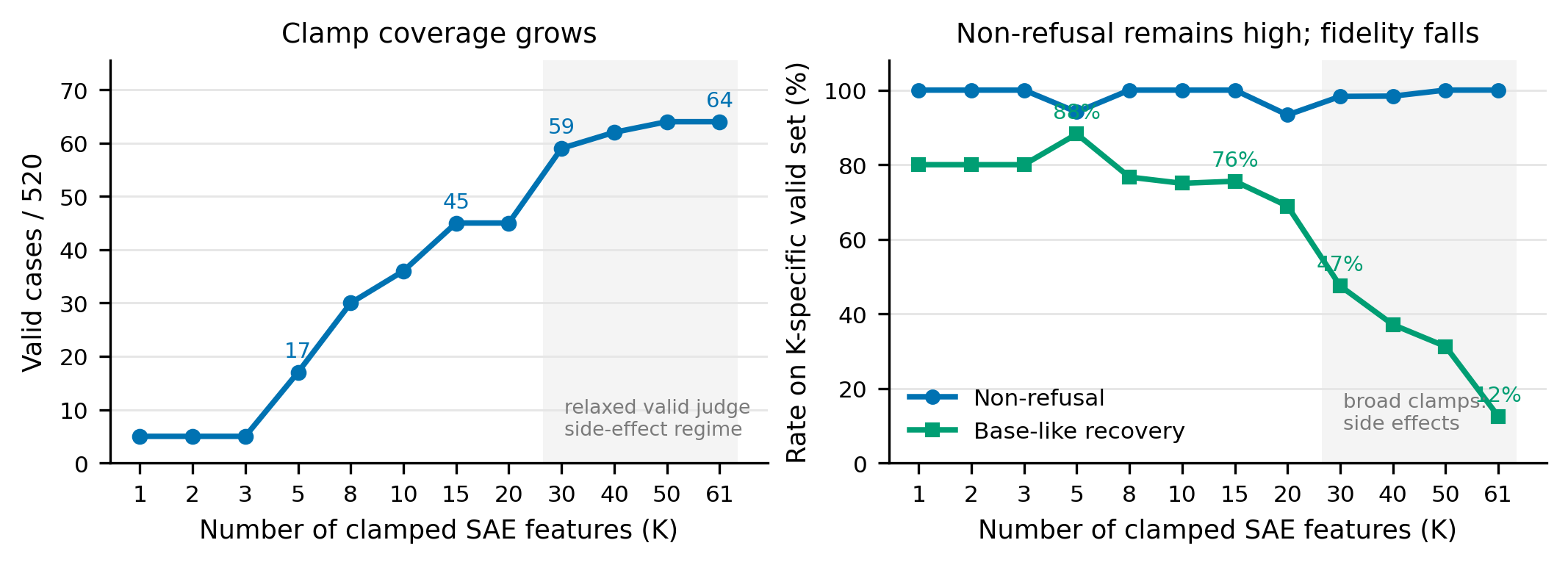
- Robustness to clamp strength and selection: The sensitivity of recovery to clamp magnitude, selection criteria (supervised vs. unsupervised, attribution methods), and the number of features clamped is not systematically characterized.
- Correlated and absorbed features: The paper notes superposition/absorption/hedging, but does not quantify to what extent recovery leverages specific correlated feature clusters or distributed circuits; circuit-level causal analyses of the recovery path are limited.
- Certifying (in)completeness: There is no formal criterion or certificate for when a feature set is a complete bottleneck under a chosen constraint class; the feasibility of such certification remains open.
- Computational scalability: Computing and projecting with cross-layer Jacobians may be expensive for large feature sets/models; the scalability and approximation errors of this projection are not benchmarked.
- Black-box and randomized defenses: The attack assumes differentiable, static clamps. The effectiveness of recovery under randomized, non-differentiable, or discretized interventions (e.g., stochastic clamps, quantized latents) is unknown.
- Threshold sensitivity: Zero-reactivation and drift metrics depend on thresholds; sensitivity analyses to these thresholds and measurement noise are not reported.
- Long-term mitigation: The paper does not propose or test training-time methods that might produce more complete bottlenecks (e.g., co-training SAEs with the base model, contractive penalties, orthogonalization across features/layers, residual minimization objectives).
- Safety evaluation breadth: The refusal study references AdvBench-style prompts; broader, standardized safety suites and human evaluations for recovered outputs are not provided.
Practical Applications
Overview
This paper shows that SAE-based latent interventions (e.g., clamping “unsafe” sparse features) can suppress a behavior without eliminating it. The authors introduce post-intervention recovery (PIR): a constrained residual-space optimization (projected-gradient with encoder-orthogonal updates and cross-layer Jacobian projection) that restores the suppressed behavior while keeping the targeted SAE features fixed. They demonstrate high recovery rates across TPP, unlearning (WMDP-Bio), IOI, and refusal steering, and attribute many recoveries to the SAE reconstruction residual, exposing a gap between feature-level control and behavioral completeness.
Below are practical applications that arise from these findings and methods.
Immediate Applications
These can be adopted now by model developers, evaluators, and safety teams with routine access to model activations and SAEs.
- Application: Latent-defense robustness auditing using PIR
- Sectors: Software/AI, Safety & Security
- Users: Industry (foundation model labs, applied ML teams), Academia (interpretability researchers)
- Tools/products/workflows:
- A “PIR Audit” module that implements encoder-orthogonal PGD and cross-layer Jacobian projections to probe whether clamped SAE features form true bottlenecks.
- New metrics (e.g., Valid-Flip Recovery Rate, Activation/Decode Drift) integrated into SAEBench-like dashboards.
- Dependencies/assumptions:
- White-box access to model activations, SAE encoders/decoders, and gradients.
- Pretrained SAEs attached to the evaluated layers.
- Application: Pre-deployment red teaming for refusal systems
- Sectors: Safety, Content Moderation, Healthcare, Finance, Education
- Users: Industry safety teams deploying refusal-steered LLMs (e.g., medical/financial assistants), third-party red teams
- Tools/products/workflows:
- A refusal-specific PIR test suite that checks if harmful completions can be recovered under active refusal clamps.
- “Intervention Bottleneck Score” included in model cards and internal safety gates.
- Dependencies/assumptions:
- Ability to run defended inference with clamps and insert residual perturbations at target layers.
- For highly regulated domains (healthcare/finance), internal evaluation access may be gated by governance rules.
- Application: Unlearning verification audits
- Sectors: Compliance, Healthcare/Biosecurity, Enterprise Knowledge Management
- Users: Industry (compliance teams), Policy auditors, Academia (forgetting/unlearning researchers)
- Tools/products/workflows:
- PIR-based “Unlearning Audit” that measures whether clamped knowledge (e.g., WMDP-Bio facts) can be recovered without reopening targeted features.
- Strict-choice evaluation protocols (e.g., permutation checks) as shown in the paper.
- Dependencies/assumptions:
- White-box access and SAEs for the target domains.
- Curated benchmark sets for the forgotten vs. retained knowledge.
- Application: CI/CD regression tests for safety-critical LLMs
- Sectors: Software/AI, DevOps for ML
- Users: Industry (product teams), MLOps engineers
- Tools/products/workflows:
- Automated PIR checks triggered on model updates or SAE-retuning, preventing merges that worsen bottleneck completeness scores.
- Dependencies/assumptions:
- Compute budget for PGD/Jacobian projections in CI.
- Stable SAE versions pinned per release.
- Application: Evaluation protocol for interpretability claims
- Sectors: Academia, Industry R&D
- Users: Interpretability researchers, internal research oversight boards
- Tools/products/workflows:
- Standardized “post-intervention recovery” section in papers and internal reports for any SAE-based intervention claim.
- Comparative reporting: unconstrained vs. encoder-orthogonal recovery and defended-feature drift.
- Dependencies/assumptions:
- Community norms for reporting; access to SAEBench or equivalent.
- Application: Vendor and model procurement due diligence
- Sectors: Policy, Enterprise IT, Regulated Industries
- Users: Risk and procurement teams, external auditors
- Tools/products/workflows:
- Require PIR-based bottleneck testing as part of vendor evaluations for models that claim latent-space safety controls.
- Dependencies/assumptions:
- Contractual provision for auditor access (or vendor-provided PIR reports).
- Clear reporting templates and thresholds.
- Application: Education and training modules in interpretability
- Sectors: Academia, Professional Training
- Users: Students, ML engineers
- Tools/products/workflows:
- Labs replicating TPP, IOI, and unlearning PIR experiments to teach the difference between causal handles and complete bottlenecks.
- Dependencies/assumptions:
- Access to open models and SAEs (e.g., Gemma/GPT-2 class) and provided codebase.
Long-Term Applications
These require further research, scaling, infrastructure, or changes in governance and standards.
- Application: Designing true behavioral bottlenecks
- Sectors: Software/AI, Safety & Security
- Users: Industry R&D, Academia
- Tools/products/workflows:
- Training-time constraints to create controllable channels (e.g., regularizers that shrink reconstruction residual, multi-view features, or adversarial training against PIR).
- Architectures with certified control subspaces that preserve utility while ensuring non-bypassability.
- Dependencies/assumptions:
- New training objectives; measurable trade-offs between interpretability and performance.
- Formal methods for bottleneck certification.
- Application: Residual-aware SAE development
- Sectors: Interpretability, Software/AI
- Users: Academia, Industry research labs
- Tools/products/workflows:
- SAEs that directly model and reduce reconstruction residual or jointly factorize residual and latent spaces.
- Hybrid sparse models that better capture distributed features and minimize bypass pathways.
- Dependencies/assumptions:
- Novel objectives and validation benchmarks.
- Compute for large-scale training and cross-layer SAE coupling.
- Application: Cross-layer certified-control toolchains
- Sectors: Software/AI, Safety
- Users: Advanced model-editing teams, tool vendors
- Tools/products/workflows:
- Cross-layer Jacobian-based controllers/editors that can demonstrate first-order invariance of defended features across layers and certify robustness to small perturbations.
- Dependencies/assumptions:
- Efficient Jacobian estimation and projection at scale.
- Extensions beyond local (first-order) guarantees.
- Application: Standards and policy for representational control claims
- Sectors: Policy, Governance, Compliance
- Users: Regulators, Standards bodies, Industry consortia
- Tools/products/workflows:
- Standards that require “post-intervention recovery” testing when models claim latent-space safety or unlearning.
- Safety certifications incorporating bottleneck completeness metrics (e.g., maximum allowed recovery rate under bounded perturbations).
- Dependencies/assumptions:
- Consensus on test protocols and thresholds.
- Mechanisms for secure auditor access (or reproducible third-party reports).
- Application: Production monitoring for recovery-path usage
- Sectors: Safety, Observability/Monitoring
- Users: Industry (platform teams), Safety operations centers
- Tools/products/workflows:
- Runtime detectors that flag anomalous reliance on reconstruction residual or off-feature directions during defended inference (e.g., residual-space anomaly detection).
- Dependencies/assumptions:
- Telemetry hooks to gather internal statistics safely and privately.
- Calibrated baselines to avoid false positives.
- Application: Black-box approximations of PIR for external oversight
- Sectors: Policy, Civil Society, Red teaming
- Users: External auditors with limited access, NGOs
- Tools/products/workflows:
- Prompt-based/learning-to-search attacks approximating PIR behavior in black-box settings to stress-test refusal or knowledge suppression when weights are unavailable.
- Dependencies/assumptions:
- Transferability from surrogate models; systematic prompt optimization techniques.
- Conservative interpretation of results due to limited observability.
- Application: Adversarial training against recovery
- Sectors: Software/AI, Safety
- Users: Industry R&D, Academia
- Tools/products/workflows:
- Incorporate PIR-like attacks during training to increase the cost or impossibility of recovery under active clamps (akin to robust optimization).
- Dependencies/assumptions:
- Stability of training with adversarial inner loops.
- Metrics to avoid overfitting to known attack classes.
- Application: Domain-specific safeguards in high-stakes deployments
- Sectors: Healthcare, Finance, Robotics, Education, Critical Infrastructure
- Users: Safety engineers, Compliance teams
- Tools/products/workflows:
- Layered controls combining latent interventions with policy-level guardrails (e.g., content filters, post-generation audits, human-in-the-loop) acknowledging that SAE clamps alone are insufficient.
- Dependencies/assumptions:
- Integration with existing safety stacks and incident response workflows.
- Cost-benefit analyses for multi-layer defense overhead.
- Application: Community benchmarks and leaderboards for bottleneck robustness
- Sectors: Academia, Open-source, Industry consortia
- Users: Researchers, tool vendors, model providers
- Tools/products/workflows:
- Public benchmarks extending SAEBench/TPP with PIR tracks (latent, output, refusal) and shared artifact repositories for reproducibility.
- Dependencies/assumptions:
- Broad participation and standardized reporting.
- Curation of sensitive tasks (e.g., bio) with proper oversight.
Key Cross-Cutting Assumptions and Dependencies
- White-box vs. black-box access: Most immediate methods require gradients and layer-wise SAEs; black-box adaptations are possible but weaker.
- SAE availability and quality: Effectiveness and diagnostics depend on SAE coverage and reconstruction quality; reconstruction residual currently enables bypass.
- Compute and operational complexity: Jacobian projections and PGD add cost; production use needs optimized implementations.
- Generalization: Results are demonstrated on standard tasks and refusal settings; further validation is needed across model families and domains.
- Safety governance: Adoption in regulated sectors depends on policy frameworks that recognize and require such diagnostics.
These applications collectively shift safety practice from “feature handles” to “behavioral bottlenecks,” promoting rigorous, adversarial diagnostics and the development of defenses that remain effective even under constrained recovery attempts.
Glossary
- Activation Drift: Change in the defended SAE feature activations relative to their clamped values after recovery. "mean activation drift drops from $0.094$ to $0.039$"
- Clamping: Fixing selected SAE features to specified values during inference to suppress a behavior. "clamping a specific harmful feature is expected to reliably prevent model misbehavior."
- Decode Drift: Change in the reconstructed residual contribution (via the SAE decoder) of the defended features after recovery. "with zero measured activation and decode drift."
- Encoder-Orthogonal Updates: Gradient updates constrained to be orthogonal to the selected SAE encoder directions to avoid direct reactivation. "we use encoder-orthogonal updates for single-layer interventions"
- Feature-Level Intervention: An operation that sets a chosen set of SAE latent features to defended constants while preserving the reconstruction residual. "A feature-level intervention selects a feature set and sets those features to defended values $c_{\mathcal{S}$."
- Feature-Map Jacobian: The local derivative that maps residual perturbations to changes in defended SAE features across layers. "we use feature-map Jacobians to constrain how perturbations affect the features across layers."
- Indirect Object Identification (IOI): A circuit-level probing task measuring preference for the indirect object over the subject via logit differences. "IOI provides a transparent circuit-level test because the target behavior has a simple readout: the logit difference between the indirect-object (IO) and subject (S) names."
- Latent-space defenses: Safety methods that detect and intervene on behaviors in the model’s latent activation space. "Recent latent-space defenses increasingly rely on these decompositions"
- Null space: The subspace orthogonal to selected encoder directions; updating within it avoids changing clamped features. "we project single-layer recovery updates into the null space of the selected SAE encoder directions"
- Post-Intervention Recovery: A constrained optimization to restore suppressed behavior while keeping the SAE clamp active. "we introduce post-intervention recovery as a white-box diagnostic."
- Projected Gradient Descent (PGD): An optimization method that iteratively projects gradients to satisfy constraints. "We therefore approximate the search using projected gradient descent (PGD)."
- Reconstruction Residual: The part of the residual stream not explained by the SAE reconstruction, preserved during interventions. "we preserve the SAE reconstruction residual"
- Refusal Steering: Modulating refusal-related SAE features to induce or suppress refusals in model outputs. "SAE-based refusal steering identifies refusal-associated features and amplifies or suppresses them during inference"
- Residual-stream activations: The activations in a transformer’s residual stream that SAEs decompose into features. "Sparse autoencoders (SAEs) decompose the residual-stream activations into interpretable features."
- Targeted Probe Perturbation (TPP): A benchmark testing latent-level interventions by ablation of target-specific SAE features and probing. "TPP provides the cleanest latent-level instantiation of our recovery test"
- Valid flip: An example where the base model shows the behavior but the intervention suppresses it, used for recovery evaluation. "We evaluate recovery only on valid flips"
- White-box diagnostic: An evaluation setting where the optimizer can inspect internal model states while the defense remains active. "Under a white-box setting, the optimizer can inspect the defended model"
- WMDP-Bio unlearning: A clamp-stage intervention that suppresses biology-domain knowledge by clamping selected SAE features. "We use the SAE-based WMDP-Bio unlearning setting"
- Zero ablation: Setting selected SAE latent features to zero as a form of intervention. "Zero ablation corresponds to $c_{\mathcal{S}=0$"
Collections
Sign up for free to add this paper to one or more collections.