- The paper demonstrates that RTN quantization causes a gradual, predictable breakdown of SAE-extracted interpretable features in LLMs.
- The study employs logistic regression on FP16 feature statistics, revealing peak activation as a dominant predictor of feature survival.
- The research shows that task-level metrics like perplexity may mask significant representational drift, stressing the need for direct feature-level audits.
Introduction
Quantization is fundamental for the efficient deployment of LLMs, yet the extent to which quantization preserves internal, interpretable representations detected by sparse autoencoders (SAEs) is not established. While operational acceptance criteria have typically prioritized task-level metrics such as perplexity, emerging interpretability methods—especially those exploiting the monosemantic features discovered by SAEs—raise the need for fidelity at the representational level. This paper empirically evaluates the survival of SAE-derived features under round-to-nearest (RTN) quantization as bit width decreases, and establishes a framework to systematically audit representational drift relative to the dense baseline (2606.03002).
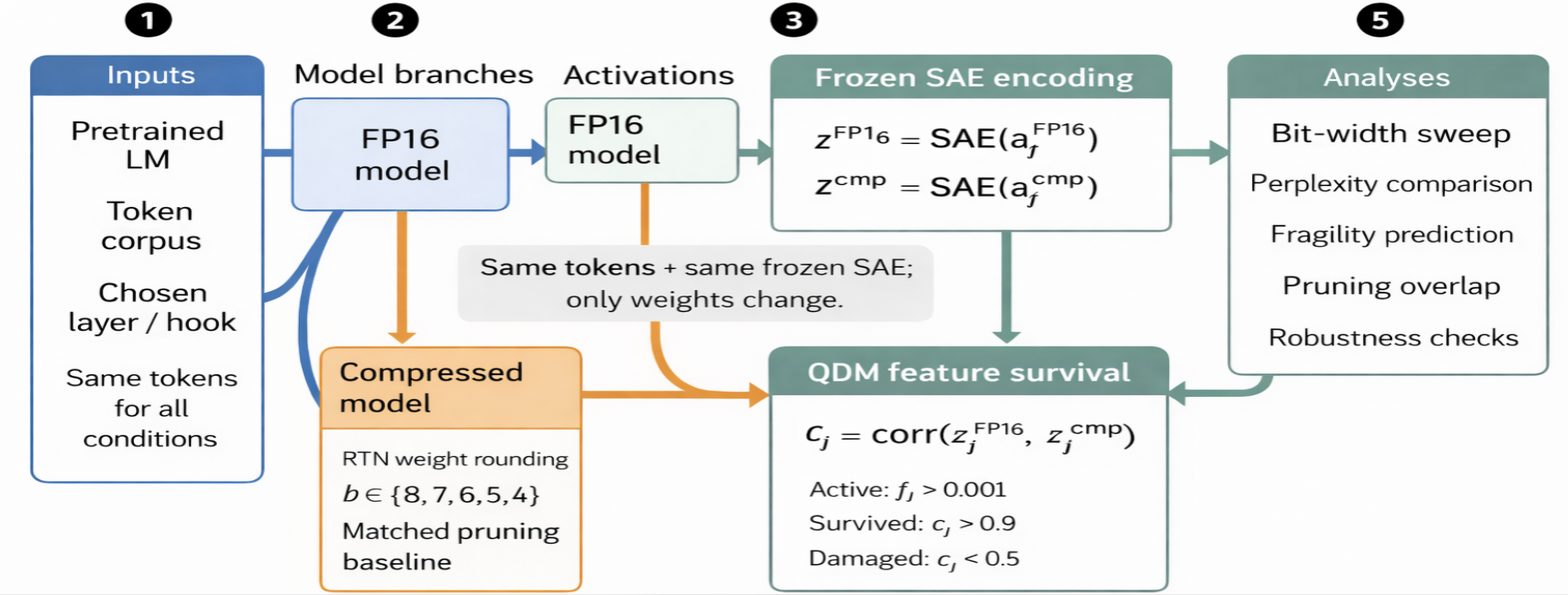
Figure 1: The QDM pipeline encodes FP16 and quantized activations with a frozen SAE on input tokens, measuring feature survival per-feature via correlation cj.
Methodology and Experimental Protocol
A frozen SAE, previously trained on full-precision (FP16) activations, is used as a reference decomposition for both the original and quantized model. The quantization operator reduces weights to b-bit grids (b∈{8,7,6,5,4}) without retraining the SAE or introducing sampling variation. Models evaluated include Pythia-70M and Gemma-2-2B, spanning an order of magnitude in parameter count. The core metric for feature survival is the Pearson correlation cj between FP16 and quantized activations over identical token sets. Survival is defined strictly (cj>0.9), degradation as partial alignment (0.5≤cj≤0.9), and damage as weak or discordant (cj<0.5).
Comparative baseline experiments employ magnitude pruning calibrated to match the perplexity impact of quantization (sparsity set to match perplexity increase at INT6). Standard task-level and behavioral checks (WikiText-2-raw perplexity, chunked and sliding-window protocols) are used to analyze divergence between internal and external metrics.
Graded Feature Survival and Its Predictability
Feature survival demonstrates a monotonic, non-binary breakdown with decreasing bit-width. At INT8, >98% of active features persist, while at INT6 survival declines to 62.4% (Pythia) and 51.3% (Gemma). Feature annihilation (damage; b0) remains negligible until INT5, with the majority of non-surviving features entering the degraded, rather than damaged, regime. The breakdown is consistent across both model families.
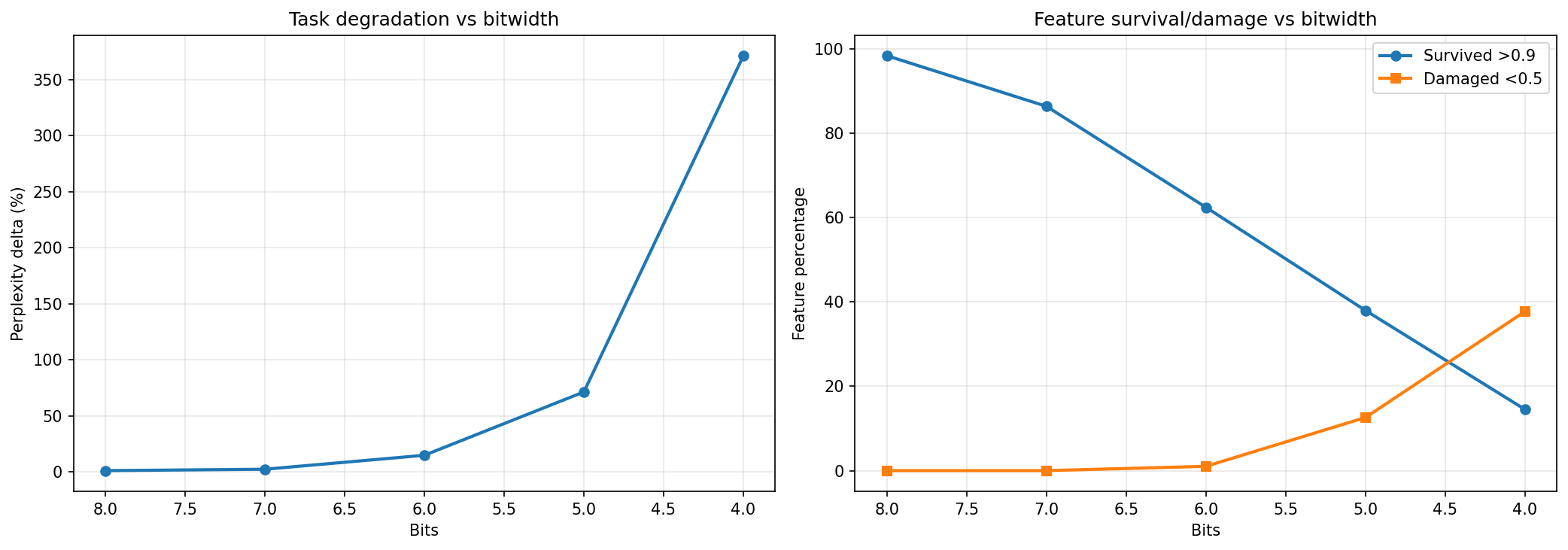
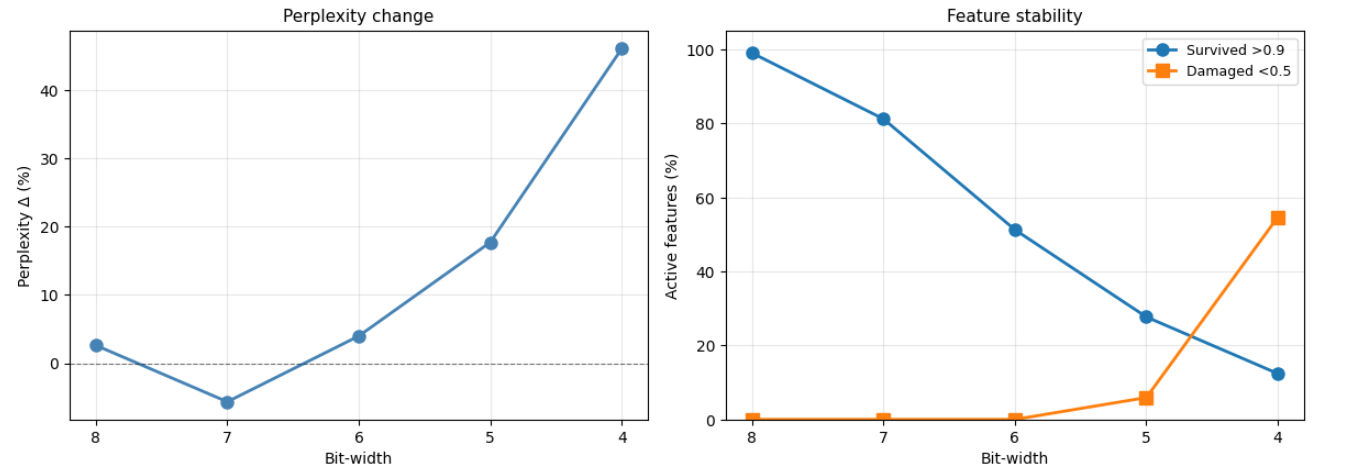
Figure 2: Feature survival, degradation, and damage rates as a function of decreasing RTN bit-width across model scale.
Survival probabilities are accurately predicted by a logistic regression over four simple FP16 feature statistics: firing rate, mean activation, peak activation, and activation concentration. The cross-validated AUC for the binary survival classifier reaches b1 (Pythia) and b2 (Gemma). Peak activation is, unambiguously, the dominant single predictor; features with high maximum activations are robust to weight rounding, while weak-signal features are most vulnerable.
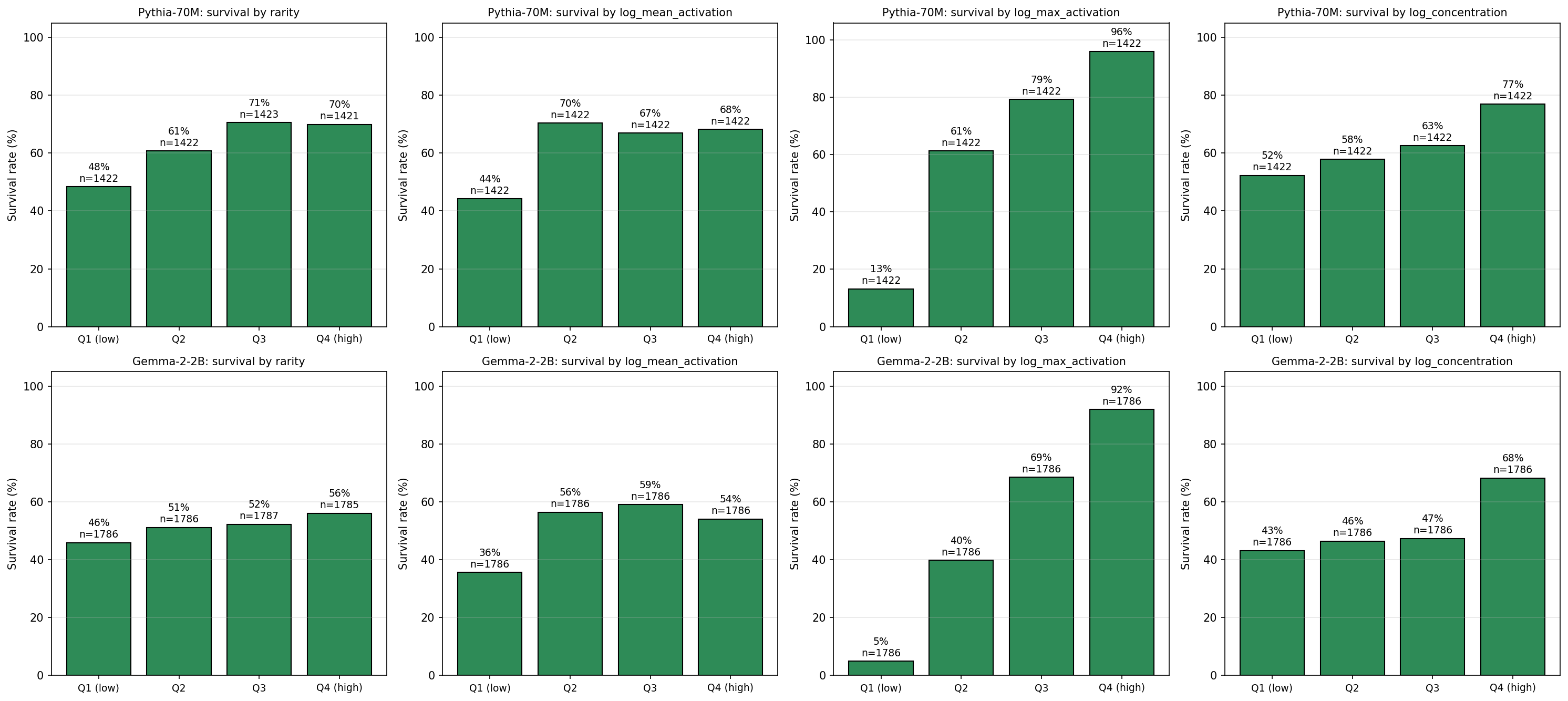
Figure 3: INT6 survival rates stratified by quartile of FP16 peak activation, demonstrating that strong activations confer robustness to quantization.
Divergence Between Task Metrics and Representational Fidelity
An essential finding is that task-level performance (as measured by perplexity) is insufficient for certifying feature-level stability. In Gemma-2-2B, quantization to INT7 actually improves perplexity (−5.65%), yet 18.7% of SAE features degrade, and at INT6, perplexity deteriorates only modestly (+3.99%) while nearly half the features lose strong alignment. Sliding-window behavioral evaluation confirms that this dissociation is not an artifact of specific evaluation protocols.
Mechanistic Parallels Between Quantization and Pruning
Matched-perplexity pruning and quantization are found to target highly overlapping sets of vulnerable features, reflected in high Jaccard index (0.79–0.86) and nearly perfect Spearman correlation (0.98) of damage scores across methods. This indicates that "compression vulnerability" via low signal is a property largely agnostic to the compression mechanism.
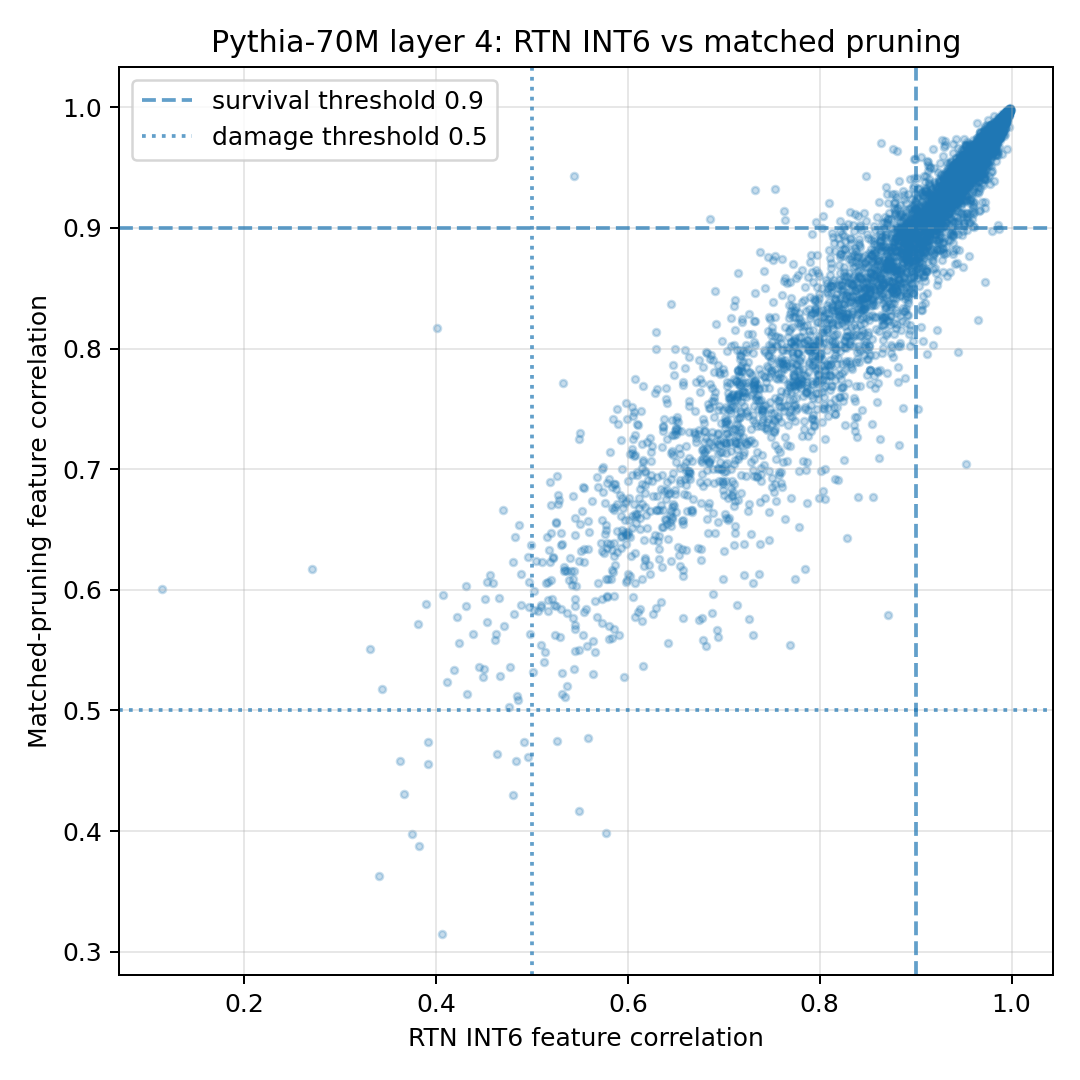
Figure 4: Per-feature correlation scatter plot comparing RTN INT6 and matched magnitude pruning, highlighting strong agreement on feature vulnerability.
Robustness Checks and Ablation Analyses
QDM estimates remain stable across substantial variations in token sampling and read-out layer, indicating that the observed phenomenon is not an artifact of sampling noise or architectural particulars. Survival rates vary minimally between random 100k-token subsets, and FP16-vs.-FP16 null comparisons accurately recover b3 everywhere, supporting pipeline reliability.
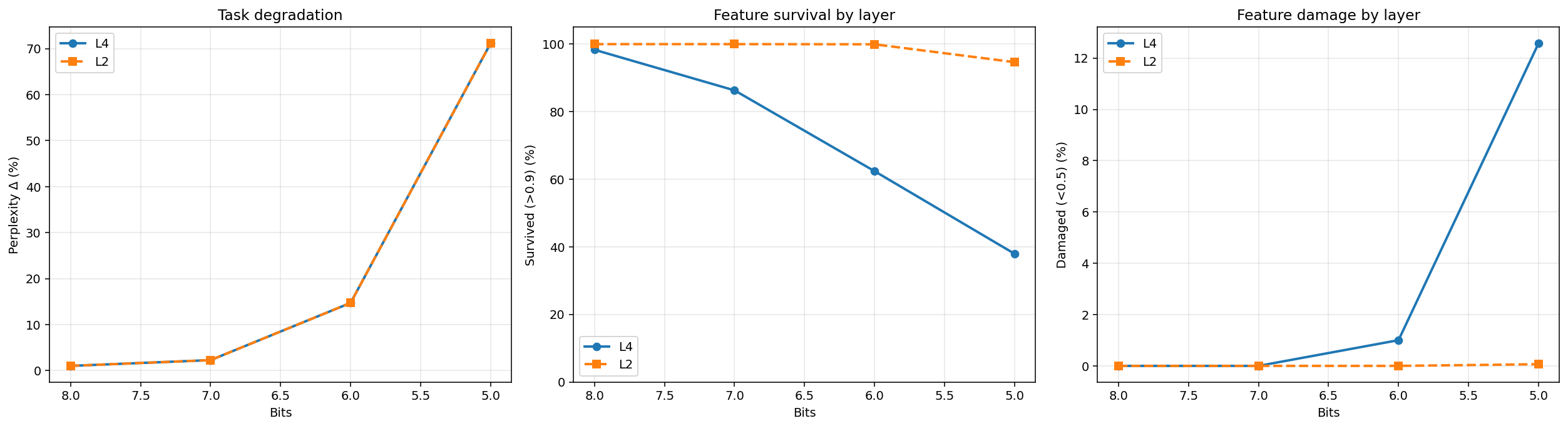
Figure 5: Feature survival as measured at two distinct residual-stream layers under RTN bit-width sweep, showing consistent breakdown pattern.
Discussion and Broader Implications
The study asserts that quantization does not induce a discrete "feature collapse" threshold, but rather a regime of gradual blurring. Many features are not destroyed but rendered unreliable as semantic anchors (i.e., they become partially—but not strongly—aligned under quantization). This has critical consequences for any interpretability- or safety-layer predicated on identifying and monitoring robust, monosemantic features: behavioral invariance does not guarantee mechanistic invariance.
The structured nature of feature vulnerability—driven by signal strength—means practitioners can predict which features are likely to fail under compression. As many state-of-the-art safety interventions (e.g., steering, auditing) assume feature stability, there is a clear requirement for direct feature-level fidelity audits in deployment pipelines.
Furthermore, the high overlap observed between quantization- and pruning-damaged features not only informs mechanistic understanding of feature redundancy and robustness, but underscores a compression-agnostic axis of feature vulnerability in LLMs—operationalized as low activation energy.
Future Directions
The findings imply that further work should focus on causal interventions: does the loss or blurring of interpretable features (as defined by SAE correlations) propagate to differences in end-task steering, safety, or model control? Auditing protocols may need to be extended to directly verify representational invariance under specific deployment quantizers, and joint training or quantization-aware SAE construction may become necessary to ensure downstream reliability.
Conclusion
Quantization systematically alters internal SAE-extracted features in LLMs before significant task-level degradation occurs. The representational drift is both gradual and predictable by basic feature statistics, not a sharp phase transition. Survival under quantization is not adequately reflected by perplexity, and pruning/quantization affect congruent feature classes. Thus, model audits that depend on interpretable features from full-precision models cannot presume direct transferability post-quantization. Direct, feature-level audits must be integrated into deployment pipelines to guarantee the robustness of interpretability-driven safety and control interventions.