Kolmogorov Regression for Robust Diffusion Policies
Published 16 Jun 2026 in cs.LG and cs.AI | (2606.18186v1)
Abstract: Finite-dimensional (FD) diffusion policies exhibit temporal drift owing to discretization artifacts that degrade long-horizon performance (when deployed on physical systems). We introduce a backward Kolmogorov equation that lifts diffusion policies to a Cameron-Martin space -- a subset of the Hilbert space. Essentially, replacing stochastic score matching with a deterministic boundary-value PDE problem. Our core innovation thrives on Gaussian measure theory whereupon the diffusion noise covariance operator is realized from a colored noise distribution which prescribes a notion of regularity on samples from the model at inference time. We train the diffusion model with a derived precision-weighted Cameron- Martin loss and a Kolmogorov residual is introduced as a PDE diagnostic during inference. These substitutions yield (i) convergence guarantees where the bound's constants depend on the effective rank of the kernel rather than action dimension, (ii) improved trajectory regularity via spectral weighting, and (iii) a deterministic failure detector without reward signals. Validation across two application domains demonstrates substantial improvements: on the PushT manipulation benchmark, the Cameron-Martin loss achieves a 17% improvement in maximum episode reward (0.95 vs. 0.78 for MSE) and 67.6% reduction in inter-step drifts during inference via the introduced residual magnitude. Similarly, on a 6-station manufacturing line with constant work-in-process (CONWIP) flow control, we achieve 28.4% lower RMSE than classical LSTM baselines; a high starvation-event recall (1.0 in test cycles), and effective bottleneck identification (Precision@1 = 1.0 in test set, 13x signal-to-noise ratio). We then certify the dispatch policies with Hamilton-Jacobi reachability theory which reduces deadlock events by 96% compared to uncontrolled dispatch over 100 simulated runs (351 events prevented).
The paper establishes a deterministic infinite-dimensional PDE framework using the backward Kolmogorov equation to robustify diffusion policies.
It employs a Cameron-Martin loss that enforces spectral regularity, yielding dimension-independent convergence and superior reward outcomes.
A diagnostic Kolmogorov residual is introduced for real-time anomaly detection and failure certification in both control and forecasting applications.
Kolmogorov Regression for Robust Diffusion Policies: A Technical Essay
Introduction
The paper "Kolmogorov Regression for Robust Diffusion Policies" (2606.18186) establishes a novel infinite-dimensional (ID) framework for denoising diffusion policies based on the backward Kolmogorov equation (BKE) and Gaussian measure theory in Hilbert space. The approach supplants finite-dimensional (FD) score-based energy modeling—where discretization artifacts induce temporal drift, sample inefficiency, and degraded transfer properties—with a function space formulation. The main contributions are: (1) a deterministic PDE-based foundation for ID diffusion via BKE, (2) measure-theoretic regularization using the Cameron-Martin geometry, (3) a diagnostic operator (Kolmogorov residual) for physics-aware anomaly and failure detection, and (4) empirical validation in both visuomotor manipulation and stochastic manufacturing domains.
Mathematical Framework: Infinite-dimensional Diffusion via the Backward Kolmogorov Equation
The framework operates in H=L2([0,T],Rda). Unlike conventional DDPMs, action trajectories are treated as paths in a Hilbert space rather than finite vectors. The forward noising process is an H-valued Ornstein-Uhlenbeck (OU) process driven by a trace-class covariance operator C determined by a smooth Matérn-3/2 kernel, thereby ensuring regular sample path geometry and suppressing discontinuities typical for white noise.
The key algorithmic substitutions are:
Colored Noise Injection: Forward and reverse diffusion trajectories are perturbed with correlated noise (η=LNξ, LN=chol(K) from the Gram matrix of the kernel), ensuring support over the Cameron-Martin space and physical plausibility.
Precision-weighted (Cameron-Martin) Loss: Training employs
LCM=E[∥C−1/2(ηθ−η)∥H2]
operationalizing a geometry congruent with the underlying Gaussian measure. This corrects for the information concentration in low-rank components and guarantees dimension-agnostic alignment between learned and data measures.
Kolmogorov Regression: Denoising is steered by a deterministic boundary value problem (the BKE),
−∂s∂u=⟨−21x,∇xu⟩H+21Tr(C⋅∇x2u)
Solutions are well-defined in function space, bypassing the absence of Lebesgue densities and the ill-posedness of FD score-matching in infinite dimensions.
This construction yields dimension-independent convergence rates: the TV distance between model and data law is bounded in terms of the effective rank of C (determined by kernel smoothness), not action dimension or discretization resolution. This is a marked theoretical distinction from FD approaches where convergence degrades as O(d) with d.
Training and Inference: Empirical Results
Training Loss and Convergence Behavior
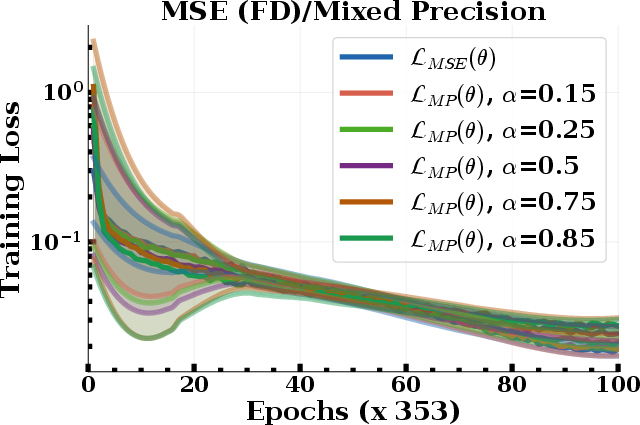
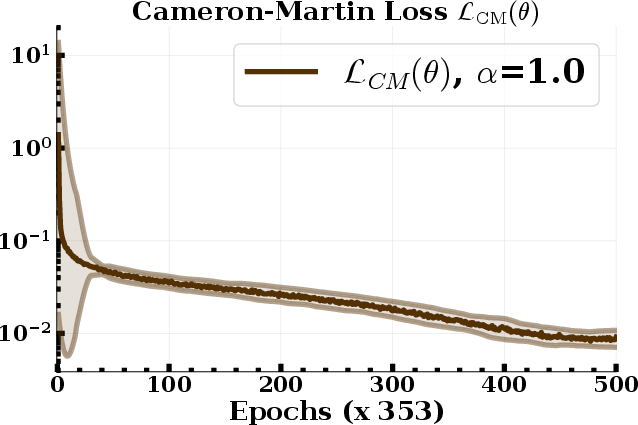
Training with the Cameron-Martin loss exhibits faster and tighter convergence (final loss H0) than MSE (H1), corresponding to improved fit to the underlying functional data distribution.
Figure 1: Training loss curves for the Cameron-Martin, Mixed Precision, and MSE losses. The Cameron-Martin loss (right) achieves lower final training loss (H2 vs. H3 for MSE) with tighter convergence, reflecting the mode-decomposed structure imposed by precision weighting.
This empirical trend matches the theoretical prediction: the convergence constant depends only on the kernel trace, not the action dimension.
Manipulation (PushT) Results
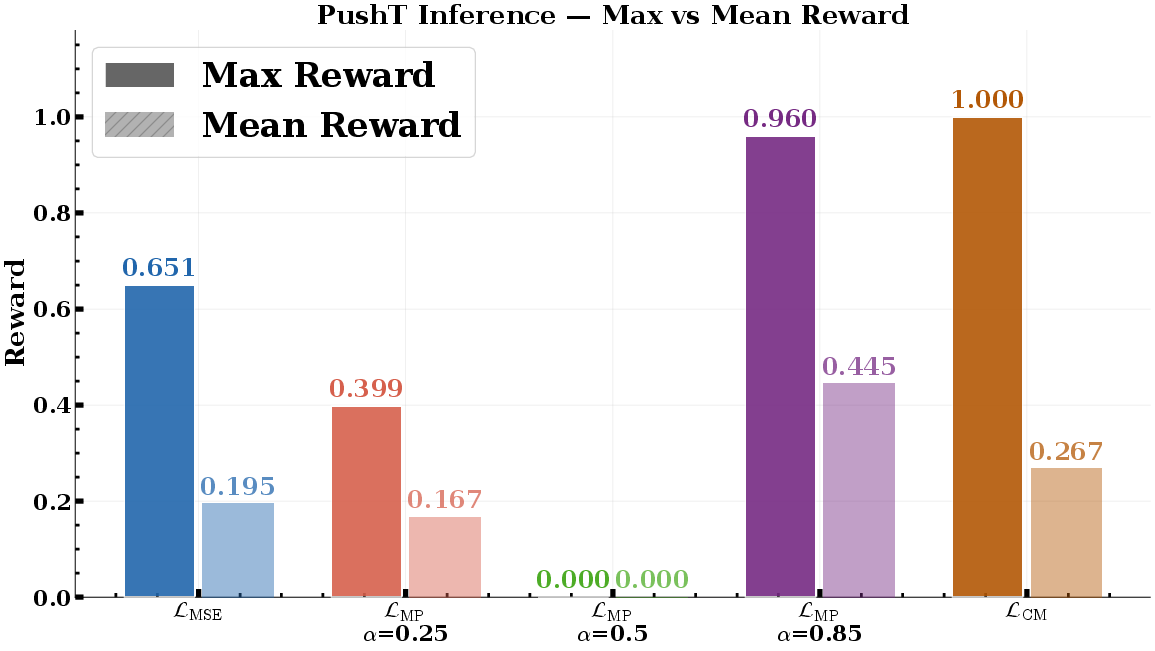
Policies trained with the Cameron-Martin loss yield maximum episodic reward H4 vs. H5 (MSE), a 17% gain. Mixed-precision (between MSE and CM loss) interpolates between regimes but never surpasses the full CM loss, which enforces regularity across all spectral modes.
Figure 2: Inference rewards during the denoising step for all three training losses.
Temporal action rollouts are significantly smoother under the CM loss, especially during late phases requiring high-precision control. Discretization-induced inter-step drift is sharply suppressed.
Kolmogorov Residual: Diagnostic and Failure Detection
The Kolmogorov residual,
H6
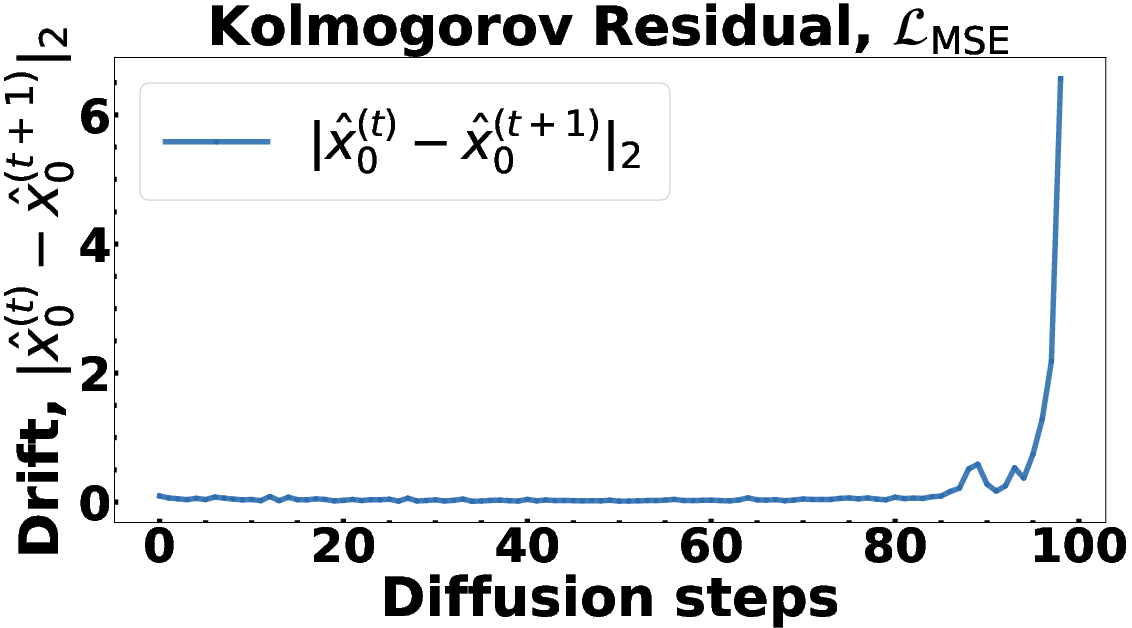
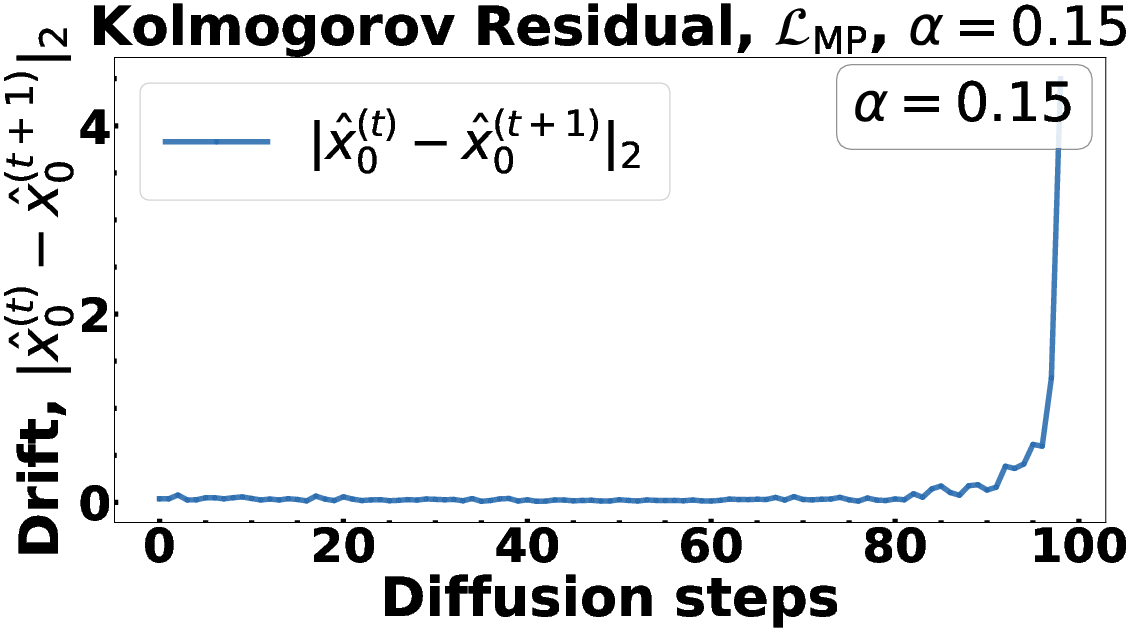
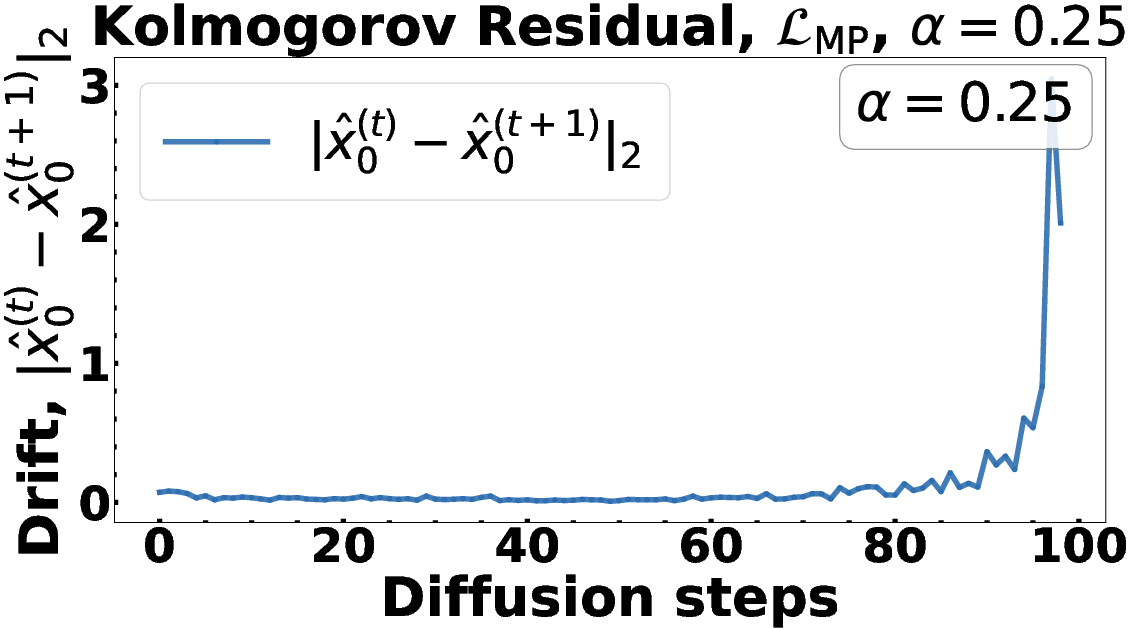
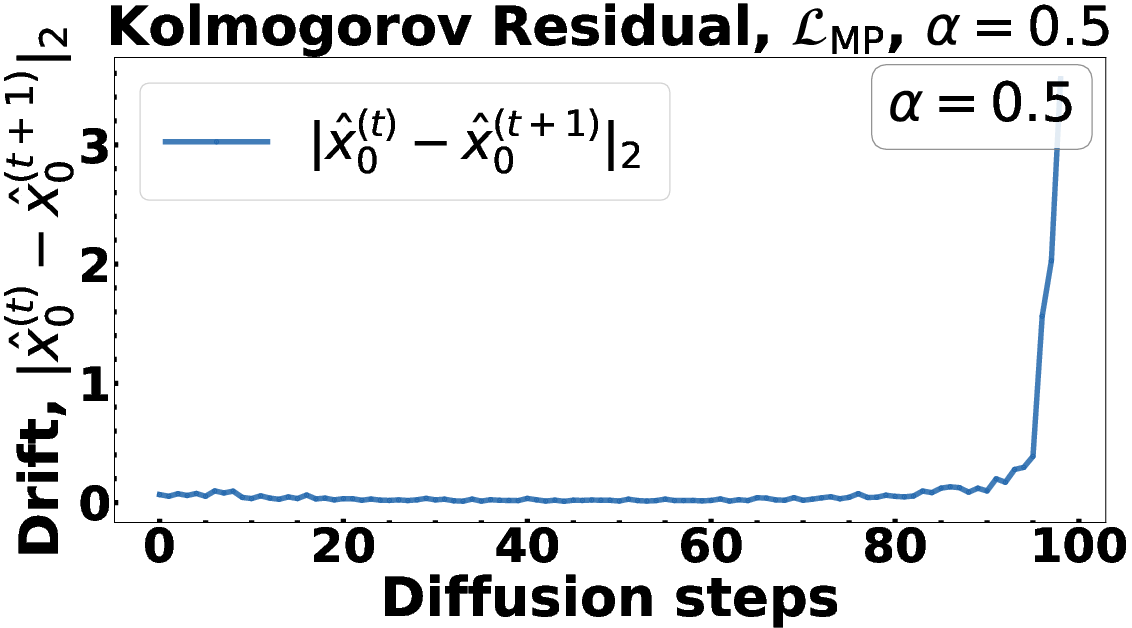
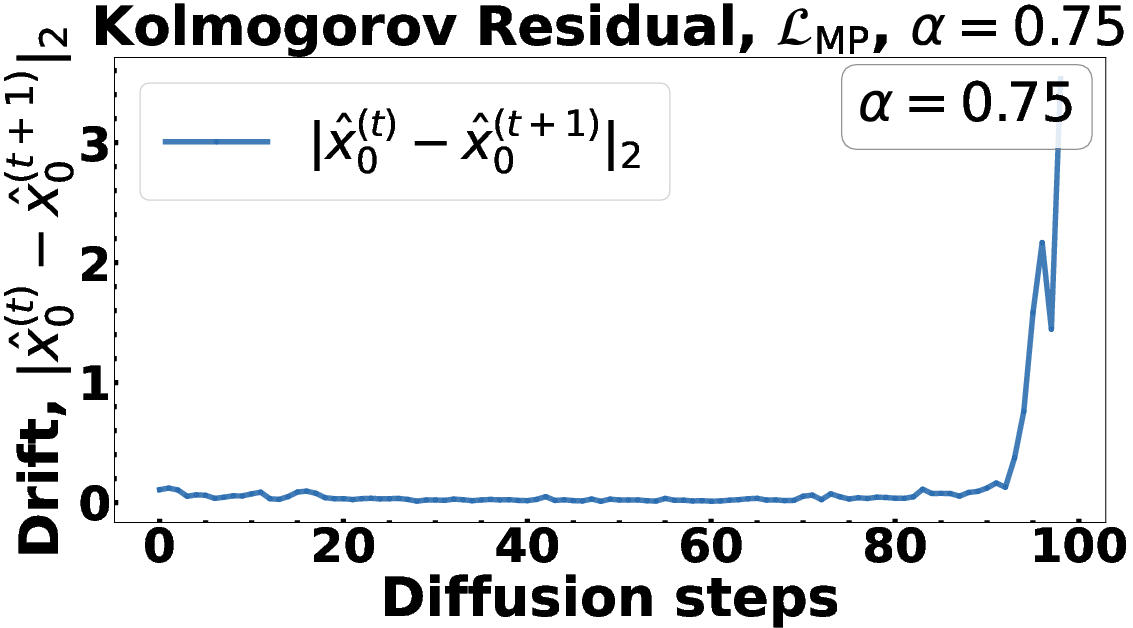
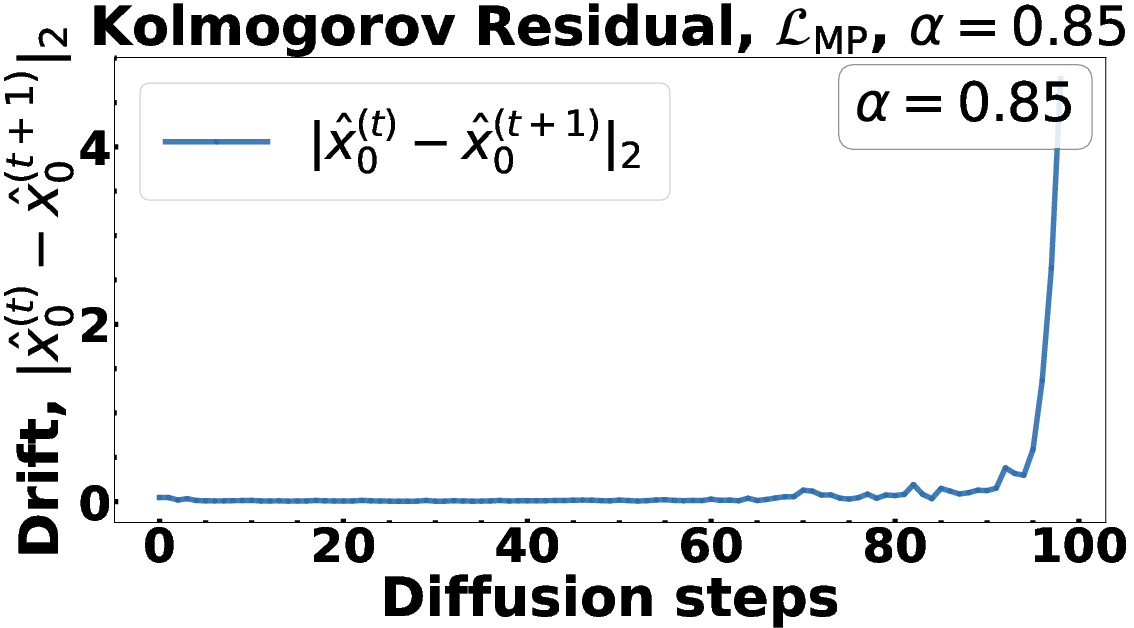
is used as a deterministic, oracle-free indicator of policy fidelity. Residual magnitude is consistently lower by 67.6% versus MSE-trained models (mean residual H7 vs H8). Empirically, high residuals directly correlate with rollout failures, enabling online detection of unreliable policies without ground-truth reward access.
Figure 3: Kolmogorov residuals measuring inter-step drift H9 across roll-outs of mixed CM-MSE training objectives for varying values of C0.
Robustness in Manufacturing Flow Control
The infinite-dimensional formulation is benchmarked on stochastic 6-station CONWIP lines, forecasting WIP profiles as functions rather than vectors.
Forecasting RMSE: Compared to LSTM baselines, the CM loss model achieves 28.4% lower normalized RMSE.
Starvation/Deadlock Prevention: Starvation recall is perfect (C1), and with reachability-based dispatch policy certification, deadlocks are reduced by 96% over 100 runs (C2 events prevented).
Bottleneck Detection: Using the Kolmogorov residual as an unsupervised anomaly score, bottlenecks are localized (Precision@1 = C3, SNR C4 vs. other stations).
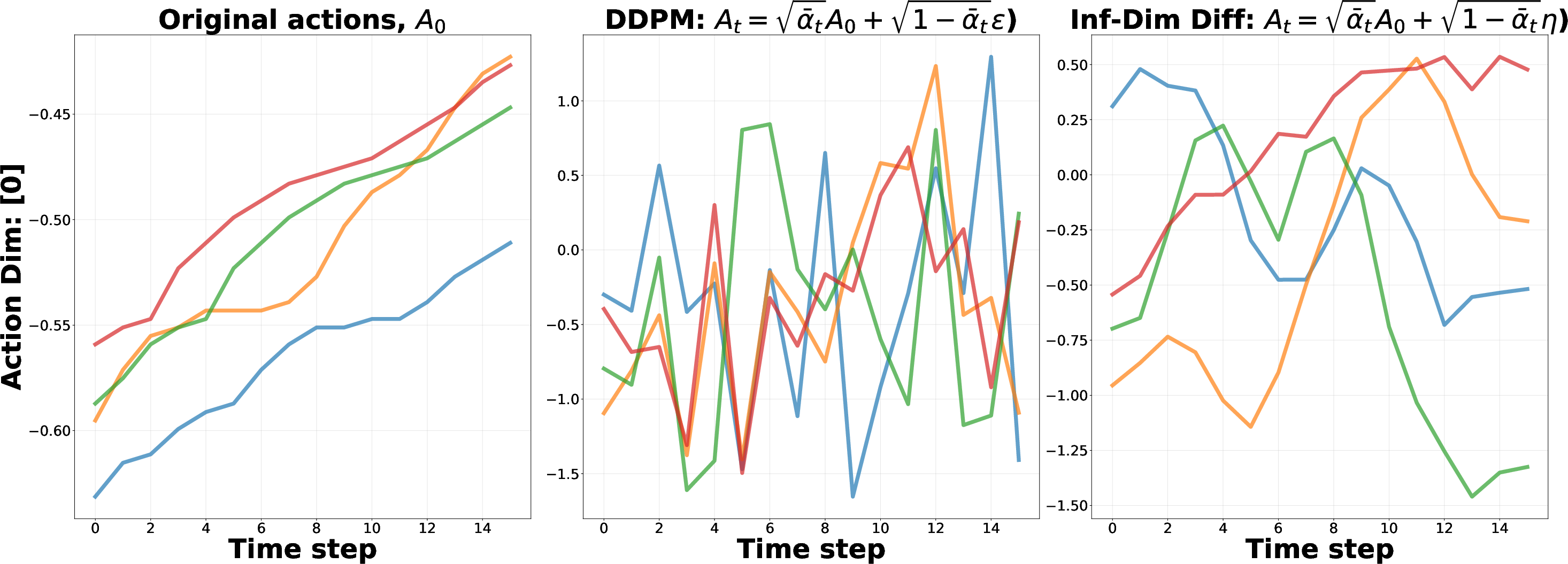
Figure 4: Noise comparison of the forward OU process, showing the variation on action distribution (left) when it is corrupted by white noise (middle) and with the Matérn-3/2 noise.
Integration with Hamilton-Jacobi reachability provides a formal certification mechanism, linking the machine learning forecaster with PDE-based safety envelopes, unattainable with typical neural network baselines.
Algorithmic Implementation
The method introduces only three minimal changes to the canonical DDPM pipeline: (1) colored noise, (2) Cameron-Martin loss, (3) colored reverse noise. Denoising architectures (e.g., conditional Unet1D, ResNet-18) and optimization routines remain unchanged, facilitating adoption in existing RL and control frameworks.
Broader Implications and Theoretical Impact
These results decisively demonstrate that measure-theoretic lifting to infinite-dimensional spaces mitigates the curse of discretization, supports generalization across horizon and configuration scale, and enables principled diagnostics. The spectral regularity imposed by the Cameron-Martin penalty not only yields better sample efficiency and final reward but also instantiates a function-space foundation compatible with subsequent neural operator architectures (e.g., DeepONet, FNO).
Crucially, the Kolmogorov residual bridges learning and verification, equipping practitioners with a direct analytic criterion for real-time, reward-independent safety assessment in both RL and operational forecasting.
Conclusion
The Kolmogorov regression-based infinite-dimensional diffusion policy framework achieves dimension-independent convergence, enforces functional regularity, and provides deterministic failure certificates via the Kolmogorov residual. Empirical results in manipulation and manufacturing control justify the theoretical advantages, including higher reward, lower drift, improved RMSE, perfect bottleneck identification, and certified safety envelopes (2606.18186). This measure-theoretic, PDE-based methodology inaugurates a paradigm for robust, interpretable, and certifiably safe deployment of diffusion models in continuous control and decision systems.
“Emergent Mind helps me see which AI papers have caught fire online.”
Philip
Creator, AI Explained on YouTube
Sign up for free to explore the frontiers of research
Discover trending papers, chat with arXiv, and track the latest research shaping the future of science and technology.Discover trending papers, chat with arXiv, and more.