- The paper introduces the CAHR algorithm, a method that reconstructs detector error model topologies using a tensor network framework for quantum error correction.
- It employs an exact algebraic inversion of syndrome correlations to derive error probabilities, thereby improving decoding performance in various code architectures.
- The study reveals a variance cascade in parameter inference that necessitates a two-stage process separating topological discovery from precise error probability estimation.
Topological Reconstruction of Detector Error Models for Quantum Error Correction
Introduction
Robust implementation of Quantum Error Correction (QEC) requires not only advanced code constructions but also accurate noise characterization at the level of detector correlations induced by circuit-level faults. Effective decoding algorithms, especially under high-weight or correlated errors typical in non-trivial syndrome extraction, depend on precise priors reflecting the actual multi-body structure of noise. The Detector Error Model (DEM) formalism abstracts these fault mechanisms into a hypergraph architecture: vertices represent syndrome detectors, while hyperedges encode physical error mechanisms capable of triggering correlated syndrome outcomes.
Recent inference approaches for reconstructing DEM topologies from syndrome statistics have faced intrinsic challenges: combinatorial blow-up in candidate hyperedges, statistical artifacts due to finite sampling, and the significant propagation of error during sequential greedy inference stages. This work introduces the Correlation-Analysis-based Hypergraph Reconstruction (CAHR) algorithm, providing a principled, algebraically exact, and globally consistent protocol for DEM inference targeting both topological structure (discrete fault mechanisms) and their associated probabilities.
To systematically address the syndrome-to-mechanism inversion, the paper advances an exact analytical mapping between experimental syndrome observables and physical error processes using a tensor network formalism (Tensor Network Detector Error Model, TNDEM). Detectors are modeled as parity-check (XOR) tensors, physically representing stabilizer measurements in the circuit, with incident error mechanisms encoded as diagonal tensors parameterized by their fault probabilities. The TNDEM formalism enables closed-form analytical inversion for arbitrary-order correlations directly from syndrome moments:
Mα=⟨i∈α∏σi⟩=∣e∩α∣≡1(mod2)∏(1−2pe),
with explicit algebraic inversion schemes (combining recursive helper functions fβ and scaled exponentiations) yielding the error probabilities pα. This structure eliminates the reliance on iterative, locally optimal fitting and exposes the full dependency graph governing statistical inference over the DEM.
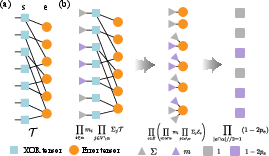
Figure 2: Schematic of the Tensor Network Detector Error Model (TNDEM), mapping physical error mechanisms (via diagonal tensors) to detector correlations through a contracted tensor network architecture.
CAHR Workflow: Topology Discovery via Global Consistency and Pruning
The CAHR procedure is a top-down, three-stage workflow constructed to minimize inference bias and suppress statistical artifacts arising from finite data:
- Pairwise Correlation Pre-Selection: All high-order hyperedges must necessarily project onto a clique of positive pairwise correlations, p~ij>0, in the syndrome data. Initial candidate pruning based on a noise-floor threshold ϵpair is performed to limit the combinatorial search space while minimally discarding genuine high-weight processes.
- Maximal Bounded Hypergraph Generation: For a known maximum mechanism degree kmax (practically dictated by circuit structure), all maximal cliques in the pairwise adjacency matrix are enumerated. The global candidate set includes all sub-hyperedges of these cliques, enabling complete hypothesis testing but dramatically contracting the space compared to brute-force enumeration.
- Concurrent Top-Down Pruning via Global Analysis: Using the exact algebraic solver, candidate probabilities pα are calculated in strictly descending order (from highest to lowest hyperedge degree). False positives (statistical or structure-induced) are pruned in situ by explicit thresholding pα<ϵglobal, ensuring that incorrect high-degree mechanisms do not corrupt lower-tier inference via algebraic subtraction.
This protocol partitions inference errors by their physical origin and statistical behavior: combinatorial candidate blow-up is controlled geometrically, while the most expensive mode—downward propagation of statistical variance (“variance cascade”)—is confined by aggressive high-degree pruning.
Statistical Properties and the Variance Cascade
A central finding is that continuous parameter inference, even with an algebraically exact solver, is fundamentally limited by a variance cascade: absolute statistical uncertainty accumulates through recursive downward subtraction from high-weight hyperedges towards lower-degree (pairwise/single) edges. This produces characteristic inflation of absolute inference errors as hyperedge degree decreases.
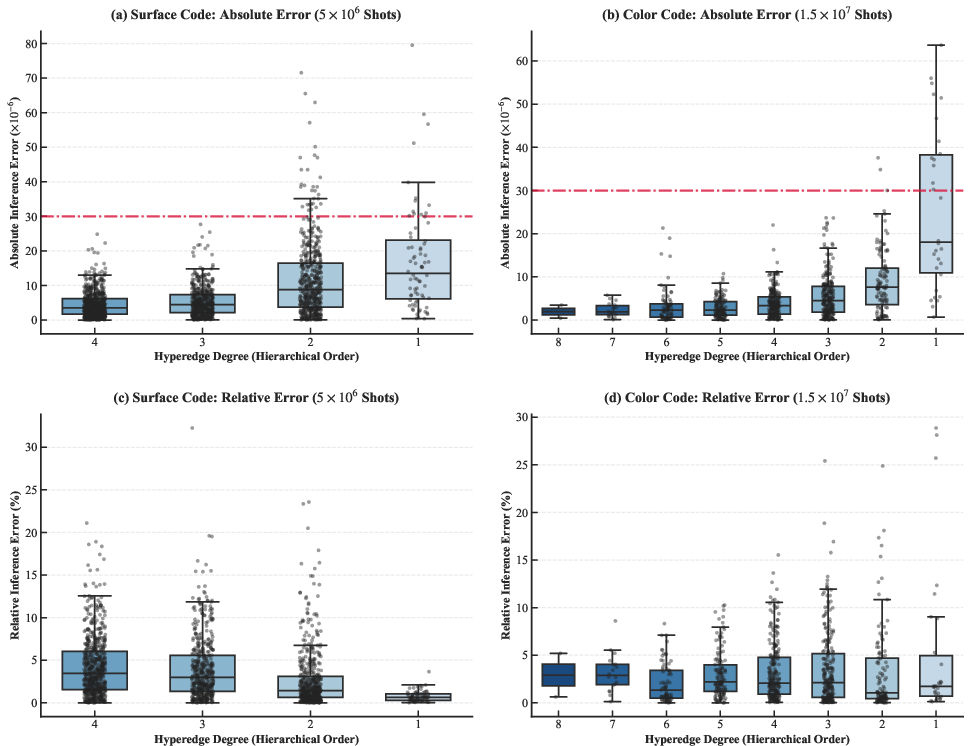
Figure 3: Hierarchical accumulation of absolute and relative inference errors (variance cascade) for surface and color codes, at the sample size required for zero-false-positive reconstruction.
Empirically, for sparse topologies (e.g., rotated surface codes), this effect is moderate and sample complexity behaves favorably, scaling sub-linearly with circuit volume. In contrast, for dense, highly interconnected codes (e.g., 2D color codes with hyperedges of degree up to 8), the variance cascade necessitates order-of-magnitude higher sample volumes to achieve the same confidence in topological recovery and low false-positive rates. Notably, the local topological density, not the overall circuit size, governs the scaling of the required statistics.
Using BP-OSD decoders, the study demonstrates that DEMs constructed by CAHR with perfect structural topology, even when populated with highly noisy continuous parameters (derived from low-shot regimes), consistently outperform DEMs inferred end-to-end (structure and parameters) from larger but insufficient statistics. Structural errors—especially the inclusion of spurious high-degree hyperedges—degrade decoders by introducing unphysical short cycles; conversely, accurate topology with noisy parameters preserves logical error rate (LER) performance much closer to ideal decoding.
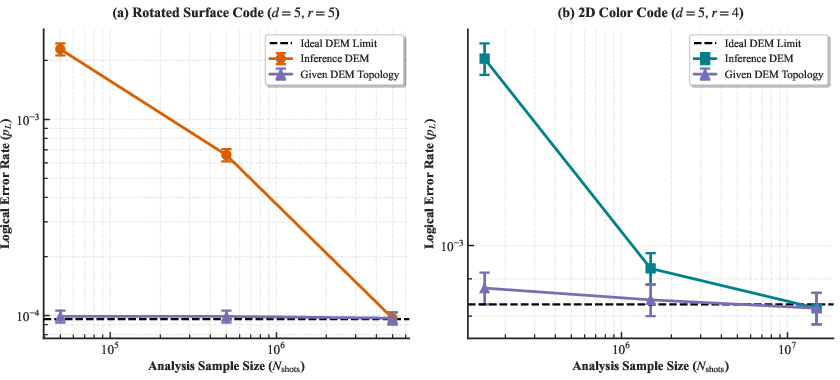
Figure 1: Logical error rates for both surface and color codes, showing the sensitivity of decoding to topological versus parameter inference errors.
Practical Considerations and Threshold Sensitivity
The choice of pruning thresholds is shown to be robust within a practical range. Anchoring to approximately pmin/2 (minimum expected physical mechanism probability) is sufficient, with performance tolerant to moderate threshold fluctuations. In blind experimental regimes where systematic prior is unavailable, this threshold can be estimated via observable data-driven diagnostic procedures.
Additionally, the CAHR process exhibits scalability to deeper circuits (i.e., larger numbers of QEC rounds) without exponential increase in sample complexity. Clique-search and hyperedge enumeration cost become significant only under undersampled regimes where noise dominates pair correlations.
Theoretical and Practical Implications
This work formalizes a distinction between two statistically and operationally distinct inference challenges inherent in DEM estimation: (1) discrete topological structure discovery and (2) high-precision parameter calibration. The results strongly support a two-stage inference paradigm for realistic quantum hardware:
- Stage 1: Use CAHR to exhaustively and reliably reconstruct the discrete DEM topology, suppressing combinatorial and statistical artifacts.
- Stage 2: Apply computationally intensive methods (such as expectation-maximization, ML, or RL-based optimizations) on the fixed topology to refine continuous error probabilities, which remain fragile to statistical cascade effects.
This separation is particularly important for dense codes and non-Pauli noise, where parameter estimation via direct correlation analysis becomes infeasible.
Limitations and Future Directions
The CAHR formalism fundamentally assumes Pauli noise; its extension to coherent, non-Clifford, or leakage errors is an open question. While some syndrome-level effects are weakly captured, explicit tensor-network generalization for non-Pauli mechanisms is required for controlled modeling. Future directions include deploying CAHR on device data for ever-larger circuits, algorithmic optimization in clique search, experimentation with dynamic or nonstationary noise environments, and hybridization with learning-based continuous estimators.
Conclusion
The Correlation-Analysis-based Hypergraph Reconstruction (CAHR) method provides a scalable, statistically rigorous foundation for DEM topology discovery in quantum error correction, pairing a structured tensor-network formalism with global top-down algebraic inference and pruning. Empirical evidence shows structural exactness is operationally paramount, and that variance cascade limits motivate post-processing of continuous parameters on a fixed topological prior. The framework supplies a critical tool for the transition from phenomenological noise models to experimentally informed, device-level quantum error correction.
References
For further methodological and theoretical context, see "Reconstruction of detector error model for quantum error correction" (2606.16288) and referenced literature therein.

