- The paper demonstrates that correlated MWPM decoding significantly raises fault-tolerance thresholds in bias-tailored compass codes under circuit-level asymmetric noise.
- The paper details a comparative analysis between CSS and Clifford-deformed (ZXXZ□) compass codes, highlighting trade-offs influenced by code elongation and noise bias.
- The paper underscores the importance of co-designing decoding strategies and syndrome extraction circuits to optimize quantum error correction performance.
Motivation and Background
Quantum error correction (QEC) is crucial for fault-tolerant quantum computation on near-term and future quantum hardware, which often exhibits strongly asymmetric (biased) noise favoring dephasing (Z) errors. Recent advances have led to the development of bias-tailored QEC codes, notably Clifford-deformed surface codes and elongated compass codes, which achieve superior thresholds under biased noise. However, conventional decoding strategies like minimum weight perfect matching (MWPM) fail to exploit correlated error mechanisms due to simplifications in their matching graphs, particularly neglecting hyperedges that encode correlations such as those between X and Z errors from Y errors.
The paper systematically explores whether adopting correlated MWPM decoding strategies can enhance threshold performance for both standard (CSS) and Clifford-deformed elongated compass codes under circuit-level biased noise, with both theoretical and practical implications for QEC co-design.
The elongated compass codes are constructed by fixing gauge operators on the square lattice via the elongation parameter ℓ. With increasing ℓ, more weight-2 X stabilizers appear, allowing more accurate detection of Z errors, thus favoring operation under dominant Z noise. These codes are X0, permitting separate treatment of X1 and X2 stabilizer generators.
Clifford-deformed compass codes, specifically the X3-deformed variant, apply Hadamard gates to selected qubits, transforming stabilizer structure and introducing symmetries akin to the X4 surface code when X5. For larger X6, deformations accentuate sensitivity to X7 errors but reduce X8 error correction capacity, yielding a threshold trade-off as a function of X9, the noise bias parameter.
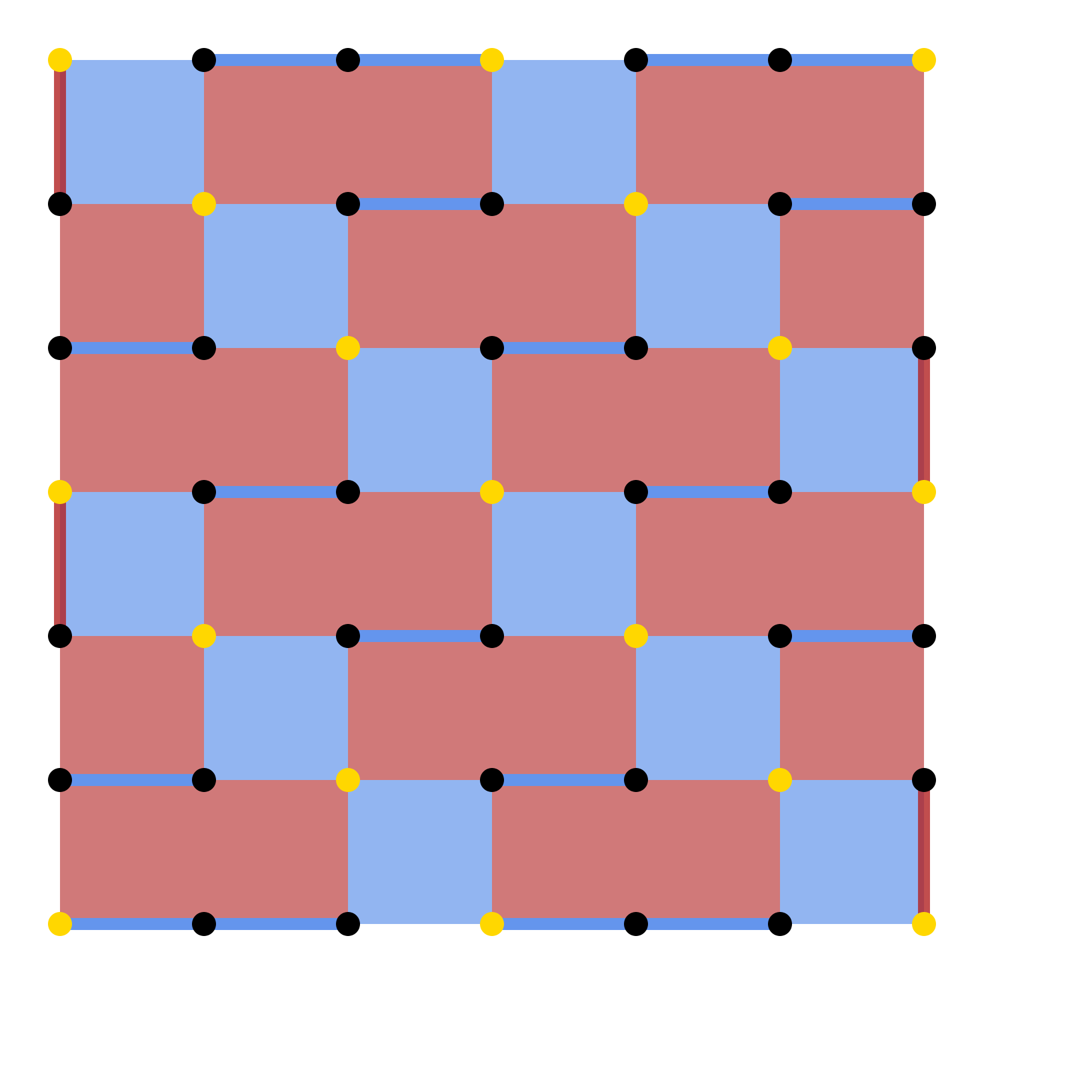
Figure 1: Schematic of an elongated compass code (Z0, Z1) with superimposed Z2 Clifford deformation highlighting spatial arrangement of stabilizers and the locations of Hadamard transformations.
Syndrome Extraction and Noise Models
The syndrome extraction circuit comprises repeated rounds of stabilizer measurement (up to Z3, the code distance) in Z4 and Z5 memory experiments, utilizing both CNOT and CZ gates, depending on stabilizer type and deformation. The implemented noise is a hybrid biased-depolarizing (HBD) model, parameterized by Z6, and includes asymmetric Pauli errors, bias-preserving gate noise, biased idling, and SPAM errors. Circuit-level analysis captures realistic QEC operational settings where gate errors and measurement noise may not conserve the bias, a critical factor limiting threshold improvements.
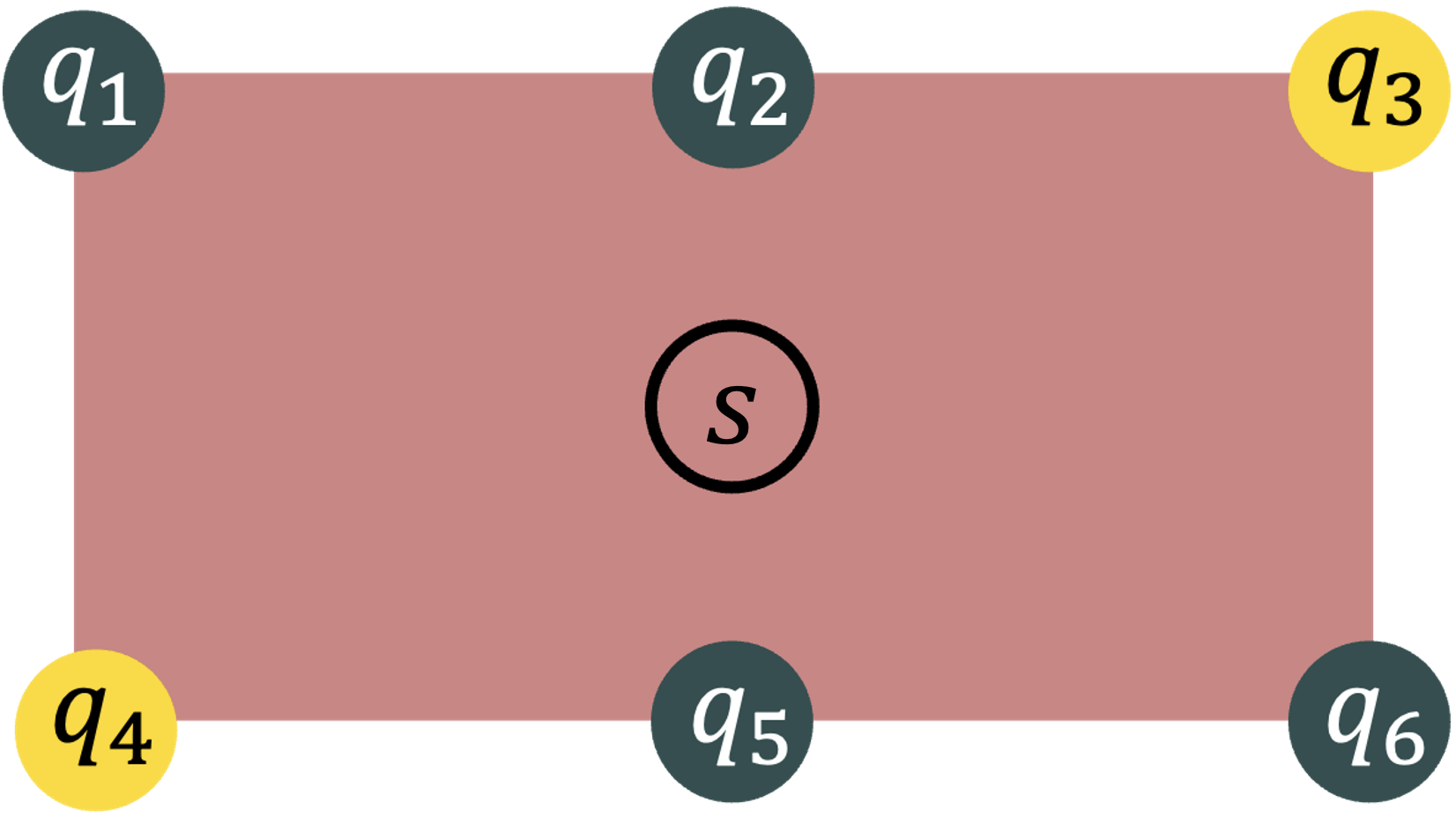
Figure 2: Depiction and circuit diagram of syndrome extraction for a high-weight Z7 stabilizer, illustrating how Hadamard transformations partition the code and impact measurement ordering.
The paper adopts two forms of correlated MWPM decoding:
- CSS Correlated MWPM (Code-Capacity Level): Separates Z8 and Z9 syndrome decoding, but updates matching graphs using the conditional probabilities induced by Y0 error correlations. Decoding ordering (Y1 vs Y2) is empirically optimized, given the information asymmetry favoring Y3 error detection.
- PyMatching Correlated MWPM (Circuit Level): Utilizes Stim-generated detector error models (DEMs) to construct hypergraphs which retain joint probability information. Two-pass decoding updates weights based on observed error correlations, outperforming standard MWPM especially in regimes with significant hyperedges due to circuit noise.
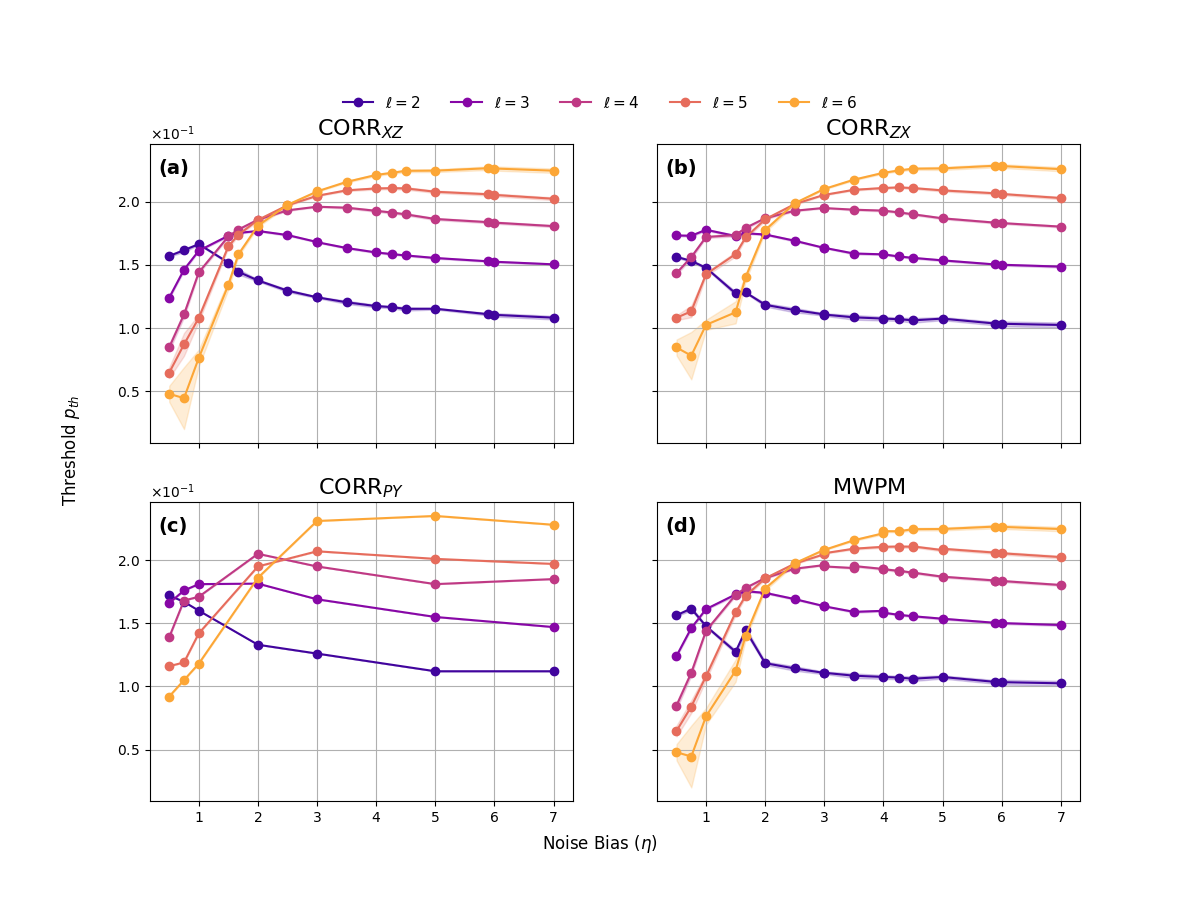
Figure 3: Threshold comparisons between CSS correlated decoding, PyMatching correlated decoding, and standard MWPM across compass codes, highlighting decoding method efficacy as a function of bias and code structure.
Numerical Results
Circuit-level simulations for both Y4 and Y5-deformed compass codes (distances Y6) reveal:
- Correlated Decoding Gains: Correlated MWPM decoding significantly raises thresholds relative to standard MWPM for all Y7 and bias values. The improvement is more pronounced at circuit level than code-capacity, where correlations are more frequent.
- Elongation Effects: Higher Y8 codes exhibit greater absolute and relative threshold gains, as measured by Y9 and CSS0. The largest relative gain (CSS1) was observed for CSS compass codes with CSS2 at low bias (CSS3).
- Deformation Limitations: For CSS4 deformed codes, threshold improvements plateau at high bias, due to the mixed use of bias-preserving and depolarizing gates in syndrome extraction, which diminish bias-induced benefits seen at code-capacity level. The threshold advantage of CSS5 deformation over standard CSS codes is lost for CSS6, in line with the surface code.
- Decoder Confidence: Complementary gap histograms confirm that correlated decoding yields more confident (lower gap) corrections as bias increases—particularly for CSS7 memories in CSS codes, while MWPM remains more confident for CSS8 codes at high bias.
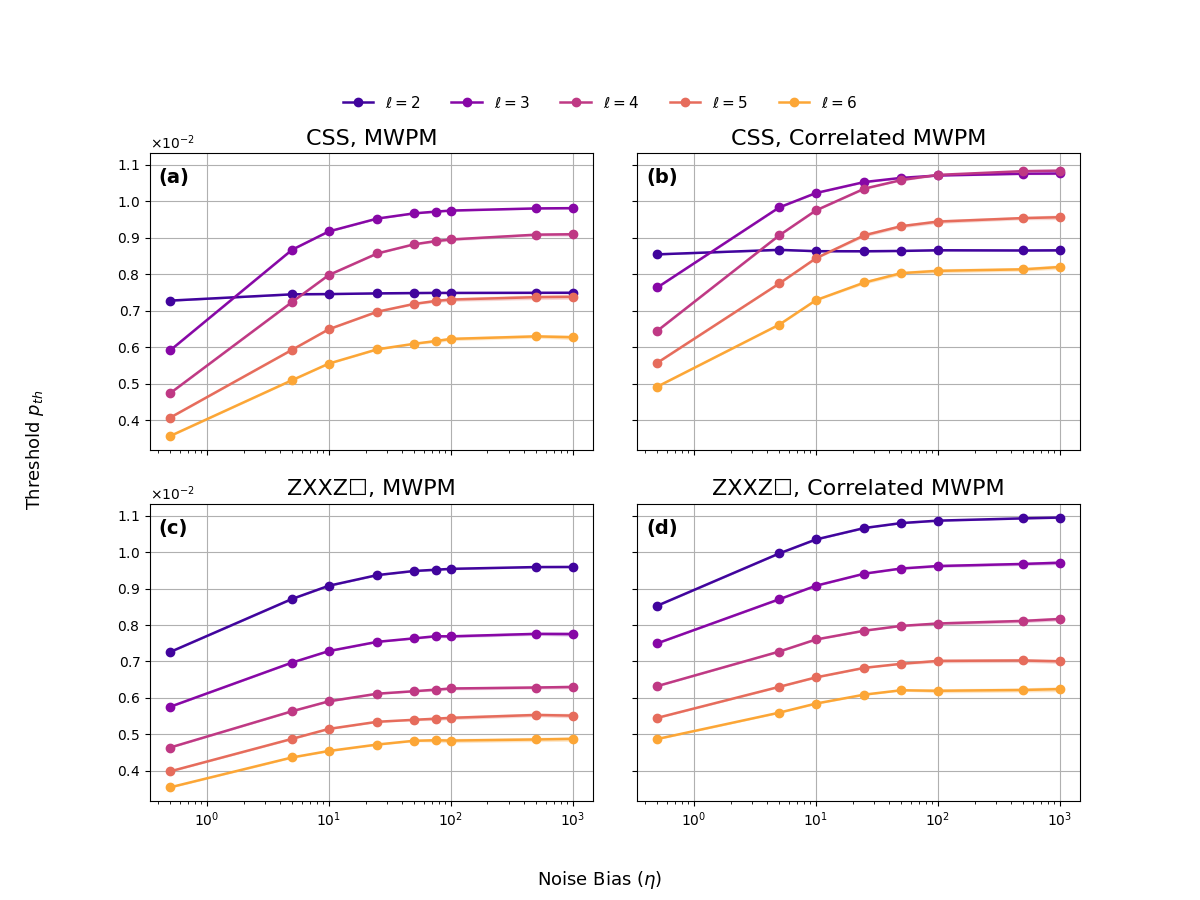
Figure 4: Circuit-level threshold comparisons between correlated MWPM and standard MWPM over a range of CSS9, separating effects of code elongation and Clifford deformation.
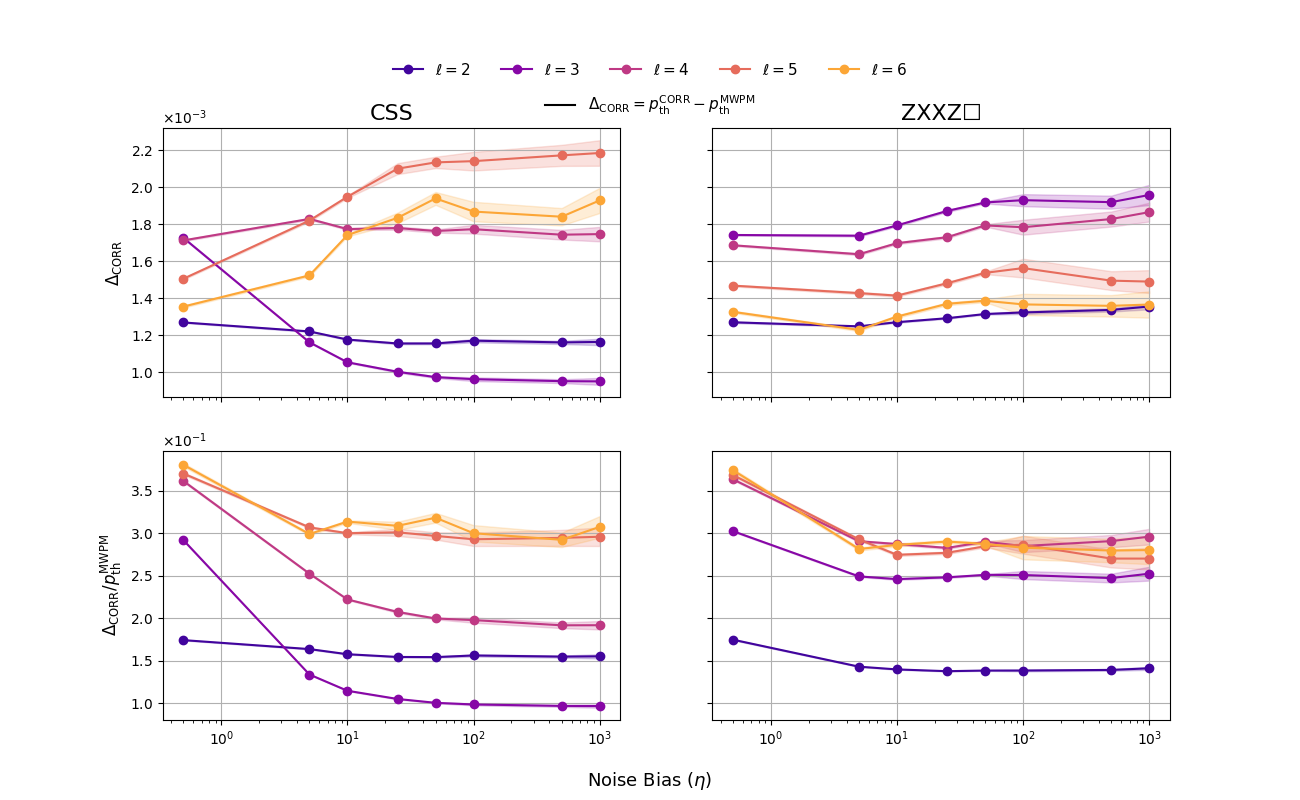
Figure 5: Threshold gain (ℓ0) and relative improvement (ℓ1) for correlated MWPM versus standard MWPM across biases and code families, showing growth with elongation and bias saturation.
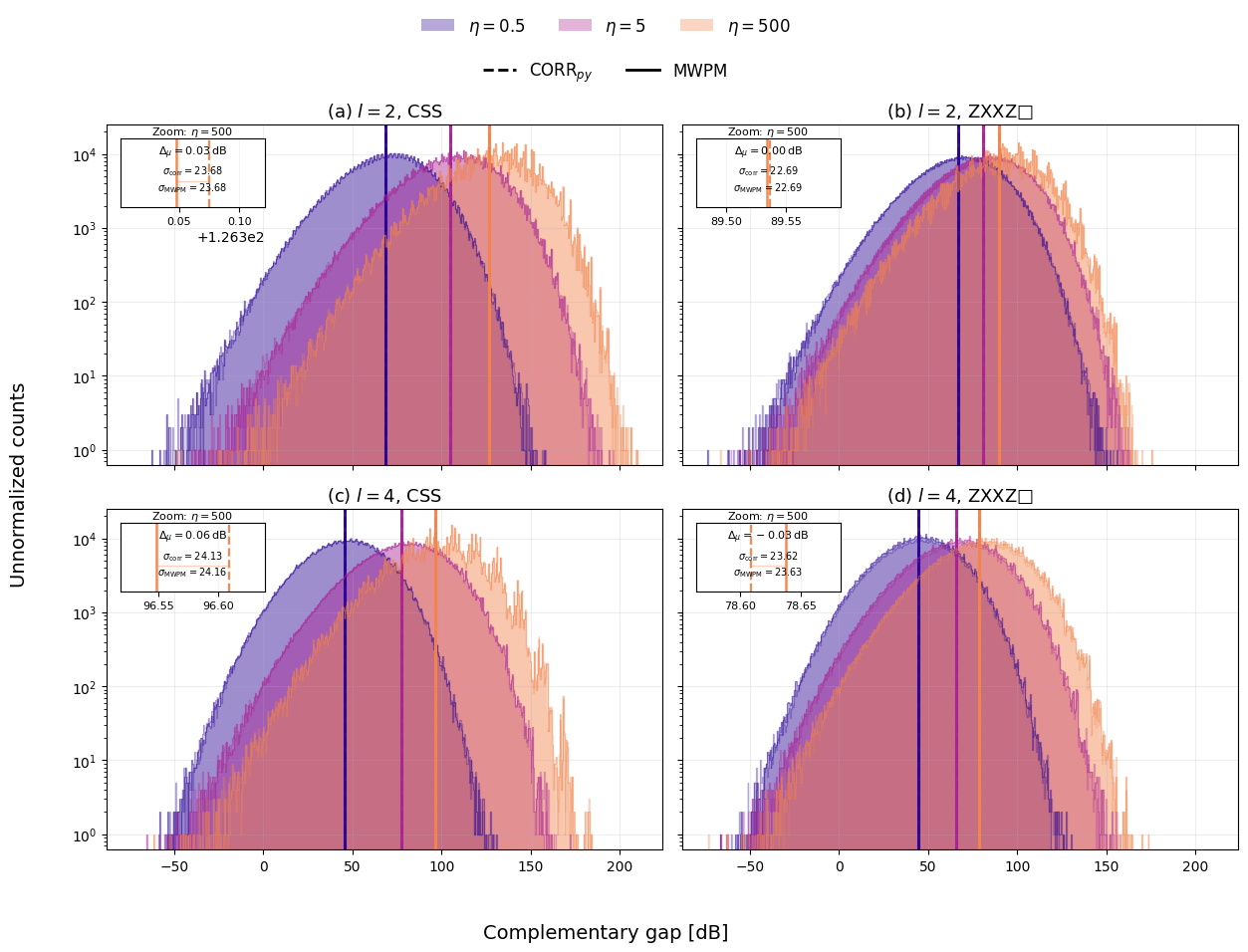
Figure 6: Signed complementary gap histograms for ℓ2 memory experiments, comparing correlated decoding and MWPM confidence at multiple bias points; negative gaps indicate erroneous logical parity assignment.
Practical and Theoretical Implications
The results affirm the value of co-designing codes and decoders tailored for hardware noise characteristics, especially exploiting correlations missed by conventional decoders. Correlated MWPM strategies are particularly beneficial for codes with high stabilizer asymmetry and elongated compass codes, improving fault-tolerance thresholds and error correction efficacy.
The observed bias saturation for circuit-level thresholds—caused by depolarizing gates—is a reminder of the importance of gate set engineering and circuit design in QEC implementations. The data further suggest promising avenues for mitigating fragile boundaries in Clifford-deformed codes, as the error decomposition enabled by correlated decoding might circumvent associated reductions in effective code distance.
Future Directions
Improvements in syndrome extraction design to maximize bias preservation, and the development of more sophisticated decoders capturing higher-order correlations, could further raise thresholds. Evaluating correlated decoding on hardware with actual asymmetric noise, investigating interaction between decoder confidence and threshold performance, and exploring heterogeneous code architectures [see (Khosravani et al., 6 Mar 2026)] are logical next steps. The possibility that correlated decoding may address fragile boundaries in Clifford-deformed codes deserves direct experimental and simulative investigation.
Conclusion
Correlated MWPM decoding provides robust threshold gains for bias-tailored compass codes under realistic, circuit-level noise. The gains are maximized for codes with pronounced stabilizer asymmetry and high elongation, underscoring the importance of decoder-code-noise co-design in practical quantum error correction. The results inform both theoretical understanding and experimental strategy for deploying fault-tolerant quantum architectures optimized for noise bias and correlated error patterns.