- The paper proposes a topology-aware generative framework by integrating a Laplacian-derived drift into flow matching, overcoming limitations of Euclidean methods.
- TFM leverages spectral decomposition to preserve topological invariants, ensuring stable sample paths and efficient, simulation-free learning.
- Empirical evaluations across graphs and complexes show significant reductions in Wasserstein distances compared to traditional flow matching techniques.
Topological Flow Matching: A Topology-Aware Generalization of Flow Matching
Introduction
"Topological Flow Matching" (2606.15897) presents a principled generalization of the flow matching (FM) generative modeling framework that natively incorporates topological information from structured domains such as graphs and simplicial complexes. Traditional flow matching operates in Euclidean space, neglecting nontrivial topological and geometric constraints inherent to many scientifically significant signals, including fMRI time series on brain graphs, traffic flows on road networks, and ocean currents discretized by meshes. The introduced Topological Flow Matching (TFM) overcomes this limitation by augmenting the underlying reference process with a Laplacian-derived drift, which systematically preserves domain topology and yields a tractable, simulation-free, and deterministic generative framework.
Background and Motivation
Many contemporary datasets are best described as signals organized on graphs or higher-dimensional simplicial complexes. Generative modeling for such domains should respect non-Euclidean structure, as has been well established in geometric and topological deep learning literature. Standard FM, while powerful and theoretically appealing due to deterministic ODE-driven sample paths and efficient, simulation-free learning objectives, fundamentally ignores the underlying topology.
TFM addresses this gap by revisiting the connection between FM and the Schrödinger Bridge Problem (SBP), a classic formulation in stochastic analysis and optimal transport. The authors leverage this perspective to demonstrate that FM can be seen as the zero-noise limit of a degenerate SBP. This connection motivates a topology-aware reparametrization of the reference process, using the (Hodge) Laplacian of the underlying domain to induce a topology-respecting drift. This is illustrated via the spectrum of the Hodge Laplacian, which organizes signals into frequency bands and encodes topological invariants such as connected components, cycles, and higher-dimensional holes.
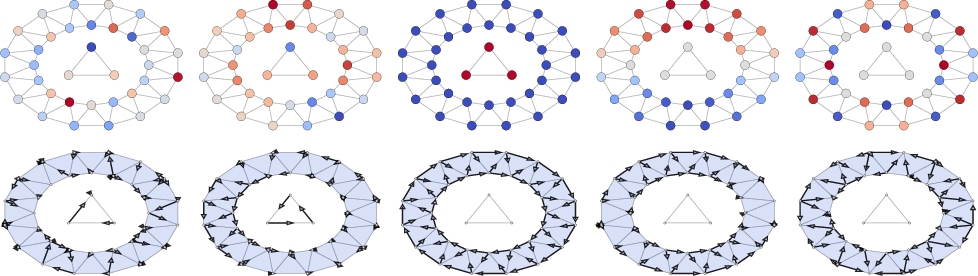
Figure 1: Hodge Laplacian spectrum and associated heat Gaussian processes, highlighting the effect of topology on signal propagation and the preservation of topological invariants.
Topological Flow Matching Framework
Structured Domains and Laplacian Dynamics
TFM is built for signals defined on graphs (node- or edge-level) and on arbitrary simplicial complexes by exploiting their Laplacian structure. For graphs, the normalized graph Laplacian acts on signals assigned to nodes, diffusing information in a way that reflects adjacency and global topology. For complexes, the Hodge Laplacian acts on k-simplices (e.g., edges, triangles), where the kernel of the Laplacian reveals topological features, such as cycles and higher-order cavities.
The reference process in TFM is defined as a linear Gaussian SDE:
dXt=Ht(Lk)Xt+αt+σdWt,
where Lk is the Hodge Laplacian and Ht is a polynomial (often chosen as Ht(Lk)=−κLk), parameterizing the diffusion dynamics. This process interpolates between the standard isotropic Brownian motion (for Ht=0) and topology-respecting heat flow.
Bridging FM and SBP
FM can be interpreted as solving an SBP with a trivial reference drift and vanishing noise. By generalizing the drift to include Laplacian terms, TFM effectively solves a topological SBP. The conditional dynamics between sample pairs—core to learning the FM vector field—now track deterministic bridges under these structured reference processes.
This leads to nontrivial conditional interpolants and matching transport costs, both of which exhibit explicit dependence on topological invariants encoded in Lk. Signal components along topological cycles are preserved under the heat flow (zero eigenvalues), while high-frequency or noise-like components are exponentially damped.

Figure 2: Conditional interpolation paths from reference noise to data on MNIST. Top: standard CFM with linear interpolation; Bottom: TFM exhibiting topology-induced smoothing and structural bias.
Algorithmic Details and Key Properties
TFM inherits simulation-free training and deterministic ODE sampling from classical FM. For a wide range of signal domains (including those represented as high-dimensional graphs and complexes), the conditional vector field for TFM can be computed analytically using spectral decomposition, and optimal (or independent) transport couplings can be efficiently computed.
A single ODE suffices to map samples from a topology-aware noise distribution to structured data, and the optimization objective remains a simple mean squared error between learned and target vector fields, vastly simplifying learning compared to stochastic Schrödinger bridge methods (SBM) or diffusion models.
Importantly, in contrast to topological SBM alternatives (e.g., [yang2025topological]), TFM provides:
- Stable, deterministic sample paths (enabling precise interpolation and generative control)
- Simulation-free learning objectives, scaling efficiently with data dimension
- Explicit bias toward topological feature preservation, with strength controlled via the heat flow parameter κ
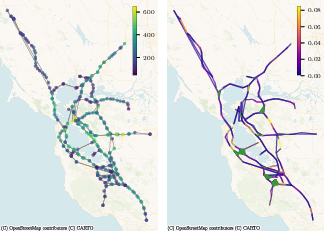
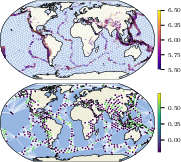
Figure 3: Left: Road network and corresponding node signal. Right: 2-simplicial complex embedding with edge and triangle structures, foundational for traffic flow modeling.
Empirical Evaluation
Datasets and Experimental Setup
The evaluation encompasses canonical physical, biological, and scientific datasets where graph and complex structure is intrinsic: global earthquake event magnitudes, traffic flow on urban road networks, brain fMRI activity on anatomical graphs, single-cell differentiation on cell-state graphs, and ocean currents on mesh complexes. Standard image generation benchmarks (CIFAR-10) are also addressed by treating images as node signals on a pixel grid.
TFM yields consistent and significant reductions in Wasserstein distances on structured generative tasks relative to classical FM (CFM, OT-CFM) and to topological Schrödinger bridge matching (TSBM):
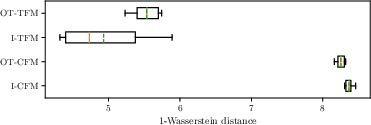
Figure 4: 1-Wasserstein performance on the earthquake magnitude generation task, visualizing median, mean, and interquartile variation across runs.
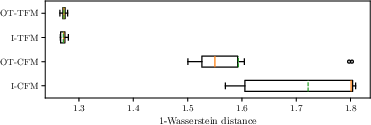
Figure 5: 1-Wasserstein test performance on the traffic flow generation experiment. TFM clearly outperforms Euclidean FM counterparts.
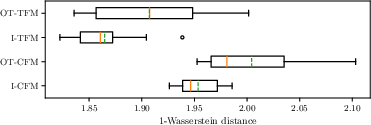
Figure 6: 1-Wasserstein test performance for ocean current matching, affirming transferability to high-dimensional edge signal domains.
TFM's most pronounced advantage emerges on the most topologically nontrivial signal domains (earthquakes, brain fMRI, ocean flows), where its Laplacian-informed process restricts generative flow to respect cycles and high-order connectivity. On regular structures like image grids (CIFAR-10), the improvement is marginal, aligning with the relative lack of domain complexity.
Ablations on the reference process parameter κ demonstrate that the performance/generality trade-off can be smoothly tuned, balancing fidelity to topology and flexibility.
Theoretical and Practical Implications
Theoretically, TFM provides a tractable, closed-form solution for generative modeling on graphs and complexes while natively encoding topological priors. The explicit bridge with SBP theory allows for controlled interpolation between purely Euclidean and topology-constrained processes, enriching the toolbox for generative modeling in applied mathematics, network science, and computational neuroscience.
Practically, TFM's invariance to domain discretization and structure makes it well suited for settings where samples are naturally defined on complex relational domains, or where physical laws (e.g., conservation, divergence-freeness) must be respected by the generative mechanism. Its simulation-free and deterministic nature promises improved sample efficiency and stability in high-dimensional regimes.
TFM is also compatible with extensions to higher-order simplicial domains, vector-valued signals, and manifolds, and could leverage advances from the expanding topological deep learning literature.
Potential Future Directions
- Adaptive or learned κ: Automatically tuning the heat flow rate could further improve generation fidelity and generalization.
- Alternative reference processes: Incorporating other kernels, e.g., Matérn or fractional Laplacians, could provide richer inductive biases.
- Cross-domain signal matching: Reference processes with time-dependent Laplacians or domain morphisms could enable aligning signals between non-coincident topological spaces.
- Functional and infinite-dimensional settings: Extensions to function spaces and forms on manifolds are theoretically grounded and likely to expand applicability in physical sciences and robotics.
Conclusion
TFM presents a simulation-free, topology-aware generalization of flow matching that provably and empirically improves generative modeling of structured signals on graphs and complexes. By integrating spectral and topological priors through Laplacian dynamics, it enables accurate, stable, and interpretable generative models in domains where respecting structure is critical. This approach provides fertile ground for both theoretical generalization and practical applications, particularly in scientific machine learning and structured data modeling.

