- The paper presents ReCAP, which uses retrieval from a demonstration pool to adapt pre-trained vision-language-action models to novel tasks at test time.
- It leverages a composite retrieval strategy combining language, visual, and proprioceptive cues to generate residual actions, significantly boosting success rates on unseen tasks.
- Experimental results on PushT and RoboTwin benchmarks show monotonic generalization gains purely by expanding the demonstration pool post-training.
Retrieval-Augmented Test-Time Task Extension for Vision-Language-Action Models
Introduction and Problem Setting
This work introduces ReCAP, a retrieval-augmented policy enabling vision-language-action models, specifically world-action models (WAMs), to acquire new manipulation tasks at test time without retraining. Traditional deployments of VLA policies typically demand per-task teleoperated demonstrations and costly fine-tuning per task, which both scale unfavorably with increasing behavioral coverage. ReCAP circumvents this by shifting adaptation from network optimization to retrieval over a demonstration pool, amortizing data and computational cost.
This paradigm leverages the insight that the pool embodiment (e.g., human-hand video) can supply high-level task structure, while the target embodiment (e.g., robot arm) need only perform an embodiment-specific correction. The operational protocol is to train a single residual policy—frozen thereafter—to predict target actions conditioned jointly on the current observation and a retrieved pool-side demonstration chunk. New tasks are added post-hoc by simply growing the retrieval database with additional, cheap pool-embodiment demonstrations.
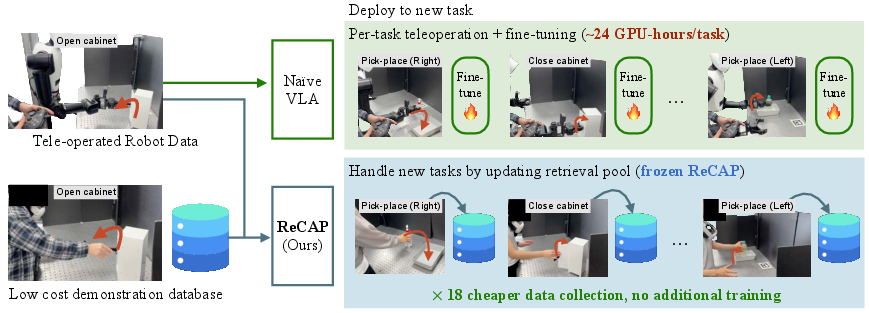
Figure 1: ReCAP overview: the standard paradigm demands teleoperated demos and per-task policy fine-tuning, whereas ReCAP absorbs new tasks via retrieval over a growing human demonstration pool, eliminating retraining.
Model Architecture and Retrieval Mechanism
At its core, ReCAP is instantiated atop a video-generation-based WAM, here Cosmos Policy. The approach encodes the current query observation and retrieves, per control timestep, a matching pool-side state-action chunk via a composite descriptor (language goals, object pose via SAM3, proprioception, and DINOv3 features). The policy then predicts both the next action chunk and the next observation for the robotic embodiment, with the action parameterized as a residual over the retrieved pool action. This forms a coarse-to-fine behavioral pipeline: retrieval supplies the motion prior, and the model adapts it to the target embodiment.
The training objective is a joint flow-matching loss over actions and future observations. The value of the video generation (i.e., state-prediction) objective is pronounced when paired with retrieval; it enforces pixel-wise consistency between the retrieved demonstration and predicted scene evolution, generating a stronger supervision signal for high-level motion alignment.
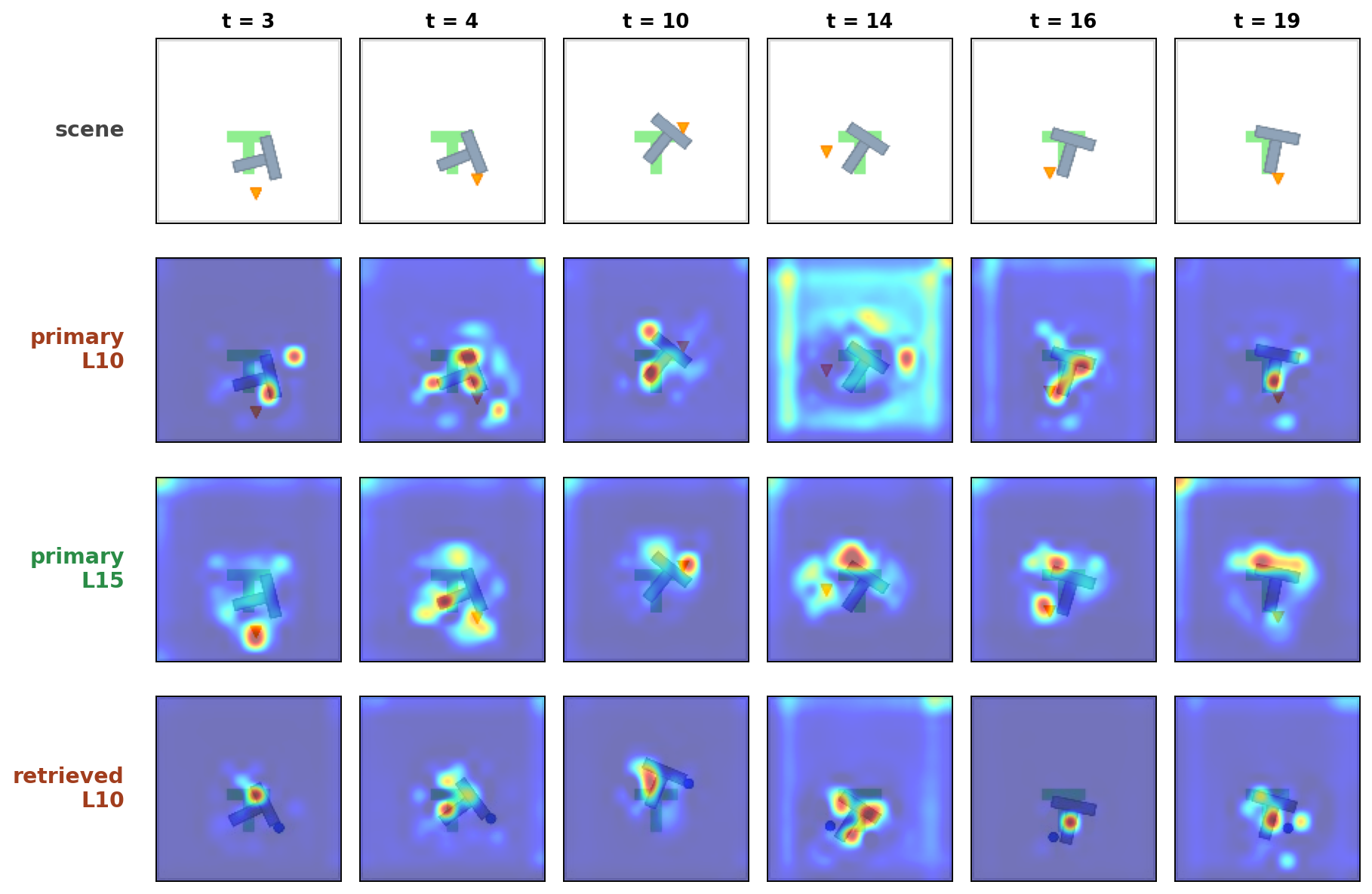
Figure 2: Action-slot attention in ReCAP shows the model initially routes attention toward the pool-supplied motion plan, then shifts to committing to its own predicted action at the decisive layer.
Experimental Results
PushT Cross-Embodiment Generalization
The principal testbed is PushT, where the target (triangle pusher) and pool (disc pusher) operate with divergent dynamics across a continuous goal-angle axis.

Figure 3: PushT pool database—test-time pool comprises disc-pusher demonstrations densely covering all goal angles, enabling retrieval on out-of-distribution tasks.
Key experimental findings include:
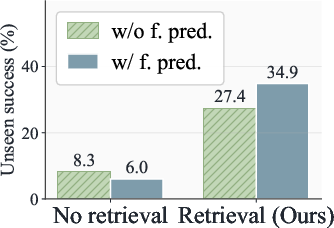
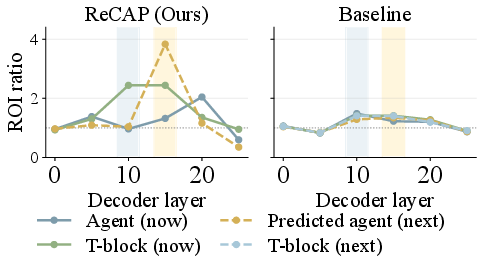
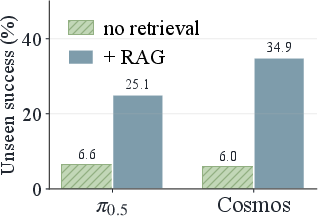
Figure 5: Comparative backbone analysis shows both action-only and WAM policies improve with retrieval, with WAMs benefiting most.
Ablation shows that the future-image objective is critical: removing it reduces performance to near that of an action-only backbone.
RoboTwin 2.0: Dual-Arm Manipulation
Within RoboTwin 2.0, a dual-arm manipulation suite, ReCAP outperforms strong cross-embodiment baselines both on seen and five held-out tasks:
Test-time pool expansion produces monotonic gains, with each retrieval pool increment enabling a corresponding new task to become solvable by the unchanged policy.
Physical Robot Experiments
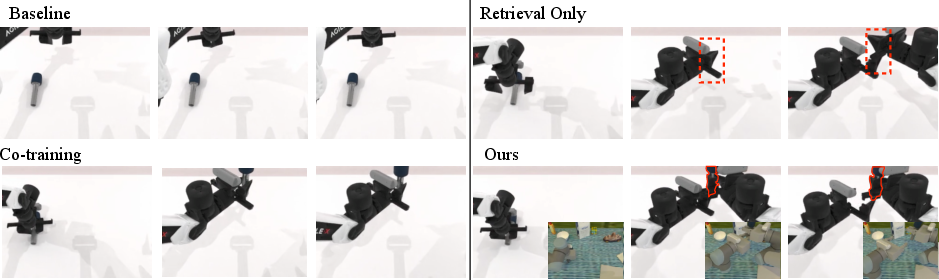
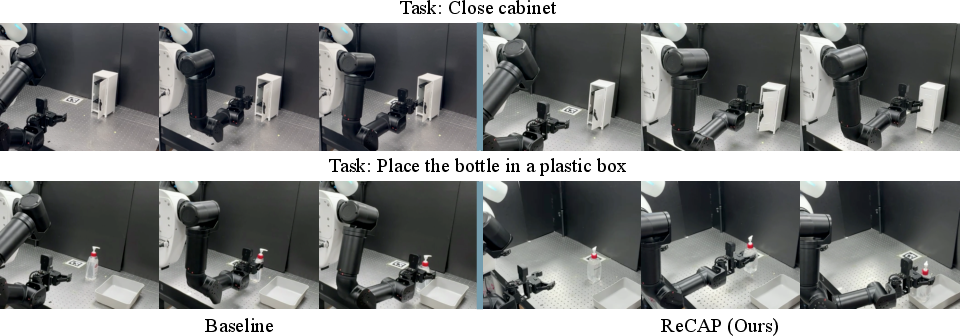
Deployments on a real robot with a human-hand video pool (wrist-pose tracked in VR) further validate the method:
Mechanism Analysis
Cross-attention probes reveal a two-stage routing: an intake layer reads the pool demonstration task region, and a commit layer shifts decisively to the policy’s own predicted next state. Failures are characterized by either attenuated commitment (universal) or inappropriate reliance on retrieval (over/under-anchoring, dependent on distance from the training set), providing actionable axes for diagnosing and improving retrieval-conditioned policies.
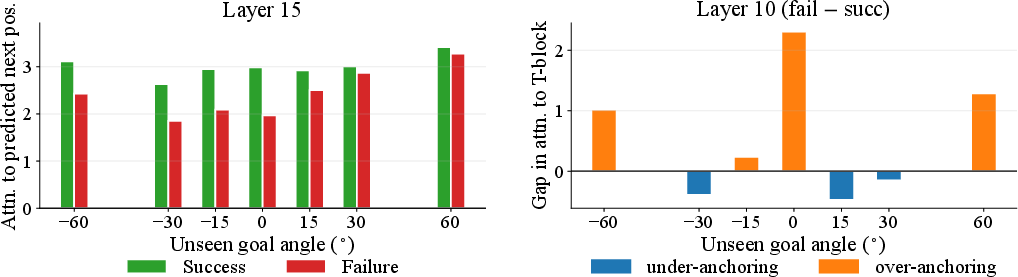
Figure 8: Failure modes—universal weakening of commit, and goal-angle-specific under-/over-anchoring on the retrieval prior.
Implications and Future Directions
ReCAP formalizes a paradigm for deploying frozen robotic policies onto novel tasks by extending a retrieval pool, substantially reducing both teleoperation and computational cost, and decoupling task adaptation from parameter updates. This architecture is most effective when (1) a shared state/action representation exists, and (2) pool-embodiment trajectories are available in a structured format.
Limitations remain: divergent action spaces (dexterous hand vs. simple gripper) and video-only pool sources require abstraction or action-translation modules. Additionally, the system’s robustness diminishes as temporal or dynamic misalignments between pool and target widen. Addressing adaptation to such mismatches and the integration of web-scale or weakly labeled demonstration sources (e.g., raw YouTube videos) constitute promising avenues for increasing transfer scalability.
Conclusion
ReCAP demonstrates that in retrieval-augmented VLA policy frameworks, behavioral generalization to new tasks can be achieved entirely at test time by expanding a demonstration pool, obviating the need for costly per-task retraining. This test-time retrieval mechanism, especially when paired with video prediction-based world-action objectives, supports scalable, modular robot learning across embodiment gaps, offering a compelling model for practical deployment and future foundation model scaling.