SimWeaver: Zero-Shot RGB Sim-to-Real for Deformable Manipulation
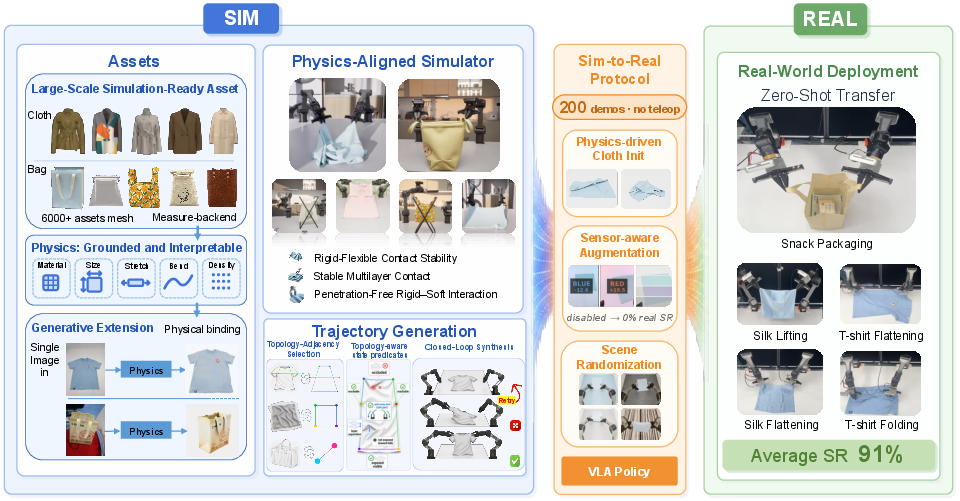
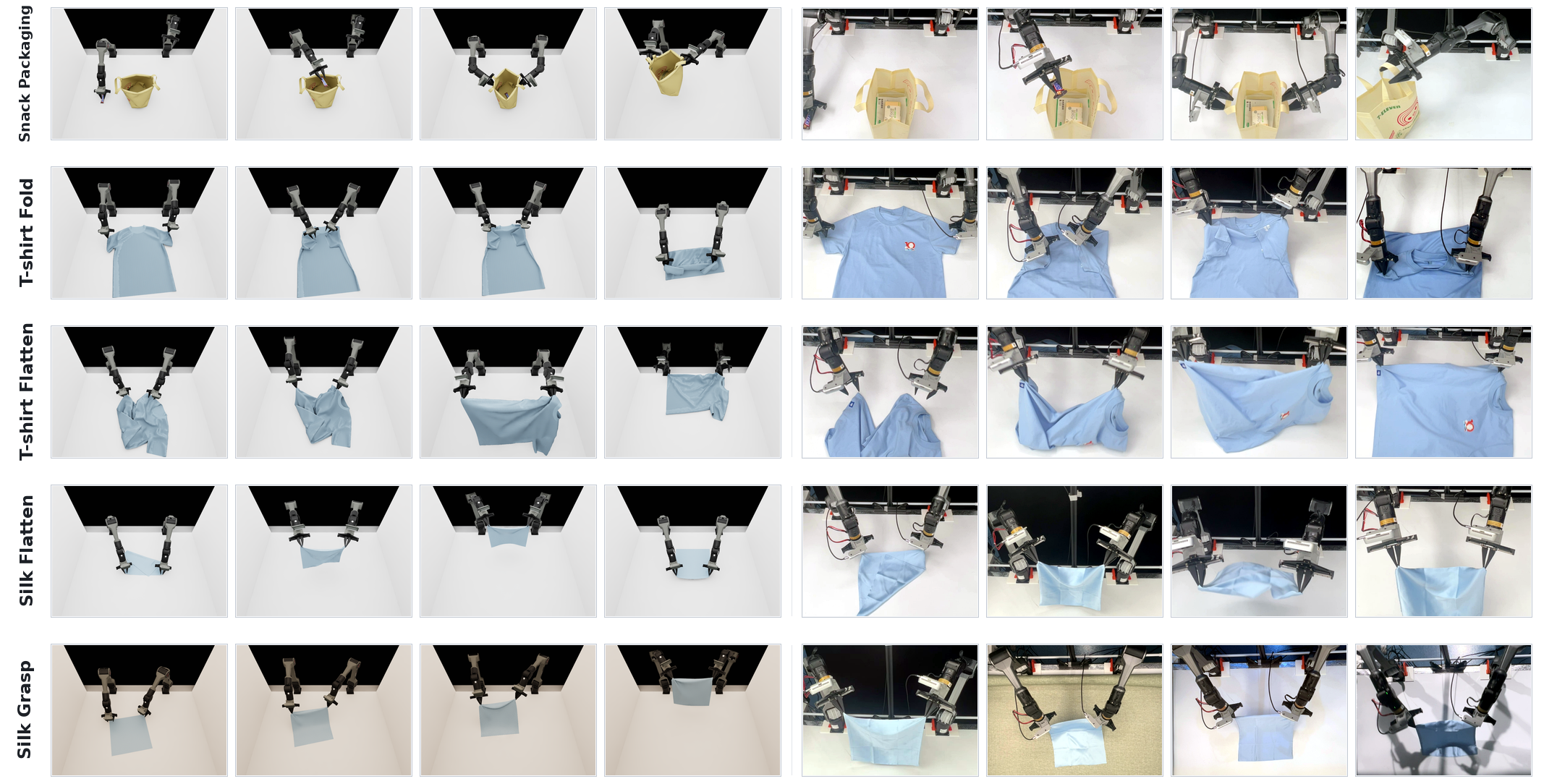
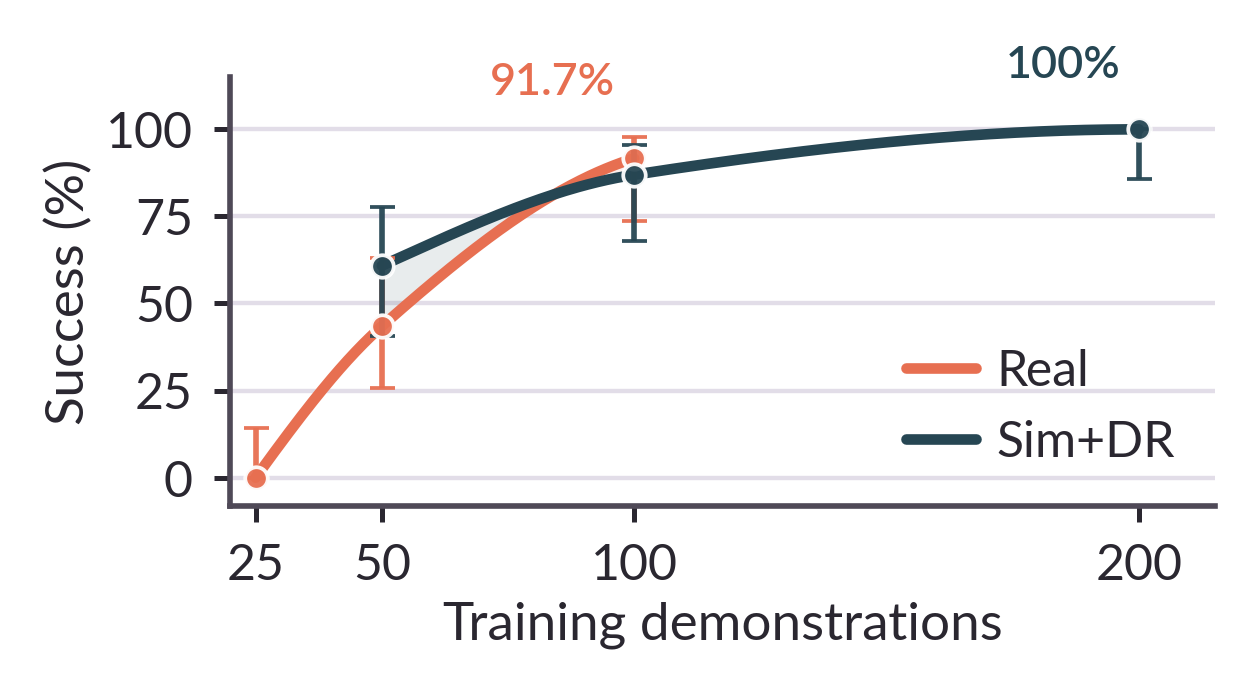
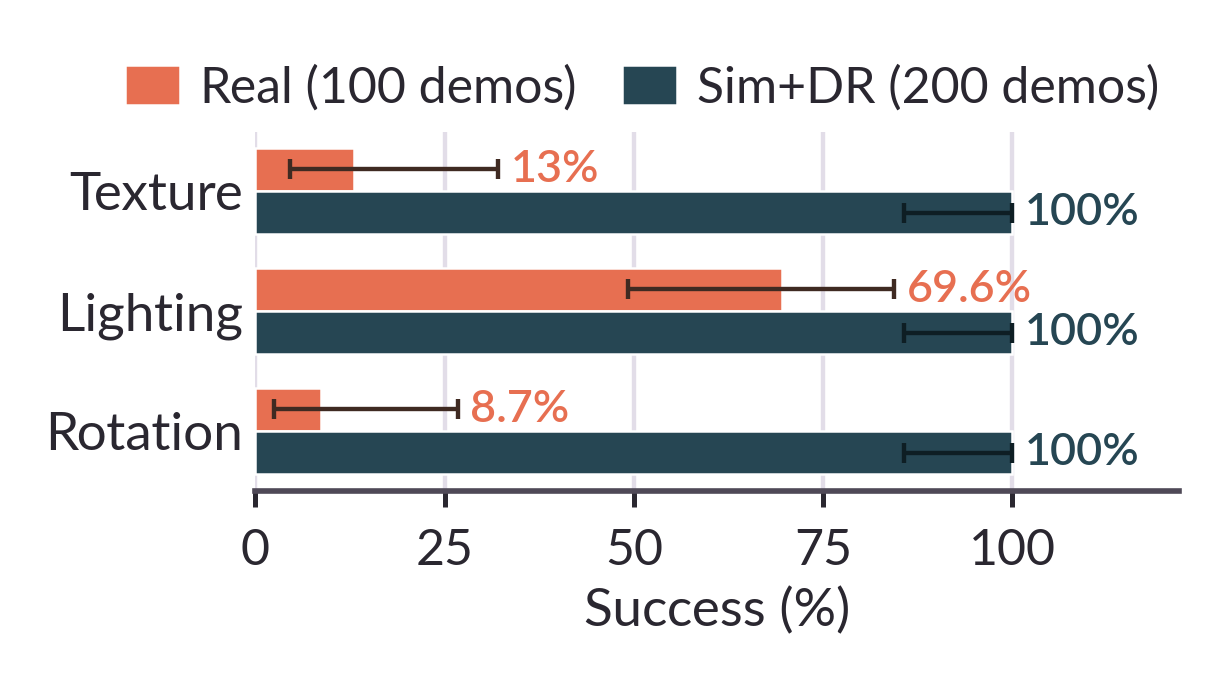
Abstract: RGB sim-to-real for deformable manipulation has remained largely unsolved without real-world fine-tuning. We present SimWeaver, which trains zero-shot RGB VLA policies on 200 simulated demonstrations per task, reaching above 80% per-task and 91% average real-world success across 5 diverse deformable tasks including plastic-bag manipulation, without teleoperation or per-task calibration. SimWeaver combines a reliable measurement-backed simulator (SimWeaver-Sim) with an extensible asset framework supporting single-image generation(SimWeaver-Asset), a deterministic topology-aware trajectory synthesizer (SimWeaver-Syn), and a sim-to-real protocol with ISP-aware photometric augmentation (SimWeaver-Real). On silk grasping, the sim-trained policy reaches 100% under visual distribution shifts where real-data baselines drop to 9-70%, at two orders of magnitude lower per-trajectory cost. We will release SimWeaver and a representative asset subset. Project page: https://simweaver.github.io/
Paper Prompts
Sign up for free to create and run prompts on this paper using GPT-5.
Top Community Prompts
Explain it Like I'm 14
Easy-to-Read Summary of “SimWeaver: Zero‑Shot RGB Sim‑to‑Real for Deformable Manipulation”
What is this paper about?
This paper shows how to teach robots to handle soft, bendy things—like T‑shirts, silk, and plastic bags—by practicing only in a computer first, and then working in the real world without any extra real‑world practice. The system is called SimWeaver. It uses regular color cameras (RGB), not special depth sensors, and it doesn’t need humans to teleoperate (manually drive) the robot to record training demos.
What did the researchers want to figure out?
In simple terms:
- Can a robot learn to handle tricky soft objects just from simulation and then work in the real world immediately (zero‑shot)?
- Can this work across different tasks (folding clothes, flattening silk, putting a snack into a plastic bag) with just 200 practice examples per task?
- Can we avoid expensive, time‑consuming human recording of demonstrations and instead auto‑generate good robot examples inside the simulator?
How did they do it?
Think of SimWeaver as a four‑part “virtual practice gym” for robots:
1) A reliable simulator (the virtual practice room)
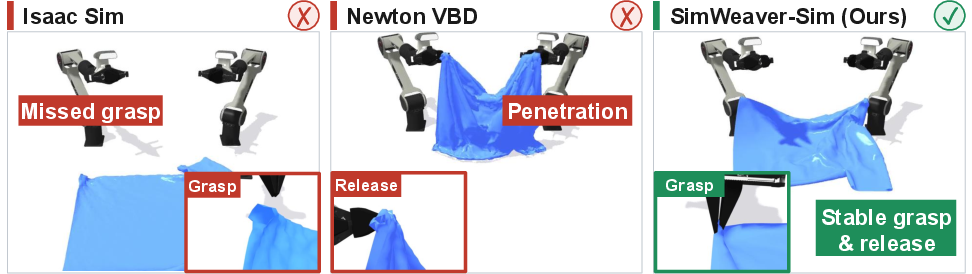
- Problem: Many simulators make soft cloth clip through hands or shake wildly, which teaches bad habits.
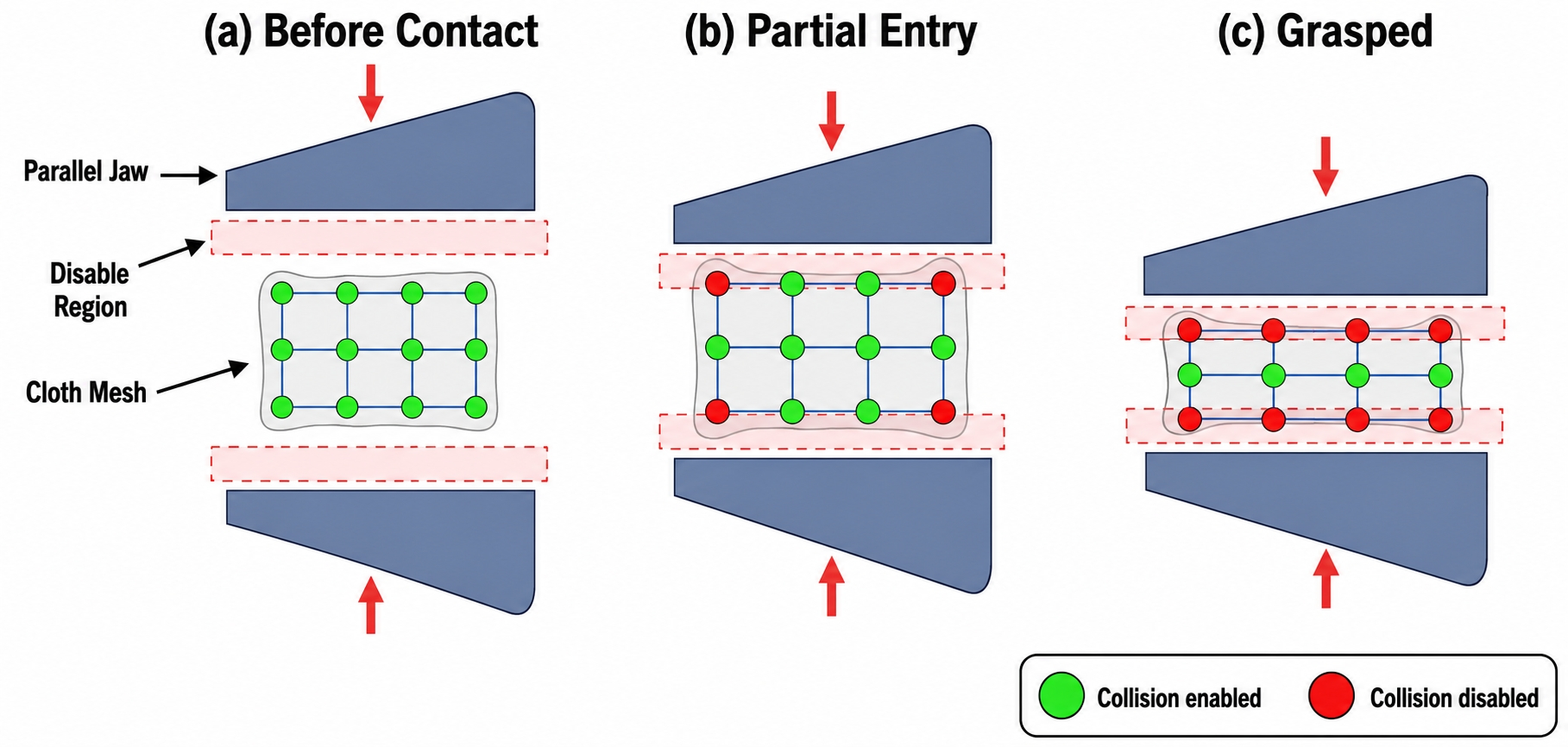
- Their fix: They improved how the robot “hands” (grippers) and cloth touch each other so there’s no slipping or passing through. They use an “active collision region” near the grippers so the cloth doesn’t jitter or penetrate when the gripper closes tightly—like gently keeping fabric from getting pinched in the wrong spot.
Analogy: Imagine practicing basketball in a video game where the hoop sometimes lets the ball pass through. You’d learn the wrong moves. They fixed the hoop so it behaves like a real one.
2) An asset system (the objects and their “feel”)
- They bring in lots of 3D models of clothes and bags and attach real‑world properties to them (like how bendy, heavy, or slippery they are), based on actual textile measurements.
- They can also create new items from a single picture and assign realistic fabric properties so the simulation behaves like the real material.
Analogy: Not just drawing a shirt, but giving it the real stiffness and slipperiness of cotton or silk so it drapes and folds correctly.
3) Automatic trajectory synthesis (writing practice examples without humans)
- Instead of humans demonstrating, the system plans the robot’s moves by understanding the object’s “topology” (where parts connect—like sleeves, corners, or bag handles).
- It picks smart pairs of grasp points (e.g., the right two corners to flatten a shirt), checks if they’re visible and reachable, tries them, and if something fails (like a blocked grasp), it re‑plans and retries—deterministically.
Analogy: A careful recipe that checks each step before moving on; if the spoon slips, it calmly tries again instead of starting from scratch.
4) A sim‑to‑real protocol (making virtual practice match real life)
- They randomize starting cloth shapes using physics so the robot sees many realistic wrinkles and folds.
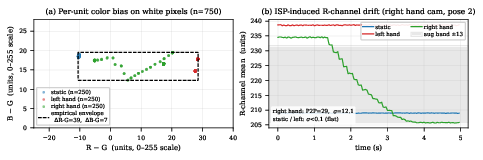
- They measure how their real cameras (three Intel RealSense units) change colors and brightness internally and then copy those quirks in the simulator with special photo tweaks. This is important because camera color drift can confuse vision models.
- They still randomize normal things like lighting and table textures.
Analogy: If your phone camera sometimes makes indoor photos too yellow, you’d practice with that same yellowish tint so your model doesn’t get surprised later.
What did they find?
Across five real‑world tasks, the robot succeeded on average 91% of the time after training only on 200 simulated demos per task, with no real‑world fine‑tuning or per‑task calibration.
Here are the tasks and success rates (23 real trials per task): | Task | Real success | |-------------------------------|--------------| | Snack into plastic bag | 86.96% | | T‑shirt folding | 91.30% | | T‑shirt unfolding (flatten) | 82.61% | | Silk unfolding | 95.65% | | Silk grasping | 100.00% | | Average | 91.30% |
Why this is impressive:
- Soft objects are hard: they fold, wrinkle, hide parts of themselves, and reflect light. Shiny silk and crinkly plastic bags are especially tough for cameras and for depth sensors.
- Zero‑shot: The model worked in the real world right away, instead of needing extra real training.
- No teleoperation: They didn’t need people to control the robot to record demos.
- Robust vision: Using just RGB (color cameras), the system handled dark, reflective, or low‑texture materials where depth cameras often struggle.
They also tested “distribution shifts” (changes in lighting, texture, or rotation) for silk grasping. The sim‑trained model kept working perfectly (100%) while models trained only on real data dropped sharply (down to 9–70% depending on the shift). Plus, generating simulated training examples was dramatically cheaper and faster than collecting real robot data.
Why does this matter?
- Lower cost, faster progress: Good simulation means you can train powerful robot skills without expensive real‑world data collection.
- Hard materials become doable: Plastic bags and silk are common in homes and factories but tricky for robots; this work shows reliable handling with plain color cameras.
- Scales to more tasks: Because assets and their physical properties are easy to extend, researchers and companies can add new garments, bags, and similar soft objects with less effort.
- Safer, cleaner experimentation: Robots can practice thousands of times in a virtual world before touching real objects, reducing wear and tear and the risk of mistakes.
In short, SimWeaver suggests a practical path to teaching robots complex, touchy tasks on soft objects—quickly, cheaply, and reliably—by getting the simulation, the training data, and the camera realism all aligned.
Knowledge Gaps
Knowledge gaps, limitations, and open questions
The following list captures what remains missing, uncertain, or unexplored in the paper and suggests concrete directions future work could take:
- Breadth of deformable categories: Performance is shown on garments, thin silk, and handled plastic bags; it remains unknown how the pipeline handles ropes, towels/blankets, sponges/foam, elastoplastic or volumetric soft bodies, and multi-deformable interactions. Evaluate on additional deformable classes (rope tying, towel folding, sponge squeezing) with the same zero-shot protocol.
- Cross-asset generalization within categories: Policies are trained per task; it is unclear how well they transfer to unseen shirts (different patterns, collars), diverse bag geometries (zip-locks, different handle shapes), or silks with varied thickness/finish. Test zero-shot transfer across multiple unseen instances per category with controlled material and geometry variation.
- Multi-task policy learning: Each task is trained separately. Can a single policy handle multiple deformable tasks (fold, flatten, bagging) and perform task composition? Train and evaluate a unified policy with language goals across the five tasks and additional held-out tasks.
- Scaling with number of demonstrations (beyond silk): Only silk grasping reports a data-scaling trend. Quantify success vs. demo count across all tasks (e.g., 50/100/200/400) and measure where diminishing returns begin.
- Robustness to clutter and unstructured environments: Experiments are conducted on a tabletop with limited scene complexity. Test in cluttered backgrounds, varied table objects, and household scenes to assess robustness of the RGB policy.
- Camera/ISP dependence and portability: Photometric augmentation is tuned to RealSense D435i units; disabling it collapses success to 0%. Assess transfer to other RGB sensors (Logitech webcams, Azure Kinect, iPhone) without per-unit ISP fitting, and explore camera-agnostic augmentation or self-supervised appearance adaptation.
- Single- vs multi-view sensing: The setup uses three cameras. Quantify performance with single overhead camera, single wrist camera, and degraded/missing views to determine minimal sensing and robustness to camera failures.
- Simulator physical fidelity beyond penetration metrics: Reliability is quantified by penetration/explosion and replay determinism, but not by matching real contact forces, frictional behavior, layer stacking pressure, or grasp force-clearance. Collect real measurements (force/torque, slip thresholds, layer compression) and calibrate/validate the simulator against them.
- Impact and validity of the active-collision-region heuristic: Disabling cloth self-collision near gripper jaws may introduce unphysical behavior. Ablate this mechanism across tasks and measure any systematic bias in learned policies; develop physically grounded alternatives (e.g., better friction and compliance modeling).
- Generalization to different robot embodiments and effectors: Results use two 6-DOF arms with parallel-jaw grippers. Evaluate transfer to 7-DOF arms, single-arm setups, suction cups, and soft/tri-finger grippers, including altered kinematic limits and compliance.
- Dynamic and high-speed manipulation: The pipeline focuses on quasi-static pick-and-place and folding. Test dynamic skills (fling, shake, snap-fold, airflow) and study whether the simulator and synthesizer remain reliable under fast transients.
- Real-time control characteristics: Control frequencies, observation latencies, and timing sensitivity are not reported. Profile latency budgets end-to-end and analyze performance degradation under induced delays.
- Failure recovery and robustness: Real-world failure cases and recovery behaviors (regrasp, replan) are not detailed. Evaluate closed-loop resilience under induced perturbations (e.g., human interference, accidental drops) and design recovery strategies.
- Point cloud vs. RGB comparison under improved depth: The point-cloud baseline fails likely due to poor consumer-depth on dark/specular materials. Re-evaluate against higher-quality depth (structured light, stereo rigs with polarization, active IR) or learned depth fusion to fairly assess modality trade-offs and multi-modal fusion.
- Domain randomization (DR) range selection and sensitivity: DR axes and ranges are hand-specified (with details in appendices). Perform sensitivity analyses and investigate automatic DR (ADR) to adapt ranges from sparse real images/video.
- Asset generation validation: Single-image asset generation assigns physical properties via category inference and library sampling, but accuracy is unvalidated. Quantitatively evaluate geometric fidelity and property assignment (e.g., bending stiffness) against real objects and test sim-to-real transfer using generated assets only.
- Coverage of material-property space and OOD materials: The pipeline relies on a measurement-backed library; it is unclear how it handles materials not in the library (e.g., coated fabrics, multilayer laminates). Explore online system identification to infer properties from minimal real interaction data and update sim parameters.
- Topology graph scalability and authoring burden: The topology-adjacency graph G is “automatic for symmetric assets, labeled once per asset class otherwise.” Assess authoring cost and scalability to diverse deformable categories (e.g., hoodies, skirts, curtains) and investigate automatic topology extraction from mesh structure or weak supervision.
- Diversity of synthesized trajectories: The generator is deterministic; diversity arises primarily from randomized initial states. Study whether adding controlled stochasticity in synthesis (e.g., grasp variants, path perturbations) improves policy robustness without sacrificing determinism.
- Long-horizon and multi-stage tasks: Current tasks have modest horizons. Evaluate tasks requiring long action sequences and multiple subgoals (e.g., bag open → insert → seal → place) with explicit success decomposition and policy memory.
- Transparency and specularity extremes: While results include reflective silk and plastic bags, robustness to highly transparent films, glossy surfaces under harsh lighting, and lens flare is not quantified. Conduct targeted stress tests across challenging photometric regimes.
- Policy architecture dependence: Only a pi_0.5-style VLA is evaluated. Compare alternative architectures (pure CNN policies, transformers without language, diffusion action-heads) and quantify compute/speed-accuracy trade-offs for deployment.
- Compute and energy costs for training: Training cost, wall-clock time, and energy for 200-demo policies are not reported. Provide reproducible training budgets and analyze scalability to larger task suites.
- Multi-object and inter-object contact: Tasks mainly involve one deformable and occasionally one rigid object (snack). Extend to multiple deformables interacting (e.g., fold shirt into bag, layer stacking of towels) to test solver and policy under complex contact networks.
- Robustness to material/parameter mismatch: Zero-shot claims assume measurement-backed parameters. Quantify degradation when material properties are mis-specified and evaluate methods (ADR, on-policy real correction) to maintain performance under moderate mismatch.
- Topological changes and damage: The framework assumes fixed topology; tearing, knotting, or plastic bag seam failure are out-of-scope. Investigate simulation and policy robustness when topology can change.
- Real-world evaluation scale: Success rates are reported over n=23 trials per task. Increase trial counts and report statistical power; include cross-day, cross-operator, and cross-environment evaluations to test stability.
- Safety and fabric integrity: There is no analysis of fabric damage or excessive contact forces. Include safety constraints (force limits, slip-aware grasps) and track wear over repeated trials.
Practical Applications
Practical Applications Derived from the Paper
The paper introduces SimWeaver, a zero-shot RGB sim-to-real framework for deformable manipulation that combines a contact-reliable deformable simulator (SimWeaver-Sim), an extensible, measurement-backed asset framework (SimWeaver-Asset), a deterministic, topology-aware trajectory synthesizer (SimWeaver-Syn), and an ISP-aware sim-to-real protocol (SimWeaver-Real). Below are actionable, real-world applications and workflows enabled by these contributions.
Immediate Applications
These can be piloted or deployed now with modest engineering effort, using off-the-shelf arms/grippers and consumer RGB cameras.
- Automated soft-goods handling in fulfillment and manufacturing (folding, kitting, bagging)
- Sectors: logistics/warehousing, apparel/textiles, contract manufacturing
- What: Train and deploy RGB VLA policies for folding T-shirts, unfolding, inserting SKUs into plastic bags, and lifting/packing soft items—using ~200 synthesized demos per task without teleoperation.
- Tools/workflows:
- Define task-specific topology graph (for the asset class).
- Generate 200 deterministic demos with SimWeaver-Syn.
- Fine-tune a VLA policy (e.g., π0.5) in simulation.
- Deploy zero-shot with SimWeaver-Real’s ISP-aware augmentation and physics-driven state initialization.
- Assumptions/dependencies:
- Parallel-jaw grippers and RGB cameras (e.g., RealSense D435i) or camera-specific augmentation ranges.
- Access to fabric parameter priors (bending, stretch, mass/area) from measurement-backed libraries; defaults may suffice for common fabrics.
- Tasks close to demonstrated categories (garments, thin silks, handled plastic bags).
- Plastic-bag opening and packaging cells
- Sectors: retail, e-commerce fulfillment, food & CPG packaging
- What: Zero-shot policies for inserting objects into handled plastic bags and lifting them; a known gap area addressed by the stable bag assets and contact handling.
- Tools/products: Pre-built bag assets with explicit handles from SimWeaver-Asset; policy training packs; ROS2 nodes for deployment.
- Assumptions/dependencies: Bag geometry variance and film thickness should be covered by asset/parameter ranges; airflow/shaking behaviors not modeled.
- Robust RGB-only vision policies for low-texture, specular, or dark fabrics
- Sectors: robotics software, quality control, automation integrators
- What: Replace depth-reliant pipelines that fail on shiny black grippers or reflective silks with pixel-based VLA policies trained with ISP-aware augmentation.
- Tools/workflows: Camera-wise ISP calibration and photometric augmentation ranges; SimWeaver-Real’s augmentation pipeline.
- Assumptions/dependencies: ISP characterization per camera model/unit; generalization to different sensor stacks may require re-fitting augmentation ranges.
- Synthetic data generation for VLA and imitation learning at scale
- Sectors: AI/ML, robotics software platforms
- What: Deterministically produce large volumes of high-quality, label-noise-free deformable manipulation demos (trajectory success/replay-stable) at low unit cost.
- Tools/products: Batch synthetic dataset pipelines; cloud job templates; reproducible demo bundles per task.
- Assumptions/dependencies: Compute availability for rendering and training; adherence to the simulator’s parameter interface to preserve physical plausibility.
- Rapid feasibility studies for end-effector and gripper design
- Sectors: robotics hardware, OEMs, integrators
- What: Use the simulator’s contact reliability and determinism to test grasp stability and multilayer interactions (e.g., jaw geometry, surface friction) against garment and bag assets.
- Tools/workflows: Parameter sweeps over friction, jaw clearances, and material stiffness in SimWeaver-Sim; success/failure metrics.
- Assumptions/dependencies: Friction measurement/estimation realism; geometric fidelity of CAD-to-sim pipeline.
- Benchmarking and reproducible evaluation for deformable manipulation
- Sectors: academia, R&D labs, benchmark consortia
- What: Standardize evaluation with deterministic topology-aware trajectories, measurement-backed assets, and sim-to-real protocols; report replay stability and failure decomposition.
- Tools/products: Asset subsets; task definitions; synthesis scripts; evaluation harnesses with Wilson CI reporting.
- Assumptions/dependencies: Community adoption; shared release of representative asset subset as the paper promises.
- Education and training modules for deformable manipulation
- Sectors: higher education, workforce development
- What: Hands-on labs for students/technicians to build sim-to-real pipelines for cloth/bag tasks without expensive data collection or teleop rigs.
- Tools/workflows: Course kits with assets, topology graphs, synthesis scripts, and ROS2 deployment templates.
- Assumptions/dependencies: Access to mid-range robot arms and RGB cameras for capstone execution; compute for training.
- Camera ISP-aware augmentation utilities for robust vision in robotics
- Sectors: computer vision, industrial perception
- What: Adopt the per-camera photometric augmentation approach (color bias, gain-loop drift) to mitigate sensor-induced visual shifts, beyond deformables.
- Tools/products: ISP profiling toolkit; augmentation range fitter.
- Assumptions/dependencies: Repeatability of ISP statistics over time/firmware; per-unit variation handling.
- Digital twin QA for task recipes before floor deployment
- Sectors: industrial automation, compliance
- What: Validate “task recipes” (topology graph + demos + policy) in closed-loop sim with deterministic replay and well-defined success predicates before running on hardware.
- Tools/workflows: CI/CD hooks for sim-based policy acceptance tests; Sobol-sequenced DR for coverage.
- Assumptions/dependencies: Coverage of DR axes for the target site (lighting, textures, table heights); alignment of sim materials to site inventory.
Long-Term Applications
These require further research, scaling, broader validation, integration with new sensors/effectors, or standardization.
- Household assistive robots for laundry and soft-goods organization
- Sectors: consumer robotics, eldercare
- What: General-purpose laundry folding/unfolding, towel handling, blanket spreading with zero or minimal site calibration.
- Dependencies: Reliability across diverse home fabrics and form factors; safe human-robot interaction; productized hardware; robust camera ISP modeling for consumer devices.
- Retail self-checkout bagging assistants and backroom kitting
- Sectors: retail automation
- What: Robots that open/hold bags and insert items reliably under crowded, variable lighting.
- Dependencies: Diverse bag SKUs and stands; ergonomic and safety compliance; integration with POS systems; fine-tuned DR to site conditions.
- Hospital/pharma sterile packaging and surgical drape handling
- Sectors: healthcare
- What: Cleanroom-capable deformable handling (drapes, sterile bags) with RGB-only policies robust to low texture and glare.
- Dependencies: Regulatory validation (GMP, ISO13485); materials with specialized properties (antistatic, multilayer laminates); contamination control; possible need for tactile feedback.
- Recycling and waste-stream automation with bagged materials
- Sectors: waste management, sustainability
- What: Automated opening/handling of waste bags for sorting lines; delicate manipulation to avoid tearing.
- Dependencies: Wide variability in bag materials, contamination, and contents; safety standards; higher-fidelity tear modeling.
- Generalized deformable manipulation beyond garments/bags (nets, ropes, multi-layer assemblies)
- Sectors: manufacturing, construction, logistics
- What: Extending topology-aware synthesis and stable contact simulation to ropes, nets, cable harnesses, and multi-layer wraps.
- Dependencies: New asset/topology schemas; enhanced self-contact/entanglement models; additional sensing (e.g., depth/tactile) for complex occlusions.
- Cross-vendor certification frameworks using measurement-backed digital twins
- Sectors: policy/regulation, industry consortia
- What: Standards for declaring sim-to-real readiness of deformable manipulation tasks using physically measurable parameters and deterministic replay metrics.
- Dependencies: Industry agreement on measurement protocols; audited material libraries; conformance testing suites.
- Asset marketplaces for measurement-backed deformables
- Sectors: software platforms, CAD/PLM
- What: Exchange and reuse libraries of physically annotated garments/bags for simulation and training; interoperability across simulators.
- Dependencies: Common parameterization standards; licensing around meshes/images; scalable single-image asset generation with reliable category-to-parameter mapping.
- Multimodal policies (RGB + tactile/force) and broader sensor support
- Sectors: robotics R&D
- What: Combine the current RGB pipeline with tactile/force sensing to handle tight grasps, multilayer stacks, and slip more robustly; support non-RealSense RGB stacks.
- Dependencies: Sensor fusion architectures; tactile simulators with accurate contact; expanded ISP models and augmentation ranges.
- Automated process discovery for deformable tasks via topology-aware planning
- Sectors: software/AI, industrial engineering
- What: From a high-level goal and asset class, auto-generate topology graphs and feasible primitives, producing “recipes” without manual task design.
- Dependencies: Reliable landmark detection; class-level topology inference; learned predicate discovery; safety-constraint synthesis.
- Real-time digital twins for monitoring and adaptive control
- Sectors: smart factories, operations
- What: Live synchronization between cell cameras and a deterministic digital twin to detect divergences and adapt grasps/trajectories on-the-fly.
- Dependencies: Robust state estimation; low-latency sim; policy adaptation mechanisms; secure IT/OT integration.
- Energy- and cost-aware planning of data pipelines
- Sectors: finance/operations, sustainability
- What: Use the demonstrated two-orders-of-magnitude cost reduction to model ROI and emissions impact of replacing real-robot data collection with synthetic demos for training.
- Dependencies: Accurate cost models for compute vs. robot time; quality metrics to ensure comparable performance.
Notes on Feasibility, Assumptions, and Dependencies
- Simulator/material fidelity
- Success depends on assigning realistic material properties (mass/area, bending, stretch, friction) to assets. Using the provided measurement-backed library is assumed; custom materials may need lab measurements or informed estimates.
- Camera and ISP specificity
- Photometric augmentation ranges were profiled for RealSense D435i units. Other cameras require ISP characterization and re-fitting augmentation ranges.
- Hardware and task scope
- Results reported with two 6-DOF arms and parallel-jaw grippers; different end-effectors may change contact dynamics. Tasks validated include garments, thin silks, and handled plastic bags.
- Topology graph definition
- Class-level topology adjacency graphs must be defined per asset class; symmetric classes can be auto-extracted, others need one-time labeling.
- Safety and compliance
- Industrial/healthcare deployments require safety risk assessments, fail-safes, and compliance with site regulations and cleanroom standards.
- Compute and integration
- Training VLA policies and generating datasets require GPU resources; deployment requires ROS2 or similar middleware and cell integration effort.
- Domain randomization coverage
- Robust zero-shot transfer assumes adequate DR over scene/robot axes and physics-driven state variation; site-specific gaps may require additional DR or light calibration.
Glossary
- 2-torus (T2): A surface with two circular dimensions (topologically equivalent to a donut), used to describe handle-like structures in deformables. "thin-shell deformation, 2-torus handles, self-contact, and large pick-and-place deformation resist standard tuning."
- Active-collision-region: A simulator scheme that restricts where self-collisions are resolved near grippers to stabilize contacts. "owing to the active-collision-region scheme detailed in \S\ref{sec:sim-design}"
- Adjacency graph: A graph over semantic landmarks encoding feasible grasp pairs for topology-aware manipulation. "The adjacency graph does most of the work: by restricting the argmax to , all non-adjacent pairs are excluded by construction and never enter the score."
- ASTM D1388: A standardized test for fabric bending stiffness (cantilever method). "e.g., ASTM~D1388 cantilever bending"
- ASTM D3107: A standardized test for fabric stretch/extensibility. "ASTM~D3107 stretch/extensibility"
- Bending stiffness: A material parameter measuring resistance to bending, critical for cloth dynamics. "Deformable object physical parameters, such as bending stiffness and friction, are matched to direct measurements"
- Bimanual: Involving two robot arms/hands simultaneously. "pass rates below 50\% on bimanual cloth tasks."
- Canonical mesh: A reference mesh configuration with consistent coordinates used for semantic reasoning. "We represent feasible bimanual configurations as a labeled graph on the canonical mesh"
- Collision-forbidden region: A zone near gripper jaws where self-collision is disabled to prevent jitter/penetration. "We define a collision-forbidden region around each gripper jaw, within which deformable self-collision handling is disabled"
- Convex hull: The smallest convex set containing a shape; used here to assess surface exposure for feasible grasps. "and surface exposure on the current 2-D convex hull, augmenting the candidate set when canonical landmarks fold inward."
- Domain randomization (DR): Stochastic variation of simulation parameters (e.g., lighting, textures) to improve real-world transfer. "Beyond rendering realism and standard domain randomization, we identify two deformable-specific sim-to-real gaps"
- End-effector: The robot’s tool at the end of its arm (e.g., gripper) that interacts with objects. "complex interactions with rigid end-effectors."
- Fisher (exact test): A statistical significance test for contingency tables, used here for success-rate comparisons. "all gaps significant under single-tail Fisher ()."
- Geodesic neighborhood: Neighborhood defined by shortest paths along the surface (mesh) rather than Euclidean distance. "where is the -radius geodesic neighborhood of on the canonical mesh"
- IK (Inverse Kinematics): Computing joint configurations to realize desired end-effector poses; feasibility must be ensured for trajectories. "partly because warping enforces no IK feasibility or bimanual consistency."
- ISP (Image Signal Processor): On-camera processor affecting image color/gain; its behavior must be modeled for visual transfer. "We characterize their per-unit ISP behavior and identify two sensor-internal failure modes"
- L-infinity (ℓ∞) norm: The maximum absolute component (supremum) norm; here used to detect layered structures in cloth. "when the canonical-coordinate spread of its physical XY-neighborhood exceeds a threshold"
- Non-geodesic neighbor: A nearby point not connected via short surface paths (indicating overlap/occlusion across layers). "when a non-geodesic neighbor lies in the cylinder above it"
- Non-rigid registration: Aligning deformable shapes by allowing local, non-rigid warps. "SoftMimicGen~\citep{moghani2026softmimicgen} warps trajectories via non-rigid registration"
- Occlusion-above: A predicate that flags grasp targets occluded by other layers above them in 3D. "Occlusion-above flags a candidate when a non-geodesic neighbor lies in the cylinder above it,"
- Out-of-distribution (OOD): Data conditions that differ from the training distribution (e.g., texture, lighting). "under in-distribution scaling and OOD shifts in texture, lighting, and rotation."
- Parallel-jaw grippers: Grippers with two parallel fingers that move together to grasp objects. "Our bimanual setup—two Piper 6-DOF arms with parallel-jaw grippers, one overhead and two wrist-mounted RealSense D435i cameras—"
- Penetration (simulation): Physically invalid interpenetration between bodies due to contact model failures. "(b) Newton VBD produces cloth--rigid penetration during dual-arm manipulation."
- Photometric augmentation: Synthetic variation of image color/brightness characteristics to match sensor distributions. "We instead apply photometric augmentation with ranges fitted to the measured per-camera statistics"
- Position-Based Dynamics (PBD): A simulation approach that enforces constraints by directly adjusting positions each step. "with Position-Based Dynamics~\citep{muller2007position} for cloth simulation"
- Replay determinism: The property that re-executing the same simulated trajectory yields identical outcomes across runs. "trajectory-replay determinism, addressing contact-reliability failures"
- Rigid-flexible contact: Interaction between rigid bodies (e.g., grippers) and deformable objects (e.g., cloth). "Rigid-flexible contact stability: reliable simulation of interactions between rigid robot end-effectors and deformable objects"
- Self-contact: Contact where different parts of the same deformable object touch each other. "thin-shell deformation, 2-torus handles, self-contact, and large pick-and-place deformation resist standard tuning."
- Self-collision: Collision detection/response between parts of the same object in simulation. "within which deformable self-collision handling is disabled"
- Sim-to-real gap: The mismatch between simulated and real-world conditions that impedes policy transfer. "pixel-based end-to-end policy learning for deformable object manipulation has stagnated due to the unresolved sim-to-real gap"
- Sobol quasi-random sequence: A low-discrepancy sequence used to sample parameters for better coverage than pure random sampling. "sampled per episode via a scrambled Sobol quasi-random sequence"
- Teleoperation: Human-operated control of a robot to collect demonstrations. "without teleoperation or per-task calibration."
- Thin-shell: Structures with one dimension (thickness) much smaller than the other two, common in cloth and bags. "thin-shell objects with handles."
- Topology-adjacency selection (tas): Deterministic selection of semantically valid grasp pairs based on topological adjacency. "Topology-adjacency selection (tas) defines semantically valid bimanual grasp pairs from the asset's canonical mesh"
- Topology-aware: Methods that explicitly account for an object’s connectivity and structure (not just geometry). "a deterministic topology-aware trajectory synthesizer (\syssyn)"
- Untangling mechanism: Simulator process to resolve interpenetrations and restore valid configurations of cloth. "through the simulator's built-in untangling mechanism"
- VBD-based (Velocity-Based Dynamics): Simulation methods that resolve dynamics via velocity constraints; here noted for contact behavior. "VBD-based~\citep{chen2024vbd} solvers including SIM1~\citep{zhou2026sim1} further improve fidelity"
- VLA (Vision-Language-Action): Models that map visual and language inputs to actions for embodied tasks. "trains zero-shot RGB VLA policies on 200 simulated demonstrations per task"
- Wilson confidence interval: A binomial proportion interval with better coverage than the normal approximation for small samples. "Wilson CIs"
- Zero-shot: Deployment without any task-specific real-world fine-tuning after simulation training. "trains zero-shot RGB VLA policies on 200 simulated demonstrations per task"
Collections
Sign up for free to add this paper to one or more collections.

