- The paper provides a regime-dependent theoretical framework that reconciles conflicting behaviors in Schatten-p norm based optimizers by unifying Muon, HTMuon, and finite-p methods.
- It introduces explicit update recursions for vector and matrix parameters under p-uniform convexity, deriving complexity bounds and batch size scaling laws.
- The analysis offers practical guidance for optimizer tuning by prescribing optimal Schatten-p norms based on model dimension, compute budget, and gradient noise characteristics.
Schatten-p Norm Selection in Deep Learning Optimization
Introduction and Motivation
The optimization geometry induced by Schatten-p norms has become a focal point in adaptive methods for deep learning, largely driven by the empirical success of optimizers like Muon, which employs the Schatten-∞ (spectral) norm. Despite successes, practitioners have observed conflicting phenomena regarding when spectral geometry actually elicits improvements. This paper provides a rigorous and regime-dependent theoretical reconciliation, supplying explicit complexity bounds and design rules for choosing the value of p in Schatten-p norm-based optimizers, covering both vector and matrix parameterizations.
The work leverages the SODA (Schedule-free Optimistic Dual Averaging) framework, extending the theoretical analysis to p>2 via uniform convexity, which was not encompassed by previous analyses. This more general approach explains several empirical findings, including the conditions in which Muon is optimal, when warmup is necessary, the batch size scaling required for acceleration, and critically, why finite-p methods (e.g., HTMuon, Soft-Muon) often outperform the pure spectral approach in settings typical of current large-scale training.
Theoretical Contributions
The analysis hinges upon the geometry-noise duality in stochastic optimization: the optimal norm depends on both the geometry in which the loss is smooth and the tail behavior of gradient noise. The SODA template is parameterized by a p-uniformly convex regularizer, yielding explicit update recursions for vector and matrix variables:
- Vector variables (ℓp): The dual update combines the sign and (q−1)-power (where p0) operations componentwise.
- Matrix variables (Schatten-p1): The dual update involves an SVD and applies the power operation to singular values, precisely matching the logic of HTMuon and Soft-Muon when p2 is finite.
This explicit parameterization unifies Muon \cite{jordan2024muon}, HTMuon, and other recent variants, enabling coverage of p3 regimes and connecting optimism, momentum, and weight decay in modern optimizers within the same framework.
The core complexity result under p4-uniform smoothness and possibly heavy-tailed statistical noise is: p5
for the accelerated setting, where p6 is the number of iterations, p7 the p8-geometry smoothness constant, p9 the optimization radius, and ∞0 the noise scale in the dual norm. This formulation highlights how the geometry (∞1) directly modulates the attainable rates, and that in the deterministic (noise-free) limit, lower ∞2 always yields stronger acceleration.
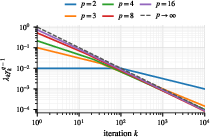
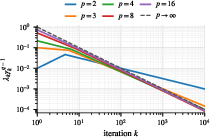
Figure 1: Non-accelerated stepsize scaling as a function of ∞3 illustrates how the effective learning rate adapts across geometries and regimes.
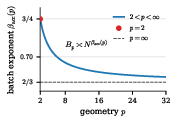
Figure 2: The accelerated batch size scaling rule under bounded variance demonstrates the growth of the optimal batch size with ∞4 and the approach to the spectral norm.
A further contribution is the noise-robust extension: the analysis tracks the heavy-tailed moment assumptions, deriving batch size scaling rules. Under bounded variance (∞5), the batch size ∞6 (where ∞7 is the total oracle budget), showing that as ∞8 (i.e., the spectral norm), ever-larger batches are required, matching empirical batch size tuning heuristics observed for Muon-like schemes.
Regime Dependence and Geometry Selection
A key advancement is the explicit identification of when a Schatten-∞9 geometry is optimal. If the objective is smooth in the spectral norm (i.e., p0 is small), intuition and prior works suggest aligning the optimizer to match, i.e., choose p1. This analysis rigorously demonstrates that this is true only in the high-dimensional or compute-constrained regime (p2, with p3 the effective parameter dimension), where the number of parameter updates is small relative to the model.
However, as soon as training steps become abundant relative to model size (the "low-dimensional" or "overtraining" regime, p4), smaller p5 (down to p6 or p7 determined by the noise moment) can be strictly optimal even when the loss is spectrally smooth. This is due to the p8 and p9 scaling in the convergence rates. The practical implication is that for modern, well-scaled training regimes satisfying Chinchilla-style recipe (p0), the low-dimensional regime prevails and finite-p1 geometries (e.g., p2) provide superior theoretical guarantees and empirical results.
This regime distinction directly explains the recent empirical transition: Muon and its spectral-norm cousins display strength in short runs and speedrun settings, but are outperformed by SGD, Adam, or Lion-like optimizers—and by finite-p3 variants of Muon—in large, full-batch or overparameterized settings.
Batch Size Scaling and Noise Robustness
The analysis provides an explicit batch size scaling law for arbitrary p4 (in both classical and accelerated schedules):
p5
Thus, maximal effective learning in Schatten-p6 optimization (especially spectral norm) necessitates large batch sizes, precisely mirroring empirical findings that Muon needs large p7 to outperform other methods. Moreover, under acceleration and bounded variance, the batch size exponent is even higher, emphasizing the need for substantial compute allocation in these regimes.
The framework also ties the preferred geometry p8 to the noise moment (p9) in mini-batched gradients, leading to the selection of the minimal admissible geometry p>20 as the budget p>21 grows relative to dimension.
Geometry Scheduling and Practical Prescriptions
The regime analysis admits an adaptive prescription:
- High dimension/low budget (p>22): Use geometry matching the smoothness; e.g., spectral norm (p>23) if smooth in p>24.
- Low dimension/high budget (p>25): Use geometry matching the tail of the stochastic noise; e.g., Euclidean or lighter norms. If the noise is heavy-tailed, select p>26 per moment bound.
- Unknown budget/anytime setting: A switching schedule for p>27 is proposed, shifting from high p>28 to minimal admissible p>29 once p0 crosses the critical boundary; this is consistent with empirical schedules applied in recent finite-p1 Muon variants.
Implications for Scaling Laws and Future Directions
Given that Chinchilla scaling regimes (p2) dominate large-scale practice, this theory explains the observed reduction in Muon's advantage and the rise of finite-p3 norm methods as top-performing optimizers in large model runs. It also supplies a first-principles justification for batch size annealing and optimizer schedule tuning beyond grid search, based on geometric and stochastic characteristics of the loss and the minibatch oracle.
Future work should investigate dynamically adaptive geometry schedules and further refine geometry selection based on empirical noise distributions in deep models, advancing toward optimizers that adapt both learning schedule and geometry automatically.
Conclusion
This paper provides the first regime- and geometry-aware analysis of Schatten-p4 norm selection for deep learning optimization, unifying and explaining much of the divergent empirical evidence around spectral norm methods. The theoretical results systematically connect optimizer geometry, batch size scaling, and statistical noise, offering actionable guidance for optimizer and training recipe design. These results heavily influence how practitioners should choose and tune optimization geometry, particularly in large-scale training and in domains increasingly demanding both high performance and robust, automatic adaptivity.