- The paper introduces a novel pruning method that extracts persona-aligned sub-networks using structured binary masks.
- It leverages automated persona-driven data synthesis to create calibration sets, achieving low degradation even at high sparsity levels.
- Experiments demonstrate that Persona-Pruner maintains role-playing fidelity and general LLM utility, enabling cost-efficient multi-agent deployments.
Persona-Pruner: Sculpting Lightweight Role-Playing LLMs
Introduction
Persona-Pruner introduces a targeted model pruning framework for LLMs, enabling efficient instantiation of lightweight, high-fidelity role-playing agents from a single foundational model. The fundamental hypothesis is that persona-specific behavior is encoded within a localized sub-network of an LLM, not its full parameter set. To realize this, Persona-Pruner couples persona-driven data synthesis with differentiable, structured pruning, extracting a persona-aligned sub-network capable of maintaining both character fidelity and general LM utility. This approach directly addresses critical constraints in multi-persona deployments—particularly for agent-rich environments like games or personalized assistants—by dramatically reducing compute and memory costs compared to model duplication or fine-tuning per persona.
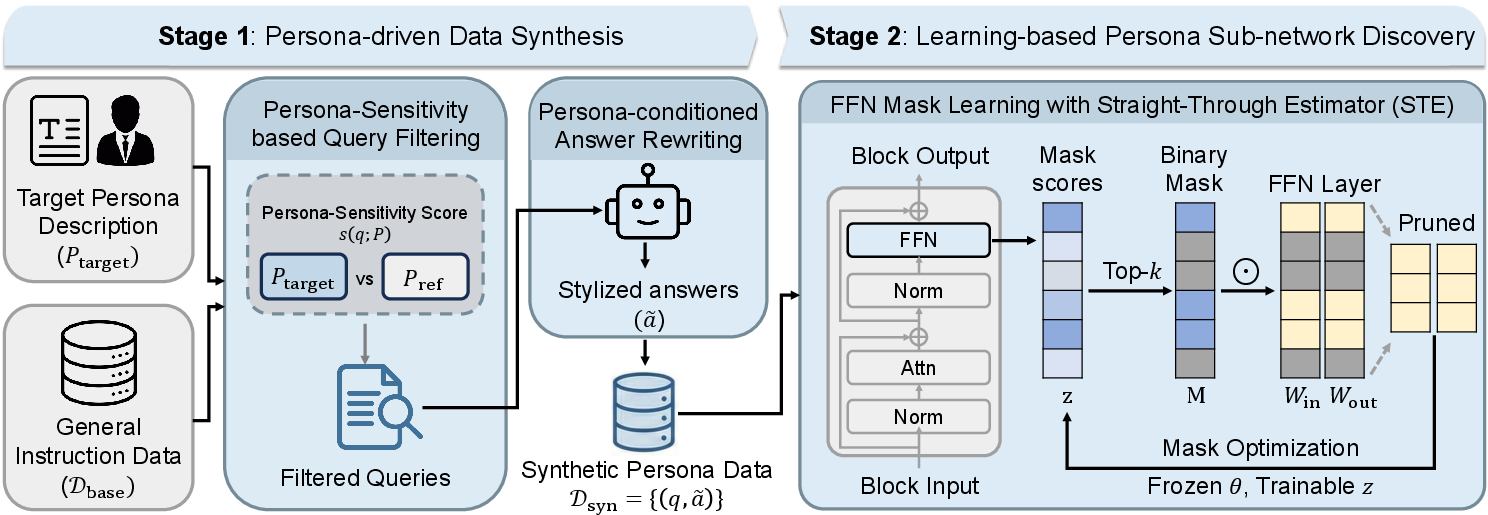
Figure 1: Overview of Persona-Pruner, integrating persona-aligned data synthesis with persona-specific structured pruning to extract sub-networks within a general LLM.
Persona-Driven Data Synthesis
A central innovation is the fully automated synthesis of persona-aligned instruction datasets, in the absence of role-specific dialogue corpora. For a textual persona definition Ptarget and a generic instruction dataset Dbase, the pipeline first filters “persona-sensitive” queries—those that induce divergent internal representations for different personas, quantified via cross-persona representation divergence over transformer blocks. Top-scoring queries are paired with persona-consistent responses, constructed by rewriting existing generic answers under strict semantic preservation, guided by high-capacity LLMs (e.g., Llama-3.1-70B-Instruct). The result is a high-signal calibration set Dsyn suitable for mask optimization.
This approach decouples persona specialization from the availability of bespoke corpora, enabling persona instantiation from arbitrary descriptions. Furthermore, tailored datasets such as Alpaca-P, constructed by persona-driven transformation of Alpaca [alpaca], underpin rigorous benchmark evaluation.
Persona Sub-network Discovery
Given Dsyn, Persona-Pruner performs persona-specific sub-network discovery by learning structured binary masks over the FFN intermediate dimensions within each transformer block. The mask optimization objective minimizes the negative log-likelihood of generating persona-stylized responses, with model weights frozen and only mask parameters updated. Mask binarization employs the Straight-Through Estimator (STE) for tractable gradient flow, enforcing target sparsity constraints.
This structured pruning targets the highest-parameter components—FFN intermediates—yielding sub-networks that are directly deployable on standard hardware. Mask optimization for each persona is independent, allowing efficient parallel agent instantiation.
Experimental Results
Quantitative Role-Play & Generalization
Empirical results demonstrate clear superiority over prior pruning baselines (Depth Pruning, SliceGPT, LLM-Pruner, Adapt-Pruner, etc.), both without and with post-pruning recovery finetuning. At 25% sparsity, Persona-Pruner exhibits negligible degradation in LLM-as-a-judge persona scores (≤3% drop versus dense), and at 50% sparsity, it outperforms all baselines by wide margins, even retaining competitive general LLM capabilities (OBQA/PIQA accuracy on par with dense). Notably, under recovery finetuning, Persona-Pruner often matches or exceeds the parent model’s role-playing performance.
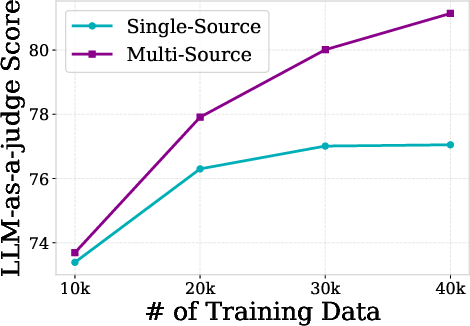
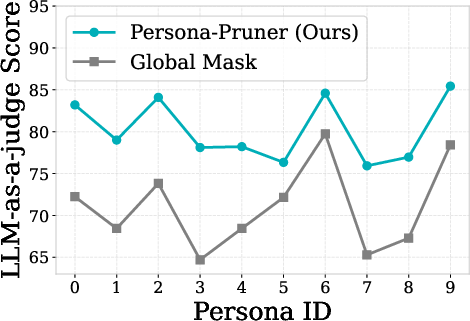
Figure 2: Data scalability analysis demonstrating monotonic improvements in role-playing performance with increasing synthesis set size and data diversity.
Mask Stability and Semantic Alignment
Extensive analysis reveals that learned pruning masks are both reproducible across runs (cross-seed Jaccard similarity r=0.99) and semantically aligned (pairwise mask similarity correlates with persona embedding similarity, r=0.65), supporting the claim that LLMs organize persona behavioral knowledge into locally distinct sub-networks.
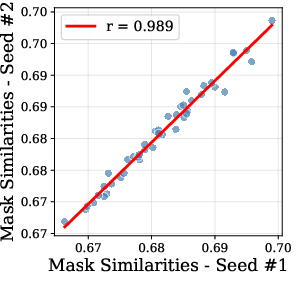
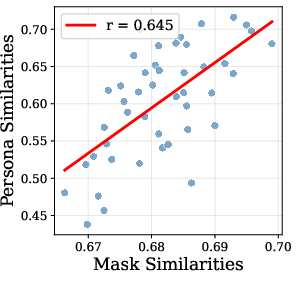
Figure 3: Cross-seed alignment—mask similarity for 10 personas across multiple seeds; high reproducibility indicates mask structure stability.
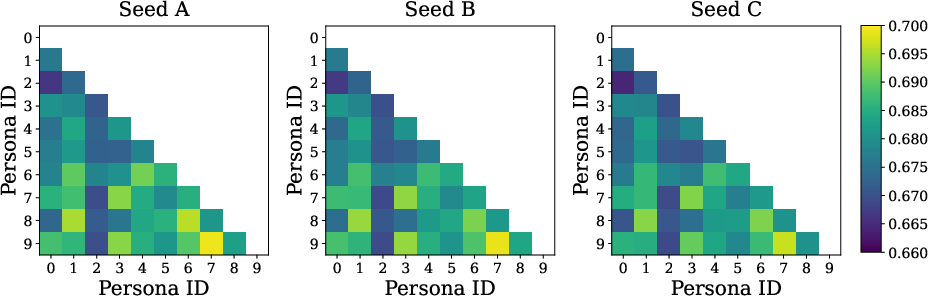
Figure 4: Pairwise Jaccard similarity heatmaps for persona-specific binary pruning masks across multiple seeds, demonstrating distinct, reproducible sub-network structure per persona.
Qualitative and Human Alignment Analysis
Qualitative evaluation consistently shows Persona-Pruner generating persona responses with deeply integrated character traits—beyond superficial attribute mentions, adjusting tone and content per description—contrasting with baselines that devolve into generic or attribute-hallucinated responses after pruning. Human evaluation (CoSER) places Persona-Pruner at top rank across anthropomorphism, character fidelity, and storyline quality, in strong agreement with LLM-based automated judging (Spearman ρ=0.87).
Multi-turn Consistency
Unlike baseline-pruned models, Persona-Pruner maintains persona attribute consistency across multi-turn dialogues, reliably preserving style and characteristic responses over long interaction spans.
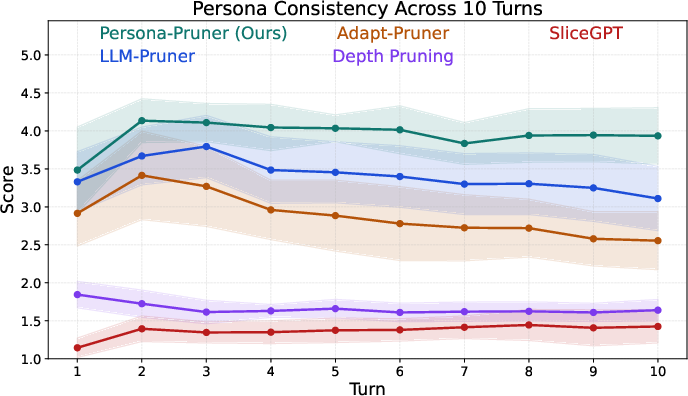
Figure 5: Multi-turn persona consistency over 10 dialogue turns, with Persona-Pruner maintaining higher attribute stability than baseline-pruned models.
Theoretical Implications
These results provide strong empirical evidence for functional compartmentalization of persona-relevant computation in LLMs—supporting the notion that identity-conditioned behaviors can be mapped to sparse, disentangled subspaces within model parameterization. From a network interpretability perspective, this straightforwardly enables analyses of role-dependent capacity allocation and offers mechanisms for persona composition, modulation, or transfer in future work.
Practical Implications and Future Directions
Persona-Pruner unlocks significant cost and scaling advantages for real-world, multi-agent applications wherein hundreds or thousands of concurrent role-playing agents are required. The persona-driven data synthesis approach circumvents expensive data collection or manual annotation, supporting scalable, automated agent deployment.
For future research, several avenues are immediately promising:
- Dynamic persona mixtures: Composing or interpolating between masks for blended or transient personas.
- Adaptive inference: Runtime persona switching or mixture-of-mask selection for contextually variable agents.
- Synergy with quantization/distillation: Chaining with quantization or knowledge distillation for further efficiency.
- Interpretable RLHF/AIF feedback: Mask analysis to identify “which neurons” instantiate which character dimensions, aiding safe and targeted model alignment.
- Digital twin simulation: Applying Persona-Pruner to behavioral simulation in virtual worlds, aligning with directions in digital twin evaluation [li-etal-2025-far].
Conclusion
Persona-Pruner demonstrates that high-character-fidelity role-playing LLMs can be efficiently realized through structured, persona-aligned sub-network extraction alone—without the need for costly per-persona fine-tuning or full model cloning. Its robust numerical performance, strong human concordance, and interpretability position it as a practical and theoretically principled foundation for next-generation, scalable agent ecosystems.

