- The paper introduces RRDA, a dual-adapter framework that distinctly writes new knowledge and suppresses existing facts via route specialization.
- It employs a learned relevance router to activate either the edit or locality adapter, enhancing precision across various prompt types.
- Experiments demonstrate RRDA's superior probability-preference accuracy on benchmarks like CounterFact, ZsRE, and MQuAKE-CF.
Route-Specialized Dual Adapters for Memory-Assisted Knowledge Editing: An In-Depth Analysis
The knowledge editing paradigm for LLMs demands precision in updating specific factual associations without polluting neighboring knowledge. Classical approaches either recursively fine-tune model weights or introduce explicit external memory banks. However, both techniques suffer from locality failures: parametric edits may generalize inappropriately, and memory-based edits may leak if retrieval is indiscriminately applied.
This work proposes reframing knowledge editing as a routed probability-preference problem: the critical question is not merely how to inject a new fact but whether the context necessitates memory activation. This recognition leads to a dual-path architecture, where route-specialized adapters—one for edit injection, one for edit suppression—are mediated by a learned relevance router.
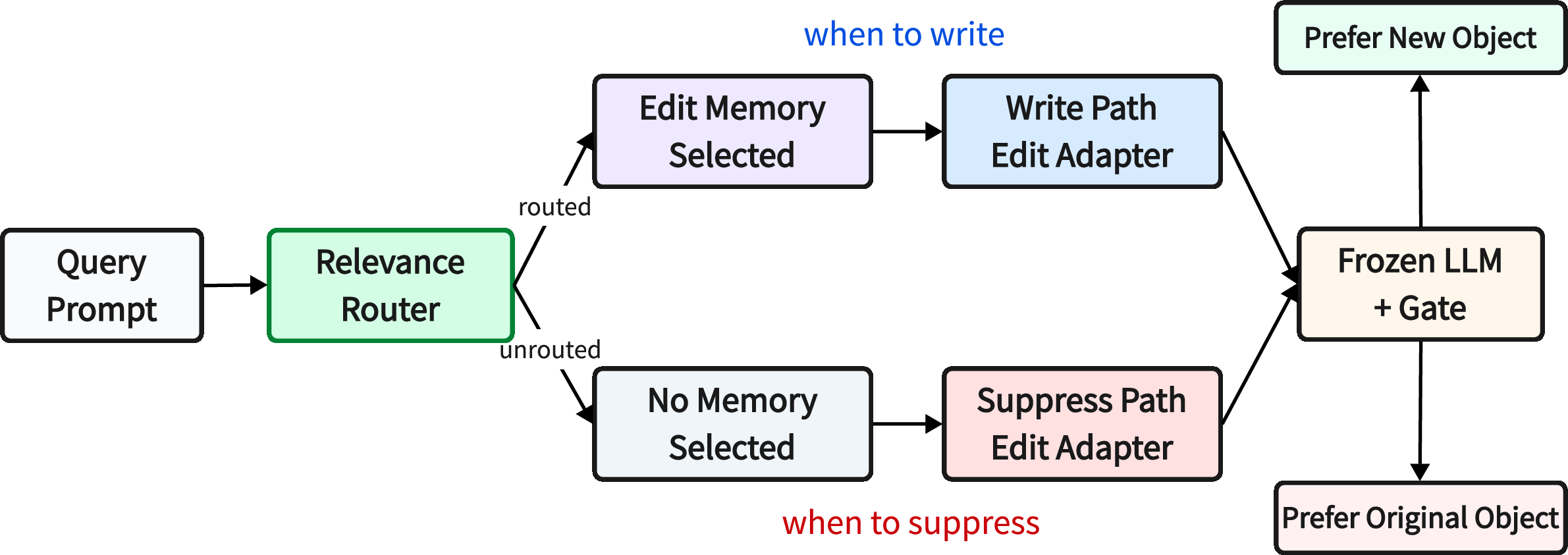
Figure 1: Route-specialized memory-assisted editing. A relevance router decides whether to retrieve edit memory. Routed prompts use the edit adapter and are optimized to prefer the new object. Unrouted non-direct prompts use the locality adapter and are optimized to prefer the protected original object.
Methodological Contributions
RRDA Architecture
The core method, RRDA (Relevance-Routed Dual Adapters), employs a two-stage decision process on each prompt: (1) a relevance router selects whether to retrieve the edit memory, and (2) the system activates either an edit-oriented or locality-oriented LoRA adapter for probability preference correction. Key architectural features include:
- Memory Bank: Constructed from direct edit records, containing explicit subject-relation-object triples for each intended edit.
- Router: Validated across four variants (subject, subject+relation, neural MLP, BGE-based semantic routing), selecting the most dataset-appropriate.
- Edit Adapter: Activated for routed prompts, trained with cross-entropy and ranking objectives to favor the new object.
- Locality Adapter: Activated for off-route, non-direct prompts, trained exclusively to preserve the original factual association (locality).
- Deterministic Inference Path: Fixed policies for routing and adapter activation, enforcing auditability and reducing stochasticity in deployment.
Probabilistic Evaluation Metric
The paper evaluates systems using the micro-averaged probability-preference accuracy over direct, paraphrase, and locality prompts—a stricter measure than generation-based metrics as it detects even silent probability shifts toward the edited object.
Experimental Results
Extensive evaluations are conducted across three knowledge editing benchmarks—CounterFact, ZsRE, and MQuAKE-CF—using two contemporary 7B/8B class models (Llama-3.1-8B-Instruct, Qwen3-8B).
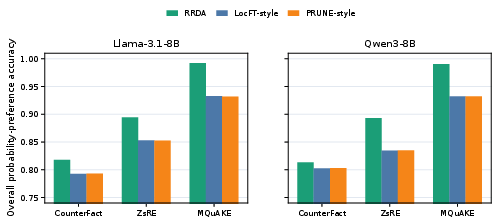
Figure 2: Overall probability-preference accuracy on two base models. RRDA is best on all three benchmarks for both Llama-3.1-8B and Qwen3-8B.
RRDA achieves top overall accuracy on all benchmarks and models under the memory-assisted editing regime:
- CounterFact: RRDA reaches 0.8180 on Llama, a relative gain over strong LocFT-style and PRUNE-style PEFT baselines, primarily from substantial improvements in locality.
- ZsRE: RRDA achieves 0.8946 accuracy, notably improving locality where baseline routers perform poorly.
- MQuAKE-CF: Nearly saturating at 0.9922, emphasizing robust generalization in multi-hop scenarios.
Notably, gains are not uniform: direct prompt accuracy is already high for all methods, but RRDA excels where off-route leaks would penalize locality.
Route Specialization: Router Ablations
The empirical investigation demonstrates that relevance boundaries are benchmark-dependent:
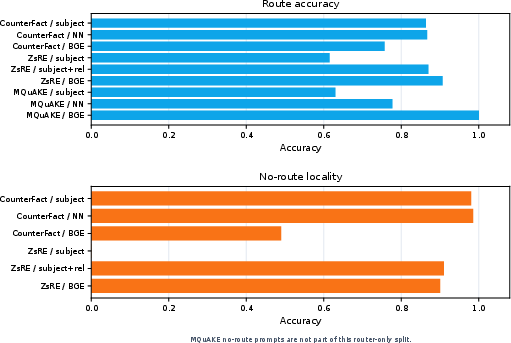
Figure 3: Different relevance boundaries are needed across benchmarks. CounterFact selects NN because it preserves no-route locality, while ZsRE and MQuAKE-CF select BGE semantic routing.
- CounterFact: Lexical/subject-based routers are safer—neural MLP routing outperforms semantic embeddings due to adverse over-routing by the latter.
- ZsRE/MQuAKE-CF: Semantic routing (BGE+MiniLM) is essential, as locality prompts can lexically overlap in subjects but differ relationally.
This suggests that future editors should consider hybrid or context-sensitive router calibration.
Adapter Ablation and Target Module Analysis
Component ablations confirm that RRDA’s performance is not simply due to increased LoRA capacity. The dual-adapter approach demonstrably segregates strengths: edit adapters excel on edit tasks, suppressor adapters safeguard locality.
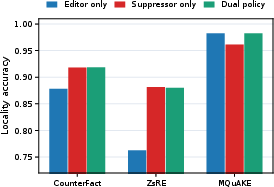
Figure 4: Locality in the component ablation. The locality adapter is most informative on CounterFact and ZsRE, where off-route prompts are present and nontrivial.
Further, module target sweeps reveal minimal benefit in expanding LoRA target modules beyond q/v, reinforcing that architectural bifurcation, rather than brute parameter increase, drives the observed improvements.
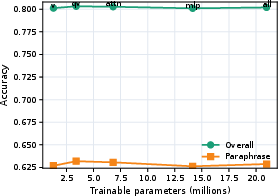
Figure 5: More target modules do not materially improve CounterFact accuracy under the rank-8, 500-step setting.
Implications and Future Directions
This study substantiates the thesis that reliable knowledge editing in LLMs requires explicit route-specialization: edit injection and suppression must be disjoint, and routers must be empirically validated for the target domain.
Practical implications include:
- Auditability and Determinism: Decomposed, route-explicit design enables explicit provenance tracking and post-edit validation.
- Deployment Suitability: The low parameter count and auditable paths support application in controlled settings where edit implications are sensitive.
Potential extensions include:
- Hybrid/Adaptive Routing: Combining semantic retrieval with supervised lexical calibration to further adapt to domain-specific risks.
- Generalization to Larger Models/Longer Edits: Scaling up to high-capacity models and longer edit sequences, where new failure modes may surface.
- Integration with Official Benchmarks: Adapting the protocol for direct comparability with generation-based standards (e.g., MQuAKE-CF exact-match).
Conclusion
RRDA represents an explicit, deterministic architecture for knowledge editing in LLMs, separating the act of writing from off-route suppression via route-specialized dual adapters and learned relevance routing. This yields strong probability-preference locality and accuracy across benchmarks and model architectures, with ablation studies confirming the essential role of route specialization over capacity scaling. The framework sets a new standard for auditable, memory-assisted knowledge editing in LLMs, with clear implications for the design of safe and precise model editors.
Reference: "When to Write and When to Suppress: Route-Specialized Dual Adapters for Memory-Assisted Knowledge Editing" (2606.14668).

