- The paper shows that the adapter’s invariant magnitude is insufficient to overcome strong pretraining priors, leading to systematic knowledge conflict failures.
- It introduces Selective Layer Boosting (SLB) and Conflict-Aware Internalization (CA) as training-free methods to amplify adapter signals and improve override performance.
- Empirical results demonstrate significant improvements in conflict accuracy—up to 71.0%—across multiple models while preserving novel fact recall.
The Override Gap in Hypernetwork-Based Instant LLM Adaptation
Hypernetwork-driven instant adaptation methods such as Doc-to-LoRA generate LoRA adapters in a single pass to internalize new knowledge into frozen LLMs. These methods promise efficient parametric updates at deployment but encounter a critical deficiency: systematic failure on knowledge conflicts—instances where a document contradicts information ingrained in the base model from pretraining. Empirical evaluations on the KID-Bench benchmark reveal that while these methods exhibit high recall on novel knowledge, their performance on conflict cases collapses as the prior grows stronger, dropping to 46.4% accuracy on deep conflicts (high-frequency, deeply stored facts).
This breakdown is not rooted in the architecture's representational capacity; rather, it is an amplitude problem. The hypernetwork does correctly localize the update signal to the right layers, but the generated adapter's "override margin" remains essentially constant across documents, insufficient to defeat the pre-existing, pretraining-induced margin in strong prior cases. This magnitude-based failure mode is reproducible across model families and aligns with direct measurements of layer-wise activations and output logits.
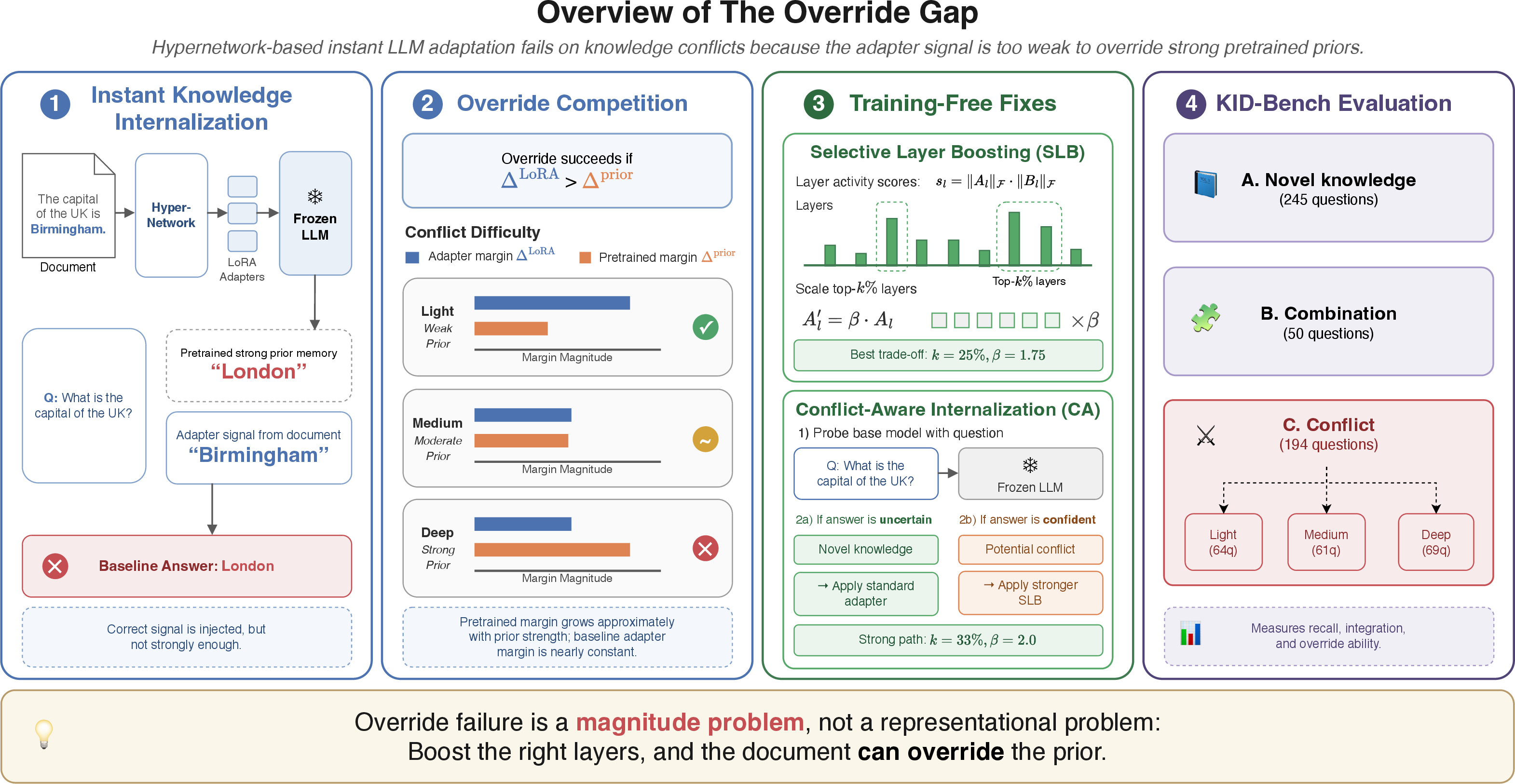
Figure 1: Overview of the override gap—hypernetwork-generated adapters direct signal to the correct layers, but cannot override strong pretraining priors without amplitude scaling.
Mechanistic Account and Theoretical Framework
The paper formalizes conflict override as a competition between the pretrained margin (Δprior) and the adapter margin (Δlora). When answering a conflicting question, the model outputs logits for competing answers: the one induced by pretraining (ypre) and the one introduced by the document (ydoc). Override succeeds exactly when the adapter-induced logit lift exceeds the pre-existing preference:
Δlora>Δprior
Systematic experiments confirm that the adapter margin is nearly invariant across documents, whereas the pretrained margin scales with the frequency/strength of the stored association from pretraining. As a result, the probability of successful override is a monotonic function of prior strength, verified by empirical trends in both stratified and continuous analyses.
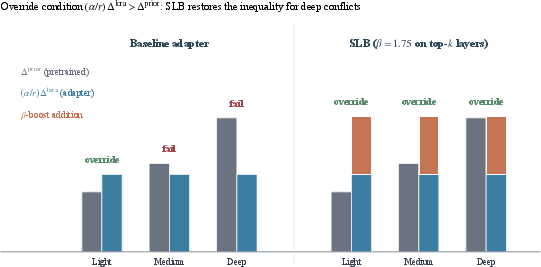
Figure 2: The override competition illustrating how prior strength governs the likelihood of successful override, and how boosting restores the margin inequality.
Methods: Selective Amplification and Conflict-Aware Internalization
Selective Layer Boosting (SLB)
SLB augments the generated adapter post hoc, without retraining the hypernetwork. The method computes the Frobenius norm product (∥Al∥F⋅∥Bl∥F) per LoRA layer, identifying a fixed top-k fraction of layers (e.g., k=25%) as the primary adapter carriers. The Al matrices in these layers are then multiplied by a boost factor β (e.g., Δlora0). This directly scales Δlora1 at the layers most relevant for knowledge override, delivering conflict gains while preserving novel-knowledge recall and minimizing off-target noise.
Conflict-Aware Internalization (CA)
CA incorporates a lightweight probe: prior to applying the adapter, the base model is queried. If the model's response is confident (e.g., lacking uncertainty markers), indicating a strong prior, SLB is invoked with an aggressive boost. If uncertain, the adapter is applied with standard scaling, as the base model lacks a pretraining prior. This conditional routing further improves performance on conflicts while keeping recall essentially untouched.
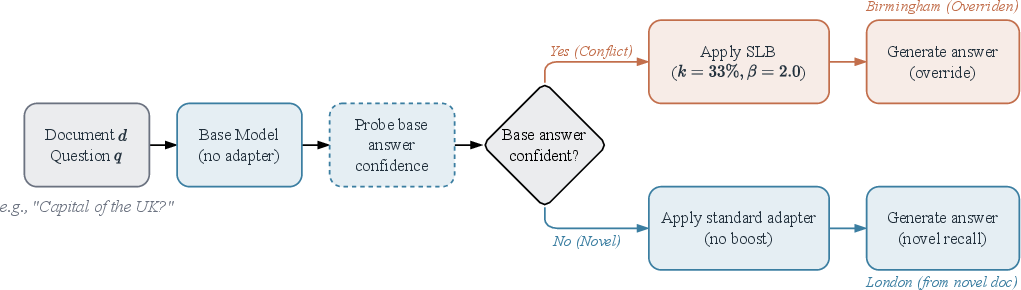
Figure 3: Conflict-Aware routing schema injecting targeted boost based on base model confidence, preserving signal-to-noise ratio for novel queries.
Empirical Results: Evaluation on KID-Bench and Cross-Model Validation
Extensive experiments on KID-Bench v2 (489 queries across novel, combinatorial, and three conflict levels) highlight:
- SLB and CA yield dramatic gains: On Gemma-2B, deep-conflict accuracy rises from 46.4% (baseline) to 71.0% (CA) and 60.9% (SLB), with novel recall unaffected (Δlora297%).
- Improvement scales with conflict prior: Accuracy gaps between low- and high-prior conflicts affirm the magnitude account (e.g., baseline falls from 68% to 16% across quartiles; CA narrows this gap).
- Cross-model robustness: Mistral-7B and Qwen-4B checkpoints produce matching improvements, with theory-predicted Δlora3 calibration required for weaker adapters (e.g., Qwen requiring Δlora4).
- Comparison to retrieval-augmented generation (RAG): Both SLB and CA outperform vanilla RAG on medium and deep conflicts despite not having documents in context, and approach or match more sophisticated RAG prompting under certain regimes.
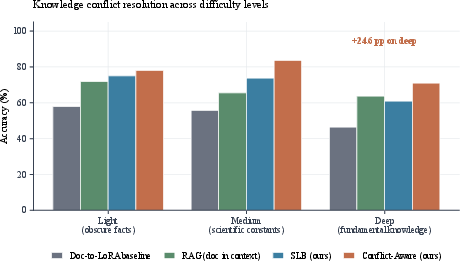
Figure 4: Conflict accuracy gradient on KID-Bench v2 for baseline, SLB, and CA, stratified by conflict strength.
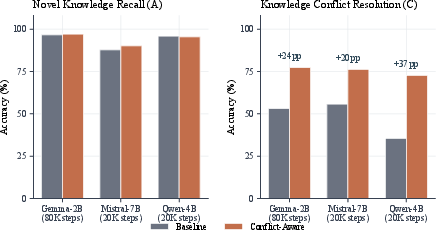
Figure 5: Cross-model validation for Conflict-Aware internalization, with consistent recall and conflict improvement observed across Gemma, Mistral, and Qwen backbones.
Analysis: Layer Locality, Dose-Response, and Adapter Space Continuity
- Layer localization: Adapter activity (measured by norm products) is concentrated in middle transformer layers, matching known loci of factual storage. Causal interventions confirm that override is distributed but exhibits redundancy, justifying selective boosting.
- Dose response: Conflict accuracy as a function of Δlora5 follows the predicted logistic profile—accuracy saturates as the boosted adapter matches the pretrained margin.
- Continuity in adapter space: Linear interpolation between adapters yields smooth behavioral transitions, suggesting that the local geometry is well-behaved, and selective boosting does not create unstable or catastrophic interference.
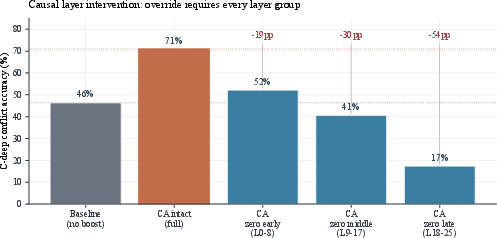
Figure 6: Causal layer interventions confirm that override requires contributions from a distributed set of layers, with some redundancy.
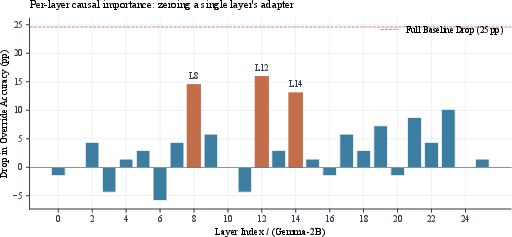
Figure 7: Per-layer drop in override after ablation, with three middle layers carrying disproportionate causal load.
Ablation and Robustness Studies
- SLB parameters: Varying Δlora6 and Δlora7 reveals that aggressive boosting improves conflicts but risks recall, while moderate (e.g., Δlora8, Δlora9) balances both.
- Layer selection: Boosting layers by norm is critical; random or bottom-layer boosting is ineffective.
- Retention and transfer: Standard MMLU, GSM8K, SQuAD, TruthfulQA, and off-topic factual queries are preserved to within statistical noise, especially when using the relevance-gated CA variant.
- Generalization: Gains transfer to held-out and external benchmarks, not just KID-Bench.
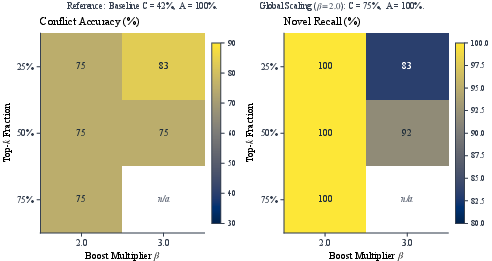
Figure 8: Ablation heatmaps over SLB parameters, demonstrating that conservative configurations preserve recall while aggressive ones further increase conflict gains.
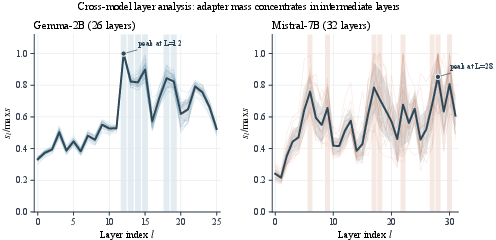
Figure 9: Norm-product heatmaps over 20 documents per model, showing stability and justifying fixed top-ypre0 layer selection.
Implications and Future Directions
This work advances a precise mechanistic understanding of conflict failure in instant internalization, shifting the focus to amplitude mismatches rather than localization errors. The methods introduced are training-free, lightweight, and can be deployed post hoc to any hypernetwork-based instant adaptation system. Practical implications include:
- Scalable fact updates: Model owners can inject or override facts without retraining or costly fine-tuning, using only matrix scaling.
- Improved reliability: Targeted adjustments allow models to align with up-to-date or authoritative sources, essential in domains facing frequent knowledge evolution or regulatory change.
- Towards continuous learning: The paradigm supports low-latency, persistent, parameter-level knowledge integration, a building block for evolving, self-updating models.
From a theoretical standpoint, the work demonstrates that static hypernetworks trained for recall are not sufficient for faithful override; explicit consideration of amplitude and prior strength is essential. Future directions include conflict-aware hypernetwork training, prediction of per-query boost magnitudes, and further integration with sequential editing and retrieval-augmented generation pipelines.
Conclusion
The override gap in hypernetwork-based instant LLM adaptation is due to a misalignment in magnitude: the signal from the adapter is too weak to outcompete entrenched pretraining priors for deeply stored facts. By identifying and quantifying this gap, and proposing SLB and CA as effective, training-free remedies, the paper establishes both theoretical and empirical foundations for robust knowledge internalization. This enables LLMs to be kept current and accurate, not just for novel facts but also for updates and corrections, without compromising existing capabilities.
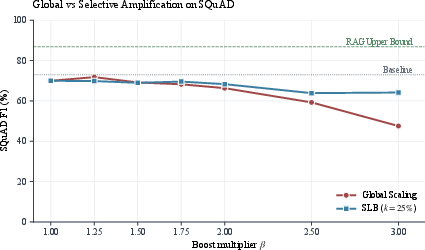
Figure 10: Comparative performance of global versus selective amplification on SQuAD, confirming selective boosting's preservation of general QA.