- The paper presents a Rydberg atomic receiver that integrates spectrum sensing and down-conversion, enabling FHSS over a continuous bandwidth from 100 kHz to 20 GHz.
- The paper reports a channel density exceeding 150,000 channels with BER below 1% under jamming conditions, outperforming conventional single-frequency systems.
- The paper validates its approach through experimental demonstrations and theoretical modeling, showing potential for miniaturized quantum radio and secure communication networks.
Ultra-Broadband Anti-Jamming Communication via a Rydberg Atomic Receiver
Conceptual Framework and Scientific Motivation
The work addresses robust, secure wireless communication in congested and hostile RF environments by leveraging a waveguide-coupled Rydberg atomic receiver configured for frequency-hopping spread spectrum (FHSS). Rydberg atoms, possessing large electric dipole moments, intrinsically combine spectrum sensing and down-conversion, eliminating conventional hardware front-ends and enabling direct heterodyne reception across ultra-broad frequency domains. The system achieves real-time binary phase shift keying (BPSK) demodulation with synchronous frequency hopping over a continuous bandwidth spanning 100 kHz to 20 GHz, attains a hopping rate of 100 kHops/s, and supports >150,000 channels, representing a paradigm shift in anti-jamming quantum communications.
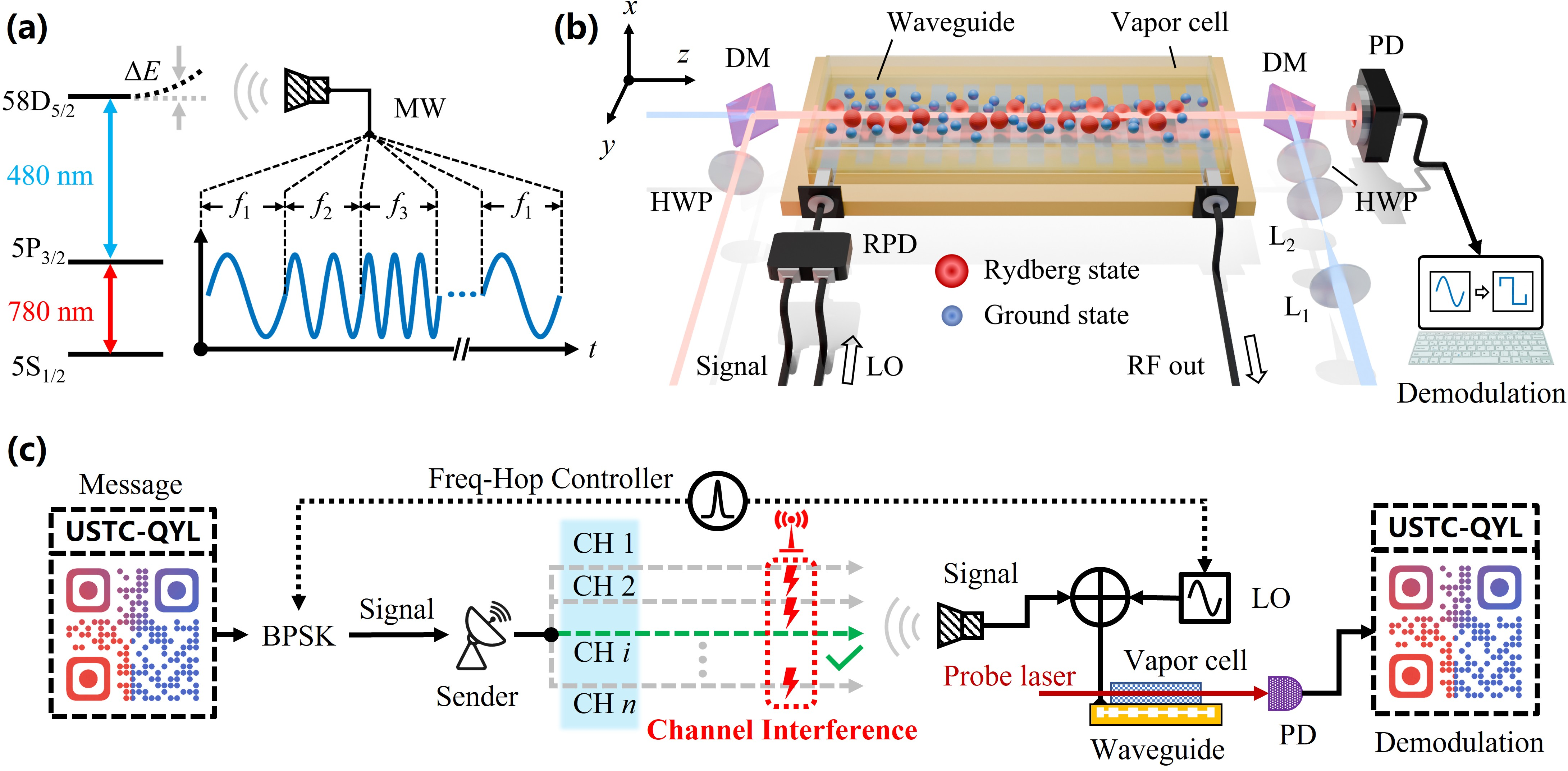
Figure 1: Energy diagram and schematic overview of the Rydberg atom-based FHSS system, illustrating atomic level structure, laser configuration for EIT, and unified MW/LO field coupling with ultra-wide frequency-hopping capability.
Experimental Implementation and Signal Processing Architecture
The receiver utilizes a vapor-cell configuration, excited by counter-propagating probe/coupling lasers on 85Rb and interrogated via MW fields. Signal transmission follows a protocol where a bit stream (e.g., QR-encoded messages) is BPSK-modulated onto a MW carrier with segment-wise 16-bit preamble, then pseudo-randomly frequency hopped across n channels. The MW carrier and LO are algebraically combined then input to the waveguide, inducing AC Stark shifts in Rydberg state energies, manifested in the Electromagnetically Induced Transparency (EIT) spectrum and read out optically. Demodulation relies on extracting the beat note between LO and hopped carrier, with downstream DSP reconstructing the original bit stream.
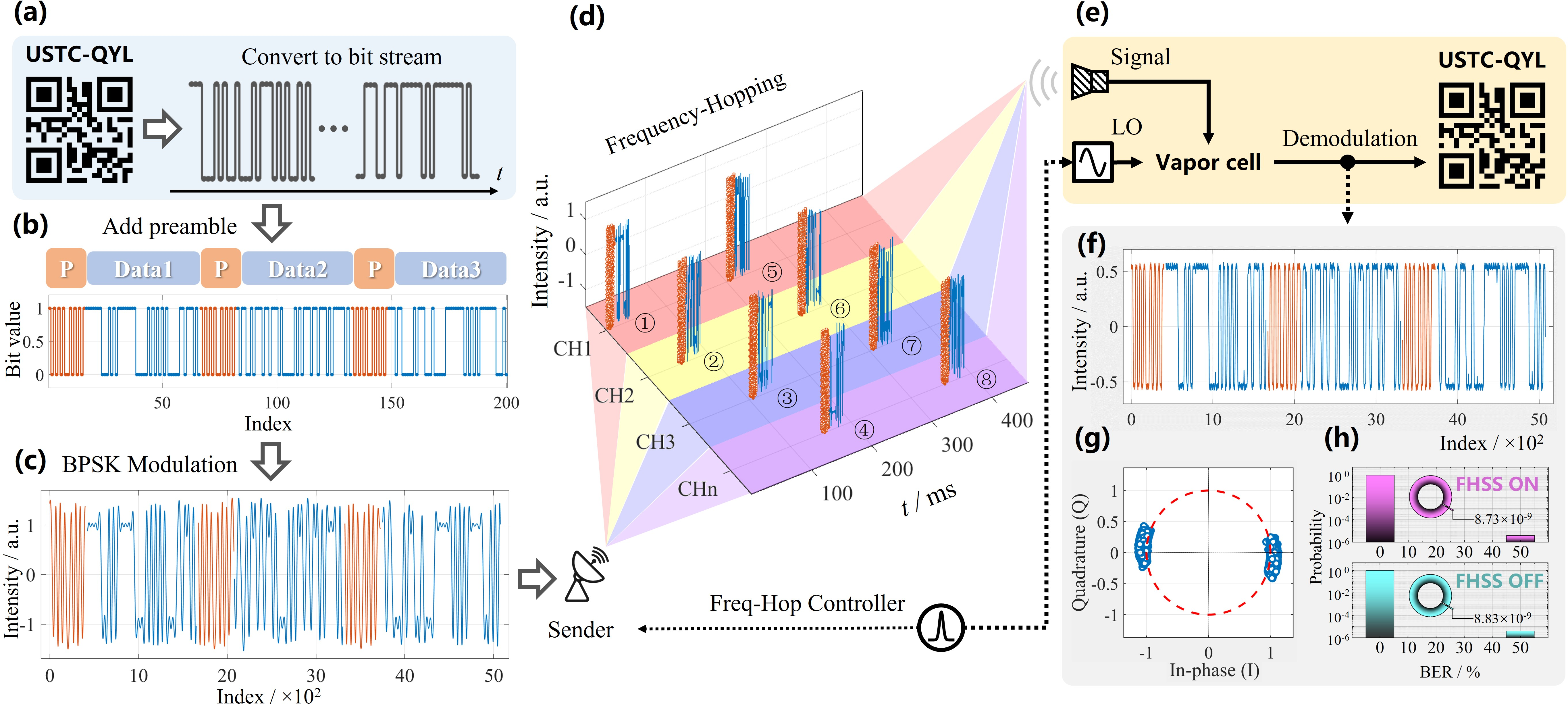
Figure 2: Flow chart detailing signal encoding, channelization, BPSK modulation/demodulation, carrier hopping, and atomic IF signal readout including constellations and BER histograms for FHSS vs. single-frequency modes.
The intrinsic sensitivity profile (frequency-corrected) demonstrates a flat -101.6 dBm/Hz response up to 20 GHz, limited by waveguide coupling efficiency at higher frequencies. The instantaneous bandwidth is measured at 132 kHz; achieved operational bandwidth is 20 GHz, offering more than 150,000 frequency-hopping channels—an increase by nearly four orders of magnitude over Bluetooth (79 MHz, 79 channels, 1 channel/MHz). The system attains a channel density of approximately 8 channels/MHz within the ISM band while supporting a symbol rate of 100 kbps. The total dynamic range approaches 102 dB, with minimum detectable MW field intensity at -138.17 dBm.
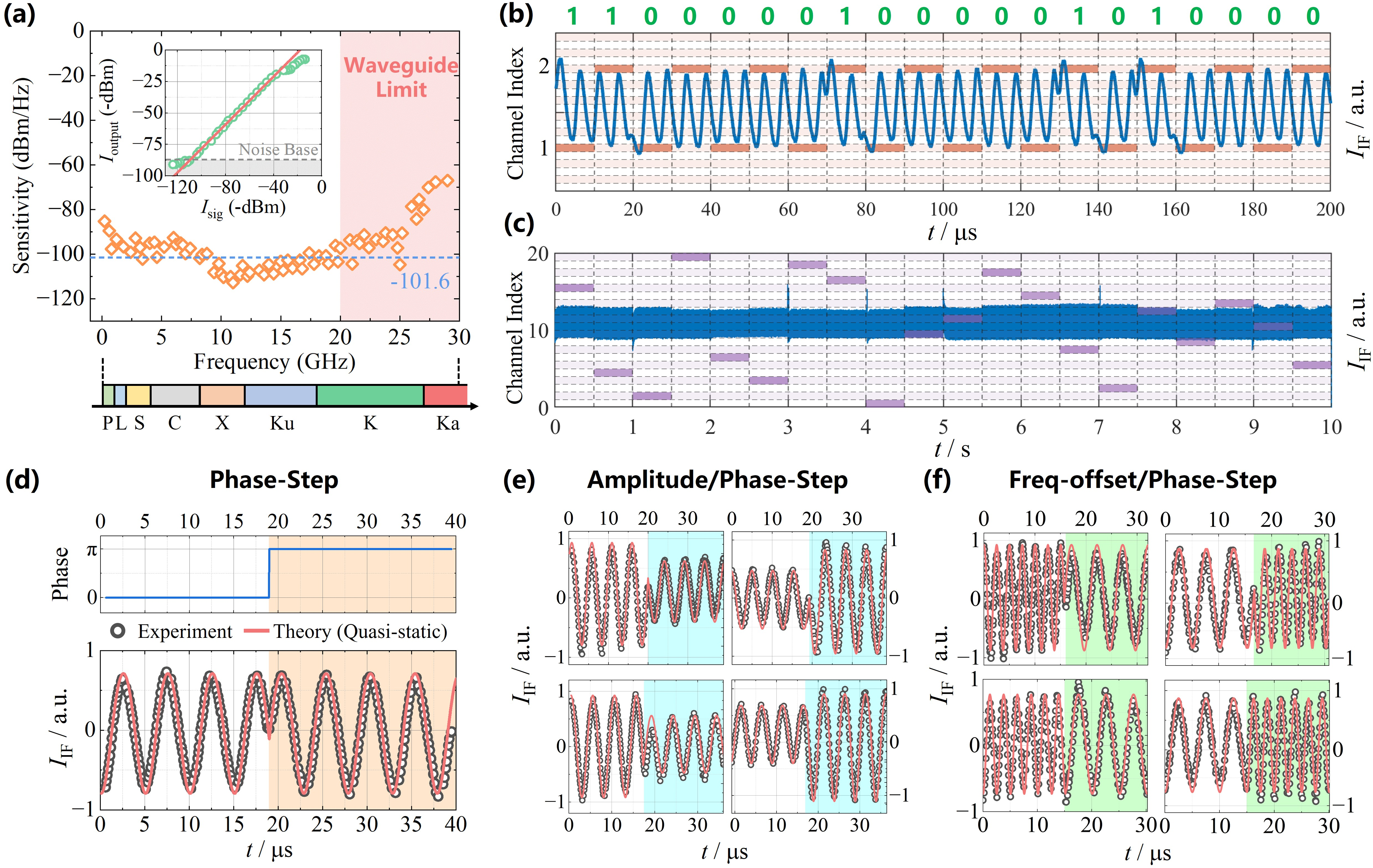
Figure 4: Frequency-independent sensitivity and dual-channel/ultra-broadband frequency-hopping communication traces evidencing 100 kHop/s operation and stable information recovery across wide spectral regions.
Anti-Jamming Analysis and Empirical Validation
Quantitative measurements reveal a jamming resistance improvement ($C_{\rm{JR}$) of 51 dB above single-frequency receivers and 23 dB above Bluetooth. Under 0 dBm interference, BER remains consistently <1%, with image transmission experiments confirming negligible data corruption. The channelization architecture provides statistical immunity: the effective interference power is randomized across operational bandwidth, reduced by processing gain GP=Bop/BD. Minimum jamming power per channel is ~10 dBm; full-spectrum suppression is infeasible owing to exponential scaling of Ptot=Psg×Nch.
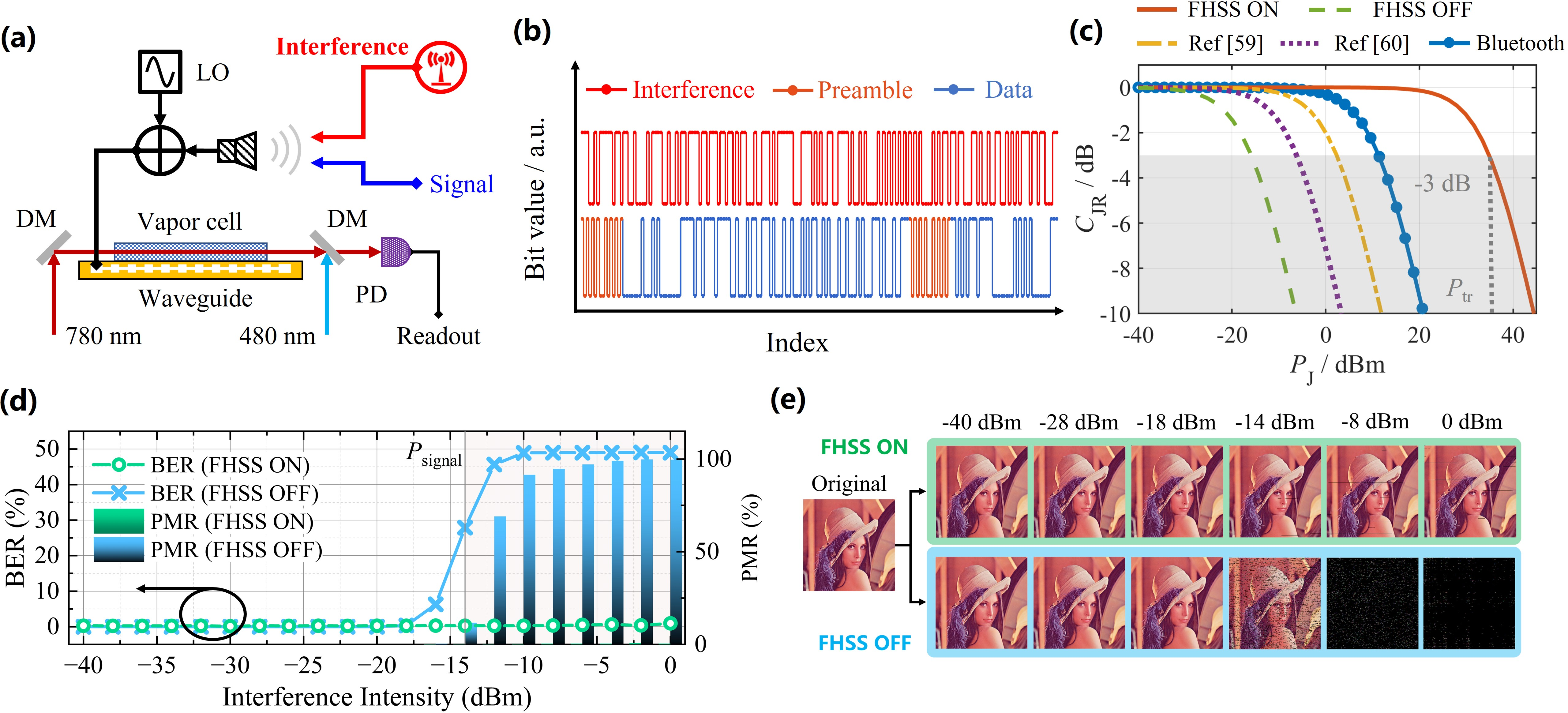
Figure 5: Experimental results juxtaposing interference resistance for FHSS-enabled and conventional systems, including BER/PMR degradation, jamming tolerance, and image restoration across variable interference levels.
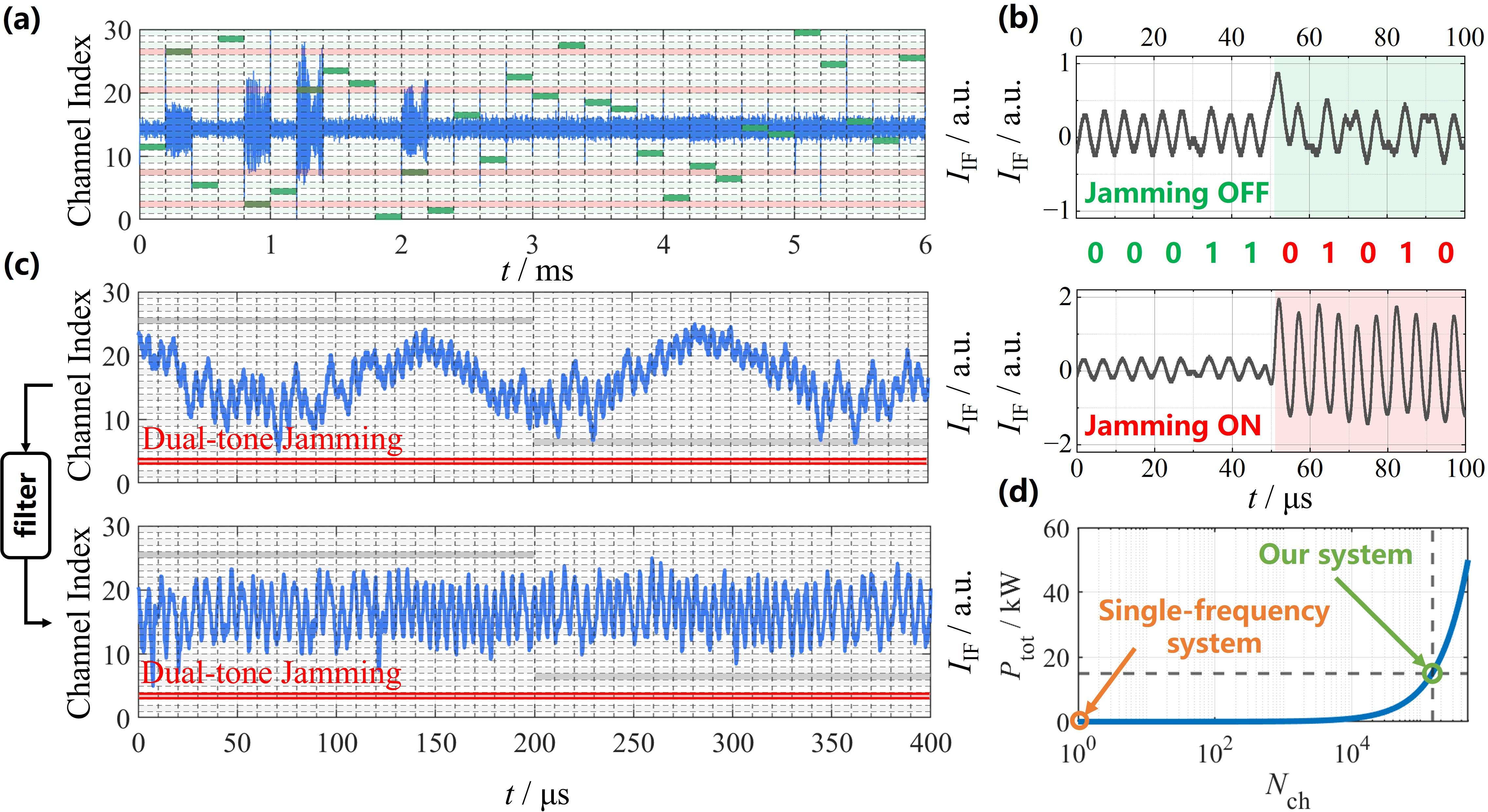
Figure 3: Multi-frequency interference scenarios, atomic IF output traces, channel occupancy mapping, distortion mitigation via bandpass filtering, and scaling law for jamming power versus channel count.
Theoretical Modeling: Atomic Dynamics and Response Characteristics
The system is modeled via the time-dependent Lindblad equation and dark-state-corrected Hamiltonian describing the off-resonant AC Stark effect induced by the combined LO/signal MW fields. The quasi-static approximation and transient four-step Adams-Bashforth (4-s AB) numerical treatment show high fidelity, with relaxation time validated at ~1 μs. This supports theoretical maximum hopping rates up to 1 MHz (current hardware limit: 100 kHop/s). The observed separation between atomic relaxation and channel dwell times justifies quasi-static assumptions in signal recovery.
Practical and Theoretical Implications
The demonstrated quantum-enabled receiver architecture reduces system complexity by subsuming conventional wideband RF chains into a single atomic backend, offering software-defined spectral agility. Miniaturization prospects confirmed via micromachined cells and integrated photonics platforms suggest viable quantum radio implementations. The antenna frontend remains the practical bandwidth bottleneck, subject to physical constraints (Chu-Harrington limit), but modular approaches can address this. Future advances in Rydberg sensitivity and transient response may enable direct field coupling, elevated hopping rates (>6 MHz), and extended symbol throughput.
Conclusion
The paper validates a functional waveguide-coupled Rydberg atomic receiver for ultra-broadband FHSS quantum communications, achieving superior interference immunity, channel density, and spectral agility relative to established standards. The underlying physics—a broadband atomic mixing regime harnessing AC Stark effect—enables direct demodulation and robust operation in complex RF environments. The results establish a scalable framework for quantum-enhanced secure communication and sensing, point to substantial headroom for rate and bandwidth optimization, and delineate clear pathways for integration into next-generation anti-jamming networks and quantum radio technologies (2606.14497).

