- The paper introduces a robust framework that certifies genuine photon-number resolution by ruling out classical post-processing simulations.
- It employs a guessing game protocol with coherent state probes to derive operational scores and threshold efficiency metrics.
- Experimental results on a SNSPD array confirm genuine resolution with high statistical significance and effective detection efficiencies up to 85%.
Operational Certification of Photon Number Resolving Detector Resolution
Introduction and Motivation
Photon-number-resolving (PNR) detectors are indispensable in photonic quantum technologies, serving roles in quantum communication, quantum sensing, and quantum computation. Despite advances in device architectures—transition-edge sensors (TES), superconducting nanowire single-photon detectors (SNSPD), multiplexed arrays—there remains a critical gap: a scalable, operational metric to certify the genuine photon-number resolution of such detectors. The presence of multiple distinct output values does not guarantee the device's ability to resolve corresponding photon numbers; classical post-processing can simulate coarse measurements using a finer label set. This paper (2606.14365) establishes a robust framework for quantifying genuine resolution and introduces an efficient certification protocol, eliminating the need for full measurement tomography and enabling scalable benchmarks.
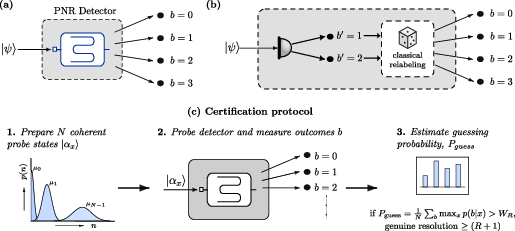
Figure 1: Certification concept—distinguishing genuine photon number resolution from classical post-processing using a guessing-game protocol based on coherent state probes and outcome analysis.
The operational notion of genuine resolution builds on quantum measurement simulatability. A measurement with K outputs may be simulated by an R-outcome measurement followed by classical post-processing. Genuine resolution is defined as the smallest R+1 where no such simulation exists. Critically, certification must be performed over well-defined photon-number subspaces, as resolving photon numbers in the single-photon regime is essential for applications such as quantum secure communication, high-fidelity quantum random number generation, and quantum-enhanced imaging beyond the Rayleigh limit.
The paper formalizes these concepts using positive operator-valued measures (POVMs), analyzing resolution both globally and within photon-number-constrained Hilbert subspaces. Linear programming is employed to verify R-simulatability, providing practical threshold efficiency values for typical subspaces. For example, three-outcome resolution in the m=2 photon-number subspace requires ηth>61.8%, and higher photon number resolution exhibits a rapidly increasing threshold efficiency—a fundamental scaling barrier dictated by loss sensitivity of higher Fock states.
Certification Protocol: Guessing Game Operational Witness
The principal certification protocol employs an operational guessing game: coherent states of varying intensity (not phase-locked) are sent as probes to the detector, with input-output statistics collected. The protocol's score is the mean probability that—given a measurement output—the experimenter correctly infers the input state. Theoretical upper bounds on achievable scores for R-outcome simulatable measurements are derived, with violation certifying genuine resolution of R+1 or greater.
This witness is evaluated both in trusted (calibrated intensities) and untrusted (intensity upper bounds) semi-device-independent modes. Importantly, the statistical accuracy is robust—significance levels reach ∼300σ in favorable cases. The protocol is efficient, requiring only O(m) probe states for subspace certification, thus bypassing the computational and practical burdens of full quantum tomography.
Experimental Demonstration: SNSPD Array
A 28-pixel multiplexed PNR-SNSPD is benchmarked using the certification protocol. Seven calibrated coherent states (R0 ranging from 0 to R18 photons/pulse) probe up to R2 photon-number subspace. Oscilloscope time-integrated waveforms are used to classify outcome bins, and conditional distributions R3 are constructed.
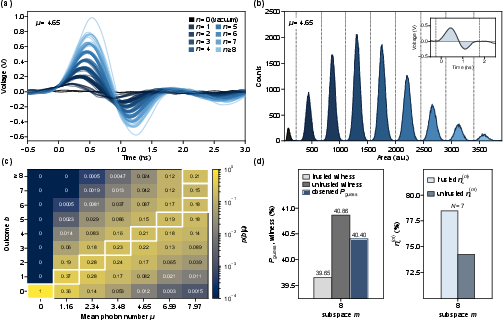
Figure 2: Oscilloscope readouts and analysis for the 28-pixel PNR-SNSPD across probe states, showing outcome histograms and conditional distributions enabling outcome classification and statistical witness extraction.
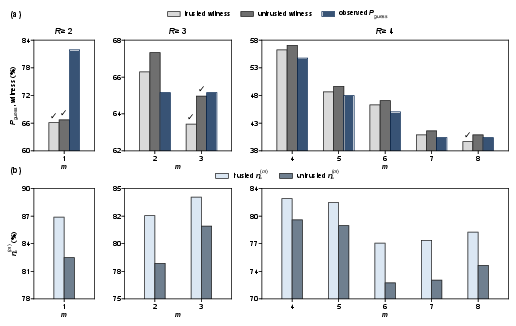
Strong numerical results are reported:
Practical Implications and Device Benchmarking
The presented framework enables operational certification using accessible measurements. It is agnostic to device architecture and suitable for benchmarking diverse PNR implementations, such as TESs, multiplexed SNSPDs, and even emerging machine-learning enhanced detectors. The protocol subsumes device imperfections into a single, interpretable metric (effective efficiency) for each photon-number subspace, allowing comparison across technologies and scaling analyses.
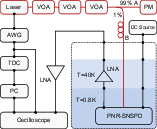
Figure 4: Experimental setup schema illustrating coherent pulse generation, attenuation, pixel-multiplexed SNSPD, and signal acquisition chain.
For vendors and practitioners, the methods provide concrete certification tools for claims of photon-number resolution—ensuring devices truly resolve photon numbers beyond classical post-processing capabilities. This standardization is essential for quantum communication integrity, advanced quantum random number generators, quantum metrology, and photonic quantum computing.
Conclusion
This work establishes a scalable, operational benchmark for certifying genuine photon-number resolution in PNR detectors, leveraging concepts from quantum measurement theory and efficient guessing-game protocols. The methodology is practically implementable, statistically robust, and device-independent, with demonstrated certification on a multiplexed SNSPD array. By providing both threshold and effective efficiency metrics, the framework fills a critical gap in PNR detector characterization and sets the foundation for standardized performance metrics in photonic quantum technology development.