- The paper demonstrates a novel photon counting detector that surpasses the Poisson noise limit by using SNSPDs combined with extensive temporal and spatial multiplexing.
- It employs arrival-time based photon number assignment, achieving sub-single-photon precision up to 276 photons per pulse and outperforming traditional techniques.
- The study validates the detector's performance through quantum detector tomography, paving the way for enhanced quantum metrology and calibration in optical systems.
Macroscopic Photon Counting Beating the Poisson Noise Limit
Overview
The paper "Macroscopic photon counting beating the Poisson noise limit" (2604.27761) presents a photon-counting detector architecture capable of resolving photon numbers from 0 to over 9000 per pulse, with measurement precision surpassing the Poisson noise limit by at least 4.1 dB across its dynamic range. The methodology, leveraging multiplexing and intrinsic photon-number resolution in superconducting nanowire single-photon detectors (SNSPDs), demonstrates sub-single-photon shot-to-shot precision up to 276 photons per pulse, bridging the operational gap between quantum measurements and power metrology at picowatt levels.
Detector Architecture and Multiplexing Strategy
The detection system utilizes both temporal and spatial multiplexing in conjunction with SNSPDs exhibiting intrinsic photon-number resolution (PNR). Optical pulses are split into 128 temporal modes for each of two outputs via a fiber-based temporal multiplexing network, then further divided into four spatial bins per output, resulting in 8 spatial channels overall. Each spatial channel is monitored with a dedicated SNSPD that resolves photon number through arrival-time discrimination, culminating in 1024 independent detection bins per pulse.
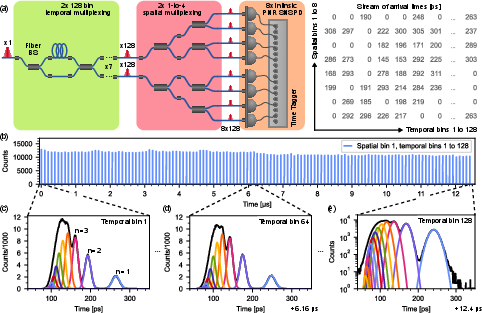
Figure 1: Multiplexed detection layout combining temporal and spatial splitting, resulting in 1024 bins each with intrinsic photon-number resolution.
Each SNSPD output is digitized, producing arrival-time histograms that allow photon-number discrimination per bin. The separation of sub-pulse arrival times (on the order of 100 ns) enables both high dynamic range and high shot resolution.
Arrival Time-Based Photon Number Assignment
For each detection bin, the assignment of photon number is performed via model-based lookup tables (LUT), constructed by fitting exponentially-modified Gaussian (EMG) distributions to the arrival-time histograms, following the methodology established by Sidorova et al. Arrival times are mapped to photon-number probability distributions, taking detector jitter and response into account. This preserves the full probabilistic photon-number information per event, enabling robust shot-by-shot uncertainty quantification.
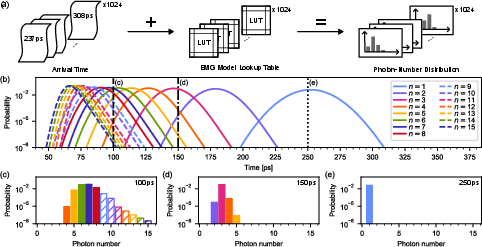
Figure 2: Arrival-time based photon-number assignment using EMG-fitted LUTs, mapping raw time tags to photon-number distributions for each bin.
Through convolution of the individual pi(n) distributions across all bins, a global photon-number probability distribution P(n) per shot is evaluated, providing central moments and credible intervals for the measured photon number.
The detector achieves measurement uncertainties below the Poisson (shot-noise) limit for all photon counts up to approximately 9000 photons. Notably, for photon counts up to 276 per shot, absolute precision better than ±1 photon is obtained, a significant improvement on prior art. Relative detector noise remains below −4.1 dB, and even at the highest photon counts measured, stays well beneath Poissonian statistics typical for coherent states.
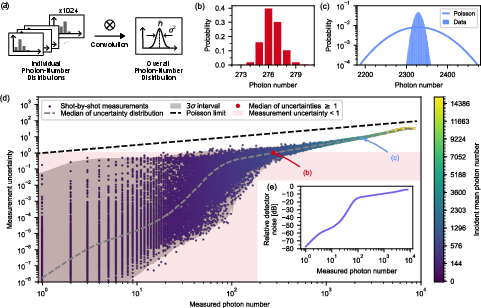
Figure 3: Aggregated photon-number distributions from 1024 bins and measurement uncertainty vs. photon number, evidencing sub-Poissonian precision.
The median measurement uncertainties per photon number are visualized, and compared to the Poisson expectation. Detector blinding, arising at high count rates, is accurately modeled and attributed to detector saturation behaviors.
Ensemble Characterization, Efficiency, and Source Analysis
Analysis of ensemble variance and mean across 105 samples per photon number validates that the detected coherent states follow Poissonian statistics until detector bin blinding becomes significant at photon numbers exceeding ∼1000. The efficiency of the device, defined as the ratio of detected to incident photon numbers, reaches above 50% for appropriately biased operation even at high count rates, with nonlinear effects observed due to AC-coupled readout and count-rate dependent efficiency.
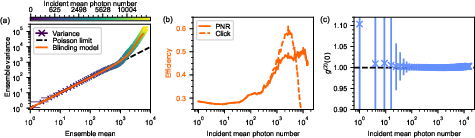
Figure 4: Ensemble variance vs. mean (showing Poisson statistical agreement), device efficiency as a function of incident photon number, and measured g(2)(0) coherence parameter.
Second-order correlation measurements yield g(2)(0)=1.000270(7), verifying coherent source operation over the full tested range.
Quantum Detector Tomography
The paper performs quantum detector tomography on the entire system, reconstructing POVM matrices with 100 ns0 elements using scalable numerical optimization. The conditional probability of detecting 100 ns1 photons given 100 ns2 incident photons is visualized, revealing both the effective linearity of detection and the efficiency limitation at high photon numbers.
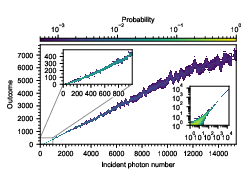
Figure 5: Reconstructed POVM matrix for the full detector, demonstrating narrow distributions and efficiency of 100 ns3 across a macroscopic photon-number range.
This tomography substantiates the device's utility for quantum state characterization at macroscopic scales.
Implications and Outlook
The successful deployment of a macroscopic, PNR, multiplexed photon counting system with shot-noise-beating precision directly impacts quantum optical metrology, bridging quantum-level and classical-level power measurements. The approach provides scalable quantum state characterization tools, crucial for the experimental realization of large-scale bosonic quantum processors and for the precise calibration of quantum light sources.
The detector architecture outperforms both multiplexed click detector arrays and previous generation TES-based systems in terms of photon-number dynamic range, measurement precision, and scalability. The methods and numerical tools introduced for large-scale quantum detector tomography further enable rigorous calibration and benchmarking of future multi-mode quantum optical systems.
Future developments could focus on improving detector efficiency through optimized biasing and readout, mitigating temporary blinding at high rates via readout circuit engineering, and extending photon-number resolution further with larger multiplexing arrays or higher intrinsic PNR SNSPDs. These advancements will support the characterization of increasingly complex photonic states for quantum information science, metrology, and fundamental quantum optics.
Conclusion
This work demonstrates a multiplexed photon-counting architecture exceeding the classical Poisson noise limit over a macroscopic photon-number range, achieving sub-single-photon resolution up to hundreds of photons per pulse. The combination of intrinsic PNR SNSPDs with large-scale multiplexing and model-based calibration enables quantum detector tomography at an unprecedented scale, providing a versatile platform for the characterization and calibration of quantum optical systems in metrology and quantum information experiments.