- The paper introduces real-time pseudo entropy as a complex extension of entanglement entropy to capture time-oriented quantum responses.
- It establishes that the short-time expansion of pseudo entropy is governed by the covariance between the subsystem modular Hamiltonian and the system Hamiltonian.
- Numerical and analytical models, including two-qubit systems and Ising chain quenches, validate modular correlations as indicators of irreversibility and critical behavior.
Real-Time Pseudo Entropy and Modular-Hamiltonian Correlations: Technical Summary
Background and Motivation
Entanglement entropy is central in quantifying non-classical correlations in quantum subsystems, but its unitary evolution prohibits a microscopic arrow of time. "Pseudo entropy" generalizes entanglement entropy to complex values, using reduced transition matrices between two possibly nonorthogonal states. This framework enables amplitude-level diagnostics of time-oriented responses in quantum systems, probing emergent irreversibility prior to any coarse-graining or probabilistic measurement. The work under discussion systematically develops the real-time pseudo entropy—constructed from the transition between a pure state and its time-evolved image—and establishes its leading order response as directly governed by modular-Hamiltonian correlations.
Definition and Central Results
The real-time pseudo entropy for a subsystem A is constructed from the reduced transition matrix between the initial state ∣Ψ⟩ and its time-evolved form ∣Ψ(t)⟩=e−iHt∣Ψ⟩: τA(t,0)=TrAˉ⟨Ψ∣Ψ(t)⟩∣Ψ(t)⟩⟨Ψ∣,SA(t,0)=−TrA[τA(t,0)logτA(t,0)].
Unlike ordinary entanglement entropy, SA(t,0) is generically complex due to the non-Hermitian nature of the transition matrix.
The core result provides a universal short-time expansion: SA(t,0)=SA(0)−it⟨KA(H−⟨H⟩)⟩+O(t2),
with KA=−logρA, the modular Hamiltonian of the initial reduced density matrix ρA=TrAˉ∣Ψ⟩⟨Ψ∣.
For Hermitian H and KA, this expansion decomposes: ∣Ψ⟩0
Thus, the imaginary part of the pseudo entropy encodes the symmetrized covariance between the subsystem modular Hamiltonian and the system Hamiltonian, manifesting time orientation even at infinitesimal time—distinct from branch-related artifacts. The real part captures the lack of commutation between ∣Ψ⟩1 and ∣Ψ⟩2.
All-Order Solution: Schmidt-Diagonal Model and Thermal Limit
For states and Hamiltonians diagonal in the same Schmidt basis, the pseudo entropy admits an exact solution for all times, expressing it in terms of a complex-tilted distribution. The explicit formula: ∣Ψ⟩3
where ∣Ψ⟩4 and averages are computed with respect to the complex tilted Boltzmann weights.
Expanding at small ∣Ψ⟩5 yields the short-time behavior: ∣Ψ⟩6
recovering for thermal states (∣Ψ⟩7) that
∣Ψ⟩8
This links the imaginary pseudo entropy rate directly to the energy variance in thermal ensembles.
Two-Qubit Example and Numerical Verification
In a minimal noncommuting example with two qubits,
∣Ψ⟩9
the explicit calculation demonstrates the above covariance-commutator decomposition. The results show, for real initial states, vanishing real response and pure imaginary slope—confirming the modular covariance prediction.
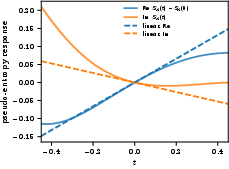
Figure 1: Real and imaginary parts of the real-time pseudo entropy in the two-qubit model; the imaginary part is linear with a slope set by the modular covariance.
Many-Body Dynamics: Ising Chain Quenches
The analysis generalizes to non-integrable many-body systems by numerically studying quantum quenches in finite transverse-field Ising chains. After a field quench, the initial slope of the imaginary component of the pseudo entropy matches the modular covariance, while the real part remains quadratic due to time-reversal symmetry.
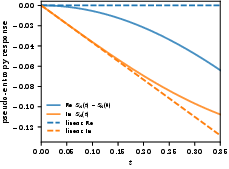
Figure 2: Real-time pseudo entropy after a transverse-field Ising-chain quench; the imaginary part demonstrates a linear dependence driven by modular covariance.
Additionally, by examining small parameter quenches, the paper introduces a modular susceptibility—the modular covariance between the subsystem modular Hamiltonian and the Hamiltonian's driving operator—which exhibits finite-size scaling indicative of sensitivity to quantum criticality.
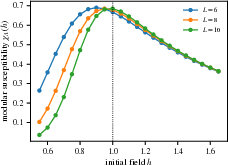
Figure 3: Finite-size modular susceptibility ∣Ψ(t)⟩=e−iHt∣Ψ⟩0 in the open transverse-field Ising chain; peak enhancement near the critical point signals critical modular response.
Non-Hermitian Extension and PT-Symmetry
The framework is generalized to non-Hermitian quantum mechanics using biorthogonal transition matrices. The modular-covariance formula persists, with expectation values replaced by biorthogonal analogues. The analytic structure across ∣Ψ(t)⟩=e−iHt∣Ψ⟩1-breaking transitions is examined, showing a shift from hyperbolic to trigonometric and branch-cut dominated pseudo entropy behavior. This connects modular-oriented response to phenomena associated with exceptional points and non-Hermitian topology.
Implications and Future Perspectives
Theoretical Implications: The imaginary component of real-time pseudo entropy defines a subsystem-oriented, time-asymmetric response sensitive to quantum correlations between system evolution and information structure. This bridges amplitude-level quantum dynamics to emergent irreversibility, prefiguring the appearance of entropy production once a probabilistic or measurement-based framework is introduced. The approach brings structural insight to irreversibility in closed quantum systems and is directly linked to modular Hamiltonians central to quantum information and holography.
Numerical Results: Strong agreement is found between analytic modular covariance predictions and exact calculations in both finite-size two-qubit and many-body settings, establishing the reliability of the response formulas.
Potential Applications: Modular susceptibilities may serve as operational diagnostics for criticality, complementing fidelity susceptibilities and quantum geometric tensors. In non-Hermitian systems, biorthogonal modular responses provide a framework for systematic studies of entropy and irreversibility near exceptional points.
Speculation and Outlook: Prospective research directions include a rigorous mapping from complex, amplitude-level pseudo entropy to classical entropy production in open or measured systems, possible universal scaling of modular susceptibilities in larger systems, and holographic derivations of modular-oriented responses as complex extremal surface areas. These results have direct bearing on the intersection of quantum thermodynamics, non-equilibrium field theory, and AdS/CFT.
Conclusion
This work establishes that the leading short-time, imaginary part of real-time pseudo entropy in closed quantum systems is universally governed by the symmetrized covariance between the modular Hamiltonian of a subsystem and the system Hamiltonian. This result clarifies the microscopic origin of oriented, time-asymmetric responses in quantum dynamics and provides a modular-based analytic tool for exploring irreversibility, critical phenomena, and non-Hermitian physics in a unified language.