- The paper demonstrates that non-Hermitian Gamma interactions induce robust long-range spin-nematic order, challenging traditional Hermitian constraints.
- It employs analytical methods such as Jordan-Wigner fermionization and Bogoliubov-de Gennes formalism to map excitation spectra and phase transitions.
- The findings suggest practical routes for engineering stable quantum states in dissipative systems and quantum simulators.
Dynamical Spin-Nematic Order and PT Symmetry Breaking in the Non-Hermitian Transverse Field Ising Chain
Introduction
The study investigates a transverse field Ising chain supplemented by a non-Hermitian, symmetric off-diagonal Gamma interaction. This extension of the Ising model introduces dissipation into the spin dynamics via non-Hermitian terms that respect parity-time (PT) symmetry but break Hermiticity. The work systematically explores equilibrium and non-equilibrium properties, focusing on the emergence of spin-nematic ordering and its dynamical features under the influence of PT symmetry breaking. Analytical and numerical methods based on Jordan-Wigner fermionization and Bogoliubov-de Gennes formalism provide exact solutions for correlation functions, excitation spectra, and dynamical observables.
The considered Hamiltonian consists of three terms: antiferromagnetic Ising coupling, a transverse magnetic field, and an imaginary Gamma interaction coupling neighboring x and y spin components. The non-Hermitian part emerges physically via post-selection in dissipative quantum trajectories, effectively describing open system dynamics in Lindblad-formalism:
H^=Jj∑σ^jxσ^j+1x+hj∑σ^jz−iΓj∑(σ^jxσ^j+1y+σ^jyσ^j+1x)
Crucially, the non-Hermitian interaction respects parity and time-reversal symmetries separately and thus maintains a PT symmetry at the Hamiltonian level. The model is exactly solvable in the thermodynamic limit by mapping to free fermions via the Jordan-Wigner transformation and applying a complex Bogoliubov transformation. The excitation spectrum, ground-state wavefunction, and correlation functions can then be derived analytically for arbitrary values of system parameters.
Phase Diagram and PT Symmetry Breaking
The work delineates the quantum phase diagram in the (Γ,h) parameter space using the real part of the quasi-particle energy gap as the diagnostic observable. Three distinct phases emerge: two gapped phases connected to the conventional Ising ferromagnetic and paramagnetic regimes, and a gapless phase that is stabilized by strong non-Hermitian Gamma interaction. Transition boundaries correspond to critical lines where the gap closes at specific momenta, associated either with spontaneous parity symmetry breaking or with PT symmetry breaking.
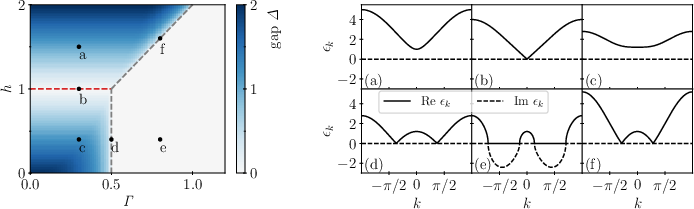
Figure 1: Phase diagram of the non-Hermitian Ising chain. The left panel shows regions of gapped and gapless behavior characterized by energy gap Δ as a function of Γ and h. Right panels elucidate changes in excitation spectra at representative parameter points.
The gapless phase for large Γ exhibits complex-valued excitation spectra in certain k-modes, a hallmark of PT symmetry breaking. Notably, this phase supports long-range order not present in Hermitian analogs—a manifestation of the non-unitary nature of the ground state and the new role of dissipation in ordering phenomena.
Static Spin and Spin-Nematic Correlations
The nature of order is probed through the computation of spin-spin correlation functions—as well as the spin-nematic correlator that captures phase-nematicity arising from coherent anisotropic spin fluctuations between neighboring sites. In the PT-symmetric regime, the long-distance xx spin correlations distinguish antiferromagnetic and paramagnetic domains as in the conventional Ising universality class. However, as the system enters the PT-broken phase, an emergent long-range spin-nematic order parameter y0 becomes non-vanishing.
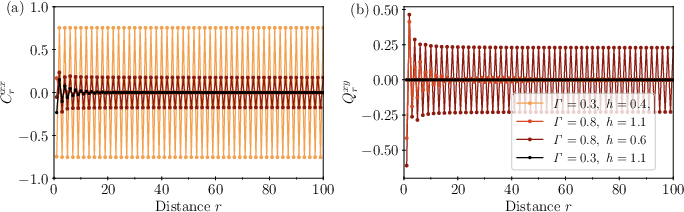
Figure 2: (a) Spatial decay of the spin-xx correlation function y1 for representative values of y2 and y3, and (b) spin-nematic correlation y4 highlighting the emergence of long-range nematic order in the PT-broken phase.
Crucially, the gapless phase with broken PT symmetry displays true long-range order in y5, violating the Mermin-Wagner expectations for 1D Hermitian models. The phase diagram as defined by the static spin-nematic order parameter directly aligns with the region of complex-valued excitation spectra.
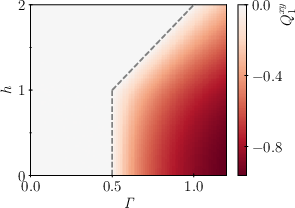
Figure 3: Phase diagram characterized by the spin-nematic order parameter y6, showing a clear separation between PT-symmetric (unbroken) and PT-broken phases.
Non-Equilibrium Dynamics of the Spin-Nematic Order
The work proceeds to analyze the non-equilibrium dynamical evolution of the spin-nematic correlation function following a quantum quench from a Hermitian to a non-Hermitian regime (sudden switch-on of finite y7). The equations of motion for the post-quench state are integrated using time-dependent Bogoliubov-de Gennes equations.
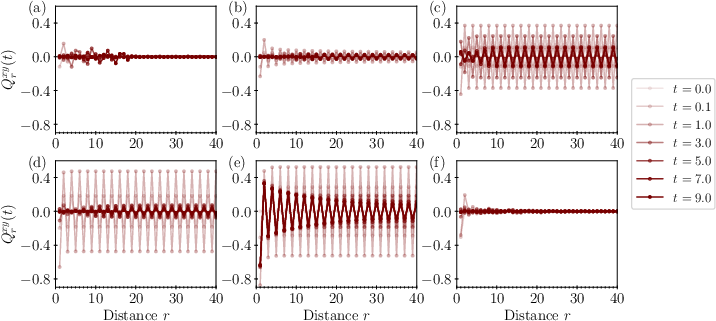
Figure 4: Time-resolved evolution of spin-nematic correlations y8 under various combinations of y9. Persistent, non-oscillatory long-range order emerges exclusively in the PT-broken region.
For quenches into the PT-broken regime, spin-nematic order exhibits robust, time-independent long-range correlations as the imaginary parts of the excitation spectrum suppress oscillatory dephasing. In contrast, quenches within PT-symmetric or at criticality result in oscillatory behavior and vanishing time-averaged nematic order. Thus, the time-averaged dynamical order parameter,
H^=Jj∑σ^jxσ^j+1x+hj∑σ^jz−iΓj∑(σ^jxσ^j+1y+σ^jyσ^j+1x)0
is a precise dynamical indicator of the PT-broken phase boundary.
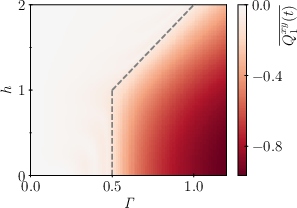
Figure 5: Phase diagram reconstructed from the time-averaged spin-nematic order parameter after a quantum quench, in complete correspondence with the static analysis.
Theoretical and Practical Implications
This work establishes the non-Hermitian Ising-Gamma chain as a minimal model supporting stable, true long-range spin-nematic order in one dimension, uniquely enabled by PT symmetry breaking. This violates standard Hermitian no-go theorems and highlights the organizing role of dissipation in quantum magnetism. The exact solution facilitates prediction of equilibrium and non-equilibrium observables, useful for benchmarking experimental quantum simulators subject to designed dissipation.
Practically, these results propose a mechanism for generating robust, dynamically stabilized spin-nematic order in engineered quantum spin chains—e.g., in cold-atom or superconducting qubit platforms with controllable dissipation. The sharp correspondence between static and dynamical nematic ordering, quantified by time-averaged observables, suggests experimentally accessible signatures of non-Hermitian phase transitions.
Theoretically, the structure of the PT-broken gapless phase and its stability against integrability-breaking perturbations, disorder, and finite system size warrant further study. The interplay between non-Hermiticity-induced ordering and topological features, as well as entanglement and many-body coherence, are compelling future directions. Non-equilibrium protocols open routes to new quantum state engineering strategies based fundamentally on tailored dissipation.
Conclusion
The research demonstrates that non-Hermitian symmetric off-diagonal interactions can fundamentally alter the phase structure of one-dimensional quantum magnets, supporting dissipatively stabilized long-range spin-nematic order unattainable in Hermitian limits. PT symmetry breaking manifests in both static and dynamical observables, providing alternative paradigms for quantum phase characterization and control. These findings extend the landscape of quantum phases accessible in condensed matter and synthetic quantum matter, with immediate implications for both fundamental and applied research in dissipative many-body quantum systems.