- The paper introduces OneRetrieval, a unified generative model that consolidates sparse, dense, and collaborative branches while enabling real-time editability through Keyword-Aligned Encoding.
- It presents an extensible codebook design with reserved blocks that allows dynamic injection of new attribute terms, significantly improving recall and conversion metrics.
- The four-stage supervised fine-tuning pipeline and successful deployment at Kuaishou validate the model's operational scalability and effectiveness in e-commerce retrieval.
OneRetrieval: Unifying Multi-Branch E-commerce Retrieval with an Editable Generative Model
Introduction
OneRetrieval introduces a unified generative retrieval framework for e-commerce, targeting the consolidation of traditional multi-branch retrieval architectures—comprising sparse (lexical inverted-index), dense-vector, and collaborative filtering branches—into a single model with competitive recall and essential real-time editability. The framework is developed specifically to overcome the editability deficit of prior generative retrieval (GR) approaches, facilitating same-day operational updates for emerging attribute terms without retraining. The central technical contribution is Keyword-Aligned Encoding (KAE), coupled with an extensible, density-aware codebook and a four-stage supervised fine-tuning pipeline, all enabling both high recall quality and editability. In production deployment at Kuaishou, OneRetrieval serves millions of users and handles hundreds of millions of page views daily, exhibiting significant improvements in recall and conversion metrics.
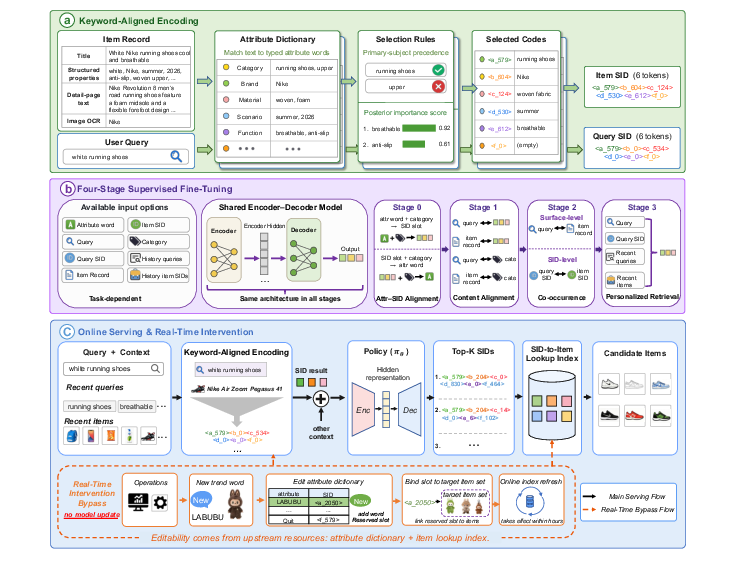
Figure 1: OneRetrieval's framework, illustrating KAE mapping, four-stage fine-tuning, and online serving with a real-time intervention bypass.
Structural Limitations of Multi-Branch Retrieval
Conventional e-commerce retrieval stacks integrate several independently trained branches: the lexical-sparse inverted index guarantees editability but suffers from intent mismatch and low conversion; dense-vector encoders offer semantic generalization but incur inflexibility for catalog evolution; collaborative filtering is effective for head items but exacerbates exposure inequalities in the long tail. The multi-branch fusion further incurs system complexity and precludes joint optimization. Crucially, only the inverted-index branch supports direct real-time intervention—enabling new or trending terms to surface by dictionary binding and incremental index updates independent of model retraining. Existing generative retrieval architectures, although promising for unified modeling and generalization, structurally lack this editability.
Generative Retrieval Editability Challenge
Prior GR approaches bifurcate into closed-codebook (e.g., DSI, TIGER, LC-Rec) and open-vocabulary (e.g., SEAL, GLEN, GenR-PO, GRAM) paradigms. Closed-codebook methods employ quantized identifier slots fixed at training, rendering them non-extensible during inference. Open-vocabulary schemes allow for greater expressivity but leave the routing of new terms ambiguous and heavily reliant on model generalization, lacking deterministic control over which items are surfaced for an injected term. Neither resolves the editability paradox of industrial e-commerce production: reconciling competitive retrieval with operational agility for trending terms.
OneRetrieval: Framework Design
OneRetrieval builds upon three architectural pillars:
- Keyword-Aligned Encoding (KAE): Each slot of the item and query identifier (SID) is explicitly aligned to a key attribute word rather than a quantized embedding, leveraging a production attribute vocabulary and producing interpretable, semantically grounded SIDs. Non-uniform capacity allocation across codebook positions is governed by attribute density statistics to minimize collision and maximize discriminative power.
- Extensible Codebook with Reserved Blocks: Through an information-theoretic agglomerative merging of 18 attribute types into six groups (ECOM6), the codebook is structured with position-specific capacity and a reserved block in each group. Reserved slots are intentionally left unbound during training and can be mapped to new attribute words (e.g., viral brands) post-deployment, maintaining full model editability without retraining.
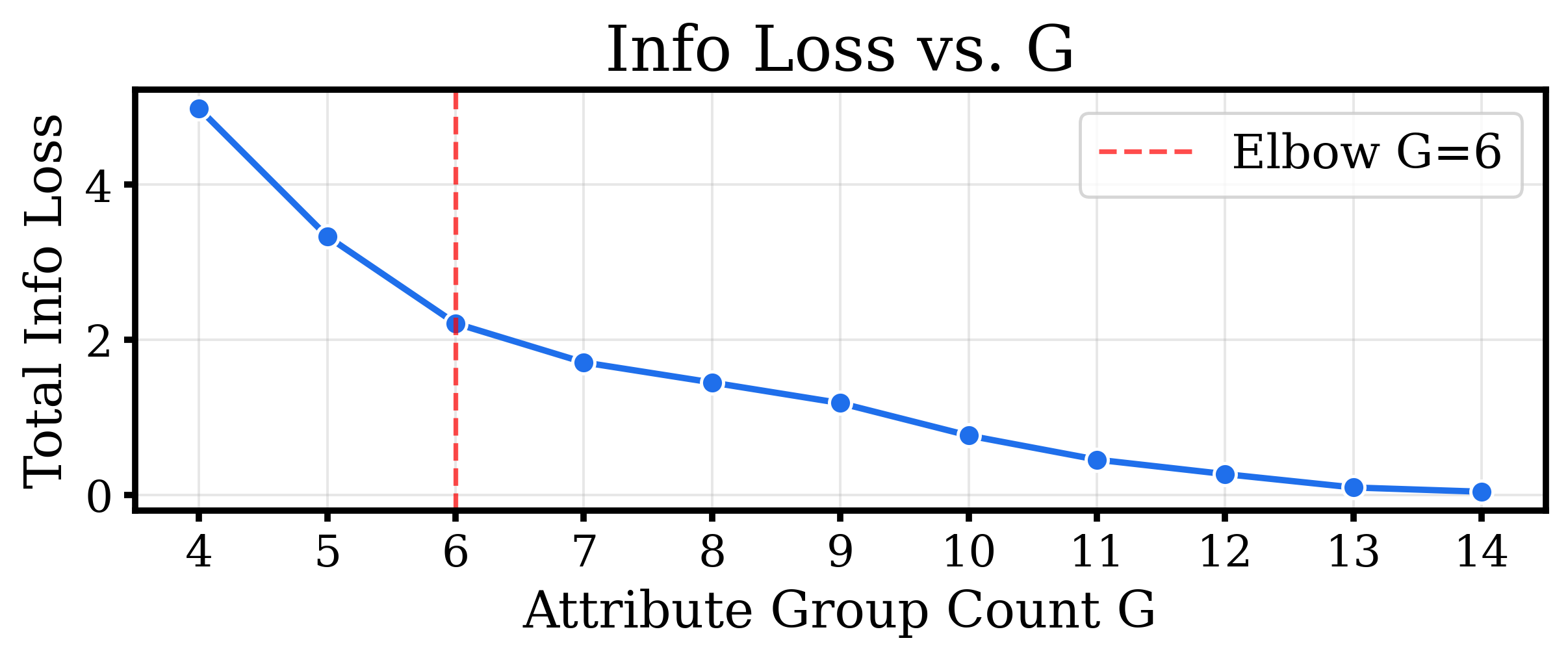
Figure 2: Knee in information loss curve establishes that merging into six groups is optimal for discriminative preservation.
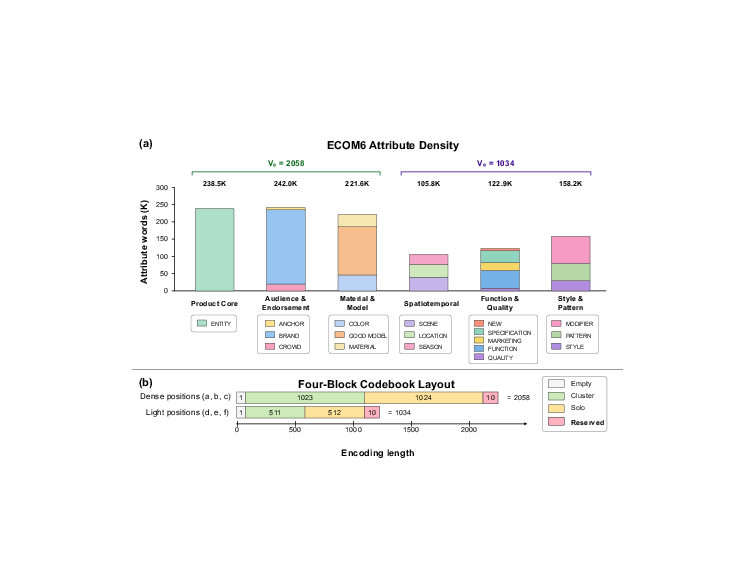
Figure 3: (a) Density of attribute words per merged group; (b) structure of codebook layout covering empty, cluster, solo, and reserved blocks.
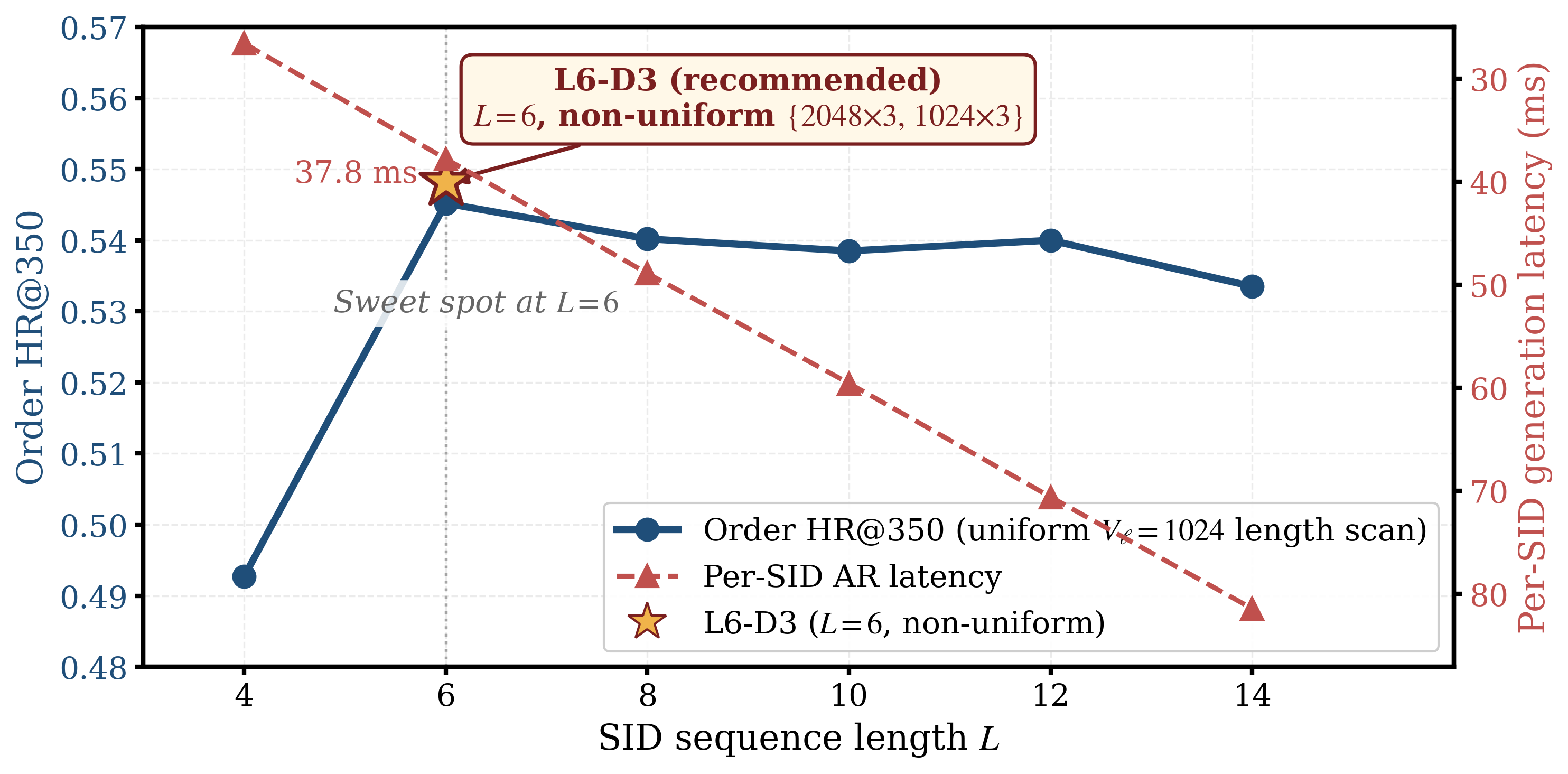
Figure 4: Codebook length analysis confirms L=6 as the cost-quality knee, and non-uniform allocation (L6-D3) optimizes recall.
- Four-Stage Supervised Fine-Tuning (SFT): The SFT pipeline initializes with Stage 0, aligning SID slots with attribute words, followed by Stage 1 for surface alignment of queries/items and SIDs, Stage 2 for collaborative-signal injection (establishing query-SID to item-SID routing), and Stage 3 for personalized retrieval with explicit reserved-slot supervision. This disentangles learning of recall quality from editability, ensuring both are realized without mutual compromise.
Codebook Design and Ablation
A detailed exploration of codebook structure identifies the following:
- Length: L=6 slots suffice to capture attribute diversity with minimal cost.
- Capacity Allocation: Non-uniform slot counts (e.g., 2048 for dense groups, 1024 for sparser ones) correspond to attribute group statistics, reducing collision without overallocation.
- Hierarchical vs. Non-Hierarchical Encoding: Attempts at hierarchical (entity-conditioned) identifiers degrade recall due to fragmentation and prefix-dependency failures in the autoregressive decoder, attesting to the necessity of non-hierarchical codebooks.
Editability: Intervention and Routing Analysis
Systematic comparison against closed-codebook (e.g., residual quantization) alternatives demonstrates that only KAE supports real-time editability, as validated by a more than tenfold increase in Intervention Hit Rate (IHR@350). Unlike quantized embeddings, which lack direct slot-to-word mapping post-training, KAE's dictionary-driven, slot-anchored encoding enables deterministic, controllable injection of new attribute terms into serving without touching learned parameters.
Table: Retrieval and Intervention Capability
| Encoding Paradigm |
Order HR@350 |
Click HR@350 |
Total IHR@350 |
| KAE |
0.5452 |
0.6033 |
0.0806 |
| RQ-VAE |
0.5075 |
0.5516 |
0.0025 |
| RQ-kmeans |
0.5355 |
0.5837 |
0.0030 |
| RQ-OPQ |
0.5376 |
0.5848 |
0.0021 |
KAE also recovers up to 73% of the activation rate achieved by the conventional BM25 inverted index on the same injected terms, while more than doubling the effective recall metrics.
Offline and Production Evaluation
Extensive experiments on a 5-million-query industrial dataset show that OneRetrieval:
- Matches or surpasses the best closed-codebook generative retrieval baseline (OneSearch) in deep-list recall (HR@350: 0.5482 vs. 0.5550 on orders).
- Outperforms all dense-vector and other generative baselines in recall, with an order-of-magnitude increase in editability.
- Retains interpretability and human-in-the-loop operationalization through explicit mapping between attribute words and codebook slots.
Online A/B Testing and Deployment
Two main experiments in Kuaishou's live search service demonstrate:
- Inverted-Index Branch Replacement: Replacing only the lexical branch with OneRetrieval yields significant order volume uplift (+0.71%, p<0.05) and improved buyer count, while maintaining CTR.
- End-to-End Replacement: Extending OneRetrieval to subsume almost all retrieval branches (inverted and dense) results in stable order conversion and a significant CTR gain (+0.82%, p<0.05), with improvements sustained across most industries, notably in intent-rich verticals such as apparel and personal care.
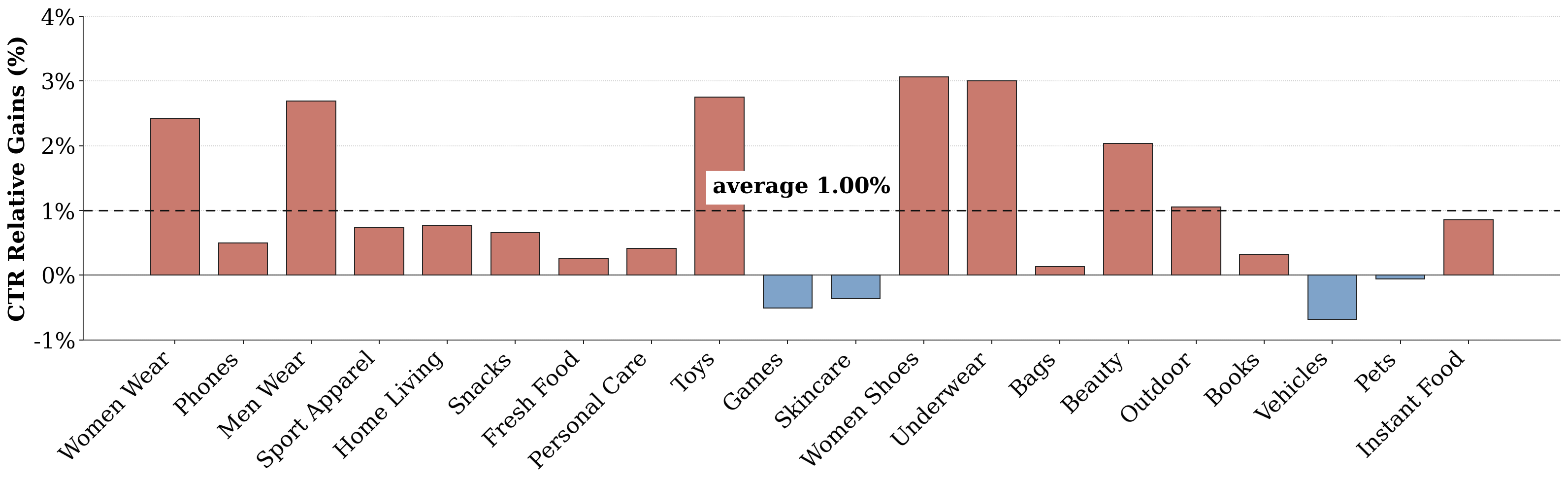
Figure 5: Relative online CTR gains across the top 20 industries, demonstrating consistent broad-based improvements and strongest gains in verticals with complex attribute queries.
Manual review corroborates these statistical gains, indicating net improvements in query-item relevance and item quality.
Theoretical and Practical Implications
OneRetrieval reestablishes the feasibility of unified, generative model-based retrieval in industrial settings by resolving the editability barrier that has prevented prior GR approaches from replacing inverted indices in production. The explicit, interpretable, and editable codebook design offers a promising framework for extensible, human-operable e-commerce search, facilitating rapid response to catalog and vocabulary dynamics.
Methodologically, the findings demonstrate that positionally-aligned, dictionary-based codebooks with reserved capacity and appropriate training regimes can recover and even extend the operational flexibility of classic IR methods, making joint semantic modeling and editability compatible for large-scale neural retrieval systems. These principles are applicable wherever real-time operational intervention and semantic coverage are both required: vertical search, large-scale recommendation, and multi-modal retrieval.
Future Directions
Potential research avenues include:
- Extension of the SID alphabet with multi-modal features (e.g., vision).
- Incorporation of reinforcement learning over conversion and engagement signals for further optimization.
- Automatic slot allocation and triggering for emergent trends based on live traffic analytics.
Conclusion
OneRetrieval demonstrates that competitive, unified recall with fine-grained, controllable editability is feasible within a single generative model. By unifying multi-branch e-commerce retrieval architectures, preserving operational agility, and supporting large-scale production deployment, it offers a scalable template for next-generation search infrastructure on noisy and dynamic product catalogs.

