- The paper introduces CaLIR, a framework that uses category-guided latent intent reasoning to bridge the semantic gap between query texts and abstract product SIDs.
- It combines Semantic ID indexing via RQ-VAE with hierarchical supervision and multi-positive loss to enhance retrieval performance in noisy, multi-intent scenarios.
- Experiments on the Amazon ESCI benchmark show significant improvements in recall and NDCG metrics, confirming CaLIR's efficiency, robustness, and scalability.
Category-Guided Latent Intent Reasoning for Generative Retrieval in E-Commerce
Motivation and Context
Product search in e-commerce presents distinct retrieval challenges: queries are often short, ambiguous, and attribute-centric, while product catalogs are large, dynamic, and hierarchically organized. Direct sequence-to-sequence generative retrieval (GR), where LLMs map queries to catalog item Semantic IDs (SIDs), is conceptually appealing but encounters a substantial representation gap. SIDs, constructed by quantization and hierarchical clustering, are abstract code tokens that do not directly reflect the semantics of user queries. Previous approaches to bridge this gap, such as explicit chain-of-thought (CoT) reasoning through intermediate textual rationales, have limited applicability owing to high inference latency and rigidity in noisy or multi-intent scenarios.
"Beyond Matching: Category-Guided Latent Intent Reasoning for Generative Retrieval in E-Commerce" (2606.07075) introduces CaLIR, a novel retrieval architecture that incorporates category-guided latent intent reasoning to mediate the mapping between query text and catalog SIDs in a computationally efficient, semantically robust, and inference-effective manner.
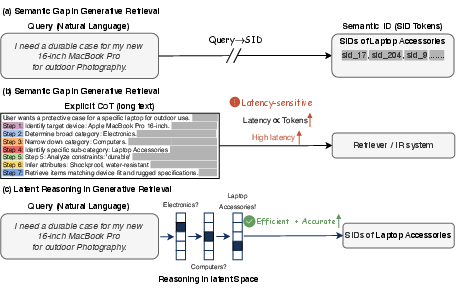
Figure 1: Comparison of direct SID generation, explicit chain-of-thought (CoT), and the proposed category-guided latent intent reasoning (CaLIR).
Architecture and Methodology
CaLIR comprises three key phases: Semantic ID indexing, category-guided latent intent reasoning during training, and intent-aware constrained decoding at inference.
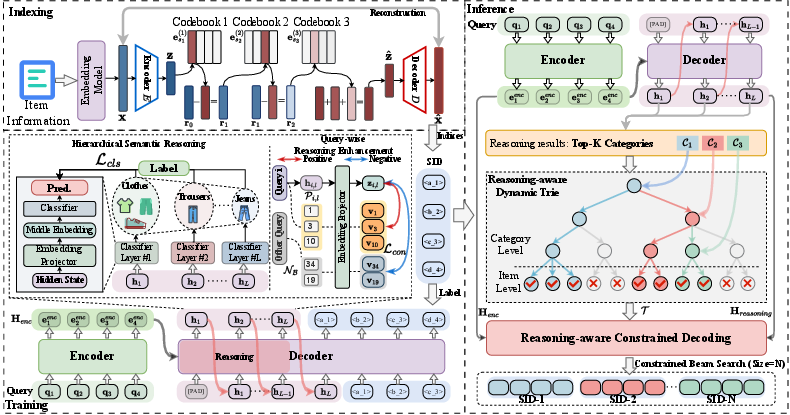
Figure 2: Overview of the CaLIR framework, including SID indexing, hierarchical latent intent reasoning with semantic supervision, and query-aware constrained decoding via dynamic prefix tries.
Semantic ID Indexing via RQ-VAE
Product items are embedded with a pretrained encoder (e.g., Sentence-T5) and quantized using Residual Quantized VAE (RQ-VAE) into a compact, hierarchically structured SID. Each codeword in the SID sequence encodes increasingly fine-grained product semantics. Collisions are avoided via the Sinkhorn algorithm to enforce unique identifiers. The resulting catalog index supports both compact addressability for the catalog and structurally meaningful decoding constraints.
Category-Guided Latent Intent Reasoning
Rather than supplying explicit reasoning outputs, CaLIR learns a continuous sequence of latent intent states in the decoder prior to SID generation. This process is grounded in the hierarchical product taxonomy:
- Hierarchical Semantic Reasoning (HSR): Each latent state is supervised to align with a particular level in the product category tree via a masked cross-entropy objective and hierarchical constraint masking. Latent representations are projected and classified at each taxonomy level, encouraging coarse-to-fine semantic alignment.
- Query-wise Reasoning Enhancement (QRE): For queries that map to multiple valid categories (multi-positive queries), latent states are regularized to cluster near all relevant category prototypes using a multi-positive InfoNCE loss, improving diversity and robustness of latent intent representations.
The training objective integrates the generative loss for correct SID sequence prediction, the hierarchical semantic alignment loss, and the contrastive multi-positive category loss, weighted by tunable hyperparameters (α for HSR and β for QRE).
Reasoning-Aware Constrained Decoding
At inference, the model predicts top-K intent categories based on the final latent intent state. It then dynamically assembles a query-specific prefix trie by logically combining the category-level tries precomputed offline. Beam search for SID generation is restricted to this pruned trie, ensuring catalog candidates are consistent with inferred intent and reducing the effective search space for decoding.
Experimental Results and Analysis
CaLIR is extensively evaluated on the multilingual Amazon ESCI benchmark, comparing sparse (BM25), dense (DPR, MPNet, BGE-M3), and generative retrieval baselines (DSI, TIGER, LTRGR, MERGE, CAT-ID2, etc.) across multiple languages. The results demonstrate strong numerical improvements across all primary retrieval metrics (Recall@5/10/100, NDCG@10/100), surpassing all tested competitors. For example, CaLIR achieves R@100 of 36.15 on ESCI-us, significantly higher than the best prior model's 32.29, and outperforms explicit CoT and explicit category-SID intermediate reasoning both in retrieval quality and inference speed.
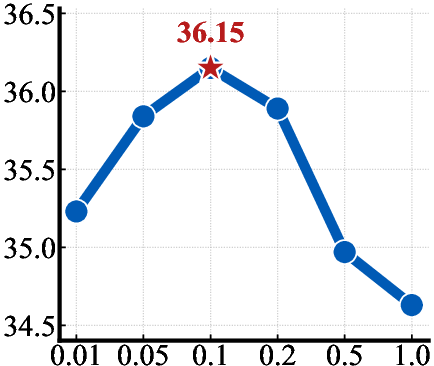
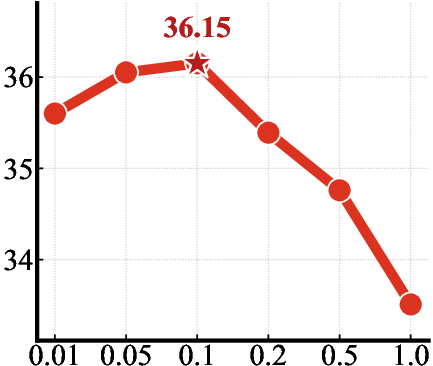
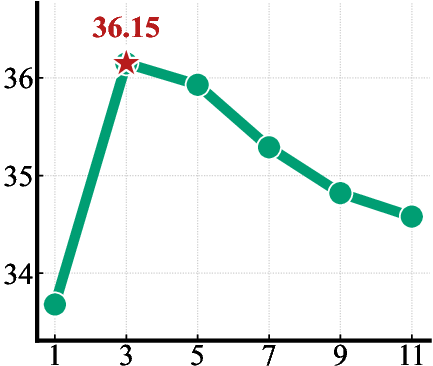
Figure 3: Performance as a function of the HSR loss weight (α).
Hyperparameter studies validate the necessity of both auxiliary semantic reasoning objectives and decoding trie size, with R@100 maximized at moderate values (e.g., K=3 for trie categories). SID codebook size and SID length are also crucial: excessively small or large codebooks/SID lengths degrade discrimination and decoding quality.
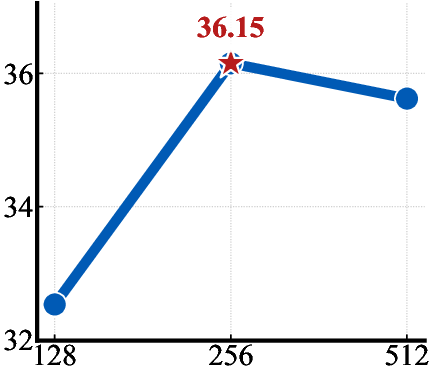
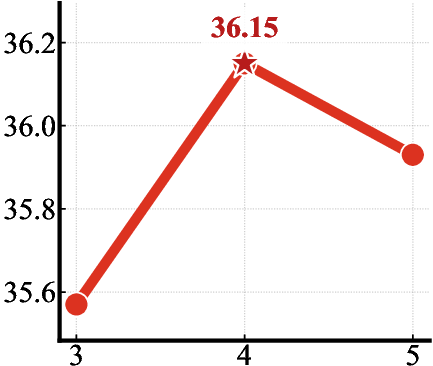
Figure 4: Retrieval performance sensitivity to codebook size for discrete SID construction.
Ablation results confirm that improvements derive jointly from HSR, QRE, and reasoning-aware decoding, with each component demonstrating incremental performance gains.
Qualitative and Attention Analyses
Visualization of decoder self-attention reveals that, during SID generation, the model attends strongly to the learned latent intent states, indicating that latent reasoning actively conditions item decoding rather than simply serving as an auxiliary training signal.
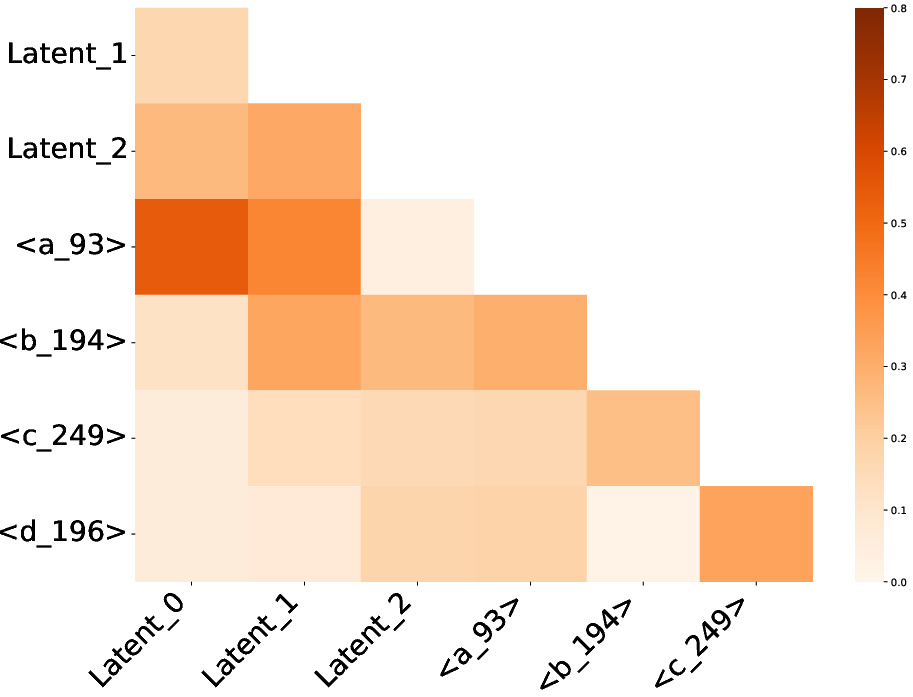
Figure 5: Self-attention visualization from the decoder on ESCI-us, highlighting strong dependencies on early latent intent states during SID generation.
Case studies show category intent paths inferred by CaLIR readily disambiguate multi-intent noisy queries, suggesting these latent trajectories encode interpretable, semantically relevant query-to-category mappings.
Robustness, Transferability, and Backbone Flexibility
CaLIR's reasoning mechanism is robust under multilingual scenarios and compatible with advanced SID construction techniques such as MERGE and CAT-ID2. Experiments on MS MARCO—with hierarchies induced by unsupervised clustering in lieu of a manually defined taxonomy—demonstrate that the framework generalizes beyond e-commerce, suggesting the core latent intent reasoning design can be adopted in general large-scale retrieval regimes.
Backbone analysis indicates that CaLIR outperforms baseline generative retrieval models even when the backbone is switched from T5 to Qwen3-0.6B, confirming architectural flexibility across LLM families.
Efficiency experiments show that CaLIR's inference latency remains practical, with lower token-wise decoding cost than explicit CoT and only a marginal parameter increase relative to baseline sequence-to-sequence GR systems.
Implications and Future Directions
CaLIR establishes category-guided latent intent reasoning as a critical mechanism to bridge abstract identifier spaces and natural language queries in LLM-based generative retrieval settings. The fusion of hierarchical category signals and latent trajectory supervision yields both higher retrieval coverage and ranking quality with competitive inference times.
The approach relaxes the reliance on explicit manual reasoning paths and can be deployed in domains without curated taxonomies by using induced hierarchies. Further work may investigate dynamic latent step-depth selection per query, integration with agentic retrieval paradigms, or hybrid latent-explicit intent modeling to further improve interpretability, robustness, and transferability. The framework's scalability and compatibility with more expressive, structured, or multimodal catalog identifiers and larger LLM backbones remains an active area for exploration in large-scale, real-world product or document retrieval systems.
Conclusion
CaLIR represents an effective and theoretically motivated solution for bridging the semantic gap between queries and abstract product SIDs in generative retrieval. Its latent, category-guided intent reasoning enables more robust, efficient, and interpretable retrieval in e-commerce and potentially broader retrieval scenarios, providing a foundation for future advances in generative, taxonomy-aware information access.

