- The paper demonstrates a driven-dissipative protocol that produces steady-state Bell states with a fidelity of 0.89 ± 0.02.
- It employs phase-engineered giant-atom interference in a common waveguide to achieve tunable superradiant and subradiant decay.
- The method allows in-situ frequency tuning to suppress radiative loss and protect entanglement, paving the way for scalable quantum networks.
Driven-Dissipative Entanglement Generation between Distant Giant Atoms
Introduction and Motivation
The robustness and scalability of quantum networks is fundamentally limited by the efficiency and fidelity of entanglement distribution across distant nodes. Remote entanglement protocols in superconducting circuits predominantly employ either temporally calibrated coherent interactions via cavity buses or dissipative stabilization using photonic channels. The present work introduces a conceptually distinct protocol exploiting driven-dissipative dynamics of "giant atoms": superconducting transmon qubits coupled nonlocally (at multiple points) to a common waveguide. This configuration enables the engineering of frequency- and phase-dependent collective dissipation and subspace protection mechanisms that are inaccessible to conventional point-like qubit architectures.
The central result is the experimental demonstration of deterministic steady-state Bell-state generation between macroscopically separated qubits using a continuous drive, achieving a measured Bell-state fidelity of F=0.89±0.02 (Figure 1). The protocol further incorporates in-situ frequency tuning to suppress radiative dissipation post-stabilization, thereby enabling quantum state tomography and providing a pathway to the practical utilization of the entangled resource.
Waveguide QED protocols with giant atoms leverage the interference between spatially separated qubit-waveguide coupling points to realize tunable and highly nontrivial dissipative spectra. The interference phase ϕ(ω) at each atom dictates the degree of individual radiative coupling, enabling either superradiance (enhanced decay at ϕ=2nπ) or subradiance (suppressed decay at ϕ=(2n+1)π). Inter-atomic phase θ(ω) further governs collective effects, allowing for the realization of decoherence-protected (dark) and superradiant (bright) collective states (see Figure 2). Operating at critical phase points creates Bell states (∣Ψ+⟩, ∣Ψ−⟩) with selective immunization to the engineered waveguide environment.
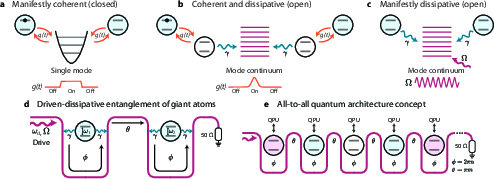
Figure 3: The three principal mechanisms for remote entanglement: coherent, combined coherent-dissipative, and driven-dissipative, culminating in the driven-dissipative scheme with sequential giant atoms enabling extensible all-to-all entanglement distribution.
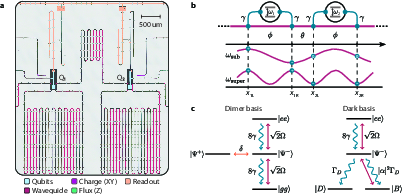
Figure 2: Device micrograph and schematic showing the two sequential giant atoms, phase-engineered couplings, and the resulting level structure of super- and subradiant states under drive and dissipation.
The implementation comprises two flux-tunable transmon "giant atoms" each coupled at two separate sites along a shared coplanar waveguide. The device is designed so that at a target superradiant frequency ωsuper, both individual and collective waveguide-mediated decay rates are maximized via constructive interference, while at the subradiant frequency ωsub, radiative coupling is suppressed via destructive interference. This architecture enables dynamic control of both the generation and storage of entanglement.
Individual and collective dissipation rates are directly extracted from transmission and time-domain spectroscopy (Figure 4) and (Figure 5), verifying the expected frequency-dependent radiative decay behavior and establishing the operational points for subsequent entanglement protocols.
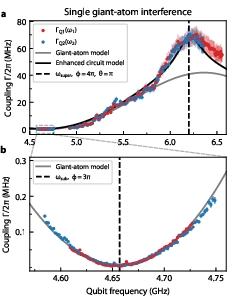
Figure 4: Measured frequency dependence of individual giant-atom decay rates, revealing maximal superradiance and near-complete subradiance.
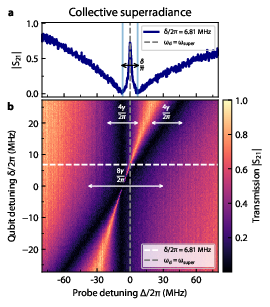
Figure 5: Transmission spectroscopy confirming the collective superradiant linewidth enhancement for two atoms simultaneously tuned to ωsuper.
Protocol for Driven-Dissipative Entanglement
The driven-dissipative entanglement protocol proceeds as follows: both qubits are tuned near ϕ(ω)0 and subject to a coherent drive through the waveguide at the superradiant frequency. A small qubit-qubit detuning ϕ(ω)1 is introduced to allow population to relax from the bright superradiant state into the stabilized subradiant dark state (ϕ(ω)2). Upon reaching steady state, both qubits are rapidly flux-tuned to ϕ(ω)3, individually decoupling them from the waveguide and thereby halting further radiative decay from the entangled state. Quantum state tomography is then performed.
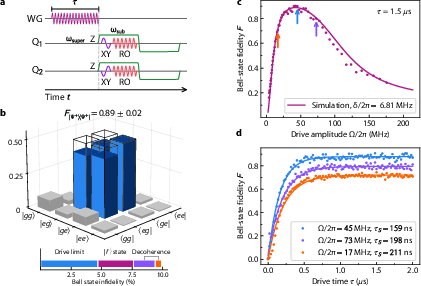
Figure 1: Experimental sequence for entanglement generation and stabilization—showing pulse timing, measured state fidelity (density matrix), fidelity optimization versus drive amplitude, and stabilization time dynamics.
The measured steady-state Bell-state fidelity is ϕ(ω)4 and concurrence ϕ(ω)5, both averaged over substantial statistical repetitions. Master equation simulations incorporating the multi-level structure of the transmons confirm that the optimal drive amplitude is set by the trade-off between fast stabilization and suppression of drive-induced state-mixing outside the two-level manifold. Breakdown analysis shows that residual ground state population, higher-level leakage, AC Stark shifts, and intrinsic decoherence constitute the dominant infidelity channels.
- Autonomous stabilization: The protocol circumvents calibration- and timing-critical coherent pulse sequences, replacing them with a single continuous-wave drive. The steady-state entangled manifold is reached exponentially as a function of drive amplitude and detuning (see Figure 5c-d).
- Protection of entanglement: Post-drive, the qubits are flux-tuned to suppress all radiative channels, protecting the entangled state long enough for state manipulation and readout.
- Achieved fidelities: The protocol delivers remote Bell-state fidelities approaching thresholds relevant for logical-qubit interfacing and distributed quantum computing architectures.
- Scalability and extensibility: The design readily extends to multi-giant-atom chains, supporting manybody entanglement and all-to-all connectivity via frequency and phase engineering (see Figure 1e).
Implications, Outlook, and Future Directions
The demonstrated driven-dissipative approach resolves a long-standing challenge in remote entanglement protocols: simultaneous maximization of the fidelity of entanglement generation and preservation of the resource for subsequent processing. Unlike single-mode/cavity-resonator schemes, the waveguide-mediated architecture provides collective dissipative engineering with in-situ tunability and extensibility to large-scale quantum networks.
Improvements in device anharmonicity (e.g., via capacitively shunted flux qubits) and active compensation for drive-induced shifts are projected to raise fidelities beyond the threshold for fault-tolerant quantum communication links.
From a theory perspective, these results validate the utility of engineered nonlocal dissipation and quantum interference in suppressing Markovian decoherence, supporting the program of reservoir engineering for steady-state quantum information resources. The architecture enables distributed entanglement distribution, resource-efficient gate teleportation, and robust metrological enhancements in quantum sensor networks. There is natural synergy with ongoing developments in waveguide QED, non-Markovian environment engineering, and manybody dissipative quantum simulation.
Conclusion
Driven-dissipative entanglement of distant giant atoms establishes a scalable, calibration-free paradigm for remote entanglement distribution in superconducting quantum architectures. By exploiting engineered giant-atom interference and correlated waveguide-mediated dissipation, the protocol realizes near-unit-fidelity steady-state Bell pairs that are readily preserved for downstream processing. The approach combines experimental practicality, theoretical robustness, and architectural extensibility, and provides a foundation for scalable, modular quantum interconnects and quantum-enhanced distributed sensing (2606.13375).

