- The paper achieves robust atom–photon entanglement by correlating a single Cs atom's Zeeman state with a photon's polarization using resonant excitation.
- It employs high-NA optical trapping, efficient photon collection, and precise state tomography to measure a raw fidelity of 0.942(16).
- The results indicate that cesium-based free-space systems can outperform previous protocols, paving the way for scalable, heterogeneous quantum networks.
Atom–Photon Entanglement with a Single Trapped Cesium Atom: A Technical Overview
Experimental Architecture and Entanglement Protocol
This work reports the generation and measurement of atom–photon entanglement using a single 133Cs atom confined in an optical tweezer and probed in free space. Entanglement is realized by exploiting resonant excitation of the atom followed by spontaneous emission, thereby correlating the atomic Zeeman state with the polarization of the emitted photon. The experimental platform employs a high-NA objective (NA = 0.55) for both trapping and photon collection, which is essential for maximizing photon extraction efficiency and spatial mode purity.
The atomic qubit is encoded in the ground-state hyperfine Zeeman sublevels (∣↓⟩=∣f=3,mf=−1⟩, ∣↑⟩=∣f=3,mf=+1⟩). The photonic qubit is mapped onto the polarization state (σ+, σ−) of the emitted photon during decay from the excited state ∣6p3/2,f′=2,mf=0⟩. Critically, only the σ+ and σ− emission channels contribute to the measured output—π-polarized emission is suppressed due to destructive interference when coupled into the single-mode fiber.
The entanglement generation sequence leverages a single 12-ns π-pulse excitation to circumvent population leakage into unwanted Zeeman sublevels present in the ∣↓⟩=∣f=3,mf=−1⟩0Cs level manifold, a complication over previous ∣↓⟩=∣f=3,mf=−1⟩1Rb-based schemes. Conditioned on photon detection, atomic state tomography proceeds via basis rotations followed by high-fidelity state-selective measurement.
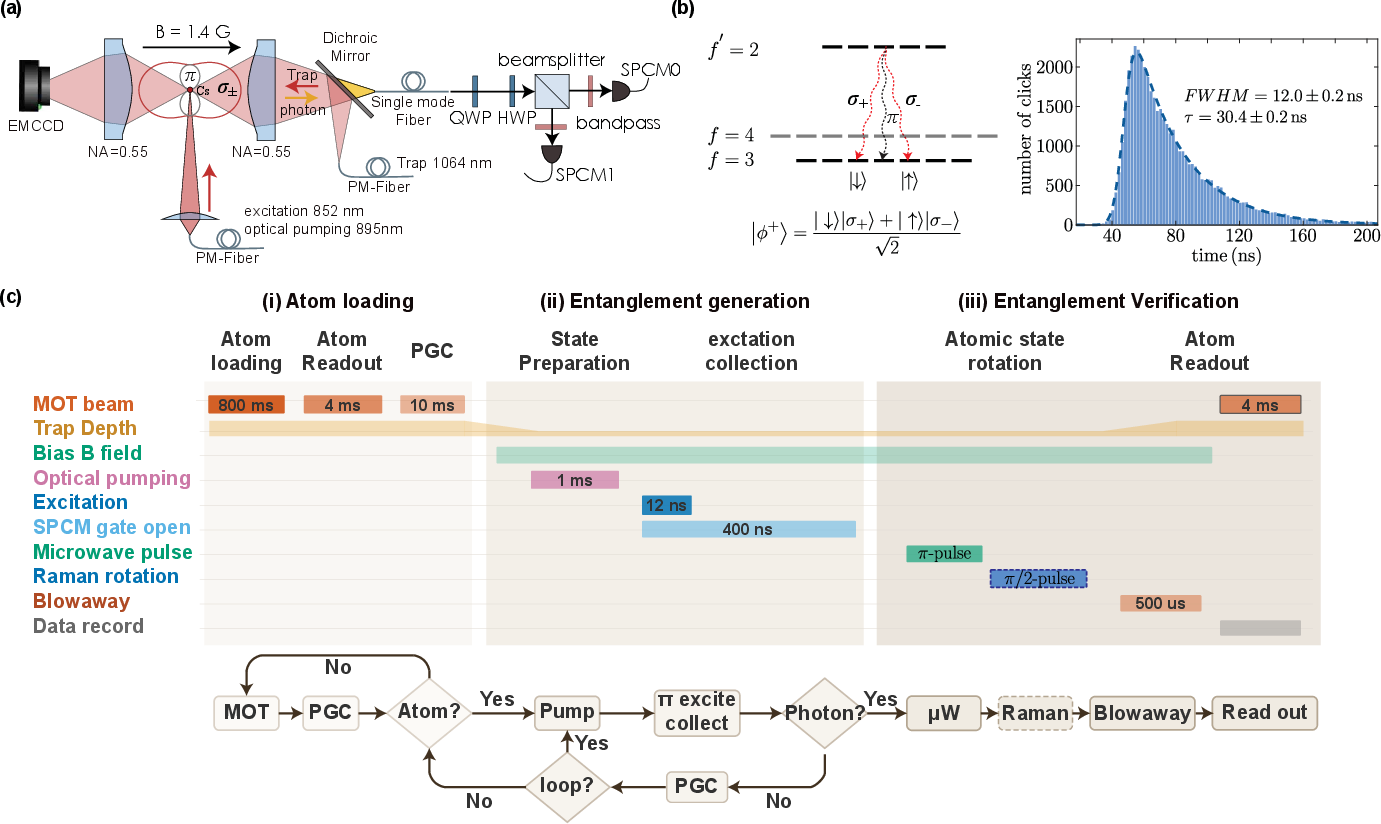
Figure 1: Schematic of optical setup, excitation and decay channels, photon detection timetags, and atom state preparation.
Coherent Control and State Dynamics
Active control over the internal atomic states is achieved through microwave and two-photon Raman transitions. The coherence characteristics of Zeeman-sensitive and -insensitive states were systematically evaluated via Rabi and Ramsey interferometry. The measured ∣↓⟩=∣f=3,mf=−1⟩2 coherence time for the clock-state superposition (∣↓⟩=∣f=3,mf=−1⟩3/∣↓⟩=∣f=3,mf=−1⟩4) reaches ∣↓⟩=∣f=3,mf=−1⟩5 ms, while Zeeman-sensitive (∣↓⟩=∣f=3,mf=−1⟩6/∣↓⟩=∣f=3,mf=−1⟩7) coherence is limited to ∣↓⟩=∣f=3,mf=−1⟩8s, predominantly by ambient magnetic fluctuations.
Mapping the atomic ∣↓⟩=∣f=3,mf=−1⟩9 state to the magnetically less sensitive ∣↑⟩=∣f=3,mf=+1⟩0 state via microwave addressing extends coherence to ∣↑⟩=∣f=3,mf=+1⟩1 ms in the ∣↑⟩=∣f=3,mf=+1⟩2–∣↑⟩=∣f=3,mf=+1⟩3 subspace, substantially outperforming analogous ∣↑⟩=∣f=3,mf=+1⟩4Rb protocols.
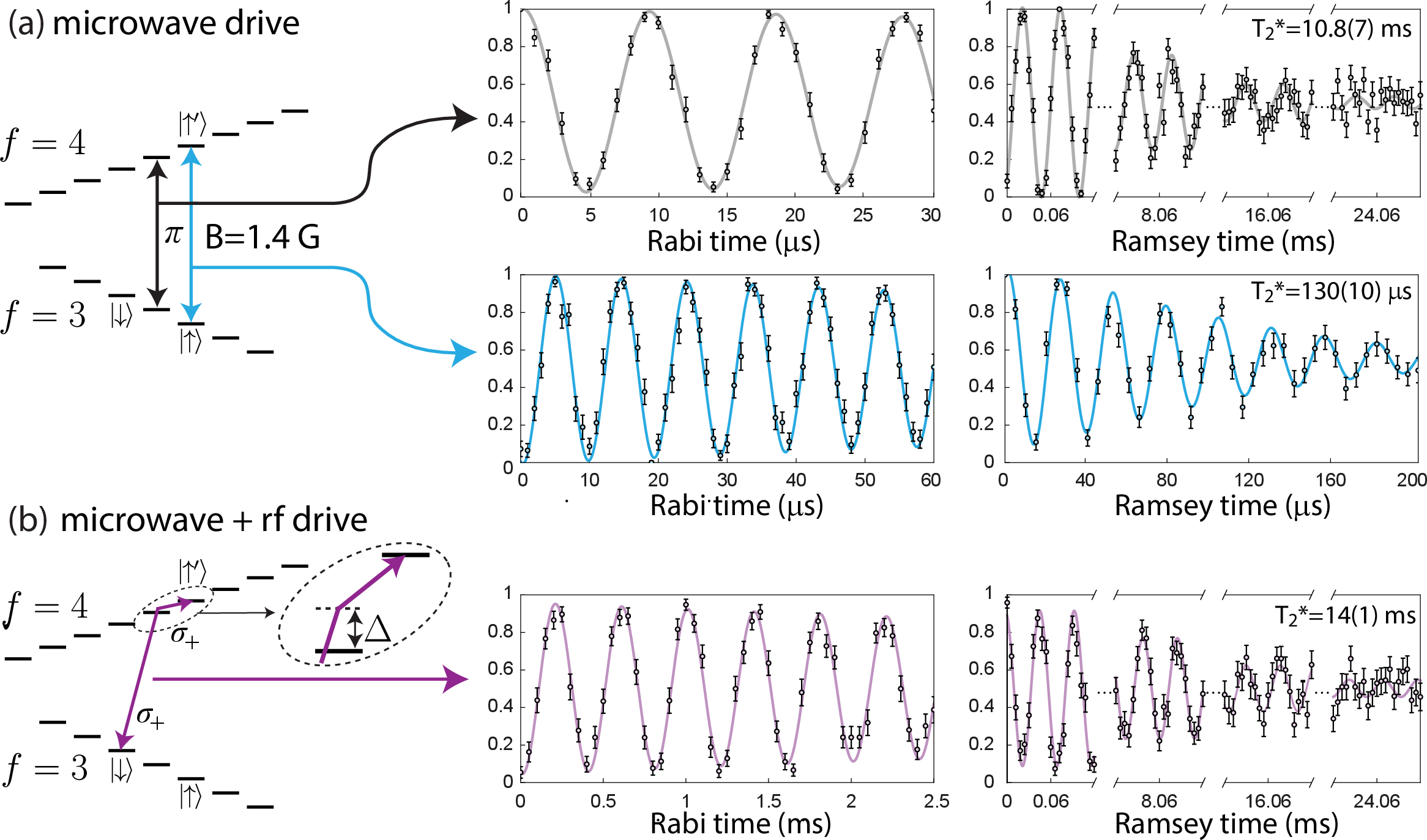
Figure 2: Microwave-driven Rabi oscillations and Ramsey coherence data for Zeeman and clock-state qubit pairs.
Entanglement Verification and Fidelity Analysis
Bell-state fidelity is quantified via parity oscillations measured in ∣↑⟩=∣f=3,mf=+1⟩5, ∣↑⟩=∣f=3,mf=+1⟩6, and ∣↑⟩=∣f=3,mf=+1⟩7 Pauli bases, following conditional photon detection. Photonic analysis bases are established by empirical maximization of parity contrast through waveplate angle scans, given the unpredictable fiber-induced polarization rotations. Atomic basis rotations for ∣↑⟩=∣f=3,mf=+1⟩8/∣↑⟩=∣f=3,mf=+1⟩9 measurements are realized via two-photon pulses, with σ+0-basis interrogation requiring a phase offset.
Joint parity oscillations in all three bases exhibit strong contrast, indicating robust coherence across the atom–photon system. Extracted Pauli correlators yield a measured raw fidelity σ+1 and a lower bound of σ+2. Correction for independently calibrated state-detection errors infers an improved fidelity σ+3. Notably, even with the richer Zeeman manifold and attendant increased re-excitation pathways in σ+4Cs, the achieved fidelity is competitive with or exceeds previous free-space neutral atom implementations.
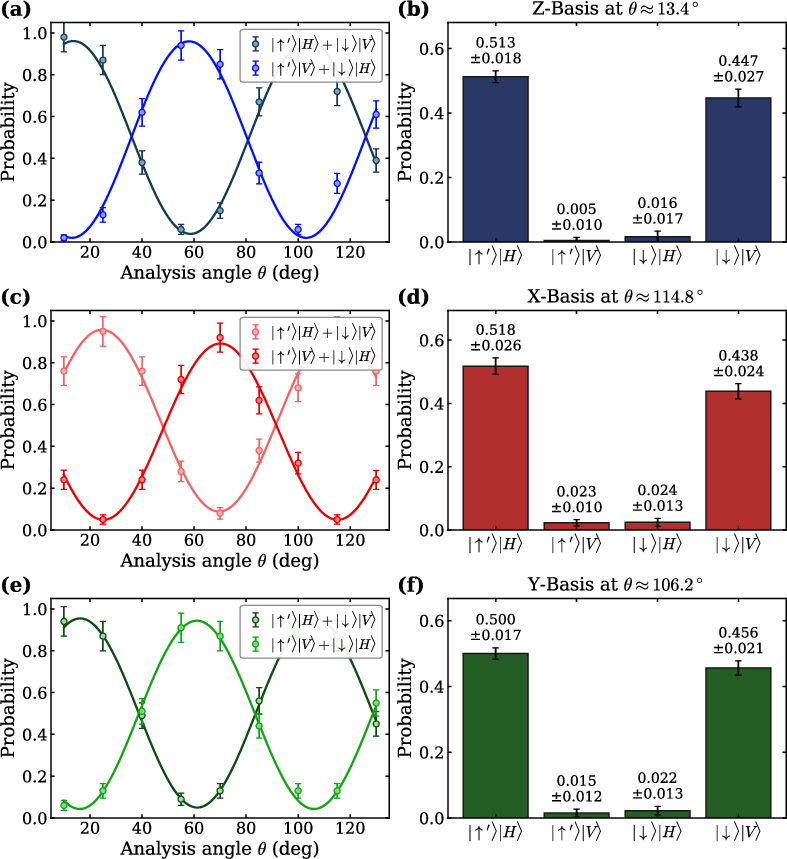
Figure 3: Atom–photon parity oscillations in σ+5, σ+6, and σ+7 bases, together with associated joint probability reconstructions at optimal analyzer angles.
Error Budget and Physical Mechanisms
The fidelity analysis dissects the leading sources of infidelity. The dominant terms are:
- Atomic dephasing prior to and during basis analysis: Estimated at σ+8, driven by magnetic field instability and the finite delay between photon heralding and final state analysis.
- State-detection inefficiency and calibration: Measured at σ+9.
- Leakage during excitation: Modeled to contribute σ−0 for 12-ns σ−1-pulse duration, balancing power broadening and double-excitation errors inherent to the multi-level excited-state structure.
- Imperfect optical pumping: σ−2, minimized by tailored optical sequences.
Other technical contributions (photon detection noise, waveplate error, basis preparation, excitation polarization purity) are negligible (σ−3).
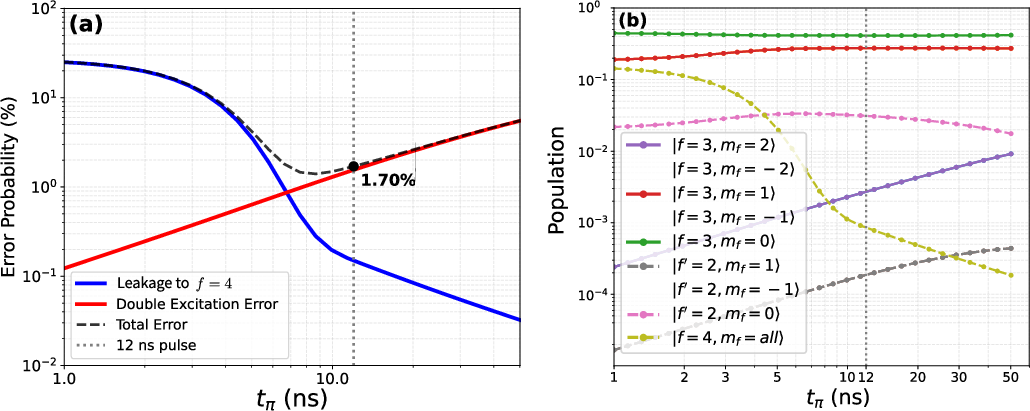
Figure 4: Numerical simulation of excitation-induced leakage and double-excitation errors as a function of σ−4-pulse duration.
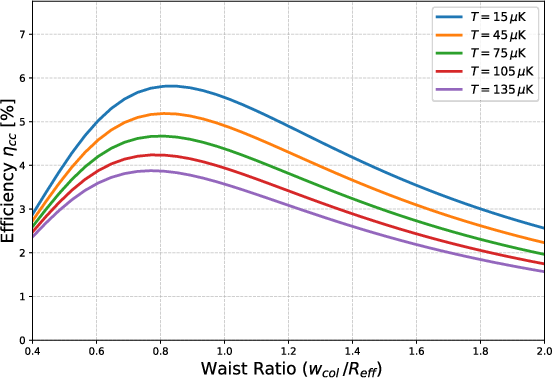
Figure 5: Simulated photon collection and fiber-coupling efficiency as a function of atomic temperature and objective parameters.
Comparative Perspective and Theoretical Implications
The reported protocol positions single cesium atoms as viable candidates for free-space atom–photon quantum network nodes. The performance parallels or outstrips σ−5Rb-based systems, demonstrating that the complications of a larger Zeeman manifold can be effectively mitigated. Importantly, coherence enhancement in cesium supports higher-fidelity entanglement distribution, a crucial metric for modular quantum networking.
The protocol’s architecture enables seamless integration into dual-species Rb–Cs platforms, enabling differentiated memory and communication roles, mid-circuit measurement, and crosstalk suppression—all essential for scalable quantum repeater networks and distributed QIP architectures.
Implications and Future Directions
This demonstration provides the essential photonic interface required for Rb–Cs heterogeneous quantum network elements. Prospective research directions include:
- Integration with dual-species arrays for distributed quantum logic and memory–communication separation.
- Entanglement distillation and multi-node teleportation protocols leveraging mid-circuit measurement in mixed-species systems.
- Optimizing photon extraction and collection mode matching via tailored photonic interfaces (e.g., photonic crystal cavities or hybrid mirrors).
- Further suppression of dephasing and leakage mechanisms, potentially through dynamic decoupling or active magnetic field stabilization.
These developments are expected to accelerate advances in modular quantum computing and quantum internet protocols, particularly as fidelity and efficiency targets continue to tighten for fault-tolerant architectures.
Conclusion
This work achieves robust atom–photon entanglement in a single trapped σ−6Cs atom, attaining a measured raw fidelity of σ−7 and substantiating the practicality of cesium-based free-space quantum interfaces. The protocol surmounts challenges posed by the extended Zeeman structure while leveraging long coherence times for enhanced networking potential. These results set the stage for heterogeneous, modular neutral-atom quantum networks, offering a concrete path toward scalable, high-fidelity quantum information processing.