- The paper demonstrates that integrating physics-derived auxiliary losses into a GNN significantly improves out-of-distribution performance.
- The methodology employs a four-layer GINE network with auxiliary losses for topological complexity and strain-energy, enhancing robustness on SAScore labels.
- Multi-seed evaluation reveals a ~26% reduction in classification error on OOD benchmarks, highlighting the benefits of physics-informed training.
Physics-Aware Auxiliary Losses for Robust GNN Synthesizability Filters: An Analysis
Introduction
As generative models in computational drug discovery compound the challenge of synthesizability prediction by exploring regions far from the training distribution, filtering mechanisms become critical downstream of candidate generators. The paper "Physics-Aware Auxiliary Losses Improve Out-of-Distribution Generalization of a GNN Synthesizability Filter" (2606.12651) directly addresses the out-of-distribution (OOD) failure mode of classically statistical synthesizability filters by integrating physics-aware auxiliary losses into a standard GNN backbone. The methodology centers on the hypothesis that augmenting graph neural network training with physically meaningful supervision can yield OOD-robust molecular filters, critically relevant for realistic deployment with generative pipelines.
Background and Motivation
Molecular synthesizability filters such as SAScore, SCScore, RAScore, and DeepSA are widely adopted for their computational speed and reasonable in-distribution performance. However, evidence shows these models degrade significantly on OOD compounds, particularly those generated to maximize novelty or complexity by upstream generative models. These degradation patterns arise because the filters are fundamentally statistical, inheriting not just the chemical knowledge but also the biases and spurious correlations of their training corpora.
The current work asserts that, in the absence of an explicit theoretical or mechanistic equation governing synthesizability (unlike in classical PINN settings), physics-derived priors should be deployed as auxiliary losses rather than architectural constraints. This is argued to be especially suitable for discrete, graph-structured molecular data, contrasting the differential equation-based biases in classical physics-informed neural networks.
Methodology
The base model is a four-layer Graph Isomorphism Network with edge features (GINE), parameterized with chemically-standard features and trained as a binary classifier for SAScore-based synthesizability labels. The experiment introduces two physics-aware auxiliary losses:
- Topological Complexity Loss: This branch predicts the Bertz molecular complexity index via Huber regression. The index, calculable in closed form from the graph, incentivizes encoding calibrated structural complexity.
- Strain-Energy Soft Penalty: This head predicts MMFF94 force-field strain energy, penalizing overconfident "easy" classification on molecules exhibiting high physical strain, via a soft asymmetric penalty.
Losses are combined in a weighted sum with hyperparameters set to keep auxiliary losses at 10–30% of the main BCE classification loss.
Training follows a protocol aligned with the DrugOOD/GOOD OOD benchmarking philosophy: a source-based covariate shift (training on drug-like HIV and Tox21 molecules, testing on COCONUT natural products). The auxiliary ablations (+complexity, +strain, +both, and baseline) are evaluated over five seeds to support robust paired comparison and confidence intervals.
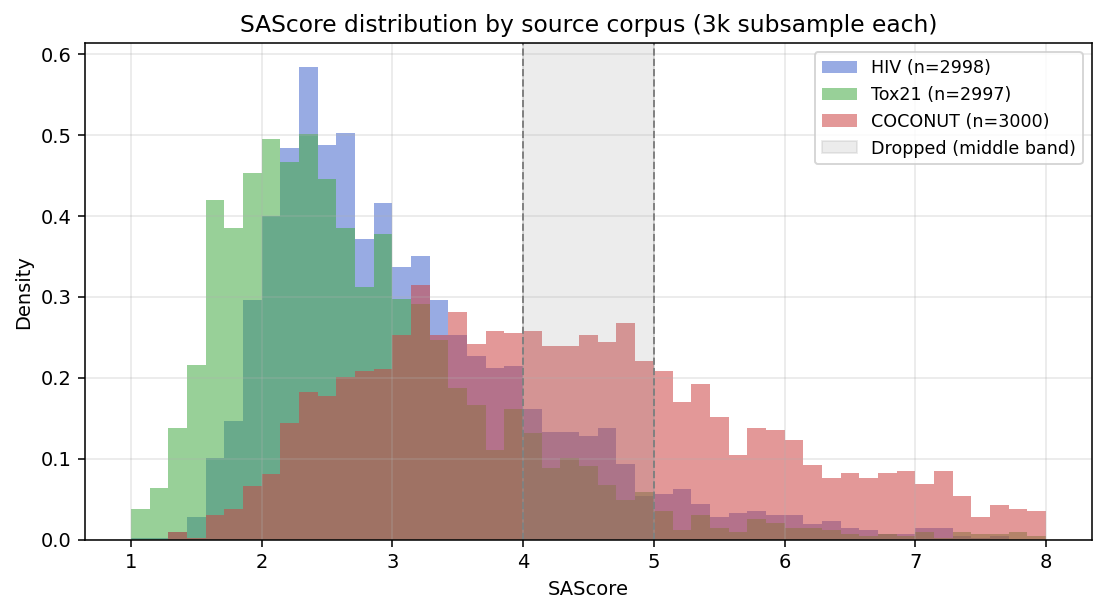
Figure 1: SAScore distributions across corpora; COCONUT natural products are systematically shifted toward higher synthesizability difficulty, motivating the use of a single-source OOD protocol.
In-distribution (i.i.d.) training on the full corpus with the GNN baseline rapidly achieves near-perfect ROC-AUC and accuracy, reflecting the ease of learning the closed-form SAScore function when thresholded and split as in DeepSA. This is confirmed by rapid convergence in validation AUC (exceeding 0.99 by epoch 4) and essentially no difference among the auxiliary loss variants.
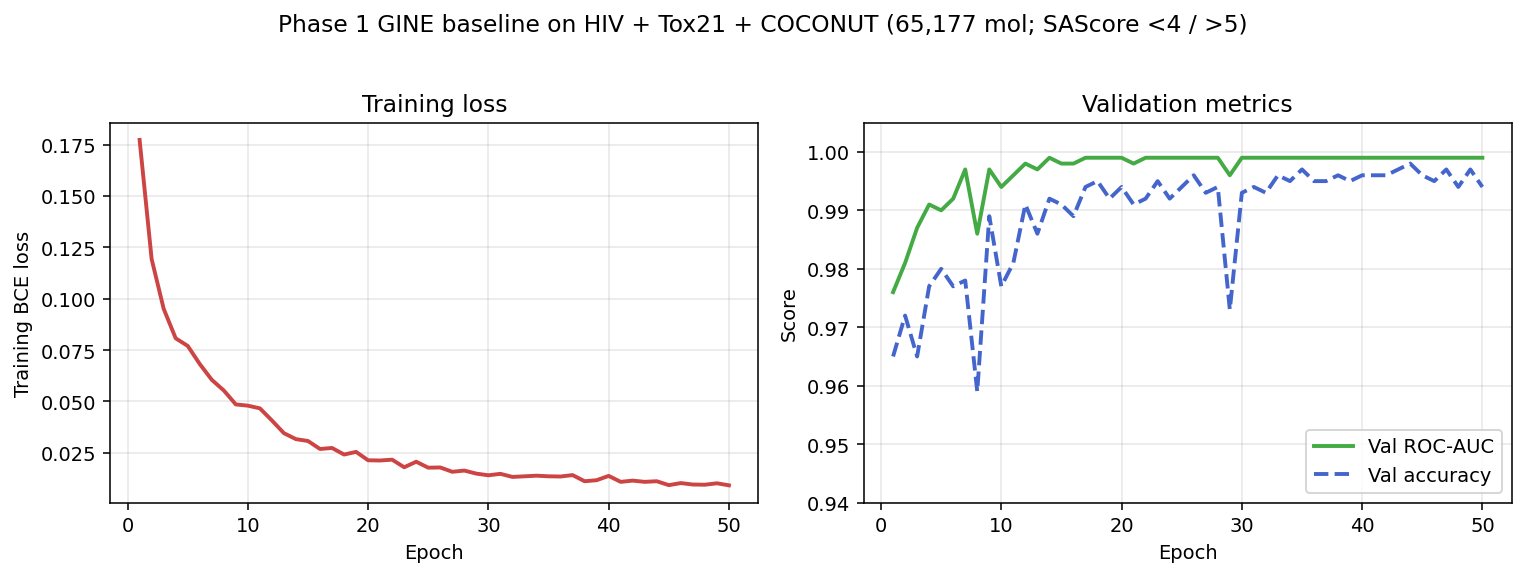
Figure 2: Rapid convergence of training loss and validation AUC for the GNN baseline, exceeding 0.99 by epoch 4.
In-distribution ablations corroborate that the auxiliary losses are neutral: all variants’ ROC-AUCs cluster within run-to-run noise, consistent with the interpretation that, for these labels, a GNN can trivially model the in-domain labeling function.
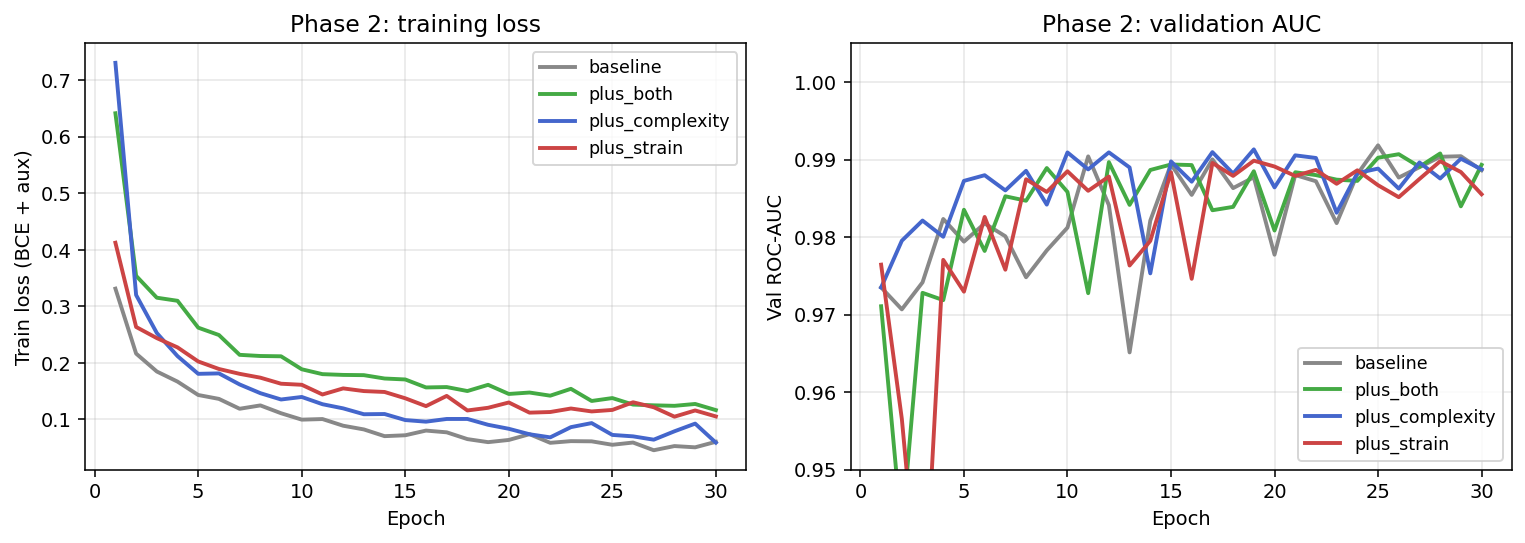
Figure 3: In-distribution loss and validation ROC-AUC across baseline and all auxiliary variants. The curves are indistinguishable, confirming neutrality in distribution.
Contrastingly, the principal findings emerge under OOD evaluation: only here do the physics-aware variants separate from the baseline. All three physics-aware loss settings (complexity, strain, both) demonstrate a statistically significant OOD improvement, evaluated by paired, multi-seed bootstrap confidence intervals. The joint auxiliary setting provides the largest absolute gain (mean OOD AUC=0.9840, Δ=+0.0066, 95% CI [+0.0038,+0.0093] over baseline). Notably, every confidence interval excludes zero, emphasizing the significance of these results.
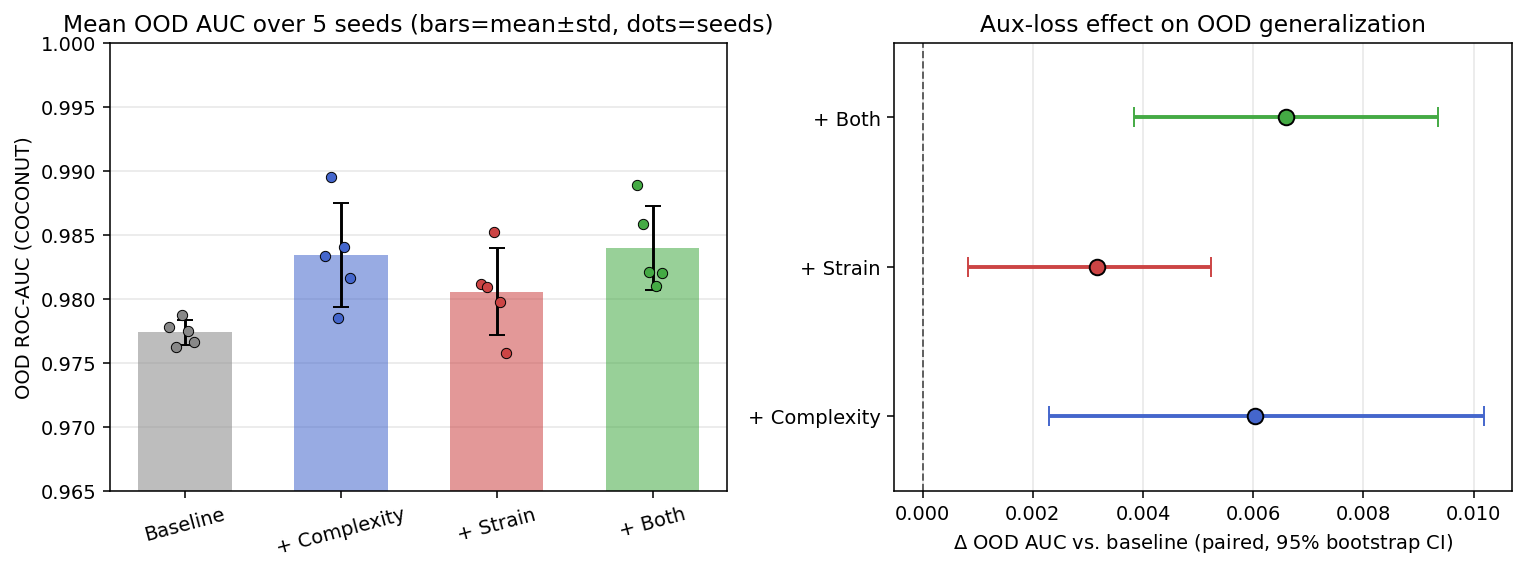
Figure 4: OOD ROC-AUC means and paired deltas versus baseline for all auxiliary variants, with bootstrap 95% confidence intervals; all auxiliary setups are significantly positive.
The effect sizes, while modest (sub-1% absolute increase), constitute a ~26% reduction in (1−AUC) classification error—nontrivial given the near-saturated baseline. Detailed per-seed analysis demonstrates consistent sign and magnitude, mitigating concerns about variance-induced artifacts.
Methodological Rigor and External Baselines
A critical methodological insight emerges: single-seed runs were found to be misleading, as stochasticity in initialization and splits could manufacture false narratives of non-monotonic interactions between loss terms. Only after explicit multi-seed evaluation, with paired bootstraps, did the reliable story emerge, underscoring the necessity of disciplined statistical procedure in small-effect analyses.
The external benchmarking against SCScore (AUC 0.656), naive molecular size proxies (AUC ∼0.78), and SAScore itself (AUC = 1.00, but circular since it is the label function), further contextualizes the performance. Notably, substantial divergence among scores on natural products highlights the lack of uniquely objective ground truth for synthesizability and the criticality of OOD assessment for filter utility in practice.
Theoretical and Practical Implications
This study demonstrates that integrating cheap, closed-form physical descriptors as auxiliary targets in GNN training yields consistent improvements in OOD synthesizability filtering, without increased inference cost or architectural complexity. The improvement is only manifest in OOD regimes, substantiating the view that i.i.d. metrics grossly underestimate deployment risks for learned filters in generative workflows.
Theoretically, the results reinforce an emerging paradigm: in many discrete, graph-structured chemistry ML settings lacking mechanistic PDEs or ODEs, the physics-informed prior should be imposed as an auxiliary signal rather than an architectural constraint or PINN residual. This aligns with a trend toward theory-guided data science applied as light regularization.
Practically, the recommendation is circumspect: the OOD-robust filter should contribute as one component in a multi-filter ensemble, not as a stand-alone gate, due to both the modest size of the effect and reliance on SAScore-proxy labels. Nonetheless, the drop-in deployability of this regularization—requiring no architecture or cost changes at test time—enables direct impact in real molecular design workflows.
Limitations and Prospects
There are important caveats: the study’s OOD effect is demonstrated on a single axis (drug-like → natural product), with only one (λc,λs) configuration and five seeds. Broader grid sweeps, more diverse splits (e.g., macrocycles, peptidomimetics), additional independent learned baselines, and deployment on generative model outputs would be valuable next steps.
The reliance on SAScore thresholds as "ground truth" is a recognized limitation, as is the use of single-conformer MMFF94 strain energies. Addressing these further, possibly with experimental validation or more structured expert feedback, could strengthen the link to true synthesizability and practical drug discovery outcomes.
Conclusion
Physics-aware auxiliary losses, imposed during training as simple, closed-form molecular physical descriptors, provide a consistent and statistically significant OOD generalization benefit for GNN-based synthesizability classifiers. The improvement is visible only in OOD regimes, reinforcing the need for stringent and relevant evaluation in pipeline design. The study also exemplifies robust statistical evaluation practices in the face of small but important effects, asserting the importance of multi-seed experimental design for claims in AI-driven scientific discovery. As molecular generative models continue to push into chemical space unrepresented in training corpora, such physics-driven regularization offers a pragmatic path toward trustworthy filter deployment and more reliable computational design pipelines.