- The paper introduces a large-scale benchmark (SEED) with 90K images for sequential provenance tracing in diffusion-based facial deepfake edits.
- The methodology employs a hybrid spatial-frequency Transformer (FAITH) that leverages both spatial and high-frequency cues to detect multi-step edits.
- Results demonstrate that frequency-guided models outperform spatial-only baselines, especially in handling longer edit chains and order-related challenges.
SEED: A Benchmark for Sequential Provenance Tracing in Diffusion-Based Deepfake Facial Edits
Introduction and Motivation
SEED ("SEED: A Large-Scale Benchmark for Provenance Tracing in Sequential Deepfake Facial Edits" (2604.10522)) systematically addresses the critical gap in visual forensics concerning the recovery of sequential editing histories in facial imagery, particularly those created by iterative diffusion-based pipelines. While the proliferation of deepfake and AI-generated content has pressured the field to develop robust detection methodologies, prior datasets remain limited to single-step manipulations or only offer global authenticity annotations. These fail to capture the complexity of sequential, compositional edits which are increasingly prevalent in real-world manipulation scenarios. The cumulative and potentially entangled artifacts introduced by multi-step editing pipelines remain poorly studied, resulting in analytic models with limited generalization and provenance tracing capabilities.
SEED Benchmark: Dataset Construction and Scope
SEED introduces a rigorous dataset and evaluation protocol targeting sequential provenance analysis. It contains over 90,000 images generated by one to four consecutive attribute-level edits to real human faces, leveraging modern diffusion-based editing frameworks such as LEDITS, SDXL, and rectified-flow Transformers. Each dataset instance is annotated with fine-grained, step-wise metadata comprising the order and identity of edited attributes, textual instructions, generation masks, and the applied editor for every step in the sequence.
Key supported tasks include:
- Authenticity Analysis: binary distinction of real vs. manipulated samples.
- Editing Trace Analysis: ordered prediction of attributes and sequence steps.
- Spatial Evidence Analysis: localization of manipulated regions via edit masks.
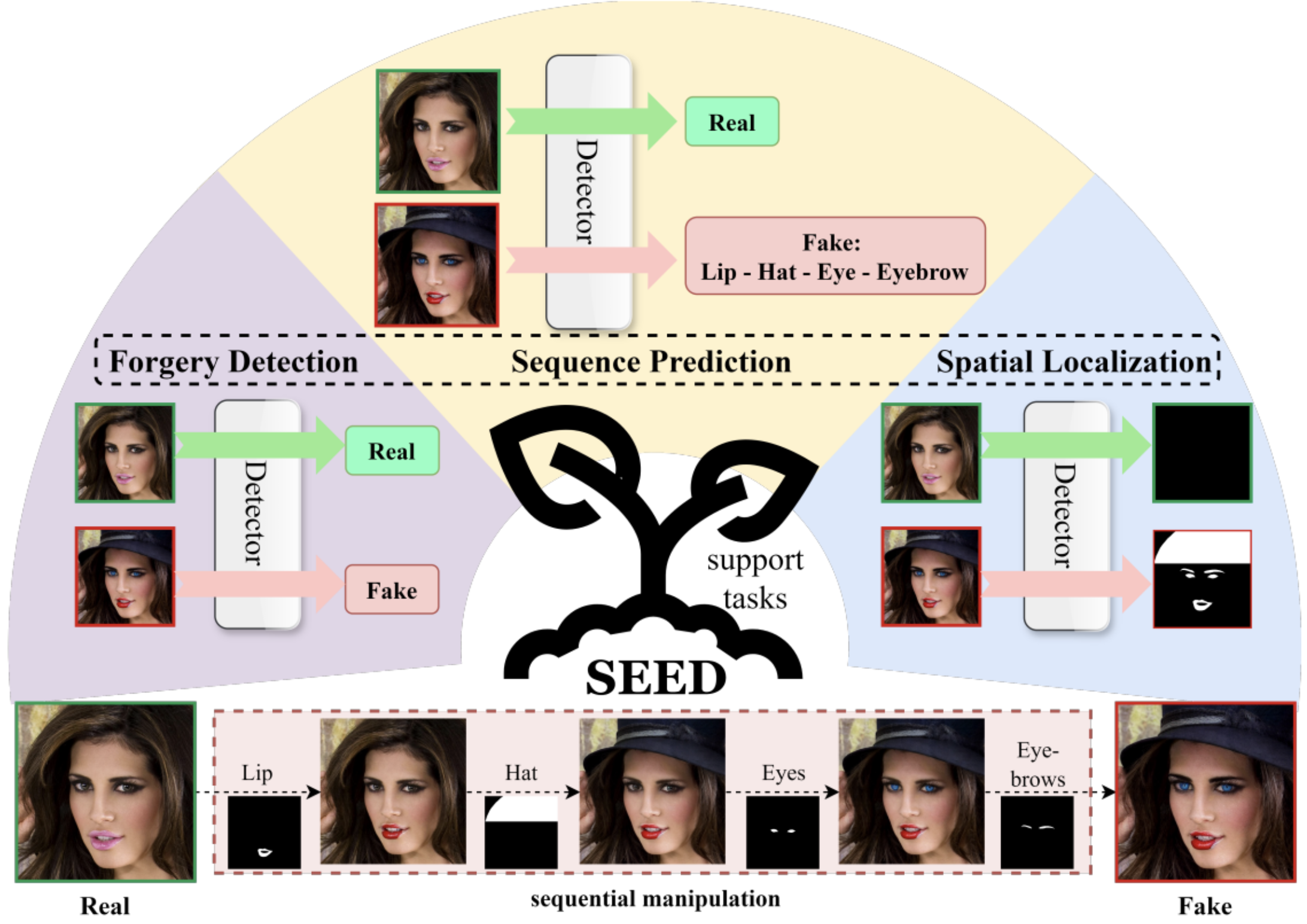
Figure 1: SEED targets authenticity, sequence, and spatial provenance analysis of faces edited through ordered diffusion-based attribute manipulations.
The SEED dataset balances sequence lengths and utilizes identity-disjoint splits to prevent learning shortcuts and to facilitate generalizable analysis. Editor diversity ensures that models are not over-specialized to a single model's artifacts. The attribute space spans both intrinsic facial features (e.g., lips, eyes, hair, eyebrows) and accessories (e.g., hats, glasses), thus modeling both low-level and compositional edits.
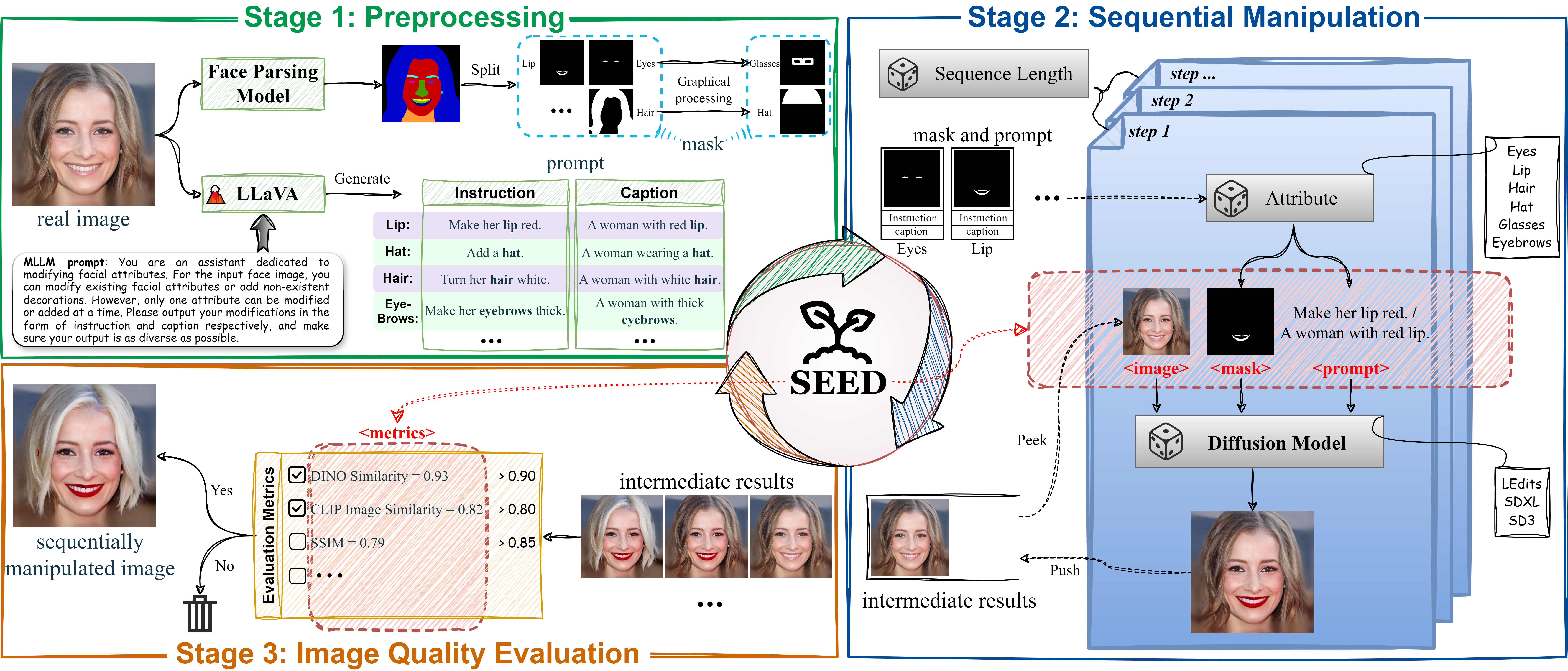
Figure 2: SEED data generation pipeline from mask/prompt construction through step-wise diffusion-based editing, with per-step quality control and provenance logging.
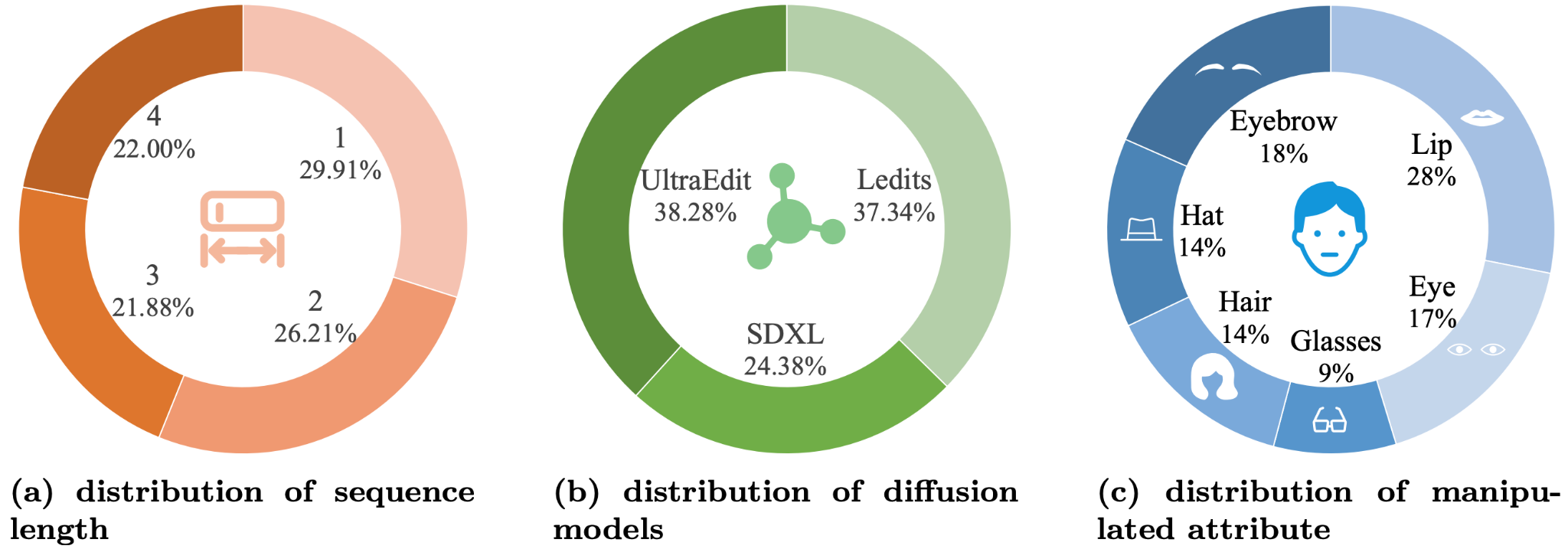
Figure 3: SEED statistics: (a) sequence length distribution, (b) distribution of contributing diffusion editors, (c) per-attribute edit frequencies.
Baseline Analysis and the FAITH Architecture
The benchmarking analysis on SEED emphasizes the deficiency of purely spatial-domain approaches when confronting subtle, weak, or overwritten artifacts that result from sequential diffusion-based manipulations. To this end, the authors introduce FAITH (Frequency-Aware Identification Transformer for Sequential Editing Detection) as a diagnostic, not ultimate, solution. FAITH employs a hybrid spatial-frequency Transformer design that combines:
- A spatial encoder (CNN + Transformer) for global and local context extraction.
- High-frequency domain features, primarily from the DWT-HH band, injected into the decoder's cross-attention. This preserves subtle artifact cues that persist across editing steps, even with image degradations.
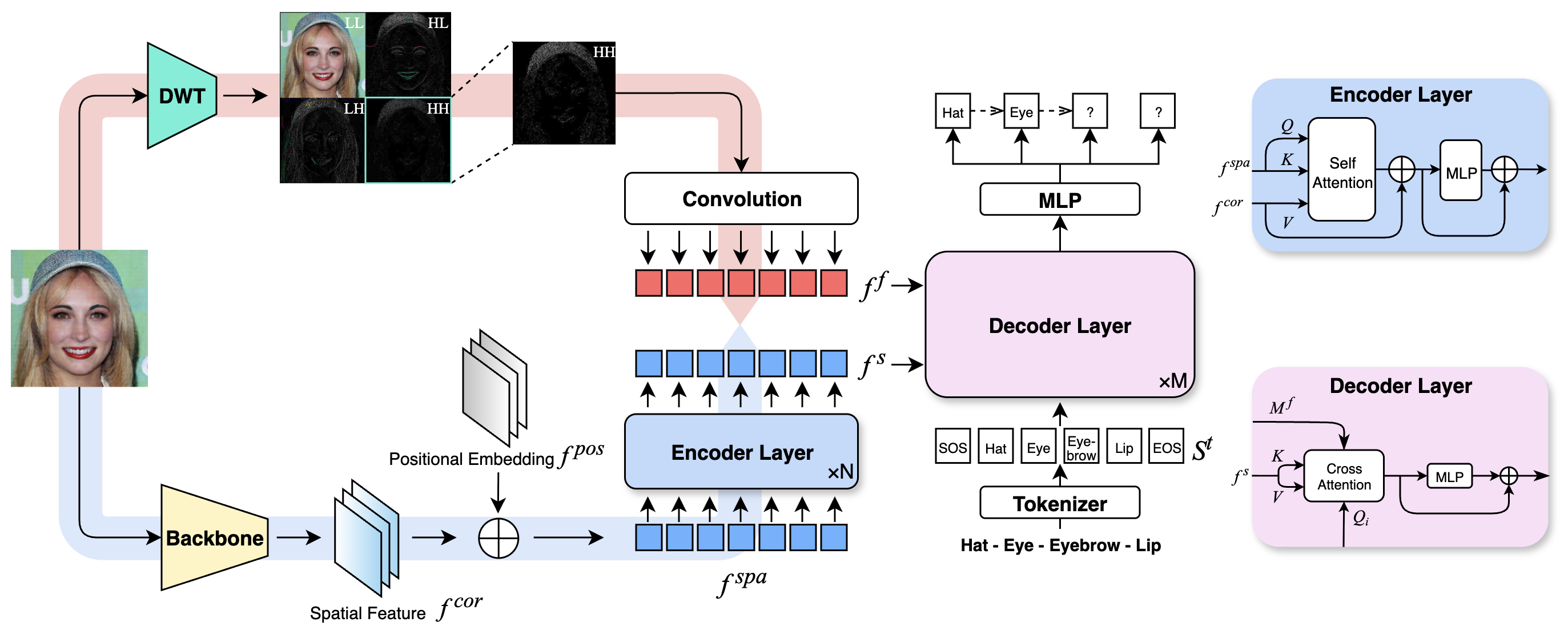
Figure 4: FAITH architecture: a hybrid spatial-frequency Transformer employing DWT-derived high-frequency guidance in sequential edit decoding.
The sequential prediction task is cast as an autoregressive sequence output problem, with attribute tokens and special markers for sequence control. Training leverages cross-entropy on the full sequence, employing teacher forcing.
Experimental Results
Quantitative evaluation reports Fixed-Acc, Adaptive-Acc, and the strict Full-Acc (requiring exact sequence match), across increasing edit chain lengths.
- All single-edit manipulation detectors fail to generalize reliably to the sequential tracing setting, showing severe performance degradation as edit length increases.
- Sequential models leveraging frequency-domain cues (FAITH) consistently outperform both classical and frequency-aware (but non-sequential) baselines. The DWT-augmented variant achieves the highest Full-Acc across most evaluations, especially for sequences of length 2 and 3.
- Performance sharply decays with length, demonstrating the inherent difficulty and information loss in provenance tracing for long, compositional edit trajectories.
- Most erroneous predictions at high L are due to ordering confusion (Swap-only), substantiating that temporal attribute disentanglement is substantially more challenging than binary authenticity or simple attribute change detection.
Robustness Analysis
Robustness to post-processing is critical for real-world deployment. SEED's benchmarks include rigorous tests under JPEG compression and additive Gaussian noise:
- All methods, especially spatial-only baselines, degrade with severe compression/noise, but frequency-guided FAITH variants are comparatively robust, maintaining higher Full-Acc and reduced catastrophic failure rates under common image-level attacks.
- DWT-based guidance is most stable under both compression and noise, confirming that directional and localized high-frequency decomposition is more resilient to global frequency attenuation or stochastic corruption.

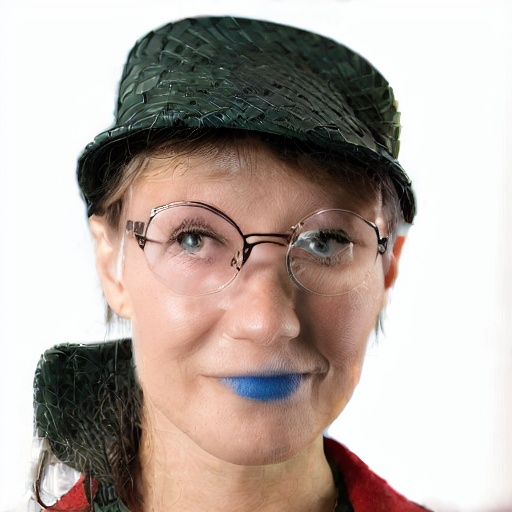
Figure 5: Qualitative comparison under compression and noise: FAITH preserves more accurate and complete edit sequence predictions than frequency-agnostic or non-sequential approaches.
Qualitative and Theoretical Implications
The qualitative analysis reveals two main failure patterns in competing baselines under post-processing: premature sequence termination (“early stopping”) and attribute order drift. FAITH remains less susceptible to these errors and more often recovers the correct chain. The hybrid approach's resilience demonstrates the complementarity of frequency and spatial cues for provenance, supporting emerging observations that manipulation artifacts, especially when weak or overwritten, persist in higher-order domains that are not adequately exploited by standard vision transformers.
Conclusion
SEED establishes a comprehensive, step-wise provenance tracing paradigm for diffusion-based facial deepfake edits, exposing the limitations of existing detectors and motivating hybrid analytic schemes. It is the first large-scale facial benchmark to pair realistic, compositional edits with temporally ordered, spatially localized ground truth, supporting robust evaluation of both detection and sequence-level recovery. The analysis confirms the need for explicit frequency-domain modeling, especially DWT-guided representations, as diffusion pipelines sanitize obvious spatial cues. FAITH's strong results set a new expectation for future architectures, both forensics- and moderation-oriented, requiring both robustness and high-fidelity edit history recovery.
Future research directions include:
- Extension to open-domain multi-modal or video-based sequential editing traces.
- Adversarial robustness under new generations of diffusion/inversion pipelines.
- Theoretical modeling of edit footprint persistence and information-theoretic limits on sequential provenance recovery in image generative models.
Conclusion
SEED offers a rigorous, compositional, and fine-grained benchmark for sequential provenance tracing of diffusion-based facial edits, providing both a new challenge and an analytic tool for the forensics and trustworthy media analysis community. The demonstrated impact of frequency-aware architectures reinforces the necessity of cross-domain modeling for effective deepfake forensics in the diffusion era.