$μ$VLA: On Recurrent Memory for Partially Observable Manipulation in VLA Models
Abstract: Vision-language-action (VLA) models predict chunks of future actions from the current observation, an assumption that fails under partial observability, where decisions depend on information no longer visible. Existing memory-augmented VLAs simultaneously introduce recurrence, retrieval, compression modules, auxiliary objectives, hierarchical memory, or task-specific architectural changes, so the contribution of recurrence itself remains entangled with surrounding machinery. We present a controlled isolation study of recurrence in a strong pretrained VLA backbone. Our formulation augments the transformer with a small set of learnable memory tokens carried across timesteps and updated through self-attention, trained end to end with truncated backpropagation through time, with no auxiliary losses and no architectural changes. We instantiate this as $μ$VLA, a family of OpenVLA-OFT variants parameterized by memory width m, TBPTT length K, and the memory update rule (cross-step gradients or a detached EMA), so that recurrence is the only varying factor. On MIKASA-Robo, $μ$VLA improves average success rate on five training tasks from 0.42 to 0.84 at the strongest setting and reaches 0.23 on held-out tasks with the same memory structure versus 0.07 for the memoryless baseline. On tasks requiring different memory structure, performance remains near baseline. On LIBERO, the strongest recurrent variant achieves 96.2% average success, indicating no regression under full observability. We interpret these results as a calibration of the capability envelope of minimal in-backbone recurrence, identifying the regime in which it is sufficient and the regime where additional memory structure is required. Demos and videos can be found in https://avanturist322.github.io/mu-vla/.

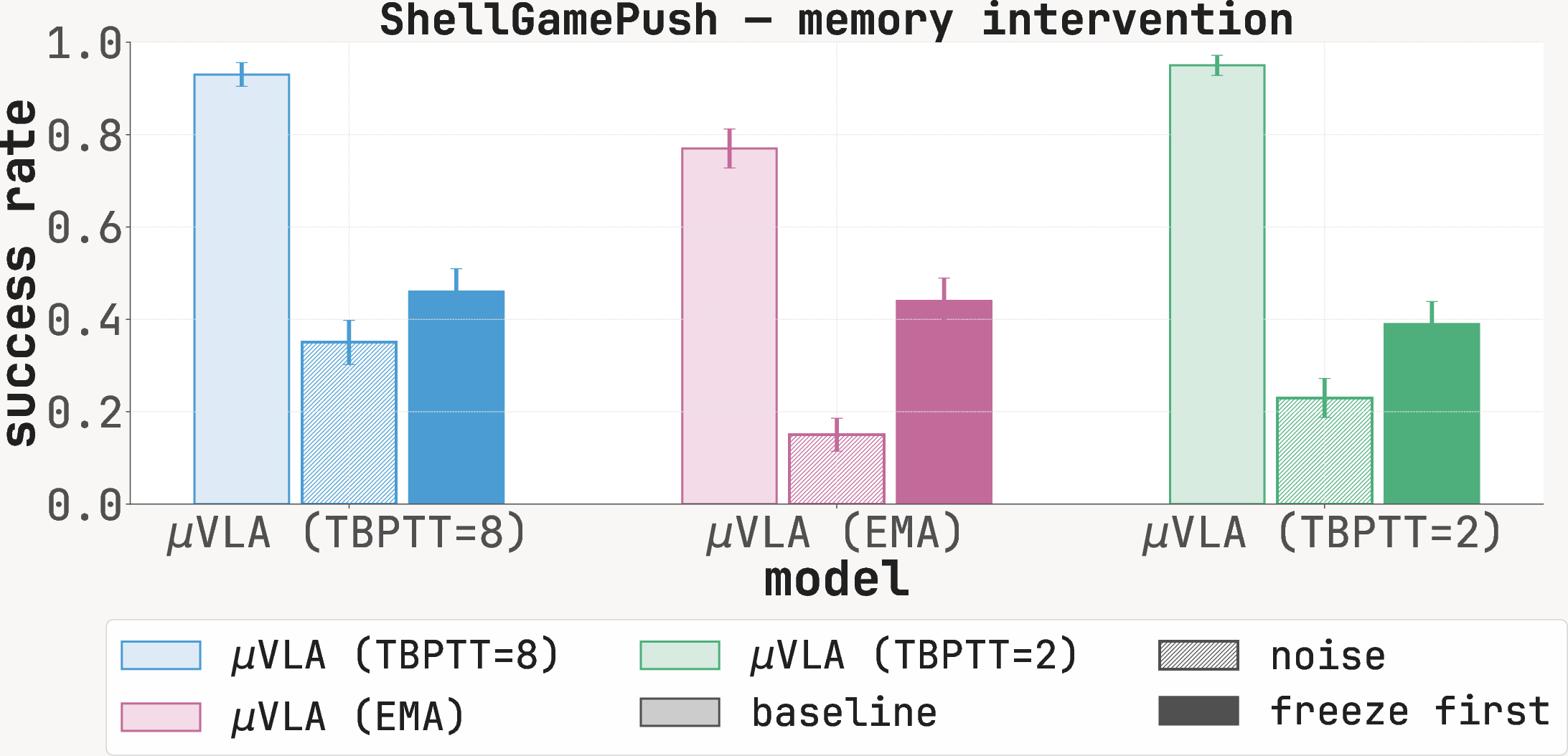
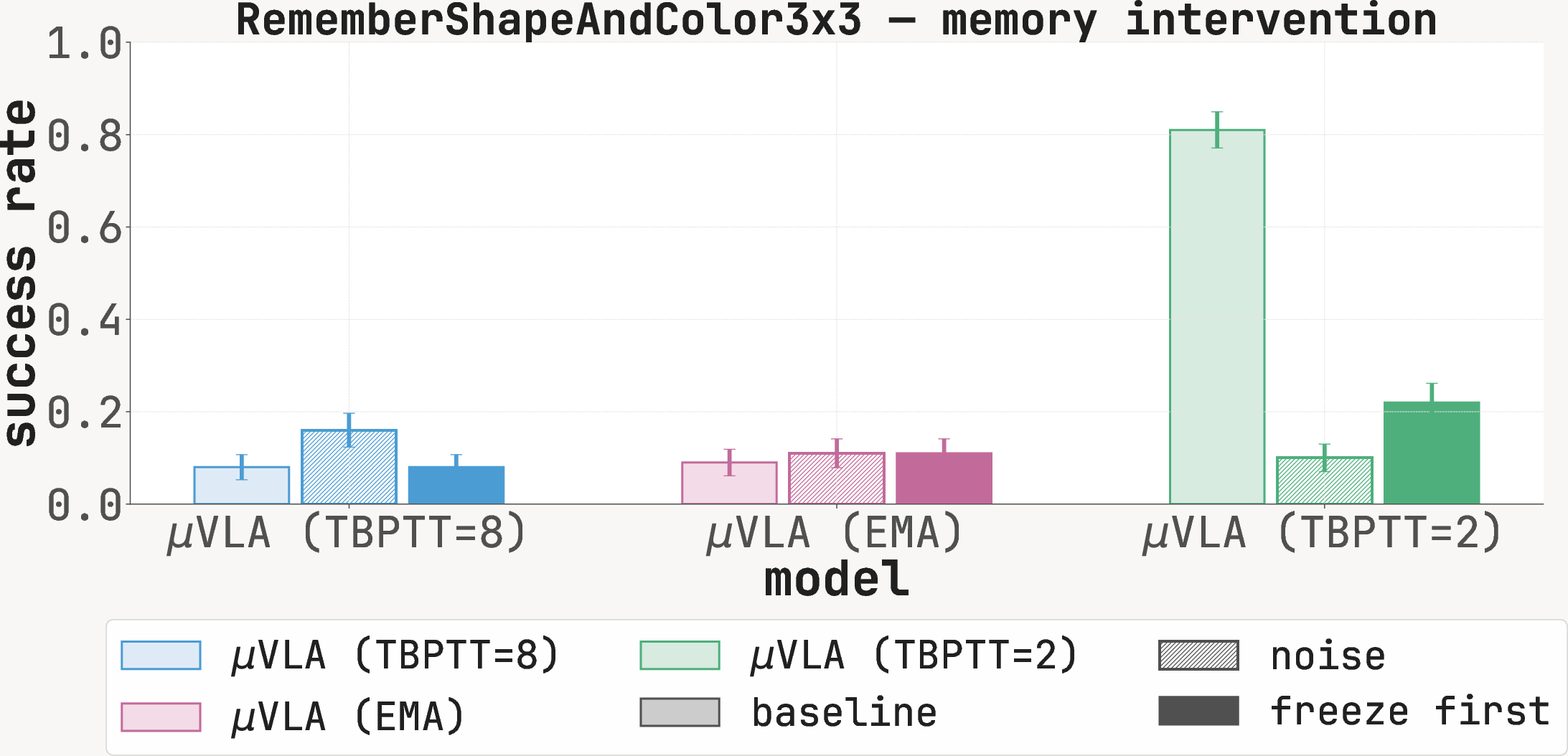
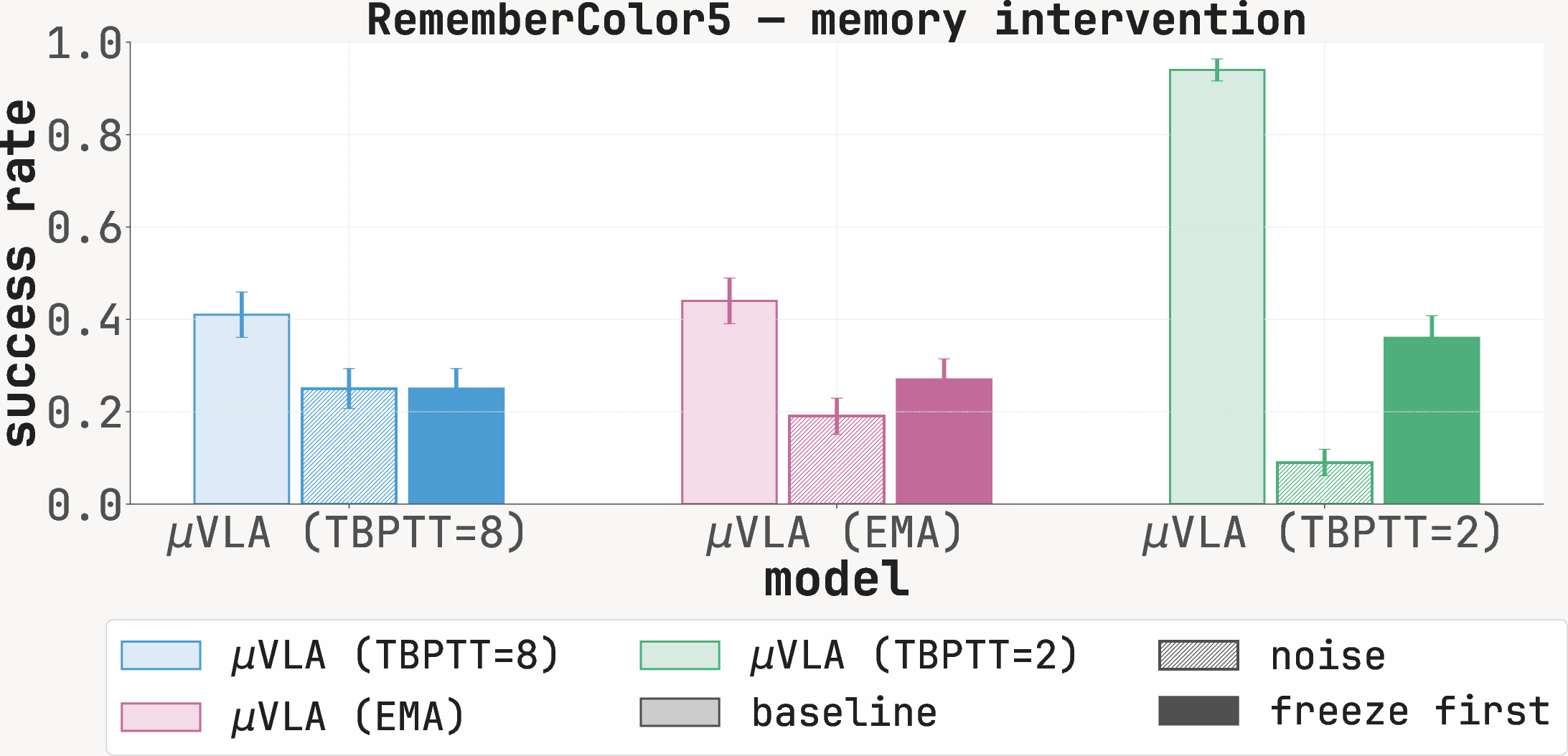
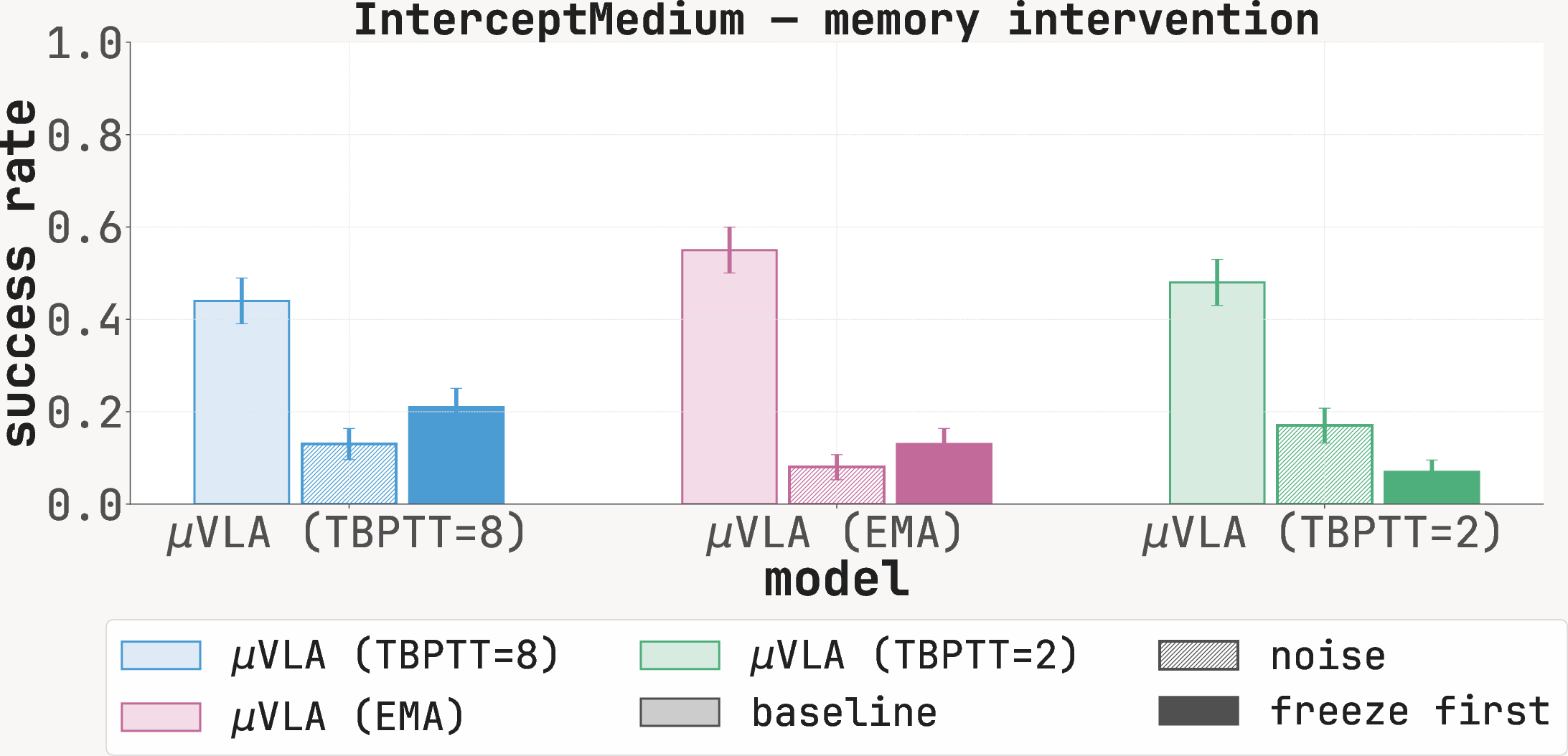

Paper Prompts
Sign up for free to create and run prompts on this paper using GPT-5.
Top Community Prompts
Explain it Like I'm 14
Plain-English Overview
This paper is about helping robot brains remember important things that aren’t always visible. The authors study a simple way to add “memory” inside a robot’s decision-making model so it can do tasks where it needs to recall something it saw earlier (like a shell game or remembering a color) even when it can’t see it anymore.
They keep the design very simple on purpose, so they can answer one main question: How much can we get just from adding a small, built‑in memory, without any fancy extra parts?
What Are They Trying to Find Out?
They focus on four easy-to-understand questions:
- If we add a small memory to a strong existing robot model, does it actually help on tasks where the robot can’t see everything it needs at once?
- What’s the best way to train this memory over time: learning across a few steps, only one step, or using a simple averaging trick?
- Will the memory learned on some tasks carry over to new but similar tasks? What about different kinds of memory tasks?
- Does adding memory hurt performance on tasks where everything is visible and memory isn’t needed?
How Does Their Method Work?
Think of the robot’s brain as a big transformer model that reads:
- what it sees (camera images),
- what it feels (its arm/hand positions, called proprioception),
- what it’s told to do (a text instruction),
- and now, a small “memory” it carries from one moment to the next.
Here’s the method in everyday terms:
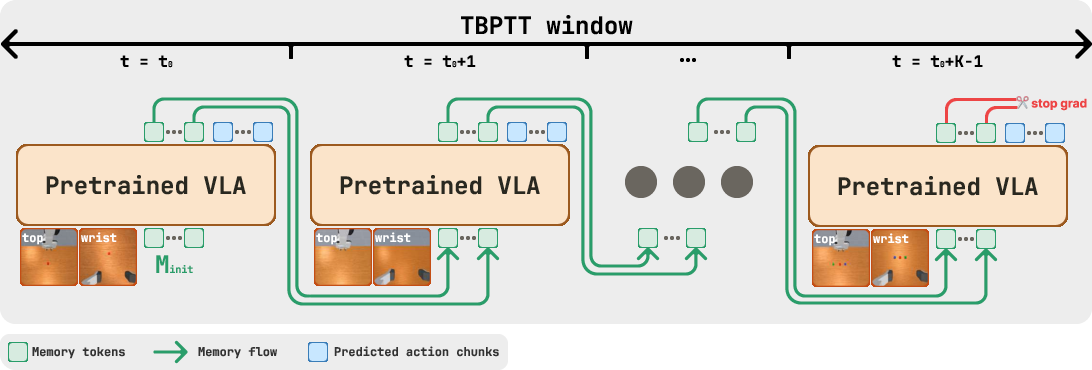
- Memory tokens: Imagine a tiny set of “sticky notes” the robot carries forward each time step. These memory notes are short summaries the model writes to and reads from, step by step.
- Attention rules: They add a simple rule so the memory can’t “cheat” by copying the robot’s own planned actions. This forces the memory to store useful observations (like “the red cube is the goal”), not just the answers.
- Keep time in order: During training, they feed whole episodes in the correct order (not shuffled frames), so the model learns to update memory naturally over time.
- Training the memory over time:
- Truncated Backpropagation Through Time (TBPTT): Think of practicing a sequence a few steps at a time (length K), then adjusting what you learned. This lets the model learn cause-and-effect across several steps.
- EMA (Exponential Moving Average): A simpler alternative that just smooths memory over time (like averaging recent notes), but doesn’t truly learn across steps.
- Step-by-step control (receding horizon): At test time, the robot predicts several actions but executes only the first one, then looks again and updates memory. This keeps the memory in sync with the world, so it won’t miss quick, important moments.
They plug this simple memory into a strong, pretrained Vision-Language-Action (VLA) model called OpenVLA-OFT and change nothing else. They vary only three knobs:
- memory size (how many tokens),
- how many steps they learn across at once (K),
- and whether they use TBPTT or EMA.
Where Did They Test It?
- MIKASA-Robo: A robot benchmark designed to require memory. Example task types:
- Cue-recall: a brief hint at the start defines the goal (like “remember the color you saw”).
- Occlusion: track an object that goes out of sight (like a shell game).
- Sequential/predictive: remember what happened earlier to act later (like “take it back” or intercepting a moving object).
- LIBERO: A fully observable robot suite where the robot usually can see everything it needs (so memory shouldn’t be necessary). This checks for any downside of adding memory.
What Did They Find?
Here are the key results in simple terms:
- Big gains when memory matters:
- On the five training tasks in MIKASA-Robo, success rate jumped from about 0.42 to 0.84 with the best memory setting (short TBPTT, K=2). That’s roughly doubling performance.
- Generalization to similar tasks:
- On new tasks that require the same kind of memory (e.g., remembering color but with a different number of options), success improved from about 0.07 to 0.23. Not as big as on training tasks, but clearly better than no memory.
- Limits on different memory types:
- On tasks that need a different kind of memory than what the model was trained on, performance stayed close to the non-memory baseline. This suggests the simple memory helps most when the “memory logic” is similar.
- No harm when memory isn’t needed:
- On LIBERO (fully visible tasks), the best recurrent version reached about 96.2% average success, staying competitive with the strong baseline. In other words, adding memory didn’t break anything.
- How to train memory best:
- Learning across a short window (TBPTT with K=2) worked best for memory-heavy tasks.
- Learning across only one step (K=1) or using the simple averaging trick (EMA) helped less.
- Using too long a window (K=8) also underperformed K=2 on memory-recall tasks.
- Why step-by-step control matters:
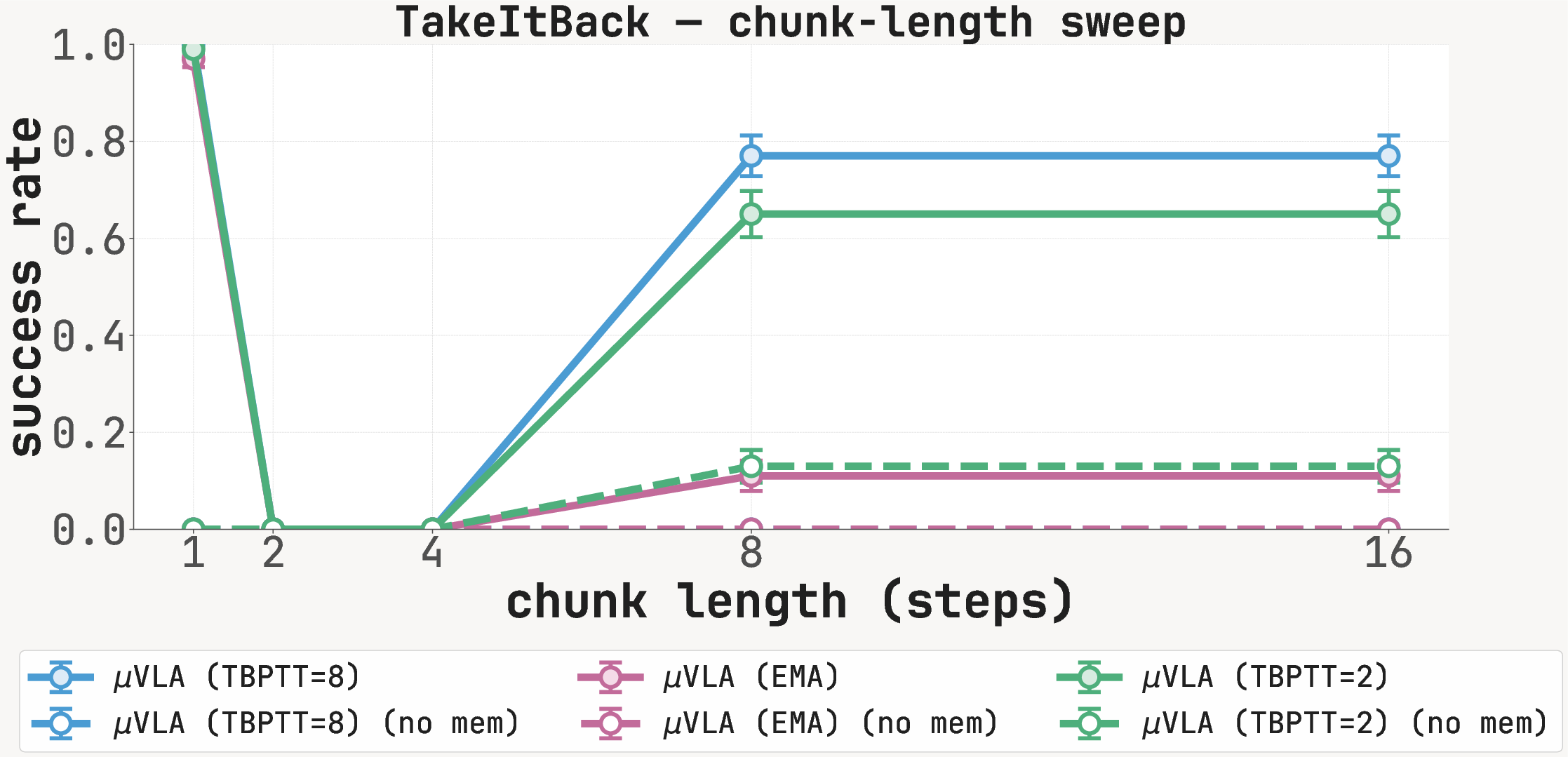
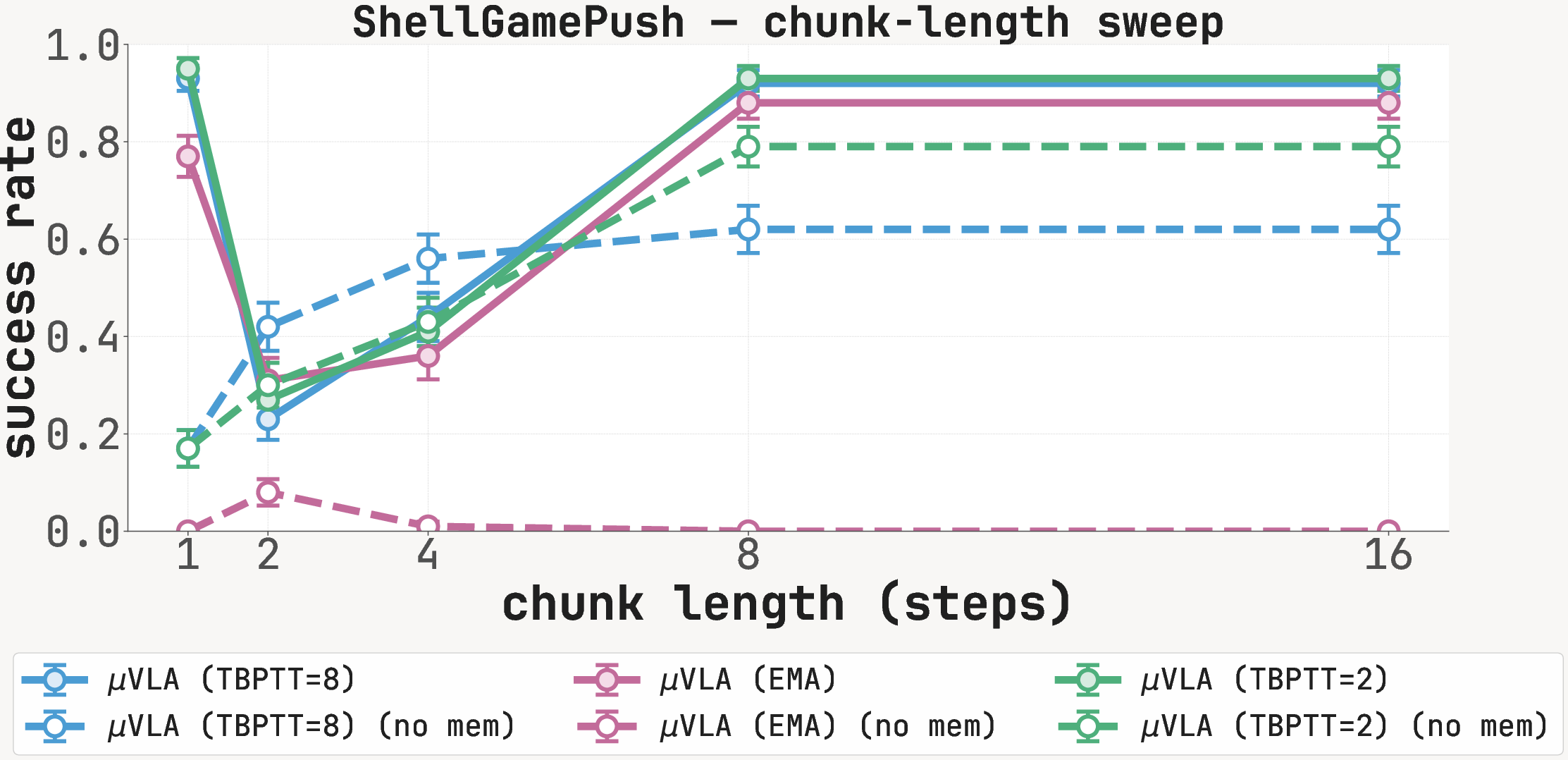
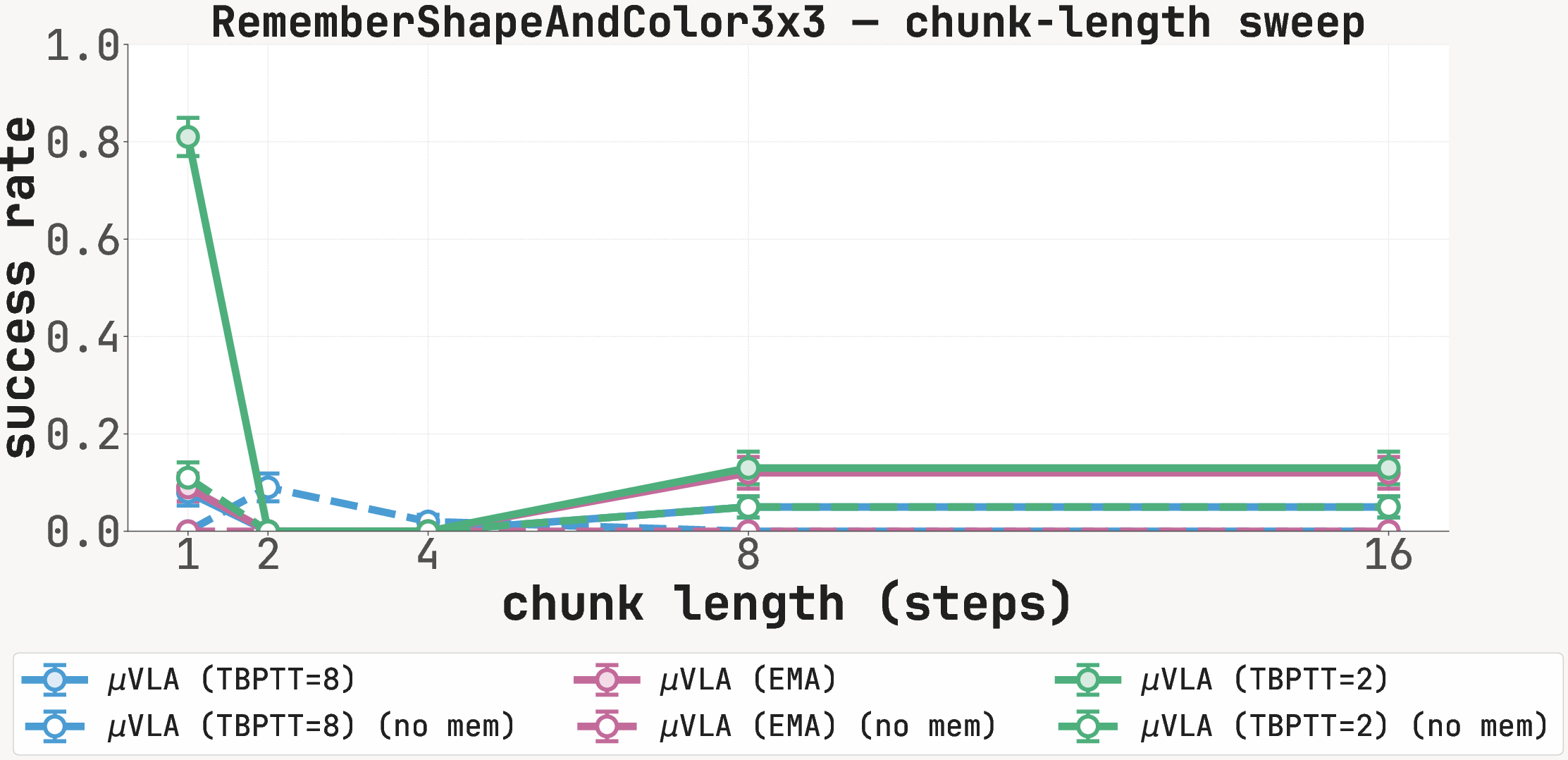
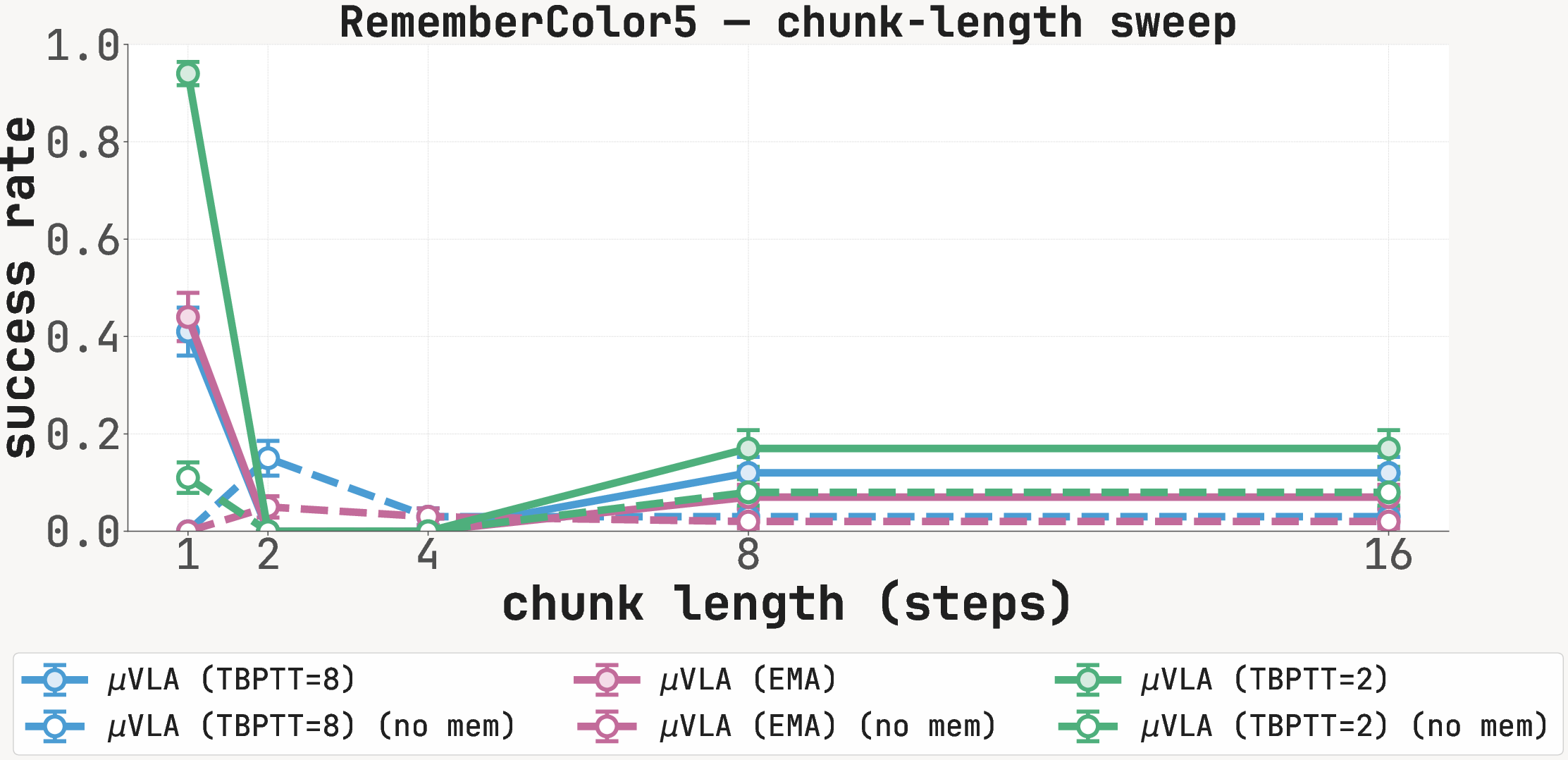
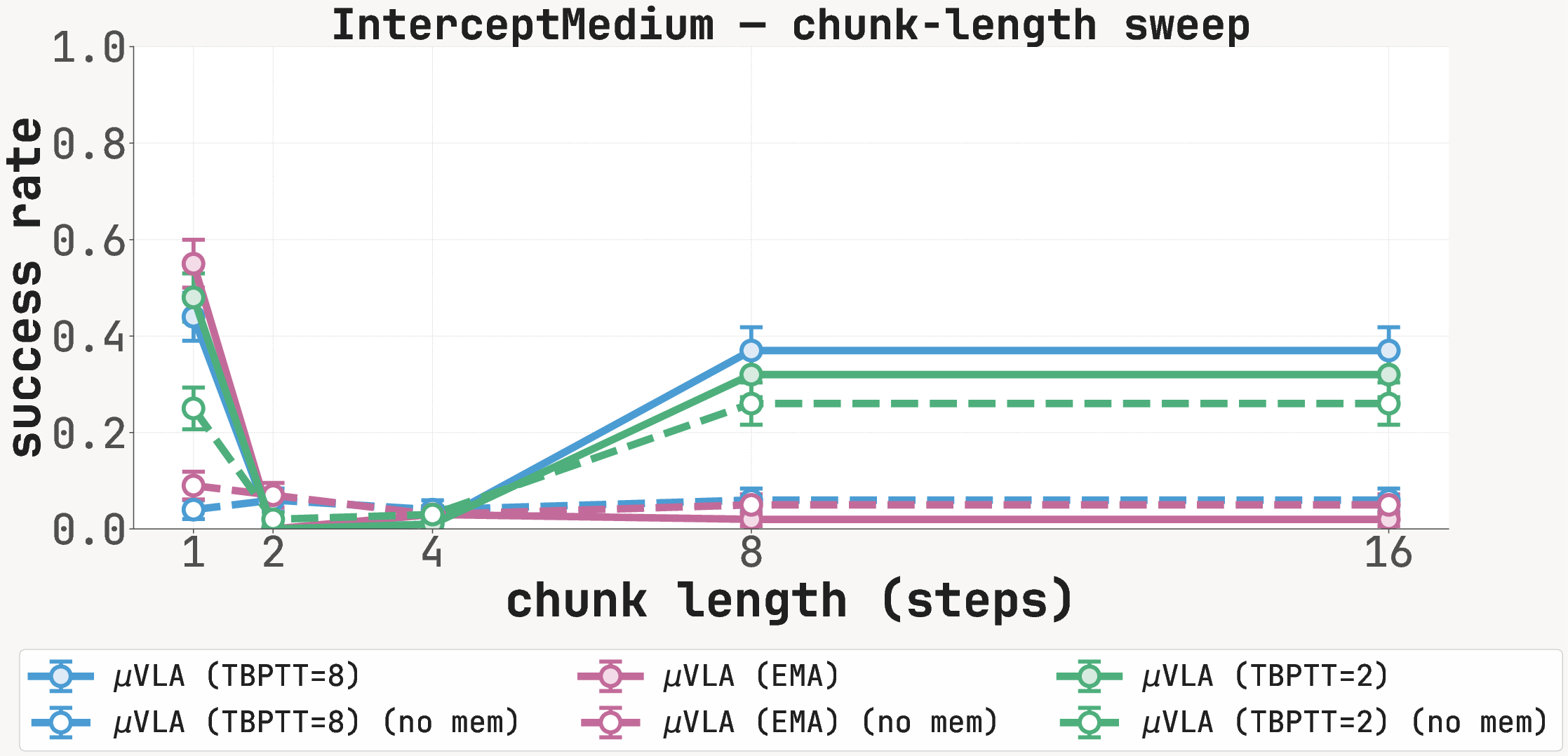
- If you execute long action chunks without re-checking the world each step, performance can collapse. Updating memory every step keeps the robot in sync with quick changes.
Why Is This Important?
- Clear, minimal recipe: The paper shows that simply adding a tiny, learnable memory inside the existing model—without complicated extra modules—is enough to solve many “I need to remember” tasks.
- Calibration, not hype: By changing only the memory part and keeping everything else the same, the authors can honestly say which improvements come from recurrence (memory over time) itself.
- Practical guidance:
- Use a few memory tokens passed each step.
- Prevent memory from reading action outputs (to avoid cheating).
- Train across a short time window (K around 2).
- At test time, re-check every step (don’t run open-loop for many steps).
- Limits and next steps:
- This simple memory doesn’t handle every kind of long or different memory problem. For tasks that need new or more complex memory structures, you likely need extra tools (like external memory, retrieval systems, or hierarchical memory).
Bottom Line
Giving a robot a small, built-in memory—like a handful of sticky notes it updates every step—can dramatically improve tasks where it must remember things it can’t currently see. This simple approach is powerful, safe to add (it doesn’t hurt easy tasks), and helps clarify when you need more advanced memory systems.
Knowledge Gaps
Knowledge gaps, limitations, and open questions
The paper isolates and evaluates minimal in-backbone recurrence in a VLA backbone. The following concrete gaps and open questions remain:
- Lack of head-to-head comparisons with equally minimal alternative history mechanisms under matched budgets (e.g., sliding context windows/KV-cache reuse, lightweight retrieval) prevents concluding when recurrence is preferable at equal compute and data.
- Memory structure is limited to a single bank of global tokens; no evaluation of object-centric/slot-based, spatial, or hierarchical memories that might be necessary for “novel memory semantics” (e.g., Rotate tasks) or multi-object tracking.
- Memory capacity scaling is underexplored: only m ∈ {1, 64} is tested. No scaling curves relating memory width m to success, latency, and stability, nor token-usage pruning/sparsification analyses.
- TBPTT truncation is explored sparsely (K ∈ {1,2,8}) with a U-shaped outcome but no mechanistic explanation; no tests with larger K, adaptive/variable-length credit assignment, or curriculum that aligns K with event spacing.
- EMA write uses a single α=0.1; no study of α sweep, learnable α, gated EMA, or alternative local-write rules (e.g., learned low-rank updates, synthetic gradients) that might close the gap to TBPTT.
- Receding-horizon inference is required for performance; open-loop chunk execution collapses. No strategy is proposed to keep per-step memory updates while amortizing compute (e.g., partial re-query, delta updates, smaller auxiliary memory-only passes).
- Real-robot validation is absent; transfer from simulated MIKASA/LIBERO to physical systems (sensor noise, latency, actuation delays, safety constraints) is untested.
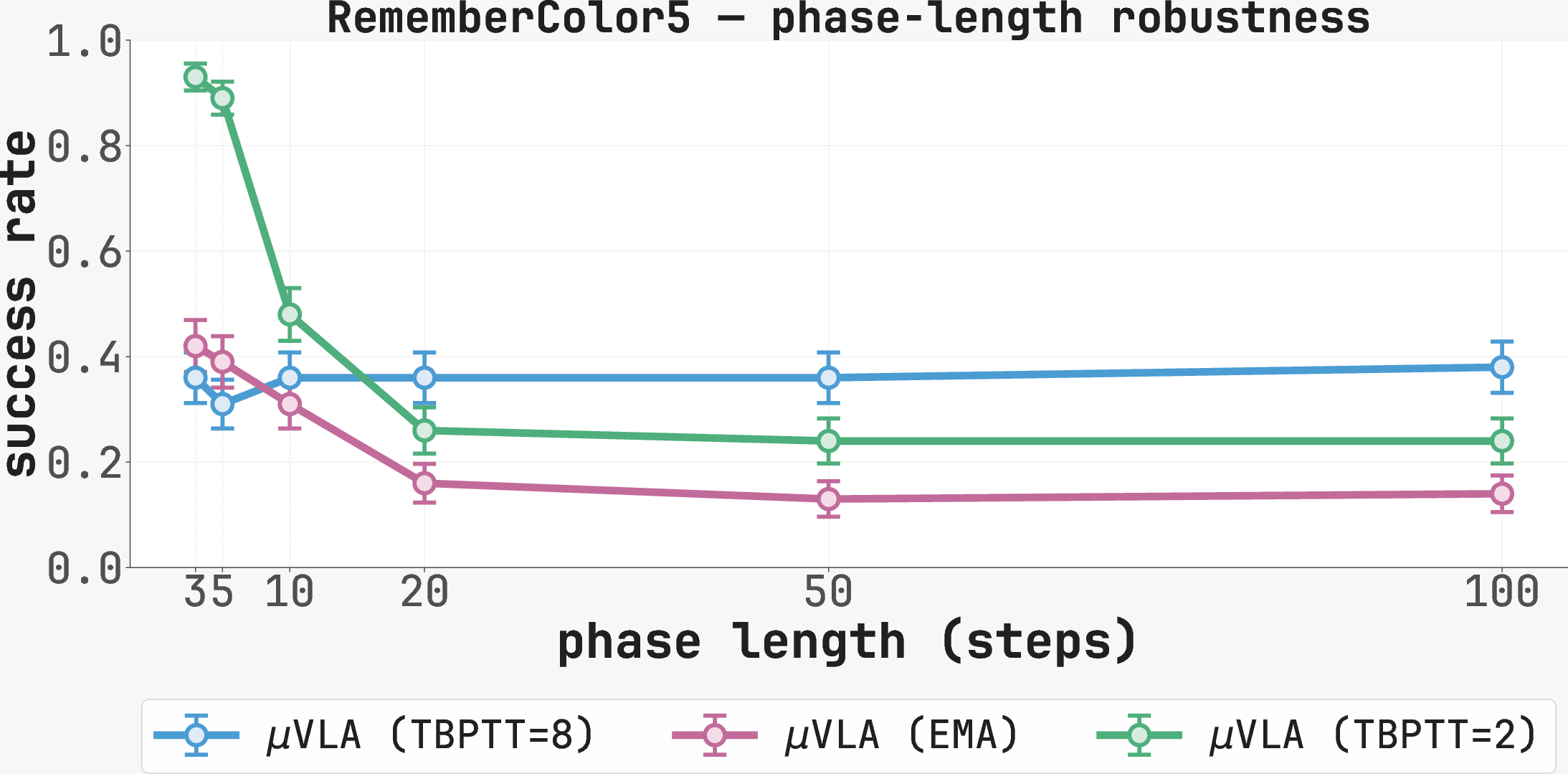
- Long-horizon retention is brittle (performance drops sharply when phase length increases); no techniques are evaluated to improve length generalization (e.g., temporal regularizers, forget gates, auxiliary recall losses, contrastive persistence, curriculum).
- Generalization to unseen memory semantics is limited; no exploration of minimal additional structure (e.g., progress counters, phase/option variables, key–value slots) that would enable compositional transfer.
- Only LoRA adapters are fine-tuned; effects of full fine-tuning, adapter placement/size, or selective layer unfreezing on recurrent state quality and stability are unknown.
- Memory token placement is fixed (between proprio and text) and at input level; no ablation of placement (before/after vision/text), positional embeddings, or per-layer recurrent states (deeper-layer memories).
- The action-copy guard (mask preventing memory reading action tokens) may also block beneficial action-conditioned memory; alternative anti-copy strategies (regularization/auxiliary penalties) or selective action-to-memory access are not evaluated (TBPTT with full mask is not reported).
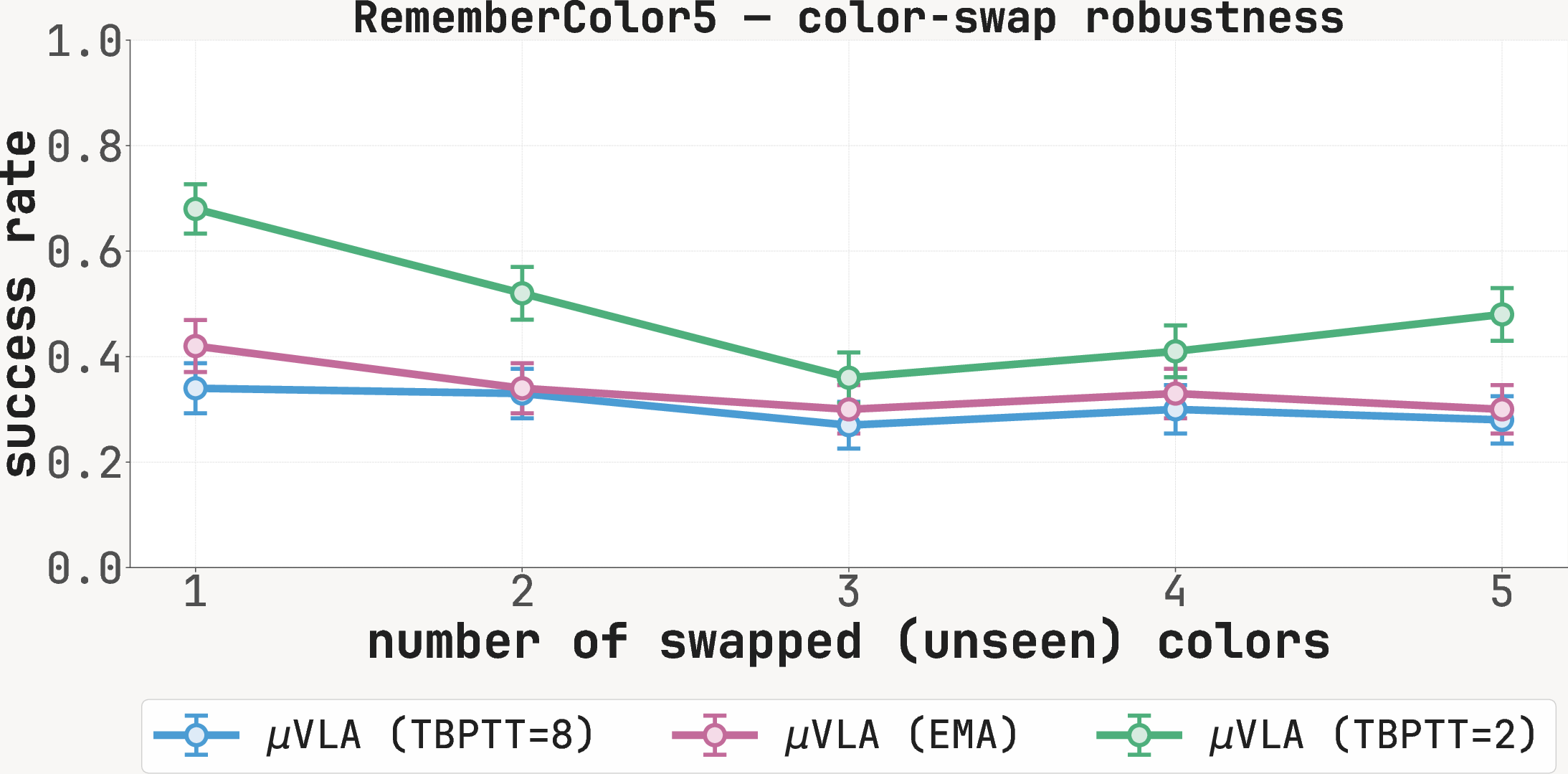
- Evaluation uses 100 deterministic episodes; robustness to stochastic dynamics, camera perturbations, distractors, lighting changes, and sensor noise is largely unmeasured beyond color-swap tests.
- Baseline coverage on MIKASA-Robo is narrow; there is no matched training-budget comparison to modern memory/retrieval VLAs on the same tasks, so the absolute capability envelope vs. stronger memory systems remains unclear.
- Memory interpretability remains limited; no probing heads/classifiers to decode stored variables (e.g., cue identity, object index, progress), no causal editing to test specific memory content, and no token-importance attribution beyond dynamics/attention rollouts.
- Memory initialization and reset policy are simplistic (learned M_init, reset at is_first); behavior under mis-specified resets, mid-episode reinitialization, or continual tasks without hard resets is untested.
- Multi-task interference as the number/diversity of tasks grows is not characterized; scaling beyond the 5-task mixture, catastrophic interference, or methods for task-conditioned memory partitioning are open.
- Embodiment and sensing diversity are limited (tabletop manipulation with fixed vision encoders); portability to mobile manipulation, different camera viewpoints, depth sensors, or tactile inputs is not assessed.
- Action parameterization is fixed (continuous L1-regressed chunks); impact of discrete action tokens, hybrid or latent actions, or closed-loop low-level controllers on recurrent state usage is unknown.
- Compute and energy trade-offs are not quantified in the main text; a clear cost–quality frontier over m, K, and inference cadence is needed for deployment decisions.
- Adversarial or worst-case evaluation of the recurrent channel is missing; how easily the memory can be corrupted by spurious cues or adversarial flashes, and how to defend (e.g., consistency checks) is open.
- Action-chunk horizon H is fixed at 8 during training; the effect of training with H=1 vs. larger H on memory learning, alignment with inference cadence, and sample efficiency is not ablated.
- Synergy between recurrence and retrieval/hierarchical memory is untested; do simple recurrence and lightweight retrieval compose additively or interfere, and what division of labor emerges?
- Gradient stability and optimization of the recurrent path (vanishing/exploding through memory tokens) are not analyzed; no reports on gradient norms, clipping, spectral control, or regularizers tailored to recurrent tokens.
- Language robustness and disambiguation via memory are not studied; performance under paraphrased/ambiguous instructions where memory must bind language cues to observations remains an open test.
- Uncertainty-aware memory (belief tracking under occlusion) is not considered; mechanisms to represent and act on memory uncertainty (e.g., stochastic memory, ensembles) could improve occluded tracking and decision thresholds.
Practical Applications
Immediate Applications
The following applications can be deployed with today’s VLAs and training stacks by retrofitting minimal recurrence (e.g., memory tokens, episodic dataloaders, short TBPTT) and switching to receding-horizon inference, as demonstrated by μVLA.
- Robotics logistics: robust pick/place through occlusions and shuffles (Shell-Game–style)
- Sectors: Robotics, Warehousing, Fulfillment
- What: Upgrade existing VLA-controlled pick-and-place systems to maintain a latent “target identity/location” when items are moved or briefly occluded.
- How (tools/workflows): Add a small bank of memory tokens (e.g., m≈64), enforce the memory–action attention guard, adopt an episodic dataloader, fine-tune with short TBPTT (K≈2), and deploy with per-step (receding-horizon) querying.
- Expected benefit: Higher success under partial observability; fewer failure modes when the target is hidden or shuffled.
- Assumptions/dependencies: Availability of temporally ordered demonstrations; sufficient per-step inference budget; tasks share memory semantics with training.
- Home assistants that recall one-shot visual cues (e.g., “bring the blue mug you saw at the start”)
- Sectors: Consumer Robotics
- What: Remember color/shape cues seen early in a task and retrieve corresponding objects later when not visible.
- How: μVLA-style fine-tuning on cue-recall demonstrations; short TBPTT (K≈2) and receding-horizon control; ensure the first cue is well captured in training data.
- Expected benefit: Large gains on cue-recall tasks without external memory systems.
- Assumptions/dependencies: Training mixture must include similar cue-recall semantics; consistent camera vantage points for initial cues.
- Sequential assembly steps that require remembering prior selections
- Sectors: Manufacturing, Assembly
- What: Maintain latent state across multi-step sequences (e.g., choose part A, later return it or pair it with part B).
- How: Retrofit recurrence into current VLA policies; leverage TBPTT (K≈2–8) depending on step spacing; adopt episodic dataloaders for training.
- Expected benefit: Improved continuity and fewer step-confusion errors without redesigning architecture.
- Assumptions/dependencies: Demonstrations must reflect the sequence structure; K and horizon tuned to step spacing.
- Dynamic object interception with partial cues
- Sectors: Industrial Automation (e.g., conveyors), Robotics
- What: Catch or interact with moving objects where intent or timing is partially observed.
- How: Add memory tokens to track transient timing cues; per-step re-query to monitor changes; tune K to dynamics (K≈2 worked well in MIKASA tasks).
- Expected benefit: Better timing and catch success under transient signals.
- Assumptions/dependencies: Robust frame-rate and latency; demonstrations that expose timing cues.
- Teleoperation assistance with persistent context
- Sectors: Teleoperation, Field Robotics
- What: Provide memory-augmented action suggestions to teleoperators when camera views are intermittent or narrow FOV hides key targets.
- How: Use μVLA as an advisory policy that maintains memory of the initial scene layout and intent; per-step inference aligned with operator sampling.
- Expected benefit: Reduces operator cognitive load; fewer failed grasps due to forgotten cues.
- Assumptions/dependencies: Human-in-the-loop safety protocols; consistent synchronization between operator actions and model updates.
- GUI/RPA agents that remember transient UI states
- Sectors: Software Automation, IT Ops
- What: Maintain a latent state of UI elements that briefly appear/disappear (e.g., modal prompts) during multi-step scripts.
- How: Port the memory-token mechanism to multimodal (screen-text) action models; train on episodic UI flows with TBPTT K≈2 to capture short-lived cues.
- Expected benefit: Fewer script failures due to missing transient dialogs or alerts.
- Assumptions/dependencies: Vision-language-action modeling of GUIs; adequate data of episodic UI flows.
- Benchmarking and evaluation for partial observability
- Sectors: Academia, Robotics R&D
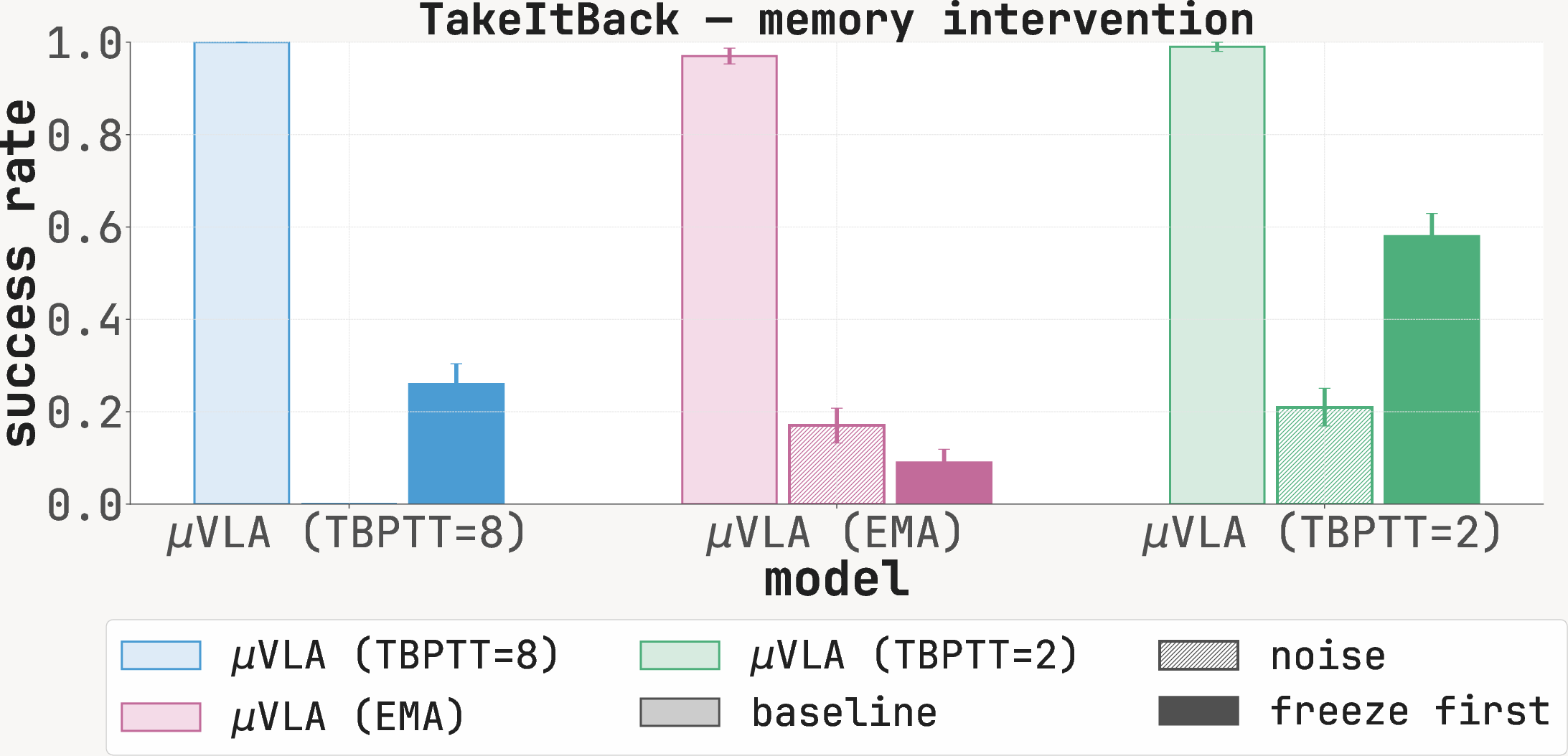
- What: Adopt MIKASA-Robo–style tasks and μVLA’s diagnostics (noise/freeze-first interventions, attention rollouts, memory-dynamics plots) to assess whether robots truly use memory.
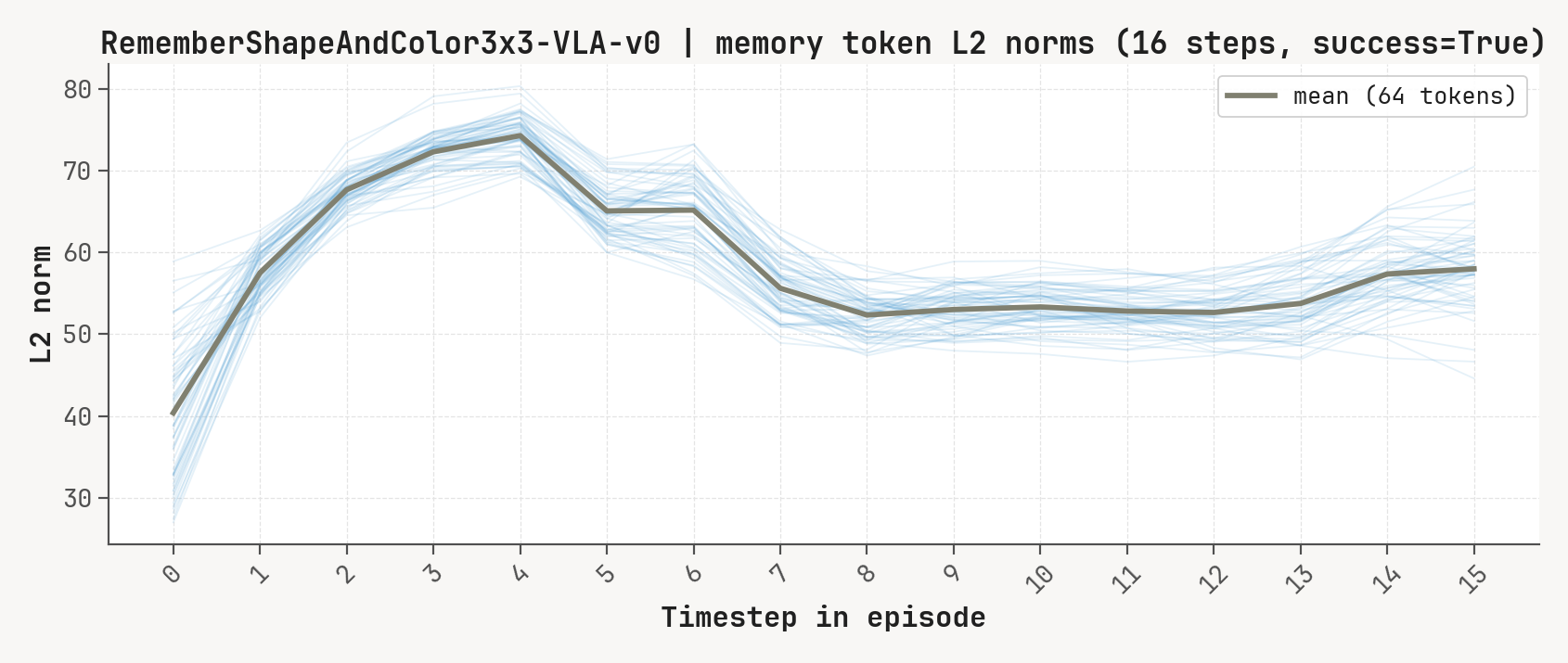
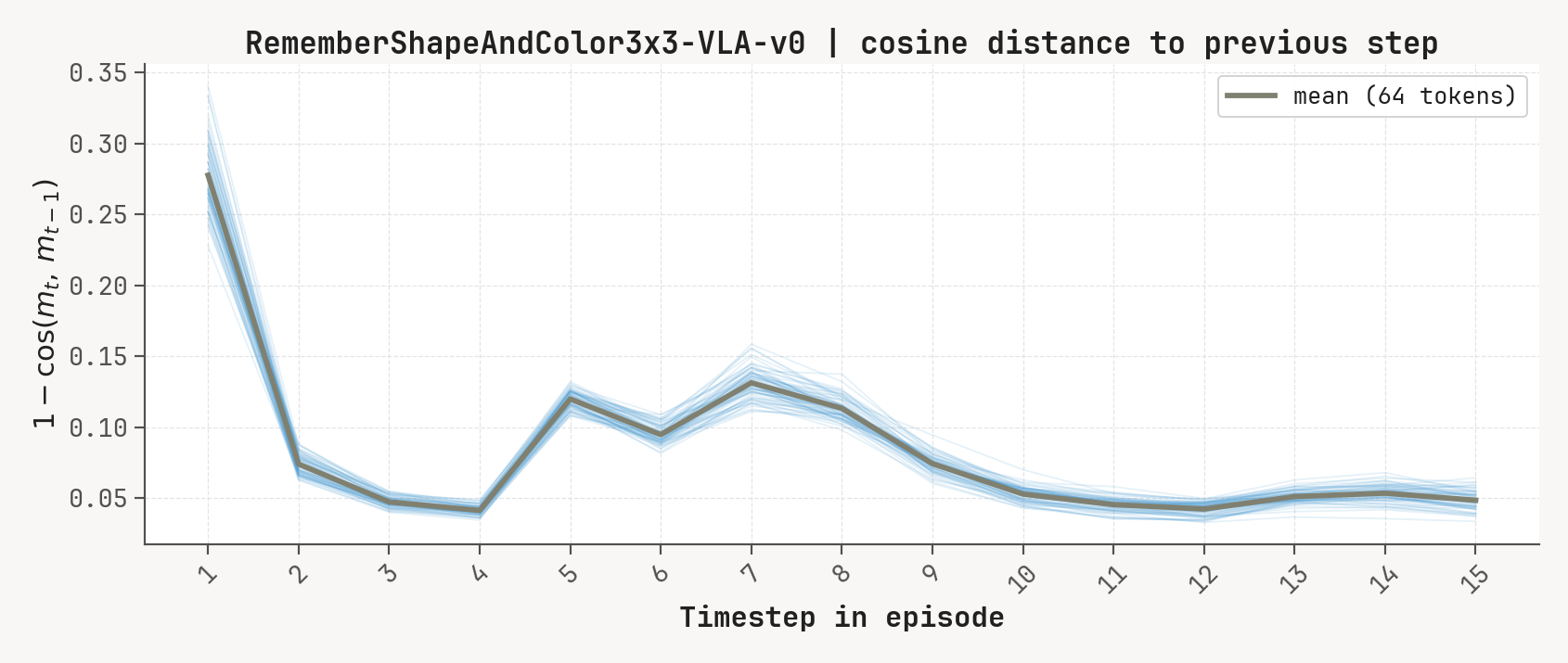
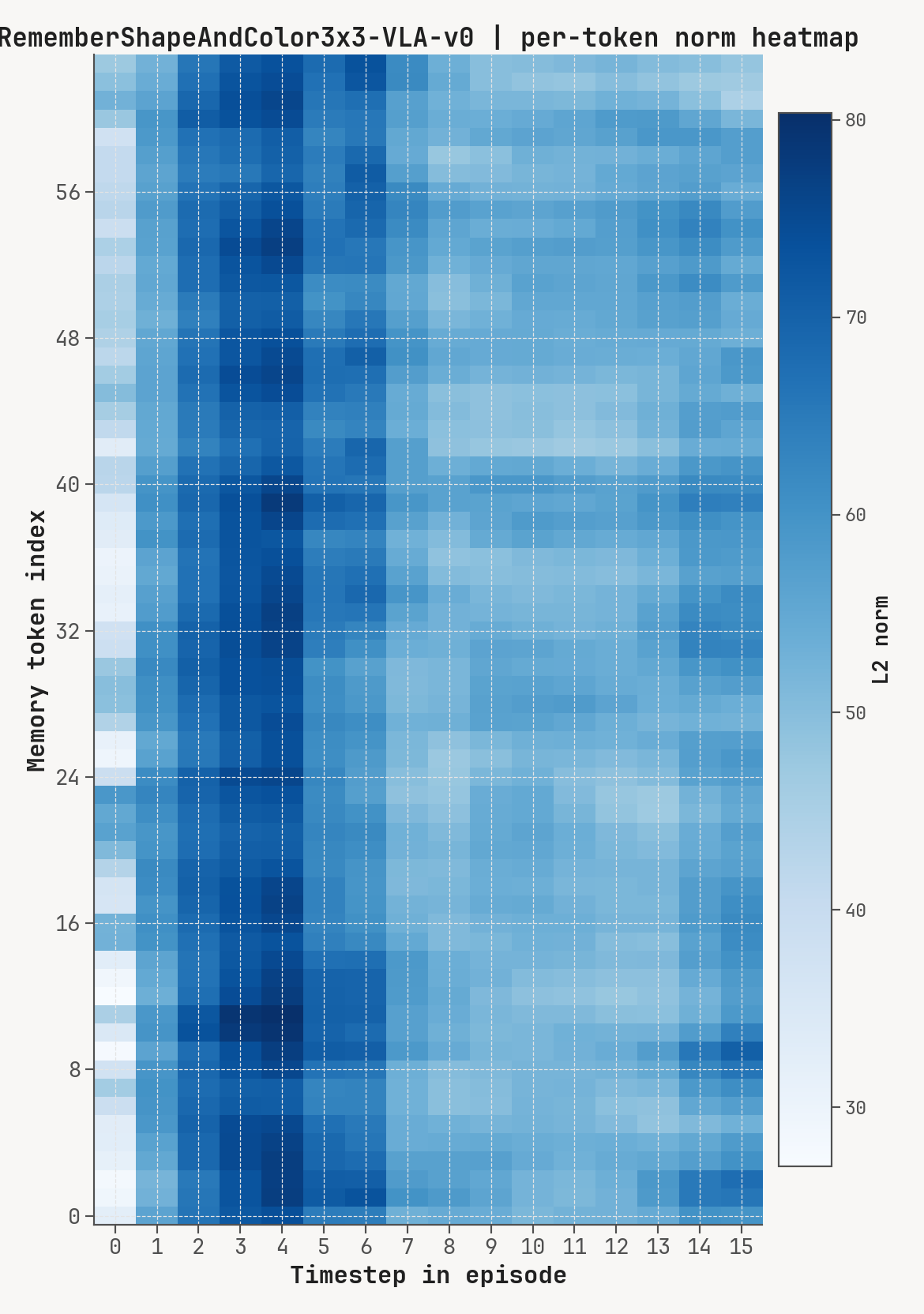
- How: Add causality tests to evaluation pipelines; monitor memory-state cosine changes to identify phase boundaries.
- Expected benefit: Clearer attribution of memory effects; faster iteration on policy weaknesses.
- Assumptions/dependencies: Access to evaluation environments; logging and visualization tooling.
- Safe deployment practice: receding-horizon execution by default
- Sectors: Robotics Software, MLOps
- What: Replace open-loop chunked deployment with per-step re-query to align train/test cadence and reliably update memory each step.
- How: Integrate receding-horizon control into inference stack; ensure latency budgets are met.
- Expected benefit: Avoids catastrophic regressions from infrequent memory updates; improves responsiveness to transient events.
- Assumptions/dependencies: Real-time compute budget; controller integration.
- Lightweight fine-tuning upgrades without architecture churn
- Sectors: Robotics, Integrators
- What: Use LoRA-based fine-tuning to add recurrence to existing OpenVLA-class backbones without full retraining or new modules.
- How: Insert memory tokens, modify attention mask (memory–action guard), adopt episodic dataloader, LoRA rank≈32 fine-tuning.
- Expected benefit: Faster integration; minimal engineering; retains baseline performance on fully observable tasks (no-regression on LIBERO).
- Assumptions/dependencies: Compatible backbone (e.g., OpenVLA-OFT), licensing for pretrained models, GPU availability.
- MLOps monitoring via memory-state change as “event detector”
- Sectors: Robotics Ops, Quality Assurance
- What: Use spikes in memory-state change (1−cosine) as implicit keyframe markers to flag important events or phase transitions during operation.
- How: Log memory tokens and cosine deltas; set thresholds to trigger annotations or operator alerts.
- Expected benefit: Better traceability and debugging of failures; automatic segmentation of episodes.
- Assumptions/dependencies: Access to internal activations at inference; lightweight telemetry pipeline.
Long-Term Applications
These opportunities require further research, scaling, or additional components beyond the minimal recurrence studied in the paper.
- Generalist long-horizon home assistants with rich episodic memory
- Sectors: Consumer Robotics
- What: Maintain multi-task, hours-long memory for chores (e.g., track where items were placed earlier in the day).
- Needed advances: Larger memory bandwidth, hierarchical or retrieval-augmented memory, training on longer horizons, better generalization across memory semantics.
- Dependencies/risks: Data collection for long tasks; safety and privacy in home environments.
- Structured/hierarchical memory combined with in-backbone recurrence
- Sectors: Robotics, Software Agents
- What: Complement memory tokens with external memory or learned retrieval for tasks with novel or compositional memory semantics.
- Needed advances: Memory controllers, write/read policies, auxiliary objectives without destabilizing training.
- Dependencies/risks: System complexity, correctness under distribution shift.
- Autonomous driving and aerial robotics under occlusion
- Sectors: Mobility, Drones
- What: Extend recurrent memory tokens to track occluded actors (pedestrians/vehicles) or waypoints through partial observability.
- Needed advances: Domain-specific perception/action parameterizations; safety certification; training on realistic occlusion dynamics.
- Dependencies/risks: High safety bar; sensor fusion; latency constraints.
- Surgical and healthcare robotics with persistent task context
- Sectors: Healthcare
- What: Maintain sterile-field status, tool usage, or step progression despite occlusions by staff or instruments.
- Needed advances: Clinical-grade datasets; verified safety monitors for memory corruption/failure; interpretability of memory contents.
- Dependencies/risks: Regulation (FDA/CE), liability, robustness in cluttered scenes.
- Human–robot collaboration with inspectable, language-addressable memory
- Sectors: HRI, Enterprise Robotics
- What: Let users query or update a robot’s internal memory (e.g., “what color did you memorize?”).
- Needed advances: Interfaces to expose and ground memory tokens; alignment methods to ensure truthful readouts.
- Dependencies/risks: UX, privacy, misinterpretation of internal states.
- Event boundary detection and self-supervised keyframe selection
- Sectors: Data Engineering, MLOps
- What: Use memory-state dynamics to detect salient events for automatic data labeling, compression, and curriculum generation.
- Needed advances: Calibrated thresholds, robust correlation with semantic events across tasks.
- Dependencies/risks: False positives/negatives; domain transfer.
- Safety monitors that watch memory integrity
- Sectors: Safety Engineering, Policy
- What: Real-time checks for anomalous memory dynamics; trigger safe states if memory degrades or diverges unexpectedly.
- Needed advances: Statistical baselines, certification pathways, failover behaviors.
- Dependencies/risks: Adversarial corner cases; cost of false alarms.
- Standards and certification for partial-observability performance
- Sectors: Policy, Industry Consortia
- What: Establish benchmarks, reporting, and minimum performance thresholds for memory-dependent tasks in commercial robots.
- Needed advances: Consensus test suites (e.g., MIKASA-Robo extensions), reproducible protocols (cadence alignment, interventions).
- Dependencies/risks: Multi-stakeholder buy-in; evolving task taxonomies.
- Memory-efficient hardware paths for per-step recurrent inference
- Sectors: Hardware, Edge AI
- What: Accelerators and runtime kernels optimized for small recurrent token banks and frequent queries (receding horizon).
- Needed advances: Compiler/runtime support for micro-state persistence; KV cache policies tailored to per-step updates.
- Dependencies/risks: Vendor support; ROI for specialized optimizations.
- Cross-task, cross-domain pretraining on partially observable datasets
- Sectors: Academia, Foundation Models
- What: Pretrain VLAs on curated partial-observability corpora to learn general memory primitives before task-specific fine-tuning.
- Needed advances: Data collection and labeling; scalable TBPTT training; curriculum over memory semantics.
- Dependencies/risks: Compute costs; catastrophic forgetting across semantics.
- Multi-robot shared memory for coordination
- Sectors: Warehousing, Field Robotics
- What: Share distilled, low-bandwidth memory summaries across robots to coordinate tasks with limited communication.
- Needed advances: Communication protocols, consensus on memory schema, security.
- Dependencies/risks: Latency, synchronization, privacy/security of shared state.
- Tooling and libraries for “memory retrofits”
- Sectors: Software, Integrators
- What: Open-source kits for adding memory tokens, attention-mask guards, episodic dataloaders, and receding-horizon controllers to VLAs.
- Needed advances: Broad backbone support, plug-and-play configs for m and K, evaluation dashboards with interventions.
- Dependencies/risks: Maintenance across fast-evolving VLA ecosystems; documentation and support.
Notes on feasibility and dependencies across applications
- Training and data: Success depends on episodic, temporally ordered demonstrations and alignment between training memory semantics and deployment tasks. Gains diminish on unseen memory semantics without additional structure.
- Inference cadence: Receding-horizon (per-step) execution is critical; chunked open-loop execution can collapse performance with recurrence.
- Hyperparameters: Short TBPTT (K≈2) often outperforms both K=1 (fully detached) and long K for cue-recall; memory width m≈64 was effective. These may need retuning per domain.
- Compute and latency: Per-step re-querying increases inference load; real-time constraints must be met (edge GPUs or optimized runtimes).
- Robustness and safety: Monitoring of memory-state dynamics can aid reliability, but production systems require guardrails for corrupted or stale memory states.
- Model backbone: Approach assumes access to a strong pretrained VLA (e.g., OpenVLA-OFT) and the ability to fine-tune with LoRA; licensing and deployment environments must be compatible.
Glossary
- Action chunking: Predicting and executing multiple future actions in a single open-loop sequence between model queries. "VLA policies typically depart from the one-step control loop by predicting an open-loop chunk of future actions from a single model query"
- Attention rollout: A technique to aggregate attention across layers/heads to visualize where the model attends. "Composing per-layer attention with rollout (mean over heads, residual factor $0.5$) on three query groups"
- Auxiliary losses: Extra training objectives added beyond the main task loss to shape learning. "trained end to end with truncated backpropagation through time, with no auxiliary losses and no architectural changes."
- Backpropagation through time (TBPTT): Training method that propagates gradients through temporal unrollings of a recurrent computation, often truncated to a fixed window. "trained end to end with truncated backpropagation through time (TBPTT) on temporally ordered episodes"
- Bidirectional self-attention: An attention mechanism where tokens can attend to both past and future tokens within the sequence. "OpenVLA-OFT\ uses bidirectional self-attention over the entire input context"
- Capability envelope: The range or scope of tasks and conditions under which a method is effective. "We interpret these results as a calibration of the capability envelope of minimal in-backbone recurrence"
- Causal intervention: An intentional manipulation of a variable (e.g., memory) to test its causal effect on outcomes. "admits causal interventions on the recurrent channel."
- Cross-step gradients: Allowing gradients to flow across timesteps so the model learns temporal credit assignment in recurrent updates. "the memory update rule (cross-step gradients or a detached EMA)"
- DINOv2: A self-supervised visual encoder architecture used as part of the vision backbone. "pairs a dual SigLIP/DINOv2~\citep{siglip, dinov2} encoder with a Llama-2-7B backbone"
- EMA (Exponential Moving Average): A smoothing update that blends new and previous states via a decay factor, here used as a detached recurrent write. "EMA replaces the end-to-end write with a detached low-pass filter,"
- Episodic dataloader: A data-loading scheme that preserves temporal order by iterating through episodes step by step. "Round-robin episodic dataloader."
- External memory and retrieval: Mechanisms that store past observations externally and retrieve them later to inform decisions. "external memory and retrieval~\citep{hamlet, memer, mapvla, noteself, torne2026mem}"
- Hidden dimension: The size of the internal feature vectors used by the model’s layers. " and the backbone hidden dimension."
- Hierarchical memory: Multi-level memory structures that organize information at different granularities. "simultaneously introduce recurrence, retrieval, hierarchical memory, and auxiliary objectives"
- KV-cache reuse: Reusing cached key–value attention states from prior steps or contexts to extend effective history efficiently. "KV-cache reuse~\citep{tempofit, kvefficient}"
- LIBERO: A fully observable robot manipulation benchmark suite used to assess policies. "On LIBERO, the strongest recurrent variant achieves average success"
- L1 regression head: An output module trained with L1 loss to predict continuous actions. "predicts a chunk of continuous actions with an L1 regression head."
- LoRA (Low-Rank Adaptation): A parameter-efficient fine-tuning technique that inserts low-rank adapters into pretrained models. "fine-tune end to end with LoRA~\citep{lora} adapters of rank $32$"
- Markovian policy: A policy that conditions only on the current observation and not on past history. "a Markovian policy cannot recover it."
- MDP (Markov Decision Process): A formalism where the current state fully determines the future, making memory unnecessary for optimal control. "Markovian (MDP) tasks where memory is not required"
- Memory-action guard: An attention-mask constraint preventing memory tokens from attending to action tokens to avoid trivial copying. "Attention mask with the memory-action guard."
- Memory tokens: Learnable tokens that carry a compact recurrent state across timesteps within the transformer. "a small bank of learnable memory tokens is carried across timesteps inside the backbone self-attention"
- MIKASA-Robo: A benchmark of partially observable tabletop tasks designed to require memory. "On MIKASA-Robo, VLA improves average success rate on five training tasks from $0.42$ to $0.84$"
- Open-loop chunked execution: Deploying a model by executing an entire predicted action chunk without intermediate feedback or re-planning. "open-loop -step chunked execution"
- OpenVLA-OFT: A fine-tuned variant of OpenVLA used as the backbone for experiments. "OpenVLA-OFT \citep{openvlaoft}, a fine-tuned variant of OpenVLA~\citep{kim2024openvla}"
- Open X-Embodiment: A large-scale dataset used to pretrain VLA models across diverse embodiments. "pretrained on Open~X-Embodiment~\citep{openx}"
- Out-of-distribution (OOD): Data or task conditions that differ from those seen during training. "OOD cue-identity tests."
- Partial observability: When the agent’s observations do not fully reveal the underlying state, requiring memory of past information. "Under partial observability, where decision-relevant information is transient, occluded, or set earlier in the episode"
- POMDP (Partially Observable Markov Decision Process): A decision-making framework where the true state is hidden and must be inferred from observations over time. "We model manipulation as a POMDP ."
- Proprioception: Internal sensory measurements of the robot’s body (e.g., joint angles), used as input alongside vision and language. "The model consumes the current observation, language instruction, and proprioception, and predicts future actions."
- Receding-horizon control: A control scheme that replans at each step by executing only the first action of a predicted action sequence. "At inference time, we use receding-horizon control."
- Recurrent memory transformers: Transformer architectures augmented with a recurrent memory that is passed across timesteps. "The design is closely related to recurrent memory transformers~\citep{rmt,ratm,cherepanov2026elmur}"
- Recurrent state: The latent memory variable propagated across timesteps that influences current predictions. "The recurrent state is not provided by the dataset"
- Representation dynamics: Temporal patterns of change in internal representations, such as memory vectors, across an episode. "representation dynamics, attention rollouts, causal noise and freeze-first interventions"
- Self-attention: The mechanism enabling tokens in a sequence to attend to each other to compute contextualized representations. "updated through the standard self-attention forward pass"
- SigLIP: A vision–language pretraining method (Sigmoid loss for language–image pretraining) used as part of the visual encoder. "pairs a dual SigLIP/DINOv2~\citep{siglip, dinov2} encoder"
- TBPTT length : The number of steps in the truncated backpropagation window for training recurrent updates. "parameterized by memory width , TBPTT length , and the memory update rule"
- Teacher-forcing-like regime: Training where the model consumes ground-truth observations while rolling its own latent state forward. "Training thus follows a teacher-forcing-like regime"
- Vision-language-action (VLA) models: Models that integrate visual inputs, language instructions, and action outputs to perform control tasks. "Vision-language-action (VLA) models cast manipulation as next-token prediction over multimodal sequences"
Collections
Sign up for free to add this paper to one or more collections.