Noise cancellation by superposition of channels and superactivation of quantum capacity: Experimental realization by NMR
Published 9 Jun 2026 in quant-ph | (2606.10744v1)
Abstract: Noisy quantum channels degrade quantum resources such as coherence and entanglement and hence pose challenges for realizing quantum technologies. Coherent control of noisy channels allows us to minimize their effects on the quantum system. Here we achieve the cancellation of two noisy quantum channels by superposing their corresponding Stinespring dilation unitaries. We first arrive at conditions under which superposition of channels results in a valid quantum channel. We then consider superposing two dephasing channels and observe their destructive interference, thereby effectively recovering the quantum coherence. On superposing two zero-capacity depolarizing channels, we show superactivation of quantum capacity. We experimentally realize the cancellation of two dephasing channels using a three-qubit NMR register. Furthermore, using a five-qubit NMR register, we realize the cancellation of two depolarization channels and demonstrate superactivation of quantum capacity.
The paper introduces a novel experimental framework that superposes quantum channels using controlled Stinespring unitaries to validate noise cancellation in dephasing channels.
Experiments employing liquid-state NMR reveal that destructive interference preserves coherence nearly perfectly, albeit with a trade-off in postselection probability.
The approach is extended to depolarizing channels, where superactivation transforms entanglement-breaking channels into ones with positive quantum capacity.
Noise Cancellation and Superactivation of Quantum Capacity via Channel Superposition: Experimental Realization by NMR
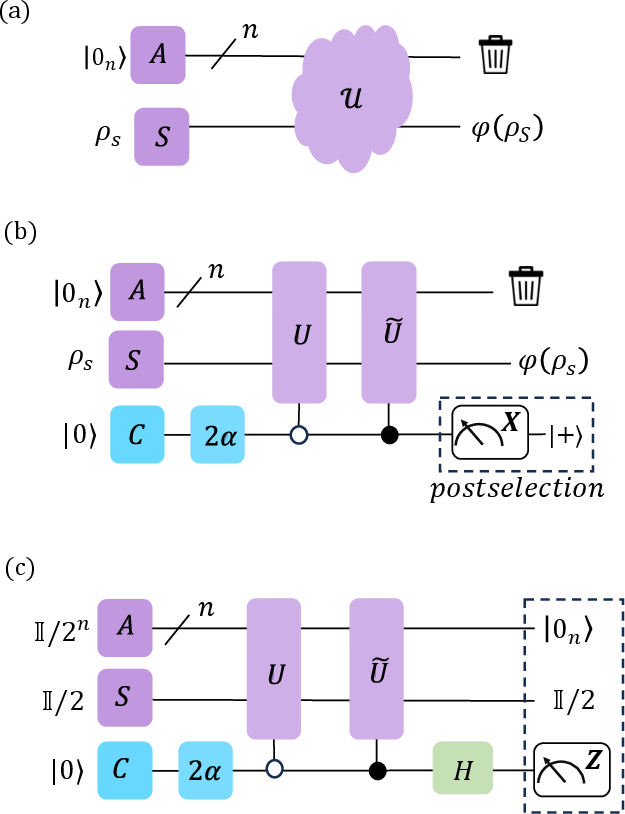
The paper presents a rigorous framework for the superposition of quantum channels by exploiting coherent control over their Stinespring dilation unitaries. The approach starts by considering two quantum channels, each modeled via a unitary interaction with an environment (ancilla), followed by tracing out the environmental degrees of freedom. By using a control qubit initialized in a superposition state, the protocol enables a coherent superposition of the corresponding dilation unitaries, implemented on a common ancillary register.
A necessary and sufficient condition is derived to guarantee that the resulting superposed map is a valid, linear, completely positive, and trace-preserving (CPTP) quantum channel. This is formalized as the requirement that the overlap of the two Stinespring unitaries, projected onto the initial ancilla state, is proportional to the identity. For channels described by Kraus operators, this corresponds to the sum i∑Ki†Ki∝I in the relevant subspace. The construction is generalized for arbitrary single-qubit Pauli channels, where the resulting superposed map yields another (in general, nontrivial) Pauli channel. This formalism unifies and extends existing notions of channel interference, spatial and temporal superposition, and connects to recent ideas of indefinite causal order.
Figure 1: Quantum circuit protocols for implementing superposed channels using controlled Stinespring unitaries and partial trace over a common ancilla.
Noise Cancellation in Dephasing Channels
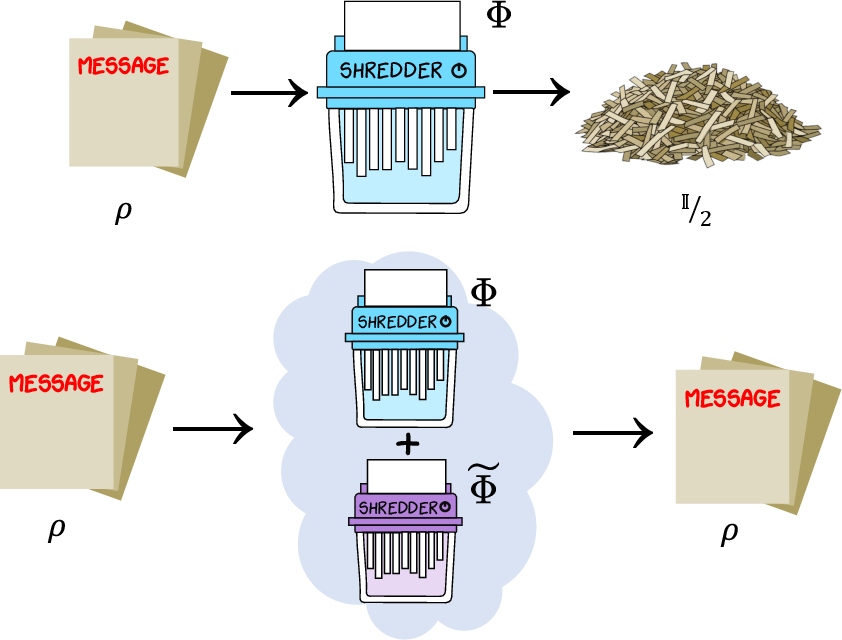
A detailed analysis is provided for the superposition of two dephasing channels with distinct strengths. These channels, which induce loss of quantum phase coherence, are fundamental for modeling noise in quantum systems. The resultant, superposed channel is shown analytically to also be of dephasing type, with effective strength governed by the control qubit's superposition parameter and the original channel strengths. There exist parameter regimes where destructive interference between the channels leads to significant noise cancellation: the original input's coherence is preserved almost perfectly, demonstrating full reversal of phase damping for carefully chosen superposition weights.
Figure 2: Coherent superposition producing destructive interference between two noisy channels and resulting in noise cancellation.
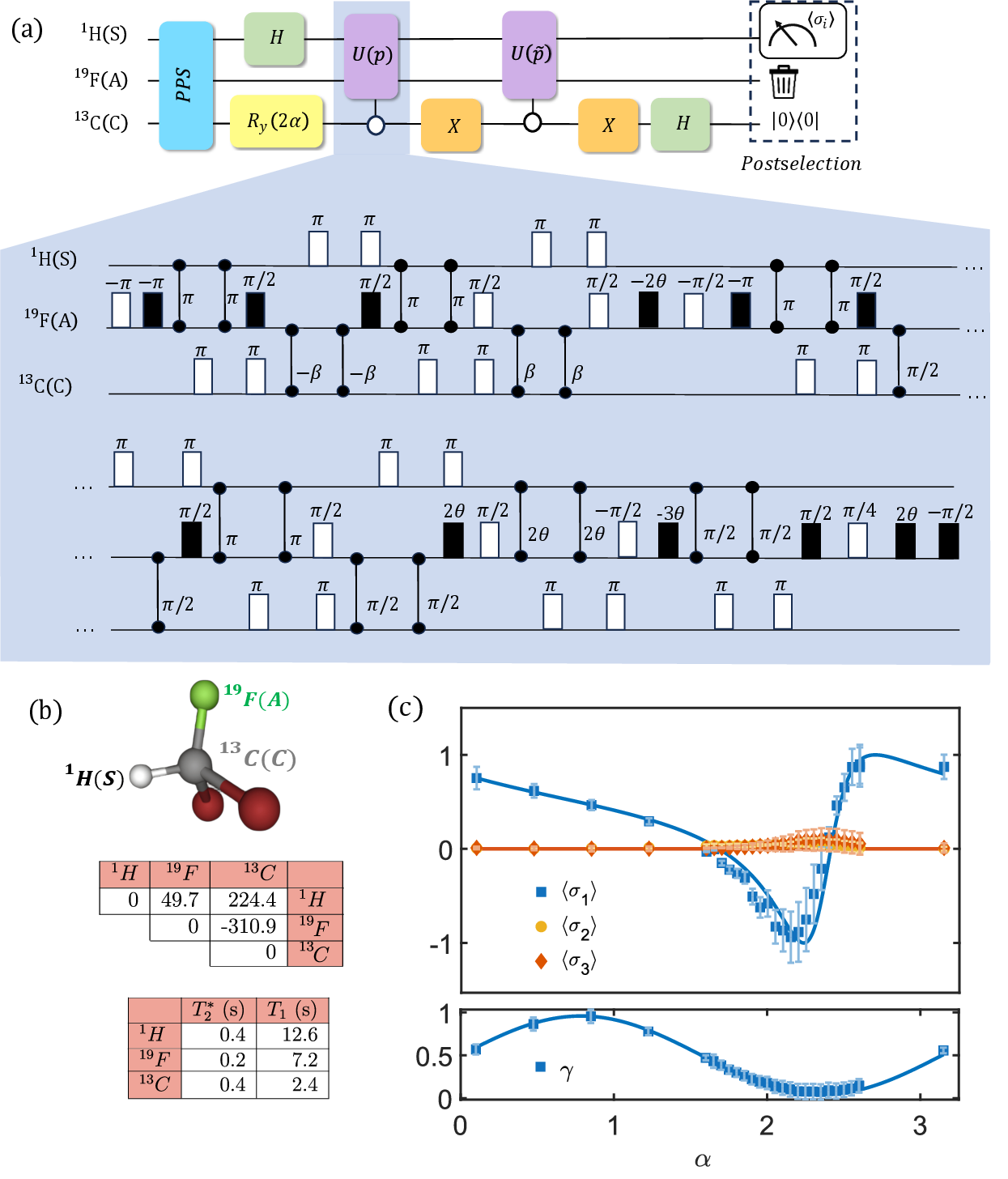
The experimental validation utilizes multi-qubit liquid-state NMR. In this setting, arbitrarily strong dephasing channels with controllable Kraus structure are programmed using precise pulse sequences. The coherence recovery is directly measured by tracking the expectation values of the transverse Pauli operators after channel action, and compared against theoretical predictions. The observed experimental curves demonstrate both constructive and destructive interference, achieving near-complete noise cancellation at specific control angles, in direct correspondence with theoretical expectations. However, this cancellation is obtained probabilistically; the normalization factor (postselection probability) for the successful coherent erasure of noise vanishes for optimal interference, revealing a trade-off between success probability and noise suppression.
Figure 3: NMR pulse sequence and experiment confirming destructive and constructive interference of dephasing channels; coherence is fully recovered at specific superposition parameters.
Superactivation and Perfect Activation in Depolarizing Channels
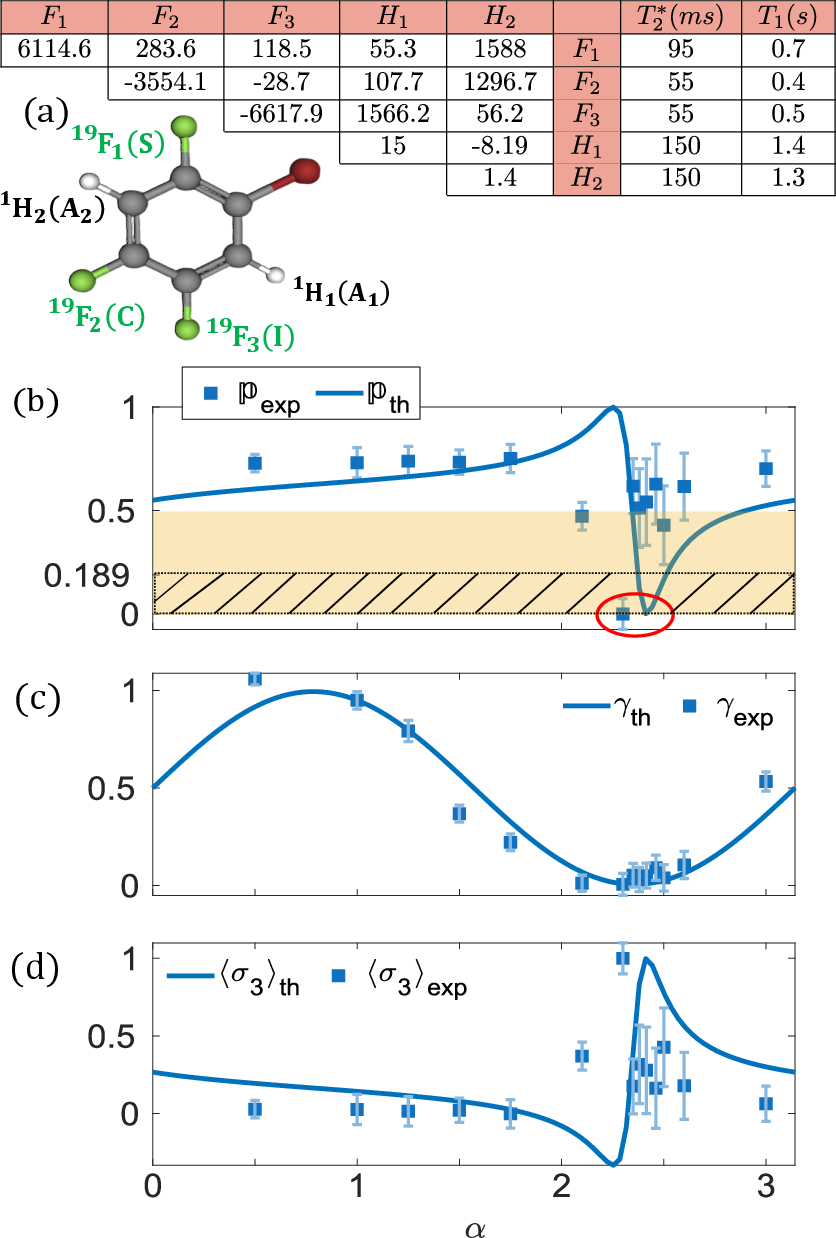
The approach is extended to depolarizing channels, a broader class encompassing arbitrary qubit noise, including entanglement-breaking (EB) regimes. The paper constructs experimental protocols for the superposition of two depolarizing channels, each individually zero-capacity (EB) and therefore unable to transmit quantum information or preserve entanglement. Remarkably, the superposed channel need not remain EB; for specific superposition parameters, its Choi matrix enters the non-separable regime, conferring a strictly positive quantum capacity ("superactivation"). At isolated points, perfect noise cancellation is theoretically predicted, corresponding to a unitary identity channel.
Figure 4: Experimental data showing the superposed depolarizing channel's effective strength, non-EB regime (shaded), and observed superactivation points versus superposition parameter.
The experimental realization is performed using a five-qubit NMR register (three 19F and two 1H spins of BTFBz in a liquid crystal environment), implementing the Stinespring framework for depolarizing channels with independent control of strengths. The protocol confirms that for specific superposition parameters, the combined channel can exit the EB regime and permit nonzero transmission of quantum information, including observation of near-perfect activation within the error bars. As with the dephasing case, the most dramatic increases in channel capacity occur at control parameters where the postselection probability drops sharply, revealing that strong capacity enhancement comes at the cost of probabilistic filtering.
Implications, Open Problems, and Prospects
The results provide the first experimental evidence that the coherent superposition of noisy quantum channels can be harnessed for engineered noise cancellation and the activation of channel capacities otherwise forbidden in standard quantum information theory. The work demonstrates a new operational resource: the ability to coherently control and superpose quantum processes via ancilla-based protocols. It establishes, with explicit state-of-the-art NMR implementations, that two entanglement-breaking channels — with no individual capacity and no classical channel composition leading to capacity activation — can be combined to yield a non-EB, even noise-free, effective channel using modest additional resources and a single common ancilla.
Theoretically, this opens several directions: generalization to superpositions of distinct or more than two channels, resource requirements for optimizing postselection success, and systematic study of capacity superactivation and perfect activation in higher-dimensional or continuous-variable systems. Practically, the coherent control of dissipative noise processes could inform the next generation of quantum communication protocols and quantum error mitigation strategies, especially where channel switching or indefinite causal order is not practical but ancilla-based superposition is experimentally accessible.
Conclusion
This study establishes a comprehensive framework for the superposition of quantum channels, rigorously characterizes the physical conditions for validity, and demonstrates through liquid-state NMR experiments the possibility of probabilistic noise cancellation and capacity superactivation for both dephasing and depolarizing channels. The findings indicate that coherent superposition of noisy processes is a powerful new tool in quantum information science, with significant implications for quantum communication, error correction, and engineered noise environments. Future research will clarify the ultimate limits of this phenomenon, its resource demands, and its full range of applications both in theory and experiment.
“Emergent Mind helps me see which AI papers have caught fire online.”
Philip
Creator, AI Explained on YouTube
Sign up for free to explore the frontiers of research
Discover trending papers, chat with arXiv, and track the latest research shaping the future of science and technology.Discover trending papers, chat with arXiv, and more.