- The paper introduces a forward-assisted purification framework that integrates pre-processing, quantum memory, and post-processing to achieve higher fidelity in quantum state recovery.
- It demonstrates that single-copy FA protocols can outperform conventional multi-copy methods, reducing sample complexity by orders of magnitude.
- The framework overcomes no-go theorems for purification, suggesting promising applications in near-term quantum technologies and dynamic quantum codes.
Forward-Assisted Purification: A Spatiotemporal Extension of Quantum Noise Mitigation
Overview and Motivation
The manuscript "Forward-Assisted Purification: A Spatiotemporal Framework Beyond Conventional Limits" (2606.02990) formulates a comprehensive theory of quantum state purification that moves beyond the standard, static, post-noise frameworks. The authors introduce a dynamical, spatiotemporal architecture for quantum purification—termed forward-assisted (FA) purification—that distributes interventions both before and after the application of noise and, crucially, enables information flow via intermediate quantum memories. This formulation extends not only the operational possibilities for noise mitigation in quantum information tasks but also allows pre-processing strategies to circumvent traditionally established no-purification theorems, notably for Bell states.
The work presents both the foundational formalism of FA purification and strong numerical evidence for its operational and resource advantages: in regimes of practical noise, FA protocols can outperform conventional purification even when consuming orders of magnitude fewer noisy state copies. These results suggest a qualitative shift in how noise should be addressed in quantum technologies, especially in the context of resource-constrained or near-term devices.
Spatiotemporal Framework for Purification
The central methodological extension in this work is the explicit treatment of noise as a quantum channel process rather than a static transformation of prepared states. Whereas conventional purification applies collective quantum channels to many noisy samples post hoc, the FA approach treats noise as a dynamical channel and introduces its manipulation at the level of quantum superchannels. This conceptual transition is illustrated by a split temporal axis:
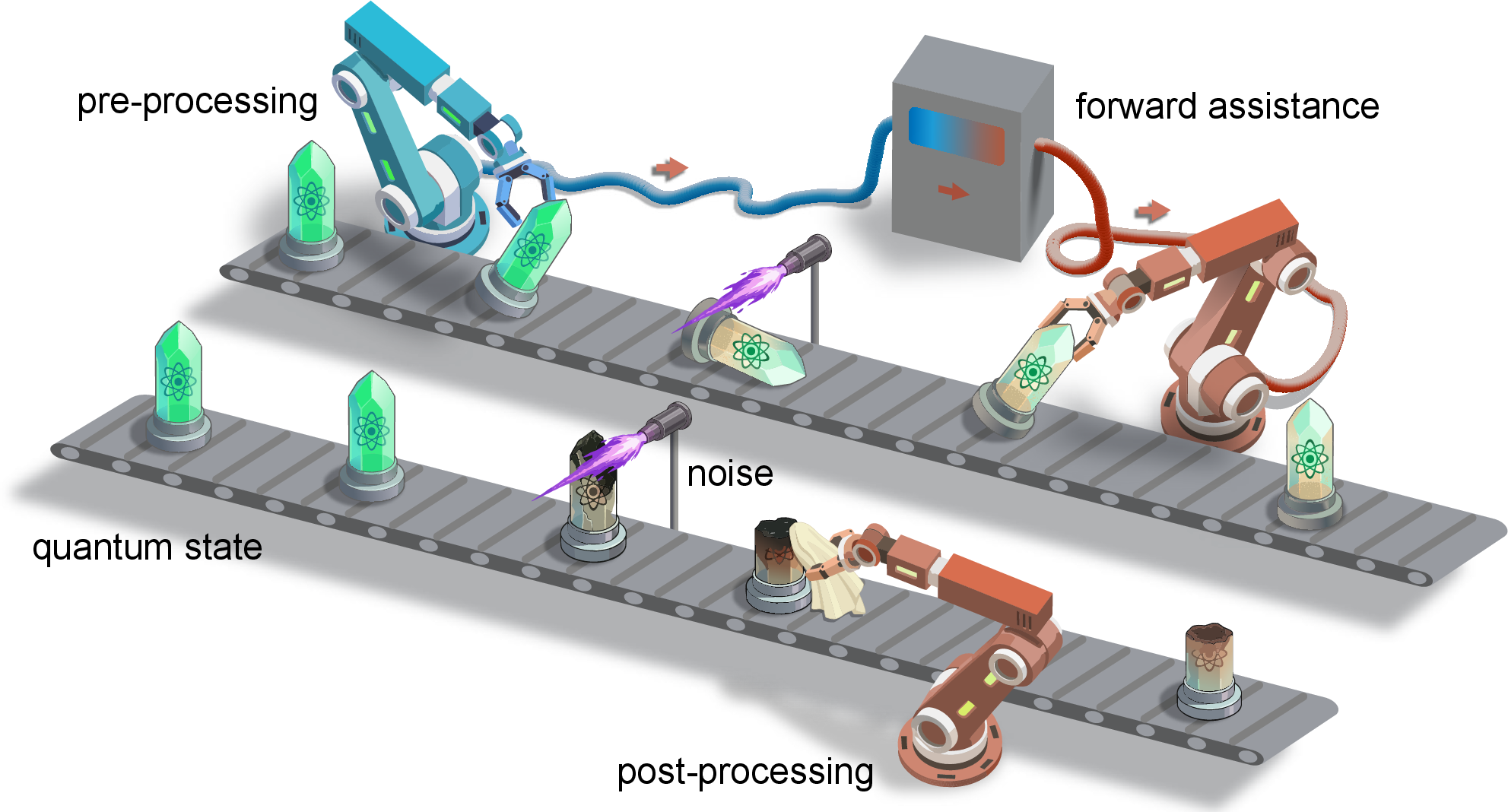
Figure 1: In FA purification (upper conveyor belt), a pre-noise operation and a temporally bridging quantum memory expand operational possibilities beyond conventional post-processing (lower conveyor belt), unlocking new recovery capabilities.
Concretely, the FA purification framework leverages the formalism of quantum superchannels, incorporating:
- Pre-processing (PreP): An intervention performed on the pure quantum state(s) prior to the action of noise.
- Quantum memory (Mem): A forward memory channel linking the pre-processing and post-processing stages, permitting temporal correlation and transfer of quantum information.
- Post-processing (PostP): A standard recovery operation performed after noise, potentially including optimal collective operations.
These elements are combined to create varied classes of FA purification protocols, including memory-free (unassisted), entanglement-assisted, forward-classical-assisted (FCA), forward-Horodecki-assisted (FHA), non-signalling (NS), and positive partial transpose (PPT) protocols. The inclusion relations among these classes are formalized via Venn diagrams:
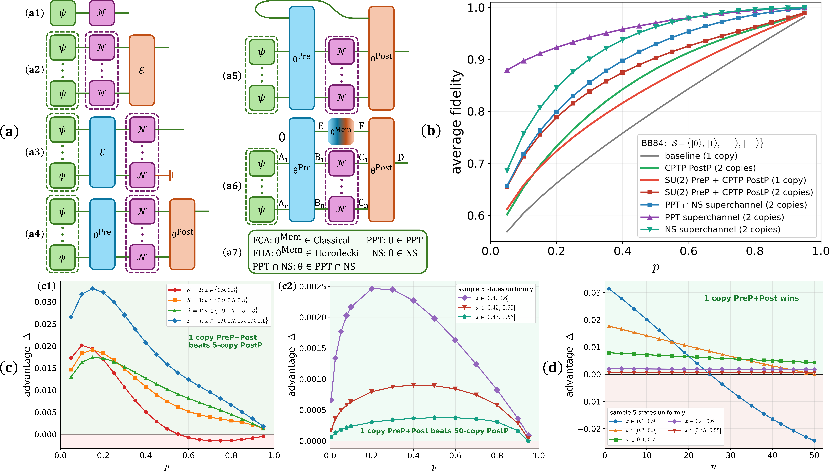
Figure 2: Schematic of purification protocol hierarchies in the spatiotemporal (forward-assisted) framework, ranging from simplest (PreP, PostP) to most general (arbitrary superchannels).
The authors formally derive a hierarchy of purification strategies governed by their access to spatiotemporal resources. The orderings, established via semidefinite programming (SDP) characterizations, confirm that:
- Every new resource or operational structure in the FA framework yields a non-decreasing achievable fidelity in the average-case purification task.
- In particular, post-processing-only (e.g., the traditional setting) is always lower-bounded by any protocol that includes pre-processing, memory, or assistance (entanglement, NS, PPT).
The operational consequences are substantial: in certain noise and input regimes, memory-free single-copy FA protocols outperform multi-copy conventional purification, sometimes by margins requiring hundreds or thousands of conventional copies to match.
These behaviors and performance hierarchies are visualized in comparative fidelity plots:
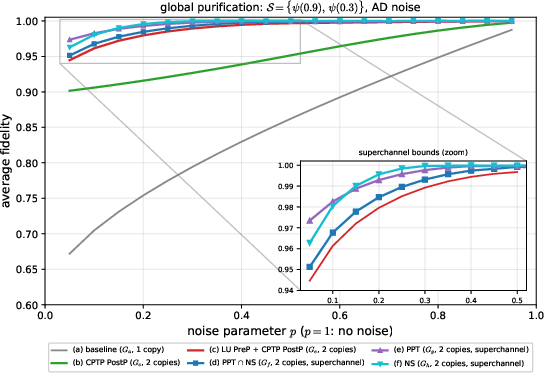
Figure 4: Benchmark of average fidelity across protocols—Forward-Assisted (FA) strategies consistently surpass conventional multi-copy post-processing approaches, with increased separation at modest noise.
Overcoming No-Purification Theorems and Sample Complexity
A significant theoretical result is the demonstrated circumvention of established no-go theorems for purification under LOCC or PPT-preserving operations—most notably for Bell state ensembles under depolarizing noise [3bb1-pmtp]. By introducing pre-processing steps (e.g., local unitary rotations), the FA strategy breaks problematic symmetries, enabling purification where it was previously forbidden. This is substantiated analytically and by fidelity-gap calculations:
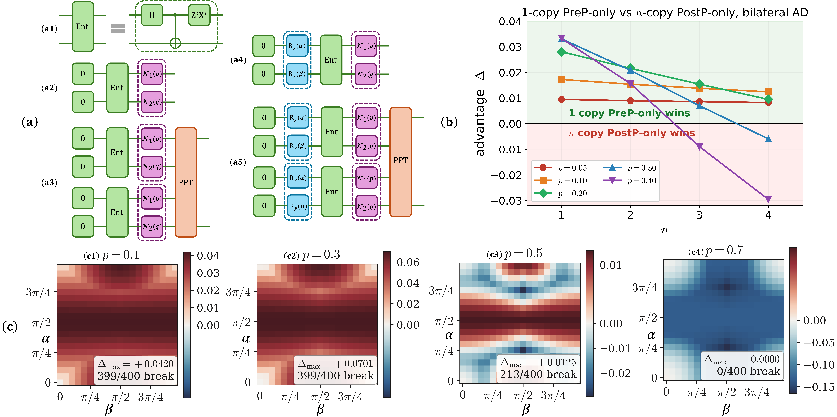
Figure 5: FA purification architectures permit Bell state recovery where post-processing-only methods are strictly impossible—pre-processing activates otherwise forbidden operational pathways.
Further, single-copy FA purification often outperforms multi-copy conventional strategies. Sample efficiency is highlighted quantitatively: for amplitude damping noise, a locally optimized single-copy FA protocol can exhibit higher fidelity than conventional purification given 50 or more noisy copies, and in extreme cases, even thousands of copies are needed for conventional approaches to match the FA single-copy fidelity.
(Figure 6, Figure 7)
Figure 8: Sample efficiency scaling—Single-copy pre-processing augmented purification matches or exceeds performance of conventional post-processing protocols using 10s–1000s of noisy state copies.
Algorithmic Advances: Representation-Theoretic SDP Compression
Addressing the computational barrier of high-copy-number purification, the manuscript develops and implements algorithms for symmetry-adapted compression of the underlying optimization problems. Combining representation theory (Schur-Weyl duality, Clebsch-Gordan recursion), the authors reduce the exponential scaling with copy number down to polynomial in practice—enabling tractable verification of multi-copy protocol performance and fidelity benchmarks for up to 50 copies on standard workstations.
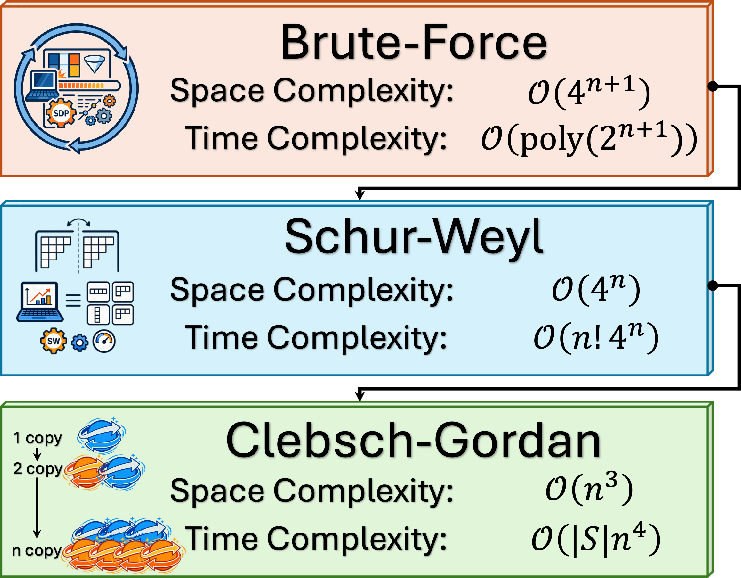
Figure 9: Exploiting permutation symmetry compresses high-dimensional SDPs into symmetry-resolved blocks: exponential bottlenecks are replaced by polynomial scaling.
Implications and Future Directions
Practical Noise Mitigation & Near-Term Quantum Technologies
The operational and sample efficiency advantages of FA purification protocols suggest immediate applications for near-term quantum devices, where the preparation and maintenance of large numbers of high-fidelity copies are infeasible. Embedding pre-noise interventions or dynamical memory is often experimentally accessible within the circuit model or in error-mitigation pipelines, and may be deployed to reduce resource demands for cryptographic protocols (BB84), state distillation, and entanglement generation/distribution.
Theoretical Unification & Extension
FA purification connects purification, channel manipulation, and quantum error correction within a common process-theoretic framework. The explicit inclusion of pre-processing (dynamical encoding) bridges the traditional gap between error correction (always with encoding) and purification (conventionally stateless at input). This alignment opens the way for new classes of dynamical quantum codes that operate over temporally structured interventions.
Open Questions and Forward Paths
Key areas for further work include:
- Extension of symmetry-based SDP reductions to distributed and multipartite settings, where current techniques reach their computational limits in few-copy regimes.
- Refined operational benchmarks for realistic noise models and hardware constraints, determining when and how quantum memory or pre-processing can be implemented at scale.
- Systematic investigation of the FA framework in quantum error correction, communication complexity, and entanglement theory, especially for dynamically adaptive protocols.
Conclusion
Forward-assisted purification redefines the achievable limits of quantum state recovery under noise by incorporating explicit spatiotemporal structure—namely, pre-processing and quantum memory—into the operational paradigm. The framework rigorously demonstrates that traditional no-go theorems for purification are not fundamental limits, but rather artifacts of a static, post-noise perspective. Both the theoretical formalism and numerical analysis indicate that significant gains in fidelity and sample efficiency are attainable with modest quantum resources, potentially reshaping protocol design in both fundamental quantum information science and applied quantum technologies (2606.02990).

