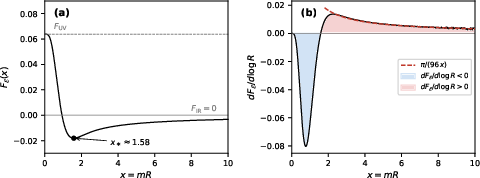
- The paper demonstrates that replica energy filters extract universal subextensive contributions in finite-volume quantum field theories.
- It introduces a kinetic framework using scaling filters to separate bulk extensive terms from boundary, topological, and fracton-induced corrections.
- The study connects scaling behavior with RG irreversibility, enabling the extraction of key anomaly coefficients and criteria for nonextensivity.
Nonadditivity in Quantum Field Theory: Replica Energies, Scaling Filters, and the Renormalization Group
Overview and Motivation
This work systematically develops the formalism of replica energies as rigorous, field-theoretical diagnostics of violations of thermodynamic additivity and extensivity, focusing on quantum field theory (QFT) in finite volume and the interplay with boundary, topological, and long-range contributions. By introducing scaling filter operators on the canonical free energy, the authors provide a kinetic framework that disentangles the extensive, bulk thermodynamic terms from genuinely universal subextensive contributions. The main achievement is to demonstrate that this approach unifies a diverse set of phenomena—ranging from topology-dependent ground-state degeneracy and fracton scaling to irreversibility along renormalization group (RG) flows and the identification of anomaly coefficients—under a common thermodynamic language rooted in the properties of partition functions.
Definitions and Scaling Filters
The canonical partition function Z and its logarithm W=logZ serve as the central thermodynamic observables. Extensivity and additivity are characterized by the scaling behavior of W under rescaling of system parameters. Replica energies E are defined as
βE(L,β)=W(L,β)−d1L∂LW(L,β)
which vanishes for a perfectly extensive free energy W∝Ld. The operator (1−d1L∂L) acts as a scaling filter, projecting out the leading bulk contributions and isolating the residual nonadditive corrections, which are sensitive to boundaries, defects, topology, and long-range physics.
This framework admits generalization to higher-order filters (for instance, to remove multiple power-law divergences on curved manifolds), as well as to anisotropic replica energies in non-isotropic geometries. The formalism is tightly linked to the machinery of Ward identities and RG equations, enabling a control over both universal and scheme-dependent parts of the free energy.
Thermodynamic Additivity Violations in QFT
Short-Range and Long-Range Mechanisms
Finite-size effects in short-range systems yield corrections that decay in the thermodynamic limit, but in the presence of long-range interactions (e.g., unscreened massless mediators linearly coupled to a nonzero density), genuine nonextensive behavior persists, destroying the standard thermodynamic limit. The authors state an explicit Nonextensivity criterion: for thermal QFTs, if a nonintegrable zero-mode propagator couples to an operator with nonzero expectation value, the system fails to be extensive (and thus additive).
This mechanism is absent in generic relativistic QFTs due to screening (e.g., Debye screening in QED, derivative couplings for Goldstone modes), but is sharply manifest in Newtonian gravitating systems. The analysis recovers the theorem of Ruelle on the existence of the thermodynamic limit and clarifies its breakdown in systems with long-range attraction.
Topological Phases and Subextensive Additivity Violations
The role of topological sectors is elucidated via the large-volume asymptotics of W in gapped (2+1)-dimensional phases, such as Chern-Simons theory on a Riemann surface Σ. The replica energy operator isolates robust topology-dependent W=logZ0 contributions (e.g., W=logZ1), which signal finite-volume violations of additivity even when the bulk is entirely local and gapped. This effect is sharply distinguished from long-range nonextensivity by the scaling properties of W=logZ2.
Fracton Phases and Subextensive Scaling
Fracton order in W=logZ3 systems (e.g., the X-cube model) is identified as a regime where the ground-state degeneracy grows subextensively, W=logZ4, leading to a replica energy that diverges linearly with W=logZ5 while W=logZ6 retains extensivity. The anisotropic structure of replica energies further resolves additivity violation along distinct spatial directions, reflecting the underlying foliation structure.
Fixed-Point Data, Scaling Filters, and RG Irreversibility
RG Analysis and Ward Identities
The filter formalism is combined with RG evolution and dilatation Ward identities, allowing for closed-form, operatorial expressions of W=logZ7 in terms of W=logZ8-functions and scaling dimensions. This enables the isolation of universal data, such as conformal anomaly coefficients, from partition functions on curved manifolds.
Hierarchy and Classification
A clear hierarchy of additivity violations is established:
| Regime |
βE(L,β)=W(L,β)−d1L∂LW(L,β)1 |
βE(L,β)=W(L,β)−d1L∂LW(L,β)2 |
| Finite-size, short-range |
βE(L,β)=W(L,β)−d1L∂LW(L,β)3 |
βE(L,β)=W(L,β)−d1L∂LW(L,β)4, vanishes as βE(L,β)=W(L,β)−d1L∂LW(L,β)5 |
| Topological liquid |
βE(L,β)=W(L,β)−d1L∂LW(L,β)6 |
βE(L,β)=W(L,β)−d1L∂LW(L,β)7 |
| Fracton/foliated |
βE(L,β)=W(L,β)−d1L∂LW(L,β)8 (0 < s < d) |
βE(L,β)=W(L,β)−d1L∂LW(L,β)9 |
| Genuine nonextensive |
Superextensive, W∝Ld0 |
W∝Ld1 |
The scaling of W∝Ld2 with W∝Ld3 enables precise discrimination between bulk, boundary, topological, and fracton regimes, and provides a diagnostic tool for the field-theoretic classification of nonadditivity.
Implications and Future Perspectives
The formalism of scaling filters and replica energies provides a unifying thermodynamic language encompassing additivity violations, defect free energies, and RG irreversibility. It distinguishes between distinct mechanisms for nonextensive behavior, clarifies the relationship between universal subleading data and RG flows, and lays bare the criteria that enable or obstruct monotonicity. The analysis shows that in W∝Ld4, kinematic projectors alone (such as higher-order filters) are never by themselves sufficient for constructing monotones; additional physical structure (strong subadditivity for entanglement entropy in W∝Ld5, spectral positivity for the dilaton effective action in W∝Ld6) is required.
The approach highlights new directions for the study of nonlocal entanglement structures in QFT, RG irreversibility in strongly coupled systems, and the interplay of topology, boundary, and long-range order. It also provides tools for the thermodynamic analysis of exotic phases, including fracton models and systems with emergent gauge constraints.
Conclusion
Replica energy filters act as rigorous, physically transparent operators selecting universal, nonadditive content in W∝Ld7, essential for understanding both equilibrium phase structure and properties along RG flows. The interplay between scaling filters and physical monotonicity constraints (from strong subadditivity or unitarity) determines which universal data can be promoted to RG monotones. This unifying formalism thus sharpens both theoretical understanding and computational techniques for diagnosing nontrivial thermodynamic behavior in quantum field theory (2606.12367).