- The paper introduces a Pfaffian reduction method that compresses an exponentially large sum into a tractable block Toeplitz-Hankel structure.
- It identifies four distinct scaling regimes in the TFI chain, elucidating thermal and boundary effects via analytic and numerical methods.
- The results uncover hidden conformal boundary data, offering new diagnostics for quantum complexity and non-stabilizerness in many-body systems.
Overview and Context
This work investigates the finite-temperature stabilizer Rényi entropy (specifically at index α=1/2) in open boundary critical quantum spin chains, with a focus on the transverse-field Ising (TFI) chain at criticality. The primary observable quantifies the spread of thermal Pauli-string expectation values, providing a fine-grained diagnostic of quantum complexity and non-stabilizerness in many-body systems. By leveraging a novel mapping of an exponentially large sum over absolute values of correlation matrix minors into a tractable Pfaffian form with a structured block Toeplitz-Hankel form, the authors achieve explicit analytic and numerical control over the entropy scaling, including in thermally nontrivial regimes where boundary effects are paramount.
The motivation arises from the emerging role of stabilizer entropies as tools for diagnosing quantum computational complexity and non-stabilizer resources in many-body systems. In particular, while conventional thermodynamic observables and standard entanglement measures often miss intricate operator structure, stabilizer-based observables are sensitive to universal conformal data, including those associated with boundaries and defects, that are invisible to conventional probes.
Pfaffian Reduction and Operator Structure
At the core of this work is the reduction of the stabilizer moment Z1/2,
\begin{align}
\mathcal{Z}{1/2}(\rho\beta) = 2{-L} \sum_{P\in \mathcal{P}L} \left| \operatorname{Tr}(\rho\beta P) \right|
\end{align}
with ρβ the finite-temperature critical TFI state and PL the L-qubit Pauli group. Utilizing the fermionic Gaussian structure and Wick's theorem, the computation of this quantity reduces to evaluating the absolute sum over all square minors of a Majorana correlation matrix G(β). Instead of summing exponentially many terms, this is exactly rewritten as a single antisymmetric Pfaffian,
\begin{align}
S_L(\beta) = (-1)L \mathrm{Pf}
\begin{pmatrix}
\mathcal{A}\left[G(\beta)\right] & I_{2L}\
-I_{2L} & -\mathcal{J}'_{2L}
\end{pmatrix}
\end{align}
where A is an antisymmetric "lift" of G and J2L′ is a universal selector encoding the minor sign structure. This compressed representation both enables efficient computation for large systems and exposes a block Toeplitz-Hankel matrix structure, granting access to powerful analytic tools for asymptotic analysis.
Four Scaling Regimes
The block Toeplitz-Hankel structure supports analytic treatment in four distinct scaling regimes:
- Regime I (Fixed T, Z1/20): Standard thermodynamic scaling at nonzero Z1/21, characterized by pure extensivity with no Fisher–Hartwig logarithmic corrections.
- Regime II (High Temperature): Perturbative expansion in Z1/22, tracking deviations from high-temperature triviality, with explicit analytic expressions for extensive and sub-leading boundary terms.
- Regime III (Saturated Low Temperature, Z1/23): The zero-temperature limit displays an Z1/24 scaling, where the Z1/25 logarithmic subleading term reflects an intrinsic Fisher–Hartwig boundary singularity due to open boundaries.
- Regime IV (Thermal Crossover, Z1/26): A finite-size window where inverse temperature scales with system size. Here, the entropy factorizes into a saturated extensive bulk and a universal Z1/27 crossover function, Z1/28, that encodes thermal population effects of boundary-localized modes.
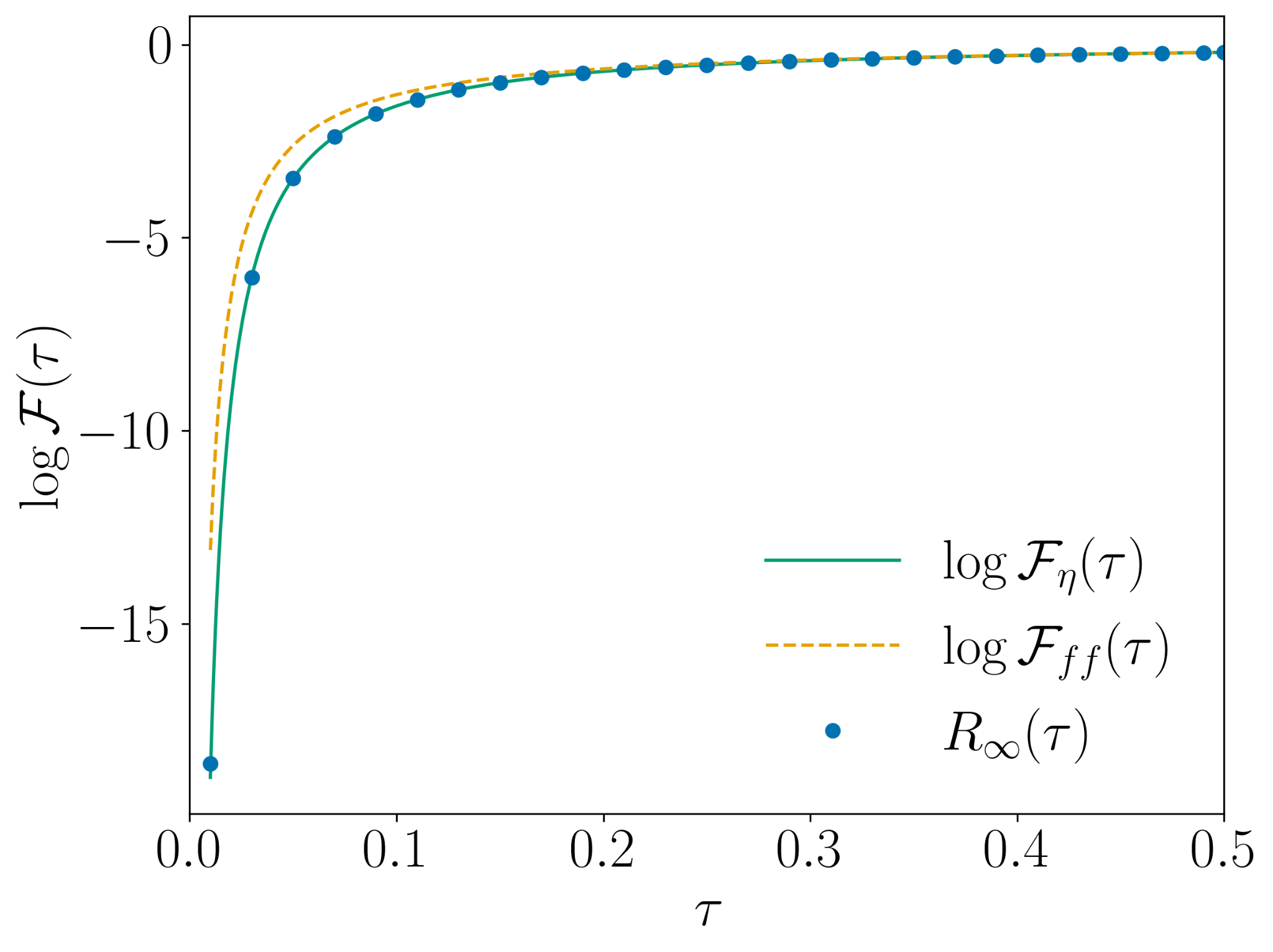
Figure 1: Regime-IV crossover in the scaling window Z1/29. Blue symbols: finite-size extrapolations of the residual ρβ0. Solid curve: eta-quotient prediction ρβ1. Dashed curve: ordinary free-boundary Majorana benchmark.
Universal Eta-Quotient and Hidden Boundary Data
In the crossover regime, the finite-temperature stabilizer entropy is shown to be governed by a level-eight modular eta quotient,
\begin{align}
\mathcal{F}(\tau) =
\frac{\eta(i\tau/2)\, \eta(2i\tau){7/4}}{\eta(i\tau)2\, \eta(4i\tau){1/2}}
\end{align}
This function encodes hidden conformal boundary information beyond the conventional free-boundary Majorana (Ising CFT) spectrum, with the deviation living in the ρβ2 sector (ρβ3).
At low temperatures (ρβ4), the modular limit of ρβ5 gives a leading Cardy-like depletion law of Pauli-string expectation values:
\begin{align}
\log \mathcal{F}(\tau) \sim -\frac{\pi}{16\tau} - \frac{1}{8}\log\tau + \dots
\end{align}
contrasting the standard Ising scaling ρβ6. The difference — an excess "Pauli-weight depletion" with coefficient ρβ7 compared to the traditional ρβ8 — signals that the stabilizer entropy is sensitive to additional universal channels associated with boundary or defect sectors, not present in free-energy thermodynamics.
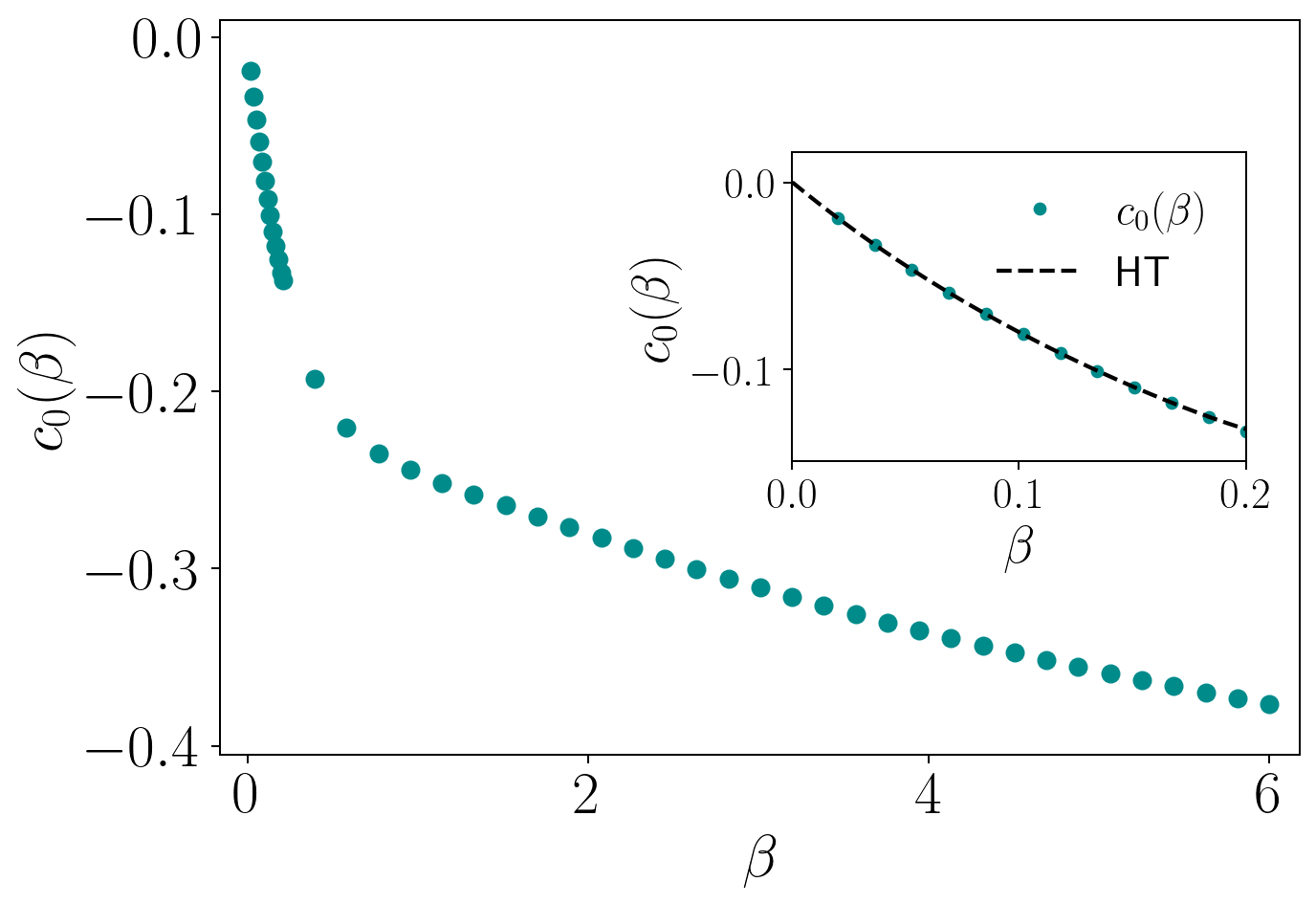
Figure 2: Regime-I finite part ρβ9 for the Pfaffian numerator as a function of inverse temperature.
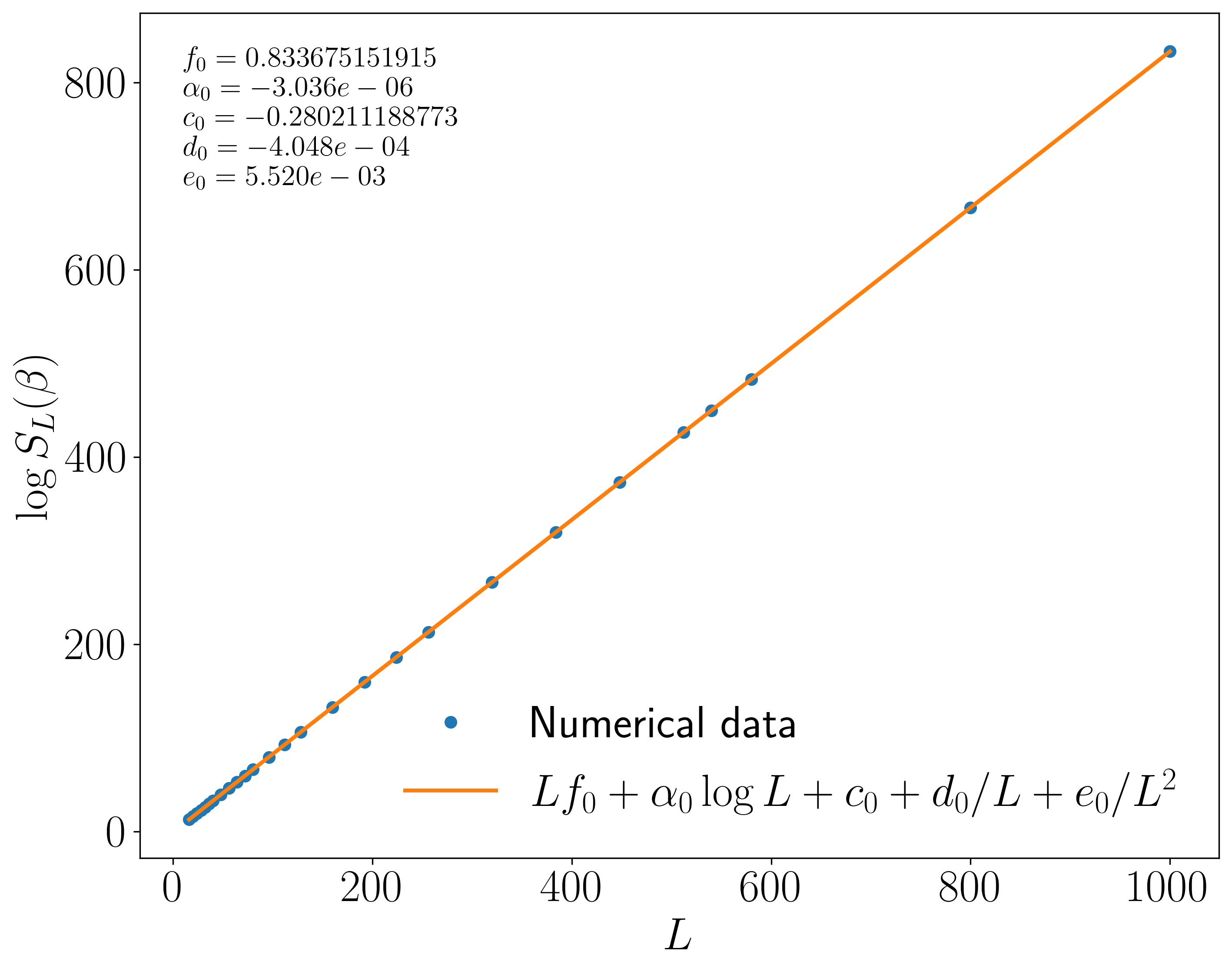
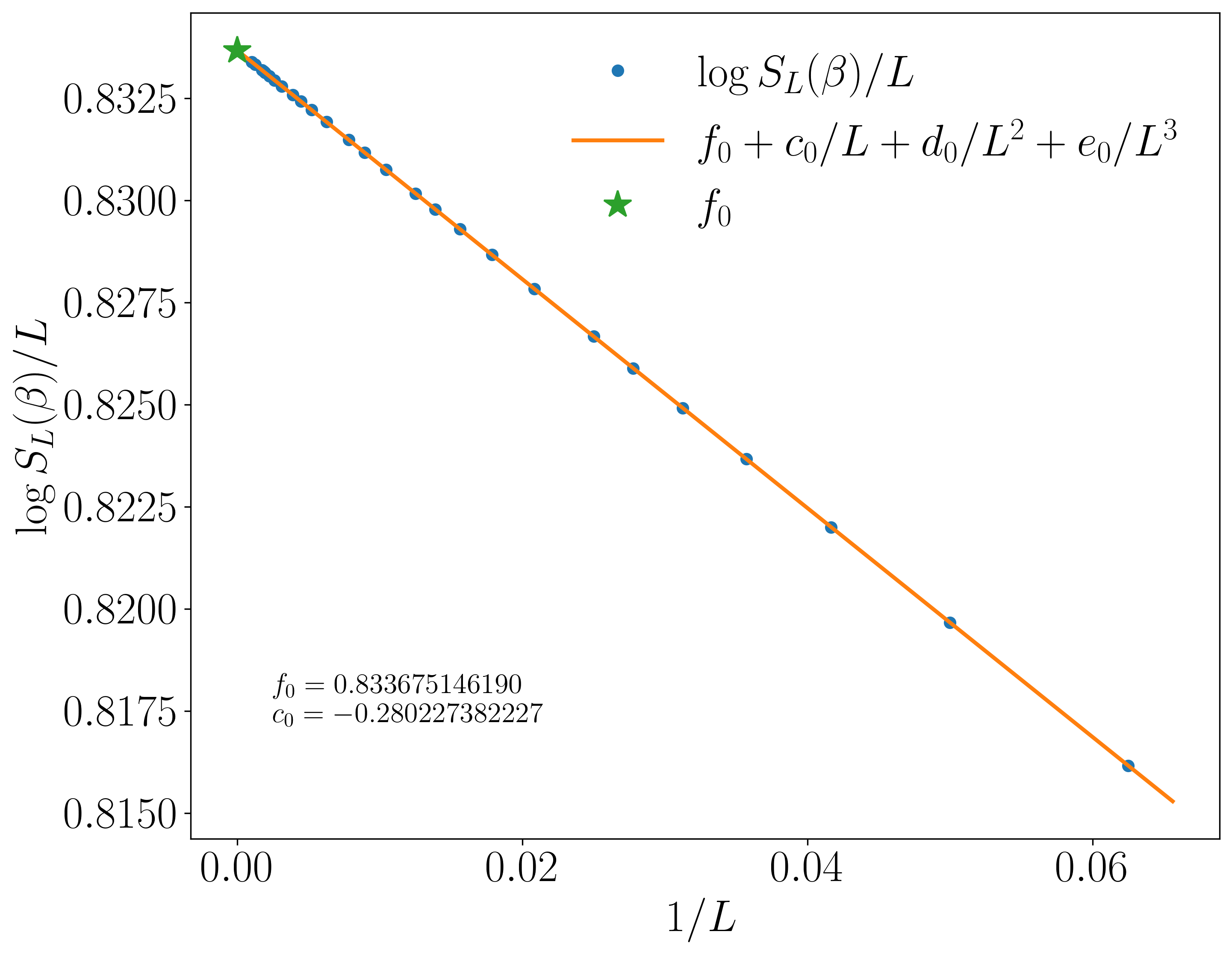
Figure 3: Numerical confirmation of Regime-I fixed-temperature scaling for the staggered-gauge Pfaffian numerator. Logarithmic coefficient is consistent with PL0.
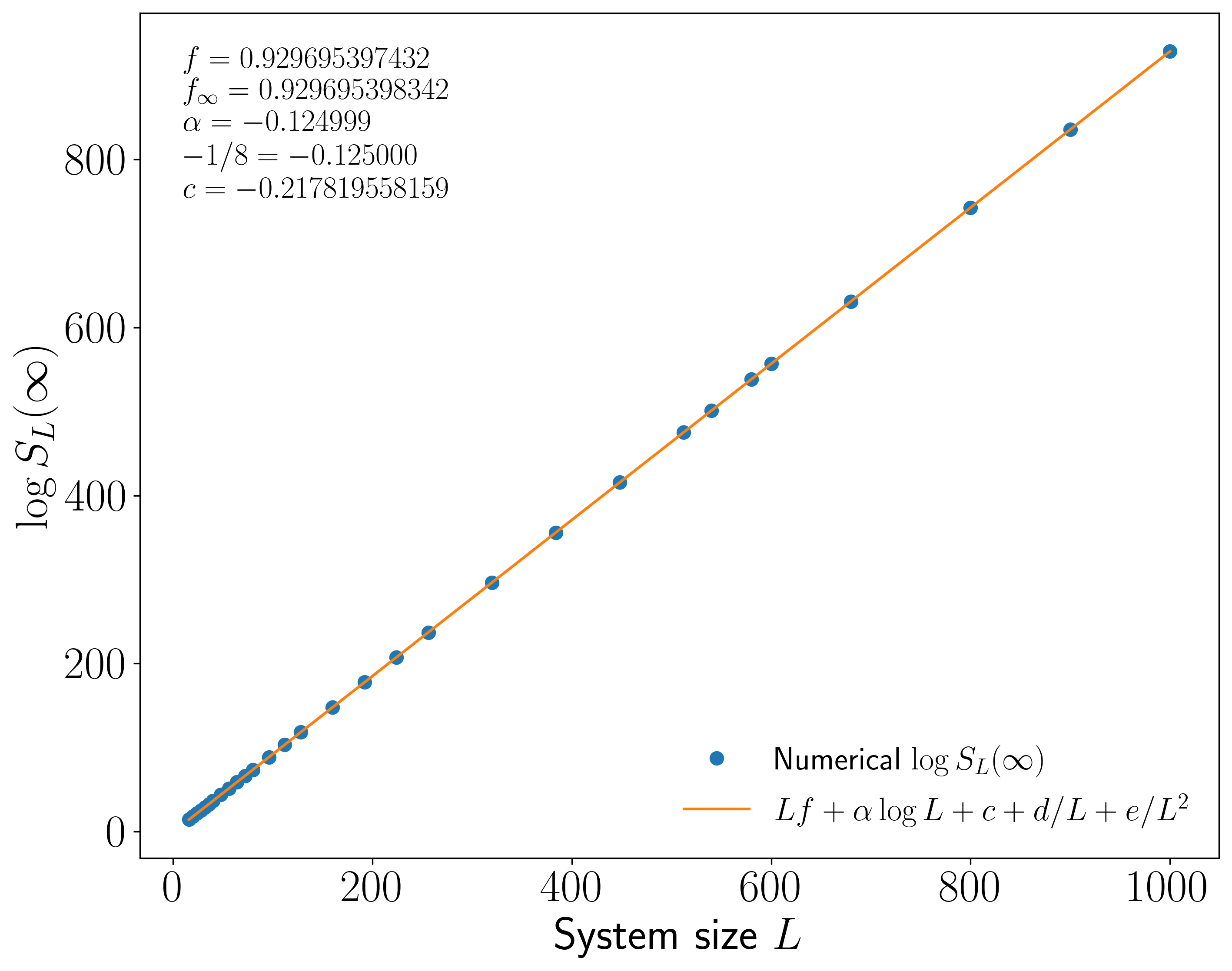
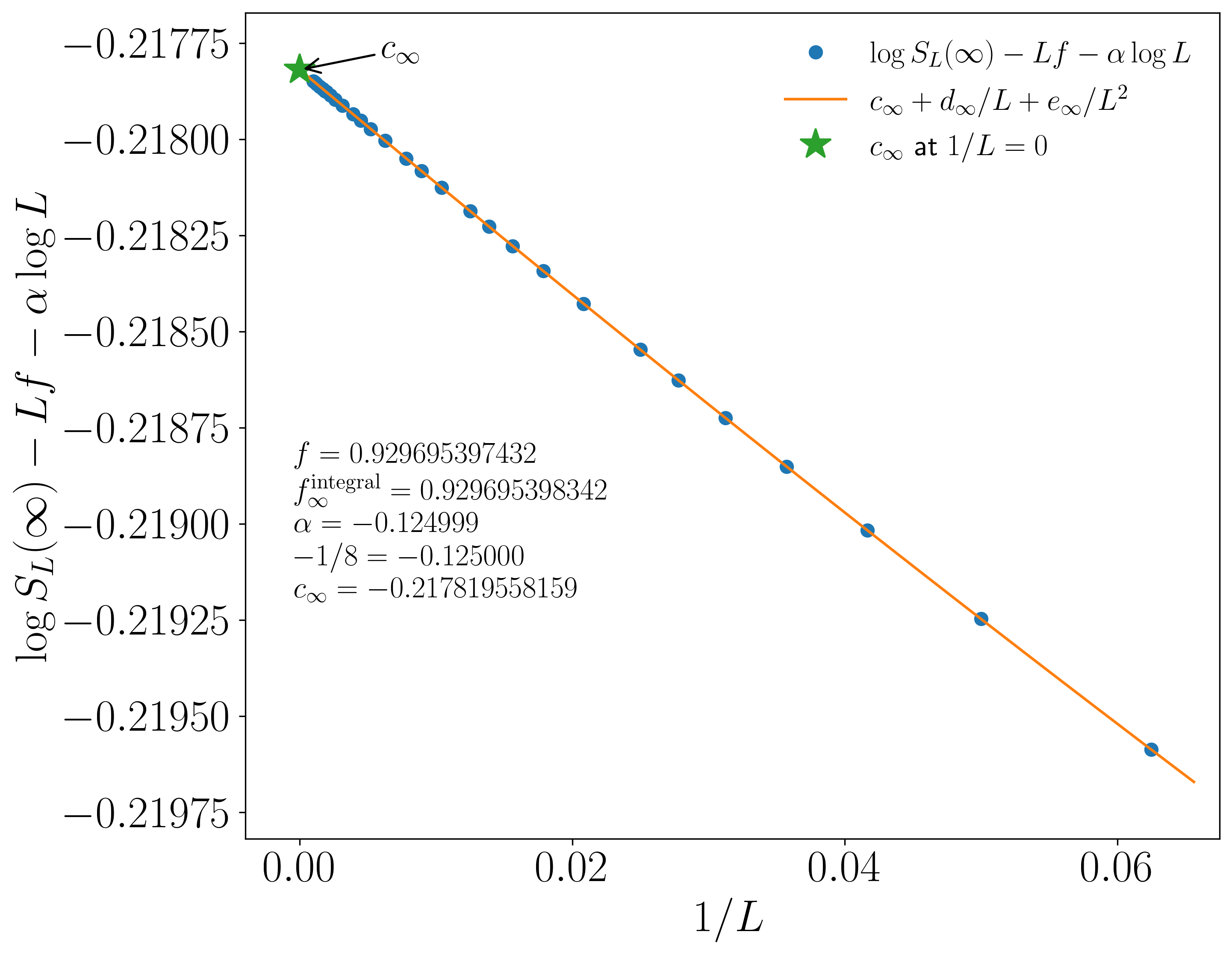
Figure 4: Scaling analysis for Regime-III; the fitted logarithmic coefficient agrees with PL1 and the saturated constant PL2 matches analytic predictions.
Purity Normalization and Physical Stabilizer Entropy
The physical mixed-state stabilizer entropy is obtained by subtracting the Gaussian-mode purity from the (unnormalized) sum over absolute Pauli amplitudes. The normalized observable is
\begin{align}
M_{1/2,L}(\beta) = 2\log S_L(\beta) - 2 \Pi_L(\beta)
\end{align}
where PL3 is the explicit purity term. In the crossover regime, the purity normalization modifies both the extensive and subleading universal scaling functions, giving a new eta quotient
\begin{align}
\mathcal{G}(\tau) = \frac{\mathcal{F}2(\tau)}{\mathcal{P}2(\tau)} =
\frac{\eta(i\tau)6 \eta(4i\tau)}{\eta(i\tau/2)2 \eta(2i\tau){9/2}}
\end{align}
Strong Numerical and Analytic Verification
All scaling regimes are supported by extensive analytic results and numerics, including explicit finite-size extrapolation and subleading correction analysis.
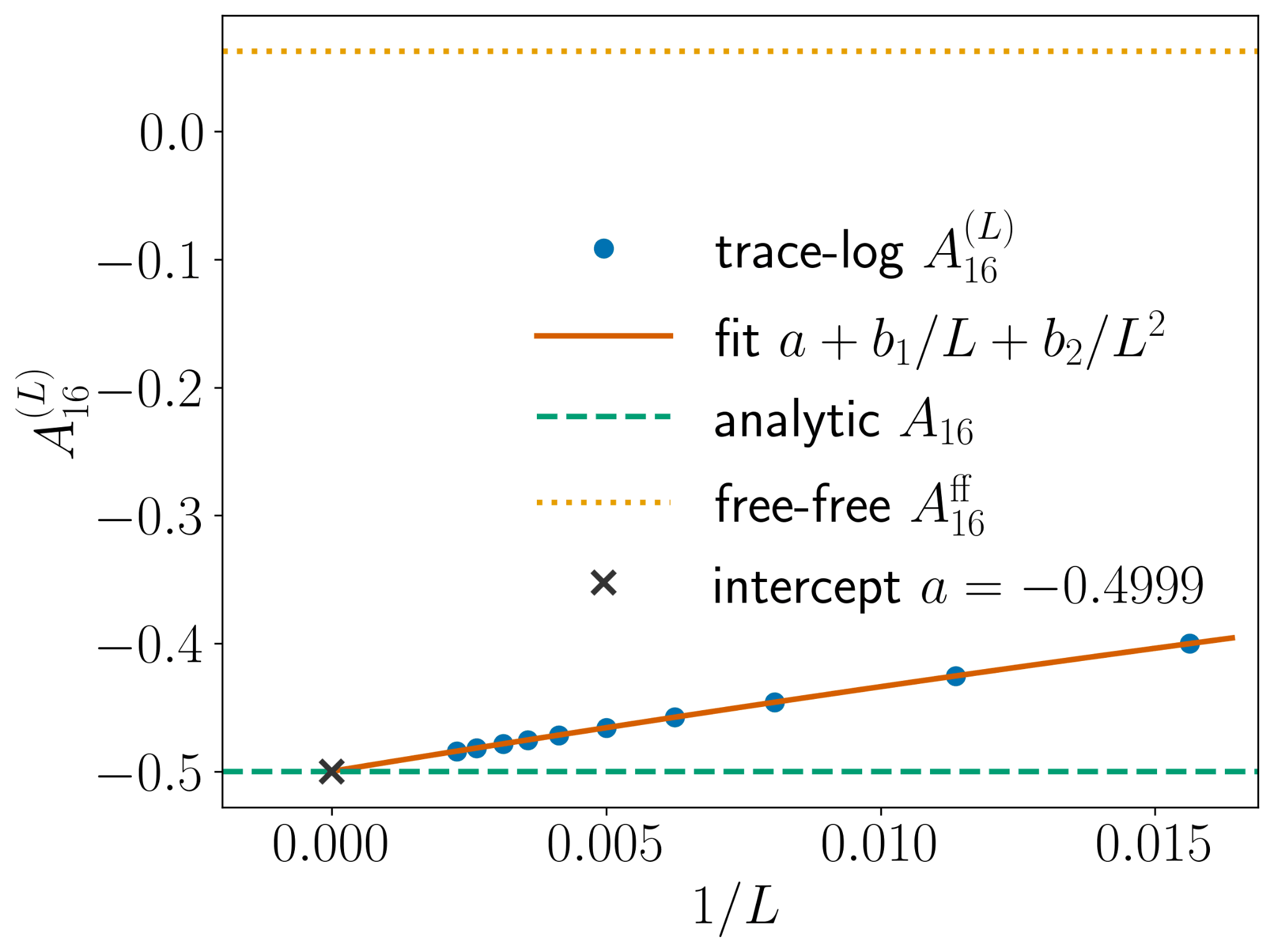
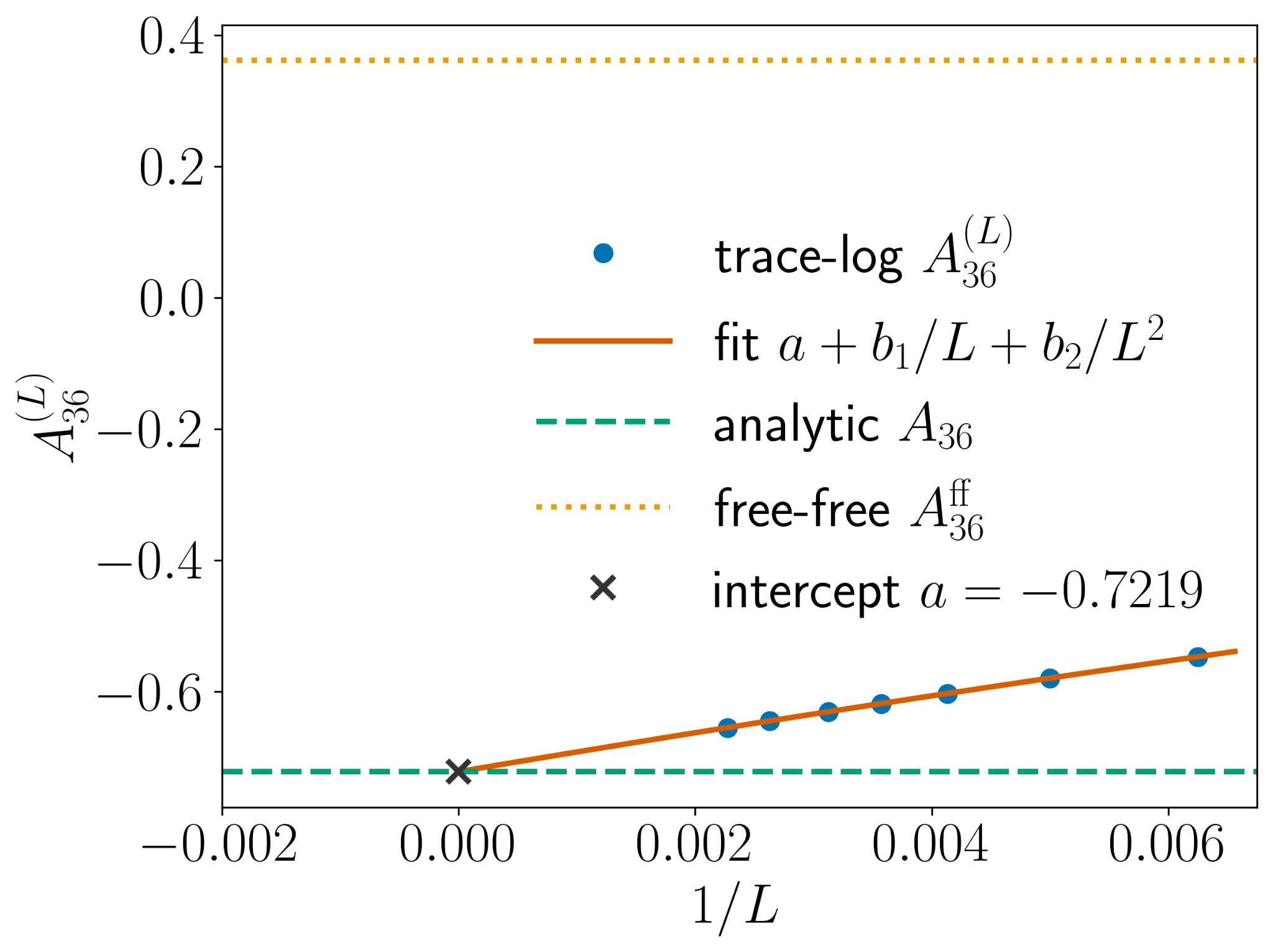
Figure 5: Trace-log extraction of the Regime-IV expansion coefficients PL4 from finite-section data, demonstrating clear convergence to the eta-quotient predictions.
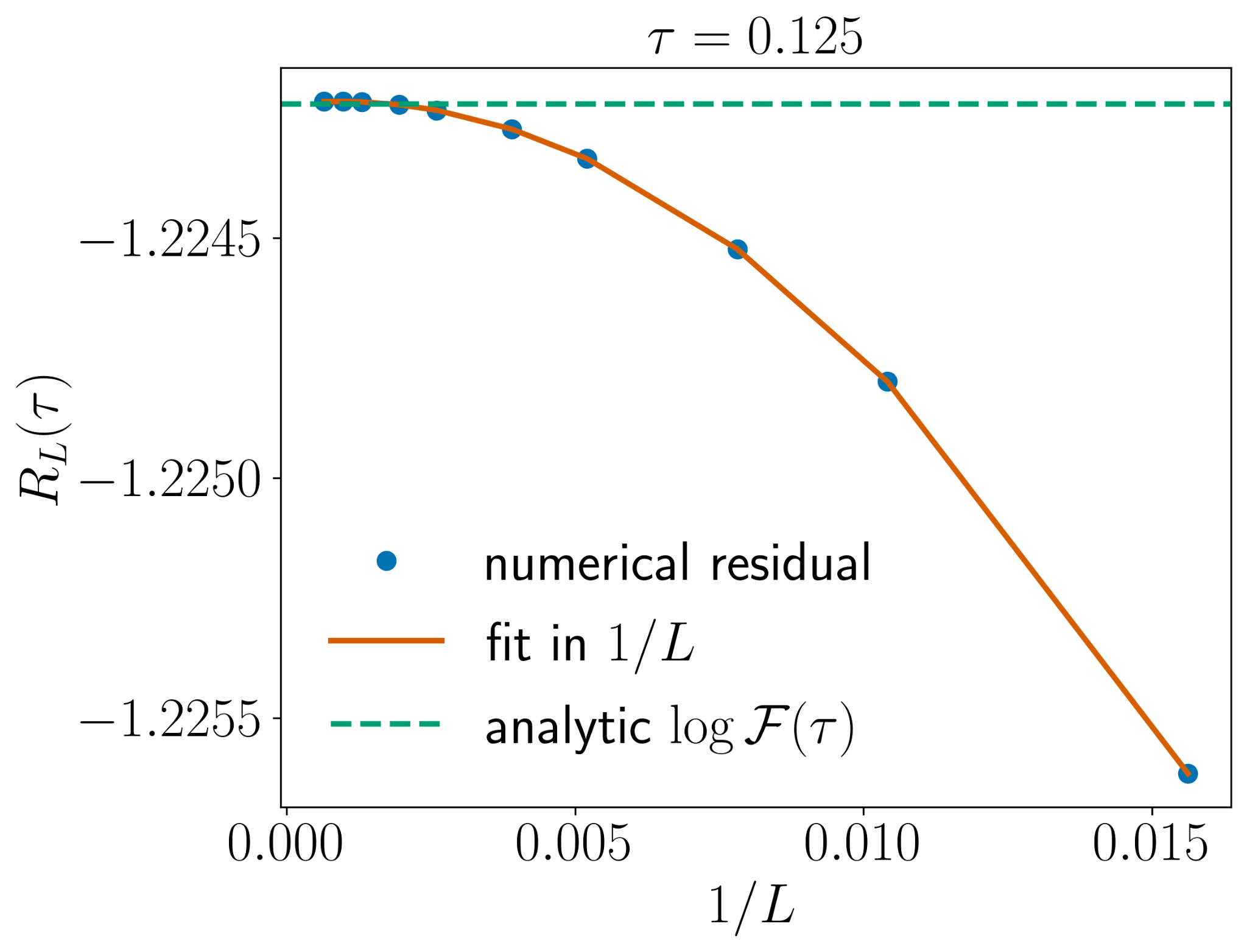
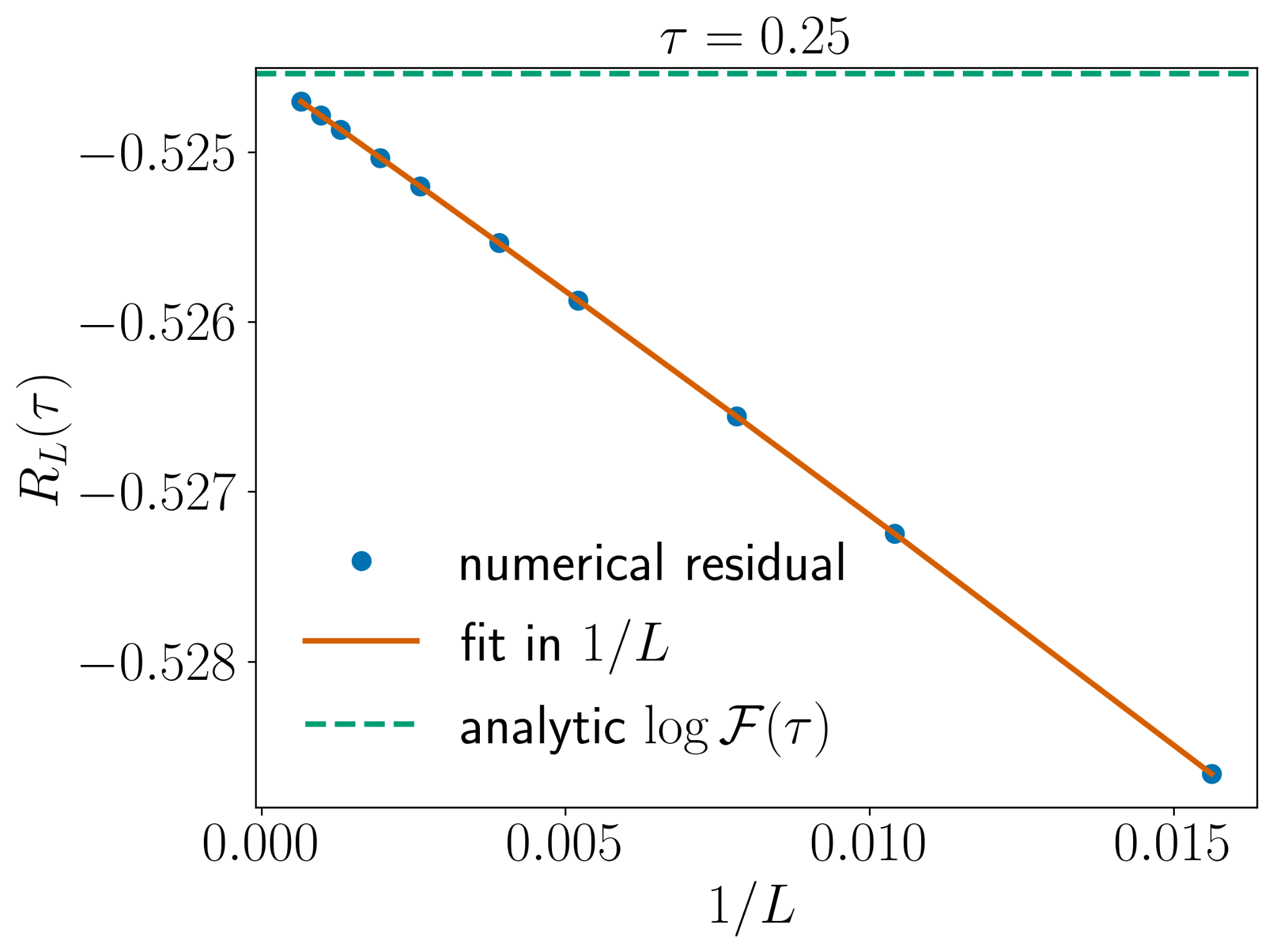
Figure 6: Finite-size scaling of the residual function PL5 in regime IV, with fits supporting convergence to the predicted universal crossover function.
Implications and Future Directions
This work demonstrates that the finite-temperature stabilizer entropy is a sensitive probe for operator-weight sectors and detects boundary-related universal conformal data completely invisible to standard thermodynamic observables. The robustness of the Pfaffian reduction enables the extraction of such information even for large systems and in challenging scaling windows.
Implications for theory include the identification of new classes of boundary CFT observables and universal defect data accessible via operator-basis analysis, potentially analogous to boundary entropy and Affleck-Ludwig PL6-factors, but acting at the level of Pauli-weight distributions. Practically, these results provide new tools for the diagnosis of non-Clifford resourcefulness and magic in thermal quantum many-body states.
Moreover, the XX--TFI "doubling" correspondence (Appendix/Sec. S10) shows that the open-boundary XX chain stabilizer entropy can be exactly constructed from the TFI result, suggesting broad applicability to free-fermion chains and further generalizations.
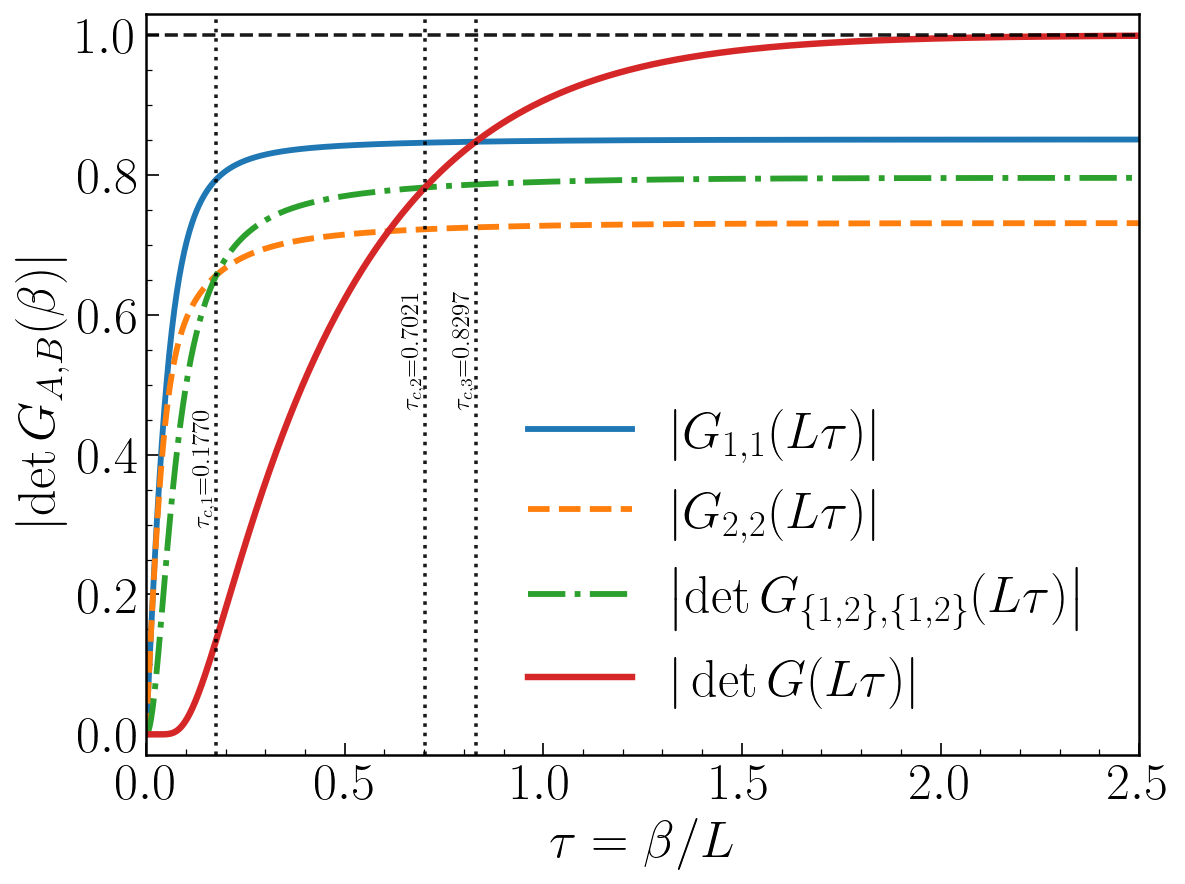
Figure 7: Structure of leading nontrivial minors in PL7 as a function of thermal scaling parameter PL8, affecting the large-PL9 limit of the stabilizer entropy.
Conclusion
The formulation and analysis of the finite-temperature stabilizer entropy in critical open spin chains, as developed here, provide an exact and highly detailed characterization of "hidden" conformal boundary and defect data not accessible to conventional local or spectral probes. The key technical reduction to a block Toeplitz–Hankel Pfaffian enables asymptotic and crossover studies unparalleled in this class of quantum many-body observables, and the appearance of canonical modular forms (e.g., level-eight eta quotients) underscores the deep connection between operator statistics and universal CFT properties. These results chart a clear path toward the systematic use of stabilizer-based diagnostics in conformal, topological, and quantum informational phases of matter.
Reference: "Hidden Conformal Boundary Data in Finite-Temperature Stabilizer Entropy" (2606.08606)

