On Subquadratic Architectures: From Applications to Principles
Abstract: Transformers dominate modern sequence modeling, but their quadratic attention incurs substantial computational cost. Subquadratic architectures offer a scalable alternative. However, it remains unclear which designs yield the most effective sequence models. We compare three leading approaches: xLSTM, Mamba-2, and Gated DeltaNet. We evaluate these models on tasks with complex dependencies: (1) code-model pre-training, (2) distillation of code models from LLMs, and (3) pre-training of time-series foundation models. Across these settings, xLSTM delivers the strongest overall performance. To explain xLSTM's advantage, we present a unified formulation and analyze the underlying architectural mechanisms, focusing on state tracking and memory dynamics. Our results show that xLSTM enables more flexible and stable memory correction via its gating scheme. We corroborate these findings on controlled synthetic length-generalization tasks. Overall, our findings indicate that xLSTM's gains on complex tasks stem from robust state tracking and accumulation.
Paper Prompts
Sign up for free to create and run prompts on this paper using GPT-5.
Top Community Prompts
Explain it Like I'm 14
What is this paper about?
This paper looks at new kinds of AI models that can handle long sequences of information (like long texts, lines of code, or time-series data) more efficiently than today’s standard model, the Transformer. The authors compare three “faster” model designs—xLSTM, Mamba-2, and Gated DeltaNet—to see which one works best and why.
Think of it like testing three different memory systems for reading very long instruction lists: which one reads fastest, remembers well, and makes the fewest mistakes?
What questions did the researchers ask?
They focused on simple, practical questions:
- Which of the three model types does best on real, hard tasks like generating code and forecasting time series?
- If we start from a strong Transformer and “transfer” its knowledge into a faster model, which design benefits most?
- What is happening inside these models’ “memory” that makes one design better than the others, especially for long, structured problems?
- Can we explain the results with small, controlled tests that isolate basic skills like counting and tracking states?
How did they study it?
To keep things fair, they tested the model designs in matched setups—same training recipe, same data sizes, same evaluation—changing only the “sequence operator” (the part that reads and remembers the sequence).
The three model types (everyday explanation)
- xLSTM: Combines two pieces:
- A fast “matrix memory” that can add up information over long stretches (good for counting and accumulation).
- A classic “recurrent” memory that updates step-by-step (good for tracking rules and states), similar to older RNNs but improved.
- Mamba-2: A state-space model that writes and erases memory in a linked way. It’s efficient but its writing and forgetting are tightly tied together, which can limit flexibility.
- Gated DeltaNet: Designed to quickly replace old memory with new information (great for direct lookup or “overwrite” tasks), but that can make counting/accumulation harder.
Here’s a simple analogy: imagine each model has a notebook (memory), a pen (write), and an eraser (forget). xLSTM has separate, flexible controls for writing and erasing; Mamba-2’s pen and eraser move together; Gated DeltaNet’s eraser is great at replacing old notes but can wipe out counts you still need.
Where they tested them
- Code pre-training: Train models from scratch on lots of programming code; then test how well they generate correct solutions.
- Distillation from a Transformer teacher: Start with a strong 4B-parameter Transformer (the teacher), then “transfer” its knowledge into a smaller, faster student model (xLSTM or Gated DeltaNet versions). This controls for training differences.
- Time-series pre-training: Train on many real-world time series (like economics or sensor data), and evaluate zero-shot forecasting accuracy across different model sizes.
A shared way to compare memory
They wrote the three designs in one common “language” to directly compare how each:
- Writes new information to memory,
- Forgets old information,
- Overwrites past entries, and
- Reads memory when making predictions.
This lets them pinpoint why one might be better at counting or at tracking state.
Mini “puzzle” tests
They also built small synthetic tasks that isolate two fundamental skills:
- Accumulation (counting): e.g., keeping a running tally far beyond the lengths seen in training.
- State tracking: e.g., following strict step-by-step rules like even/odd parity or small group operations.
These tests check if models generalize to much longer sequences than they trained on.
What did they find?
Here are the main results:
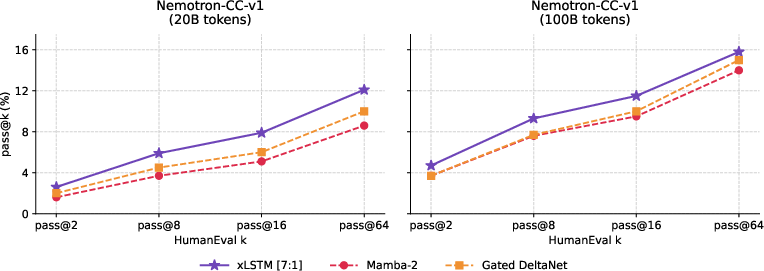
- Code pre-training: xLSTM-based models consistently produced better code solutions across data settings and sampling budgets. On general reasoning tests, xLSTM still led, though by a smaller margin.
- Distillation: When converting a strong Transformer into a faster student, the xLSTM matrix-memory version (xLSTM[1:0]) typically beat Gated DeltaNet on average across code benchmarks.
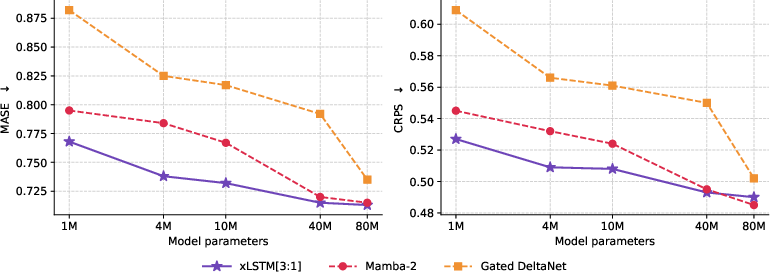
- Time series: xLSTM-based backbones were best from 1M to 40M parameters; at 80M, the gap narrowed, with Mamba-2 slightly edging one metric, but performance was essentially close.
- Synthetic puzzles:
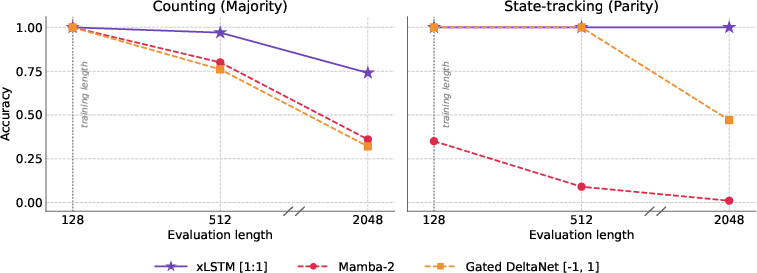
- xLSTM’s matrix-memory alone excelled at counting/accumulation but not state tracking.
- Adding a small recurrent part (xLSTM[1:1]) achieved perfect state tracking and still kept strong counting, making it the only design that handled both well.
- Mamba-2 and Gated DeltaNet struggled to combine both skills at long lengths; Gated DeltaNet’s overwrite helps lookup but can hurt accumulation. A special Gated DeltaNet variant with “negative eigenvalues” improved some state-tracking tasks but did not solve the overall tradeoff.
Why this matters: Tasks like code and time-series forecasting need both skills—adding up signals over long stretches and following structured rules. xLSTM’s mix is well-suited to that.
Why does xLSTM do better? A simple explanation
Inside these models are “gates” that control how much to write and how much to forget. xLSTM keeps these gates flexible and separate, and it combines:
- A fast, additive memory that can keep tally over long context (great for accumulation),
- With a small number of recurrent layers that are good at following precise step-by-step rules (state tracking).
Mamba-2 links writing and forgetting, which reduces flexibility. Gated DeltaNet’s powerful overwrite is great for replacing old info but can erase helpful counts. xLSTM’s more flexible “pen and eraser” make it better at both remembering totals and following rules.
What’s the impact?
- For building faster, more scalable AI models, choosing the right backbone matters. The results suggest using xLSTM-heavy “hybrid” models: mostly the fast matrix memory, plus a few recurrent layers to handle structure.
- This could lead to stronger small-to-mid-sized models that run more efficiently than full Transformers while handling complex tasks well.
- It also gives designers a clear principle: combine accumulation and state tracking in one model if you want good performance on real-world, long, structured data like code and time series.
Key takeaways
- Transformers are powerful but can be slow on very long inputs. Subquadratic models are faster.
- Among leading options, xLSTM usually performs best on complex tasks because it balances two core skills: counting-like accumulation and precise state tracking.
- If you need a practical, scalable sequence model for things like code or time series, an xLSTM-heavy hybrid is a strong, evidence-backed choice.
Knowledge Gaps
Knowledge gaps, limitations, and open questions
Below is a concrete list of what remains missing, uncertain, or unexplored in the paper, framed to guide follow-up research:
- Scaling behavior beyond current regimes:
- How do the observed advantages evolve at larger language-model scales (e.g., ≥1B–7B) and longer training runs (beyond 100B tokens)?
- In time series, does the xLSTM lead persist or disappear beyond 80M parameters, and what are operator-specific scaling laws (loss vs. compute/data)?
- Generality across teachers and distillation settings:
- Do the plug-in results hold across different teacher models (sizes, architectures, instruction vs. base, multilingual)?
- Can Mamba-2 or xLSTM[0:1] be fairly included in linearization via principled initialization schemes (e.g., attention-to-SSM mapping, recurrent weight initialization), and how would they compare?
- Sensitivity of student outcomes to Stage I/II weights, top-k, training length, and window/sink hyperparameters remains unquantified.
- Breadth of domains and tasks:
- Effectiveness on domains beyond code and time series (e.g., long-document NLP, multilingual, speech/audio, proteins, genomics, reinforcement learning trajectories).
- Robustness on code tasks with broader evaluation suites (e.g., CodeContests, DS-1000), and across programming languages and problem distributions.
- Downstream time-series tasks beyond zero-shot forecasting (e.g., anomaly detection, classification, imputation, irregular/uneven sampling, missingness).
- Hybrid-architecture confounds:
- How sensitive are results to the fraction and placement of attention layers in hybrids (e.g., sweeping [m:s] ratios, placement of recurrent layers)?
- Does xLSTM’s advantage persist in fully subquadratic networks with no self-attention or with different amounts of sliding-window attention?
- Fairness of operator tuning:
- To what extent do results depend on operator-specific hyperparameters (gate nonlinearities, normalizers, state dimensions, chunk sizes, optimizers)?
- Would Mamba-2 or Gated DeltaNet close the gap with best-effort, operator-specific tuning (e.g., alternative discretizations, normalization, learned scalings, architectural variants)?
- Negative-eigenvalue parameterization scope:
- The Gated DeltaNet
[-1,1]variant is only tested in distillation; does enabling negative eigenvalues improve pre-training and time-series performance? - Are there stable training recipes for negative-eigenvalue SSM-like operators at scale, and what are their trade-offs?
- The Gated DeltaNet
- Memory normalization and numerical stability:
- The analysis omits explicit normalizers commonly dropped in practice; the impact of explicit normalization (and its placement) on stability, gradient flow, and long-context behavior is not evaluated.
- Numerical stability of exponential input gates (xLSTM) and their interaction with chunkwise kernels at very long contexts remains untested.
- Chunk size and kernel effects:
- How do chunk sizes, kernel implementations, and state checkpointing strategies affect operator performance, stability, and effective context integration?
- Mechanistic evidence for “memory correction”:
- The claim that xLSTM’s exponential gate enables more flexible/robust correction is supported by outcomes, not causal analyses; direct measurements (gate statistics over time, contribution tracking, causal ablations) are absent.
- Do real tasks exhibit the hypothesized counting-like accumulation and state-tracking behaviors in learned states?
- Theoretical characterization:
- No formal capacity results are provided for xLSTM (or variants with exponential gates) under finite precision; rigorous characterization of computational classes for the compared operators remains open.
- Implications of negative eigenvalues and mixed recurrent/matrix-state dynamics for formal state-tracking capacity need proof-level treatment.
- Synthetic-task coverage and realism:
- Synthetic probes cover a narrow set (AnBn, AnBnCn, Majority, Parity, Z5, S3) with a single training length (128); broader suites (varying alphabets, distractors, noise, intermittent resets), longer-length extrapolations, and repeated seeds are needed.
- Mapping from synthetic capabilities to real code/time-series subskills (e.g., variable binding, scope updates, multi-scale dynamics) remains indirect.
- Operator head interactions:
- The unified formulation focuses on single-head behavior; multi-head interactions (interference, specialization, redundancy) and their role in memory dynamics are not analyzed.
- Training efficiency and hardware metrics:
- No comparisons of training/inference throughput, latency, memory footprint, or energy across operators and kernels are reported, despite practical relevance for “subquadratic” claims.
- Sensitivity to normalization and gating choices:
- Effects of different normalization layers (LayerNorm, RMSNorm, GroupNorm) and gate nonlinearities (exp vs. softplus vs. sigmoid variants) on performance, stability, and generalization remain unexplored.
- Long-context and very-long-horizon behavior:
- Distillation tested up to 4k tokens; persistence of operator differences at 32k–128k+ contexts (and in long-horizon time-series forecasting) is unknown.
- Retrieval and replacement-heavy tasks:
- The paper notes Gated DeltaNet’s replacement-style memory; when do such mechanisms outperform xLSTM (e.g., pure retrieval tasks with low accumulation demands)? Task characteristics favoring each operator remain uncharacterized.
- Forecasting pipeline dependencies:
- Results rely on one TSFM pipeline (corpus, patching, head). How robust are operator rankings to alternative heads (e.g., diffusion, flow), patching strategies, and domain-specific preprocessing?
- Statistical significance and variability:
- Confidence intervals, variance across seeds, and statistical tests are not reported; significance of observed margins, especially where small, is unknown.
- Integration with MoE and other scaling strategies:
- How do these operators interact with Mixture-of-Experts, sparse activation, and parallel recurrent/attention routing at scale?
- Continual learning and catastrophic forgetting:
- Do differences in memory dynamics translate to better/worse continual learning, rapid adaptation, or resistance to forgetting?
- Bidirectional and encoder–decoder settings:
- Only causal, autoregressive settings are studied; behavior in bidirectional encoders and seq2seq encoder–decoder architectures is unexplored.
- Reproducibility and artifacts:
- Availability of code, kernels, and exact configurations is not specified; reproducibility across hardware/software stacks needs validation.
- Energy and cost trade-offs:
- Compute/energy costs per point of quality for each operator (training and inference) are not quantified, limiting practical design guidance.
Practical Applications
Immediate Applications
Below are concrete, deployable uses that leverage the paper’s findings on xLSTM, Mamba-2, and Gated DeltaNet, especially the demonstrated edge of xLSTM on complex, long-dependency tasks (code and time series), its plug-in strength in distillation, and the practical efficiency of subquadratic, chunkwise kernels.
- xLSTM-heavy hybrid code models for developer productivity
- Sector: Software/DevTools
- What: Replace most attention layers with xLSTM[7:1]-style blocks in 300M–1B parameter code assistants to improve code generation (HumanEval and related) at fixed compute.
- Products/workflows: IDE plugins, CI/CD code-fix bots, code-review copilots; extend existing hybrid frameworks (e.g., lm-engine) with xLSTM blocks.
- Assumptions/dependencies: Availability of code corpora (e.g., Nemotron-CC-Code), chunkwise kernels for linear attention, small fraction of attention retained for global mixing; benefits most visible at small–mid scales.
- Transformer-to-xLSTM student distillation for lower-latency inference
- Sector: Software, Edge/On-device AI
- What: Use the reported two-stage linearization pipeline (sliding-window attention + sinks, hidden-state alignment + top-k KD) to convert a 4B-class Transformer teacher into an xLSTM[1:0]-augmented, subquadratic student with comparable code performance.
- Products/workflows: Distillation toolchains for internal LLMs; deployment of subquadratic students to GPUs with memory constraints or to high-QPS services.
- Assumptions/dependencies: Access to teacher weights/license (e.g., Qwen3), integration of chunkwise, parallel-friendly linear-attention kernels, careful init (reuse Q/K/V) and two-stage objectives.
- xLSTM-based time-series foundation models (TSFM) for forecasting
- Sectors: Energy, Finance, Retail/Supply Chain, Telecom, Manufacturing, Healthcare operations
- What: Adopt xLSTM[3:1] as the default mixer in 1–40M TSFMs to improve MASE/CRPS at fixed parameter budgets; deploy zero-shot or lightly adapted forecasters.
- Products/workflows: Load/price forecasting (energy), demand/supply planning (retail), risk & volatility baselines (finance), traffic forecasting (telecom), predictive maintenance (manufacturing), hospital admissions/bed utilization (healthcare operations).
- Assumptions/dependencies: Patching scheme + forecasting head from TiRex-style pipelines; domain adaptation for covariates; at ~80M scale, gaps narrow vs Mamba-2.
- Streaming/long-context inference with subquadratic operators
- Sectors: Mobile/IoT, Embedded systems, Contact centers
- What: Deploy chunkwise linear attention (xLSTM mLSTM paths) for O(T) memory/computation in streaming ASR/NLU pipelines, log parsing, or contact center analytics.
- Products/workflows: On-device summarizers and anomaly detectors with sliding-window attention fused with linear attention.
- Assumptions/dependencies: Hardware-optimized chunkwise kernels; gating/normalization tuned for stability; large contexts may still benefit from a few attention layers.
- Architecture selection guidance for sequence tasks with complex dependencies
- Sectors: MLOps, Platform teams
- What: Choose xLSTM when both accumulation (counting-like) and finite-state tracking matter (e.g., code, multi-signal forecasting); consider Gated DeltaNet for overwrite-heavy retrieval tasks; note Mamba-2’s tied gates can limit counting/state tracking.
- Products/workflows: Internal cookbook for backbone choice; design checklists during model R&D.
- Assumptions/dependencies: Task analysis indicating presence of long-range counts or state updates; acceptance of minor attention budget.
- QA and model vetting using synthetic counting and state-tracking tests
- Sectors: MLOps, Academia
- What: Add AnBn, majority, parity, modular arithmetic, and S3 tasks to pre-deployment evals to detect length-generalization failures.
- Products/workflows: CI gates that fail models not generalizing beyond training length; lab courses and benchmarking kits.
- Assumptions/dependencies: Reproducible synthetic task generators; clear pass/fail thresholds aligned with product use.
- Cost and carbon reduction in model serving
- Sectors: Finance (ops), Public sector IT, Enterprise IT
- What: Replace quadratic-attention-heavy stacks with xLSTM-based hybrids to reduce inference cost and energy without sacrificing accuracy on complex tasks.
- Products/workflows: Model portfolio rationalization; internal “Green AI” dashboards tracking compute/kWh per request.
- Assumptions/dependencies: Accurate capacity planning; monitoring to preserve QoS; willingness to modify backbone.
- Retrieval-focused components using Gated DeltaNet
- Sectors: RAG systems, Knowledge management
- What: Use Gated DeltaNet in memory modules that benefit from explicit overwrite behavior (fast, keyed replacement).
- Products/workflows: Key-value memory layers in RAG pipelines; short-term cache updates in session-based recommenders.
- Assumptions/dependencies: Acceptance of weaker counting/generalization; careful normalization; consider [-1,1] parameterization where improved tracking is needed (with trade-offs).
- Education and training content
- Sector: Education/Academia
- What: Teach unified gating/memory dynamics and subquadratic operators through labs comparing xLSTM, Mamba-2, Gated DeltaNet.
- Products/workflows: Course modules; open-source notebooks on chunkwise kernels and synthetic tasks.
- Assumptions/dependencies: Access to modest compute; open-source implementations.
- Internal R&D playbook for hybrid ratios
- Sectors: AI labs, Startups
- What: Start with m-heavy, s-light xLSTM ratios (e.g., [7:1] for code, [3:1] for TS) and tune the fraction of attention layers (e.g., ~3 of 24) as a default baseline.
- Products/workflows: Standard backbone templates in new projects.
- Assumptions/dependencies: Validation on target tasks and scales; mixed precision and fused kernels available.
Long-Term Applications
These opportunities require further scaling, validation, regulatory clearance, or ecosystem development. They build on the paper’s principles: xLSTM’s combined accumulation + state-tracking and the unifying memory-gating perspective.
- Frontier-scale hybrid LLMs with dominant xLSTM layers
- Sectors: General AI platforms, Enterprise SaaS
- What: Train 10B+ parameter hybrids that replace many attention layers with xLSTM, especially for code, tools use, and long-context reasoning.
- Products/workflows: Next-gen copilots with improved latency/cost; long-context assistants.
- Assumptions/dependencies: Empirical confirmation that xLSTM advantages persist at frontier scales; optimized multi-head mLSTM kernels; distributed training support.
- Multi-modal temporal foundation models
- Sectors: Healthcare, Robotics, Smart cities, Industrial IoT
- What: Extend xLSTM-based TSFMs to fuse time series with text, images, or graphs (e.g., patient vitals + notes; robot sensors + instructions).
- Products/workflows: Predictive care assistants; factory digital twins; traffic/delivery orchestration.
- Assumptions/dependencies: Large, well-curated multi-modal datasets; safety validation; data governance.
- On-device assistants through large-scale distillation pipelines
- Sectors: Mobile, Consumer electronics, Automotive
- What: Industrialize the two-stage linearization with xLSTM[1:0] to compress powerful teachers into subquadratic, on-device models (for code, summarization, task automation).
- Products/workflows: Private on-device copilots; in-car assistants with long-context logs.
- Assumptions/dependencies: Continued progress in efficient kernels, memory planning, and power envelopes; licensing and privacy constraints for teacher data.
- Sector-specific regulated forecasting (clinical, risk, grid operations)
- Sectors: Healthcare (clinical forecasting), Finance (risk), Energy (grid)
- What: Use xLSTM-based TSFMs for clinically actionable predictions, risk stress-testing, and grid reliability forecasts.
- Products/workflows: Clinical decision support, capital planning tools, outage prevention.
- Assumptions/dependencies: Rigorous validation, fairness and bias checks, model interpretability, regulatory approvals (e.g., FDA/EMA, financial regulators).
- Hardware and compiler co-design for linear-attention matrices
- Sectors: Semiconductors, Systems
- What: Create accelerators and compiler passes optimized for chunkwise linear attention and mLSTM state updates.
- Products/workflows: Custom silicon/firmware; library-level fusions (kernels for state updates + gating).
- Assumptions/dependencies: Sufficient market demand; open standards for subquadratic ops.
- Formal-code reasoning and program-analysis LLMs
- Sectors: Software assurance, Security
- What: Couple xLSTM’s sLSTM state tracking with formal tools (symbolic execution, static analysis) for better variable binding, scopes, and control-flow reasoning.
- Products/workflows: Advanced bug finding, exploit detection, refactoring engines.
- Assumptions/dependencies: Datasets with verified semantics; hybrid neuro-symbolic pipelines; longer training schedules.
- Robust online/continual learning for nonstationary streams
- Sectors: Finance, Retail, IoT, Cybersecurity
- What: Leverage flexible memory correction and accumulation for streaming updates without retraining (concept drift handling).
- Products/workflows: Continual forecasters; adaptive anomaly detectors.
- Assumptions/dependencies: Stable online training recipes; safeguards against catastrophic forgetting; monitoring.
- Safety-critical control and planning
- Sectors: Robotics, Autonomy
- What: Apply xLSTM’s state-tracking to control policies that require long-horizon internal state and accumulation (e.g., planning with sparse rewards).
- Products/workflows: Robot controllers; predictive planners in warehouses or mobility.
- Assumptions/dependencies: Safety constraints, sim-to-real transfer, integration with classical controllers/verification.
- Standard-setting and policy for efficient AI
- Sectors: Public policy, Standards bodies
- What: Promote benchmarks that include complex-dependency tests (counting/state tracking) and encourage subquadratic backbones to reduce energy/carbon.
- Products/workflows: Procurement criteria, energy reporting standards, public leaderboards with length-generalization suites.
- Assumptions/dependencies: Consensus on metrics, tools for energy accounting, stakeholder buy-in.
- Theory-informed operator innovation
- Sectors: Research/Academia
- What: Explore new gate/overwrite designs (e.g., controlled negative-eigenvalue transitions) that jointly improve counting and tracking without trade-offs.
- Products/workflows: Next-gen subquadratic operators; unified training heuristics for stability.
- Assumptions/dependencies: Further theoretical advances; extensive benchmarking at scale.
Glossary
- Accumulation: The capability to aggregate information over long contexts, often beyond training length. "Counting tasks isolate accumulation beyond the training length"
- Attention sinks: Special tokens that act as fixed attention targets to stabilize or augment sliding-window attention. "sliding-window-attention scaffold with attention sinks, hidden-state alignment, and sparse top- knowledge distillation."
- Causal masking matrix: A mask that enforces causality in attention by preventing access to future positions. "where $\mat{M}~\in~\{-\infty,1\}^{T \times T}$ is a causal masking matrix"
- Chunk-wise formulation: Processing sequences in parallel-sized chunks while maintaining a recurrent state across chunks for efficiency. "practical implementations use the intermediate chunk-wise formulation"
- Continuous Ranked Probability Score (CRPS): A proper scoring rule for probabilistic forecasts measuring distributional accuracy. "MASE and CRPS scores (lower is better)"
- Fast-weight mechanism: A dynamic memory update scheme where weights change rapidly based on recent inputs to store associations. "a combination of the fast-weight mechanism of Delta-Nets"
- Finite-state tracking: Maintaining and updating a finite internal state to implement discrete sequence rules. "two primitives: accumulation and finite-state tracking."
- Foundation models: Large, broadly pre-trained models used as general backbones across modalities and tasks. "remain the default backbone for foundation models in language, code, and time series."
- Gated DeltaNet: A subquadratic linear-attention architecture combining DeltaNet fast weights with SSM-style gated transitions. "Gated DeltaNet~\citep{yang24gdn} is used in competitive hybrid LLMs"
- Geometric mean: A multiplicative average used to aggregate metrics across heterogeneous datasets. "and report \ac{mase} and \ac{crps} aggregated by geometric mean."
- Gated Recurrent Unit (GRU): A recurrent neural network with update/reset gates; often less expressive in counting tasks. "making it similar to a \ac{gru} \citep{cho14gru,dao24mamba2}."
- Intra-layer hybrid block: A layer that fuses multiple sequence operators in parallel within the same block. "an intra-layer hybrid block: the tested linear-attention operator runs in parallel with sliding-window attention"
- Inter-layer hybrid: An architecture mixing different operator types across layers in a stack. "Here, ``inter-layer hybrid'' means that most layers use the tested subquadratic sequence operator, while a small number of layers remain standard self-attention layers."
- Knowledge distillation: Training a student model to mimic a teacher model’s outputs or representations. "Linearization, a form of knowledge distillation, converts an open-weight Transformer teacher into a subquadratic student"
- Length-generalization: Generalizing to much longer sequences than those seen during training. "controlled synthetic length-generalization tasks."
- Linear attention: An attention mechanism with linear-time complexity that avoids the softmax, enabling efficient state updates. "Linear attention is a basic subquadratic attention variant that does away with the softmax in regular attention."
- Linearization: Converting a Transformer into a subquadratic student through structured distillation and architectural changes. "Prior linearization work typically fixes the target operator family"
- Lorenz attractor: A canonical chaotic dynamical system used as a challenging time-series example. "(here, a Lorenz attractor)"
- Mamba-2: A subquadratic sequence model derived from state-space models with tied input/forget gates. "Mamba-2 \citep{dao24mamba2} appears as a core component in competitive hybrid LLMs"
- Matrix-state: A memory representation stored as a matrix that accumulates key-value associations over time. "plug-in matrix-state replacements"
- Mean Absolute Scaled Error (MASE): A scale-free forecast error metric used to compare time-series models across series. "MASE and CRPS scores (lower is better)"
- Negative-eigenvalue parameterization: Allowing negative eigenvalues in state transitions to enable richer dynamics and state tracking. "the negative-eigenvalue parameterization of~\citet{grazzi25unlocking}"
- Null-space: The set of vectors mapped to zero by a given matrix; used to remove components along specific directions. "an orthogonal projection onto the null-space of ."
- Orthogonal projection: A projection that removes components along a specified direction while preserving orthogonal components. "an orthogonal projection onto the null-space of ."
- Outer product: A matrix formed by multiplying a column vector and a row vector, used to write key-value associations. " denotes the outer product,"
- Pareto-dominate: To outperform another method on multiple metrics without being worse on any. "and was shown to Pareto-dominate transformers"
- Patching scheme: A strategy that segments time series into patches for model input during pre-training. "the same corpus, patching scheme, optimizer, and forecasting head are shared across all models"
- pass@k: A code-generation metric measuring the probability of at least one correct sample among k attempts. "We evaluate code generation with HumanEval pass@ for "
- Permutation composition: Combining permutations to form a new permutation; used as a hard state-tracking test. "cannot solve hard state-tracking problems such as permutation composition"
- Sliding-window attention: Attention restricted to a fixed recent window to reduce complexity. "sliding-window attention of window size 512 and four sink tokens"
- Sliding-window-attention scaffold: A distillation framework that anchors a student with sliding-window attention plus auxiliary mechanisms. "a sliding-window-attention scaffold with attention sinks, hidden-state alignment, and sparse top- knowledge distillation."
- Softmax attention: The standard attention mechanism applying a softmax over similarity scores. "the regular, causal softmax attention can be written as"
- State tracking: Maintaining and updating latent memory states to reflect structured dependencies over time. "robust state tracking and accumulation."
- State-space models: Models with latent states updated by linear dynamics and driven by inputs, used for efficient sequence modeling. "derived from state-space models"
- Time Series Foundation Models (TSFM): Foundation models pre-trained on diverse time series for general-purpose forecasting. "Time-series Foundation-Model Pre-training"
- Top-: Using only the k most probable elements from a distribution, often for efficient distillation. "top- sparse teacher distribution."
- xLSTM: An extended LSTM family combining matrix-state linear attention (mLSTM) and recurrent (sLSTM) layers. "xLSTM enables more flexible and stable memory correction via its gating scheme."
- Zero-order hold discretisation: A discretization method that assumes inputs are held constant over each sampling interval. "the sample time in the zero-order hold discretisation"
- Zero-shot: Evaluation without task-specific fine-tuning or additional training. "We evaluate zero-shot on GIFT-Eval"
Collections
Sign up for free to add this paper to one or more collections.

