- The paper introduces an agnostic Occam bound that links circuit depth with sample complexity, balancing trace-distance error and approximation error.
- It proposes a hierarchically nested model selection strategy that adaptively penalizes excess circuit complexity based on finite-data constraints.
- The work formalizes a sample-supported expressibility law, ensuring that deeper quantum circuits are statistically justified by available quantum samples.
Quantum Occam Learning: Sample-Supported Expressibility for Circuit-Based Quantum Learning
Introduction
The paper "Quantum Occam Learning: Sample-Supported Expressibility for Circuit-Based Quantum Learning" (2606.12211) rigorously develops an information-theoretic learning theory tailored to quantum data generated via finite-size quantum circuits. Central to its thesis is the reconciliation between the expressibility of quantum circuit ansatz and their statistical learnability from finitely many quantum samples. By formalizing the approximation-estimation tradeoff in quantum state learning, the authors elucidate how the complexity of quantum circuits must be justified, not simply by physical implementability or optimization, but by the statistical capacity supported by finite quantum data.
The learning problem targets n-qubit pure states, denoted Sn,G, generated by at most G two-qubit gates. The trace distance D(ρ^,σ^) is adopted as the error metric, and the statistical capacity of an ansatz is quantified by its metric entropy. The critical insight is that metric entropy is essentially linear in G, up to logarithmic factors and architecture-dependent constants, and governs the number of quantum samples required for global state learning. If the model has excess expressibility (large G), the available copies may not suffice to statistically identify the state, even with arbitrary collective measurements.
Approximation-Estimation Tradeoff and Agnostic Learning
The paper eschews the rigid realizability assumption (that the unknown source lies exactly in Sn,G), instead introducing:
- the best G-gate approximation error dG(ρ^) (distance from the source to the closest state in Sn,G),
- and the approximate circuit complexity Sn,G0 (minimum Sn,G1 such that Sn,G2).
The key theorem establishes an agnostic Occam bound: given Sn,G3 copies, an information-theoretic learner achieves trace-distance error no larger than the best Sn,G4-gate approximation error plus a statistical penalty Sn,G5. This mirrors the classical bias-variance tradeoff, but with distinct quantum technological implications as model complexity is a circuit resource, not merely parameter count.
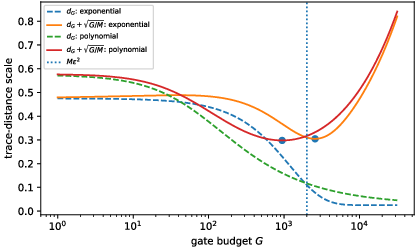
Figure 1: Illustrative approximation-estimation tradeoff for Sn,G6, showing how the statistical radius Sn,G7 interacts with decreasing approximation error Sn,G8 as circuit depth increases.
Adaptive Model Selection: Structural Risk Minimization
Recognizing that the underlying circuit complexity is often unknown, the authors construct a hierarchically nested set of circuit classes and introduce an adaptive model selection strategy. The main adaptive Occam theorem states that, without knowing the correct Sn,G9, the learner competes (up to logarithmic factors) with the optimal point on the entire approximation curve G0. This operationalizes quantum structural risk minimization and minimum description length (MDL): the selection of a more expressive ansatz is penalized according to its statistical complexity and is justified only if it delivers commensurate improvement in fit.
Sample-Supported Expressibility Law
A central practical consequence is formalized in the sample-supported expressibility law: for target trace-distance accuracy G1, G2 samples can only support G3 gates, modulo logarithmic corrections and tomography saturation at G4. Thus, circuit complexity is not an unconditional resource, but must be adaptively limited by sample size.
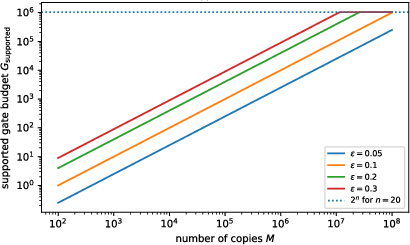
Figure 2: Sample-supported expressibility boundary (for G5); curves depict G6 vs. sample budget G7 for several target accuracies, saturating at the pure-state tomography dimension G8.
Theoretical and Practical Implications
Quantum Machine Learning and Generative Modeling
The results impose a fundamental data-dependent constraint on variational ansatz design for generative modeling: excessive ansatz depth is not statistically justified unless more samples are available or the error metric is weakened. This complements the literature on barren plateaus and trainability by identifying sample complexity as a bottleneck even when optimization is ideal.
Quantum Data Compression
Approximate circuit complexity G9 naturally quantifies quantum data compressibility. The Occam bound yields efficient compressed representations of quantum sources when D(ρ^,σ^)0 is small, with sample complexity scaling linearly in D(ρ^,σ^)1 and quadratically in D(ρ^,σ^)2.
Tomography and Scaling Laws
The Occam-theoretic scaling interpolates between low-complexity learning and full Hilbert-space tomography, unifying previous results on the sample complexity for bounded-circuit learning [zhao2024learning].
Model Overparameterization and Underspecification
When D(ρ^,σ^)3, the model is statistically underspecified. Training protocols may fit observables or partial distributions but global trace-distance identification becomes impossible due to the abundance of indistinguishable hypotheses.
Future Directions
- Integrating Occam theory with experimental constraints (measurement locality, hardware noise, restricted measurement classes)
- Refined metric entropy calculations for structured, noisy, or hardware-efficient ansatz families
- Joint analysis with optimization dynamics (trainability, barren plateaus) to synthesize statistical and computational barriers to quantum learning
Conclusion
The paper establishes bounded circuit complexity as a statistical resource for quantum machine learning, not merely as an architectural promise. Circuit expressibility must be matched to the sample budget to support uniform quantum state learning in trace distance. The Occam adaptive model selection framework enables principled ansatz selection, balancing approximation and estimation, and provides a rigorous guideline for the practical deployment of quantum learning protocols in the presence of finite quantum data.

