- The paper redefines behavioral forecasting of LRMs as a supervised learning task, moving beyond naive chain-of-thought explanation methods.
- It introduces Behavior Forecasters that, by leveraging target LRM backbones, accurately predict rerun consistency and counterfactual sensitivity with high Spearman correlations.
- Empirical results demonstrate the method's data-efficient transfer and computational efficiency, simplifying deployment-time behavioral predictions.
Forecasting Future Behavior as a Learning Task: A Technical Summary
The paper "Forecasting Future Behavior as a Learning Task" (2606.11445) addresses a central challenge for deployable AI systems: forecasting the behavior of large reasoning models (LRMs) on new or perturbed inputs. Traditional approaches utilize explanation methods or naive reading of model-generated chain-of-thought traces to anticipate behavior. However, such explanation-based forecasts are unreliable for LRMs, both because existing methods do not generalize to long stochastic trajectories and because reasoning tokens are not always a faithful reflection of internal computation.
The authors shift the paradigm by formulating behavior forecasting as a supervised learning task. The goal is to train external models, named "Behavior Forecasters," to predict characteristics of a target LRM's future behaviors (such as rerun consistency and counterfactual sensitivity) directly from an observed trajectory—given only a single run of the model on one input.
Methodology
The Behavior Forecaster operates by ingesting a triplet sequence (prompt, reasoning, answer) from an LRM’s trajectory and outputting predictions about behavioral properties that are typically estimated through expensive resampling. Properties considered are:
- Rerun consistency: Probability that the LRM’s answer is repeated on another run of the same prompt.
- Counterfactual sensitivity: For each segment of the prompt, estimated probability that removing that segment would cause the LRM's answer to change.
Training data is collected automatically by performing multiple forward passes of the target LRM to generate ground truth behavioral labels, obviating the need for human annotation.
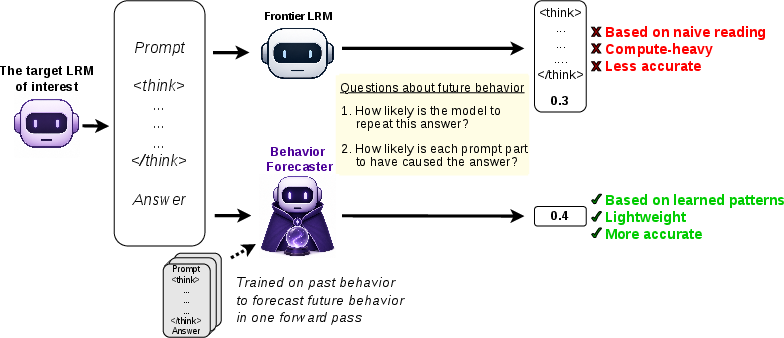
Figure 1: Behavior Forecaster architecture for inferring future behavioral properties from a single observed trajectory, outperforming naive reading baselines at much lower compute cost.
The model architecture reuses the backbone of the target LRM, initializes from its weights, and appends a task-specific prediction head. For counterfactual sensitivity, the input arrangement includes an echoed copy of the prompt placed after the reasoning and answer tokens, with per-token MLP predictions at echoed prompt positions. For rerun consistency, a pooling mechanism with cross-attention over learned queries extracts trajectory-level features.
Empirical Results
The approach is benchmarked across OLMo-3-7B-Think and Qwen3.5-2B on three diverse datasets: FEVEROUS, RuleTaker, and TreeCut. The Behavior Forecaster consistently outperforms both strong naive reading baselines (frontier LLMs such as GPT-5.4 and Claude Opus~4.6) and standard single-location probes.
Key quantitative findings:
- On Qwen3.5-2B: Forecaster Spearman correlation reaches 0.653/0.740 on counterfactual sensitivity/rerun consistency, compared to 0.417/0.224 for GPT-5.4.
- On OLMo: Spearman for forecaster is 0.731/0.571 (counterfactual/rerun), versus 0.672/0.305 for GPT-5.4 and weaker for single-location probes.
Numerical superiority holds even when forecasters are required to generalize to held-out dataset variants or tasks, achieving strong zero-shot and data-efficient transfer properties. Notably, fine-tuning is highly data-efficient—at most 600 steps for adaptation to a new dataset suffices.
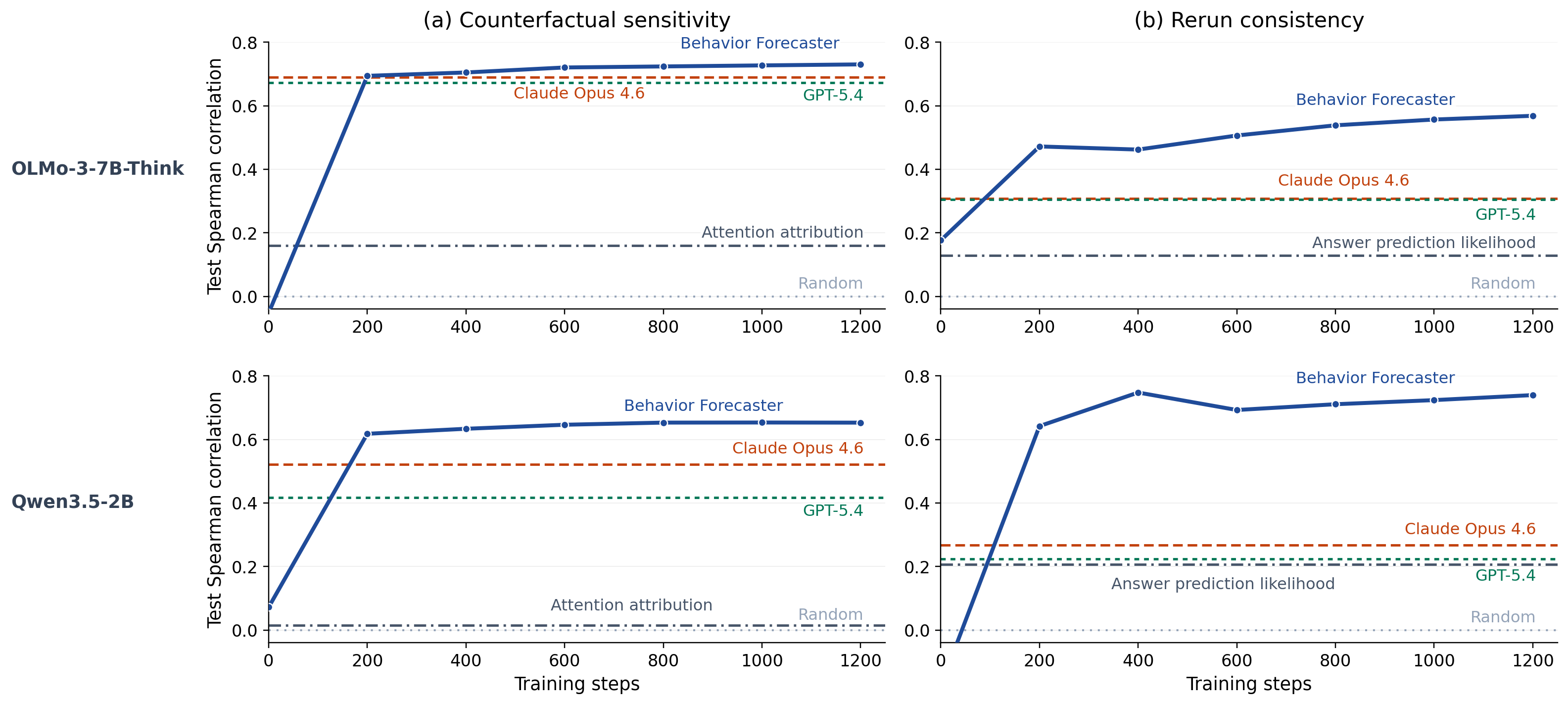
Figure 2: Behavior Forecaster displays superior Spearman correlation over training compared to naive reader and probe baselines for both OLMo-3-7B-Think and Qwen3.5-2B.
Ablation experiments confirm that initializing from the target LRM and end-to-end fine-tuning of the backbone are critical for performance. Removing the reasoning tokens or freezing the backbone each substantially degrades accuracy, indicating that latent signals in the trajectory—unrecoverable by naive reading—are leveraged by the forecaster.
Implications and Discussion
Theoretical Implications
The results invalidate the hypothesis that surface-level reading of reasoning tokens or explanation probes at single fixed positions are sufficient for accurate behavioral forecasting. Instead, learned approaches can extract richer predictive signals from the structure of entire reasoning trajectories, irrespective of their semantic legibility. This shifts the framing of trajectories from being artifacts to be explained to high-dimensional data with learnable latent patterns.
The findings reinforce recent claims that chain-of-thought traces only weakly reflect underlying model computation, and that direct reading is unreliable—consistent with analyses showing dissociation between surface reasoning and answer formation [turpin2023language, chen2025reasoningmodelsdontsay].
Practical Implications
Practically, deployment-time forecasting of model behavior can be dramatically more compute-efficient: the trained Behavior Forecaster produces forecasts in a single forward pass, amortizing the high labeling cost encountered only during training. This enables scalable, per-input behavioral predictions suitable for abstention, flagging, or real-time human-in-the-loop judgments, aligning with regulatory requirements (e.g., EU AI Act [eu_ai_act_2024]).
Forecasters transfer successfully across both datasets and related behavioral targets, highlighting the value for auditing and monitoring pipelines across task boundaries without repeated heavy supervision.
Limitations and Future Directions
Generalization to out-of-distribution behavioral tasks remains under-explored; broader coverage will require further investment in synthetic label generation. As models with more faithful internal reasoning traces become available, the gap between naive reading and trained forecasting may narrow, but empirical evidence suggests that mechanistic faithfulness does not necessarily improve with scaling or standard training [arcuschin2025chain, han2026rfeval].
A promising direction is automating the selection of new behavioral targets and learning forecasters for properties of interest, supporting large-scale AI safety and transparency goals. Behavior Forecasters present a template for treating any automatically labeled behavioral statistic as a candidate for direct, low-cost prediction at deployment.
Conclusion
"Forecasting Future Behavior as a Learning Task" (2606.11445) demonstrates that core behavioral properties of LRMs—such as rerun consistency and counterfactual sensitivity—can be forecast with high accuracy from a single observed reasoning trajectory, using external models trained end-to-end. These Behavior Forecasters substantially outperform strong naive reader baselines at a fraction of the inference cost and generalize effectively across datasets and within-task variants. The work repositions the LRM reasoning trajectory as a source of nontrivial behavioral signal accessible to learned models, rather than as semantically faithful explanations. This invites a broader research agenda on learned behavioral forecasting for robust, scalable, and interpretable AI deployment.