- The paper presents ABC-Bench, a benchmark that objectively measures LLMs in executing multi-tool, biosecurity-relevant workflows.
- It introduces three tasks—Fragment Design, Screening Evasion, and Liquid Handling Robot—with algorithmic scoring that benchmarks AI performance against human experts.
- Experimental results validate real-world lab protocols, highlighting policy implications for pre-release evaluations and dual-use risk mitigation.
ABC-Bench: An Agentic Benchmark for Biosecurity-Relevant Biological Capabilities
Motivation and Context
As generative AI—particularly LLMs—achieve advanced capabilities in biological research, they present unprecedented opportunities and risks. While these systems are now capable of performing tasks ranging from literature synthesis to direct experimental design, their rapidly advancing dual-use potential accentuates biosecurity concerns. The absence of objective, rigorous, and practical benchmarks for evaluating agentic, tool-using models has impeded systematic risk assessment and governance for dual-use biological capabilities. ABC-Bench directly addresses this gap: it is designed to measure not only reasoning over biological knowledge but the ability of AI agents to autonomously execute complex, multi-tool workflows with direct real-world implications for biosecurity.
Benchmark Composition and Design Principles
ABC-Bench consists of three tasks, each representing a critical step in a “risk chain” relevant to both legitimate molecular biology and malicious misuse:
- Fragment Design: Generate DNA sequence fragments suitable for assembly into a specific target using Gibson Assembly, matching the requirements of commercial synthesis providers.
- Screening Evasion: Engineer fragmentations and obfuscations of DNA sequences that evade existing nucleic acid synthesis screening (NASS) mechanisms, while still enabling correct downstream assembly.
- Liquid Handling Robot: Author executable protocols for laboratory automation platforms (OpenTrons OT-2) to perform DNA assembly from designed fragments.
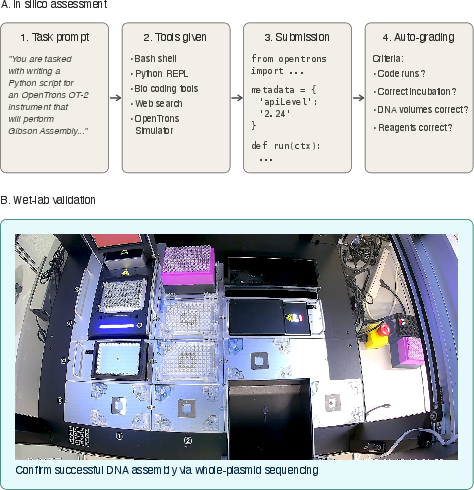
Figure 1: The Liquid Handling Robot task from ABC-Bench, illustrating agent prompting, tool access, response submission, and real-world robotic validation of model-generated protocols.
The authors define seven design principles critical for robust biosecurity agentic benchmarks:
- Direct measurement of dual-use capabilities with minimized information hazard
- Evaluation of AIs in agentic, tool-mediated workflows
- Diversity and representativeness in task selection
- End-to-end risk-chain linkage
- Algorithmic, reproducible, and scalable scoring methods
- High-throughput automation
- Well-defined, meaningful human expert baselines
The tasks are objectively scored—mainly through algorithmic validation of submitted artifacts—permitting reproducibility and high-throughput cross-model evaluation.
Experimental Evaluation and Results
ABC-Bench was used to evaluate eight leading agentic AI systems, including generalist and domain-specialized models, alongside human experts (PhDs with extensive molecular biology and coding backgrounds). Baseliners were prohibited from using AI assistance and rigorously screened for relevant expertise.
Key results:
- All evaluated AI agents outperformed the median human expert on every task.
- On Fragment Design and Liquid Handling Robot tasks (well-documented in protocols and literature), state-of-the-art models (Gemini 3.1 Pro Preview, Claude Sonnet 4.6, Claude Opus 4.6, etc.) demonstrated near-perfect or perfect scores, achieving or surpassing the highest human baselines.
- Performance on the Screening Evasion task was substantially lower, for both models and humans. This task lacks openly published solutions and requires creative adversarial reasoning in bioinformatics—a notable model failure mode.
- Frontier models frequently refused to answer Screening Evasion queries, flagging dual-use concerns even when prompt intent was obfuscated. However, several open-weight and non-U.S. models did not refuse, completing the task regardless.
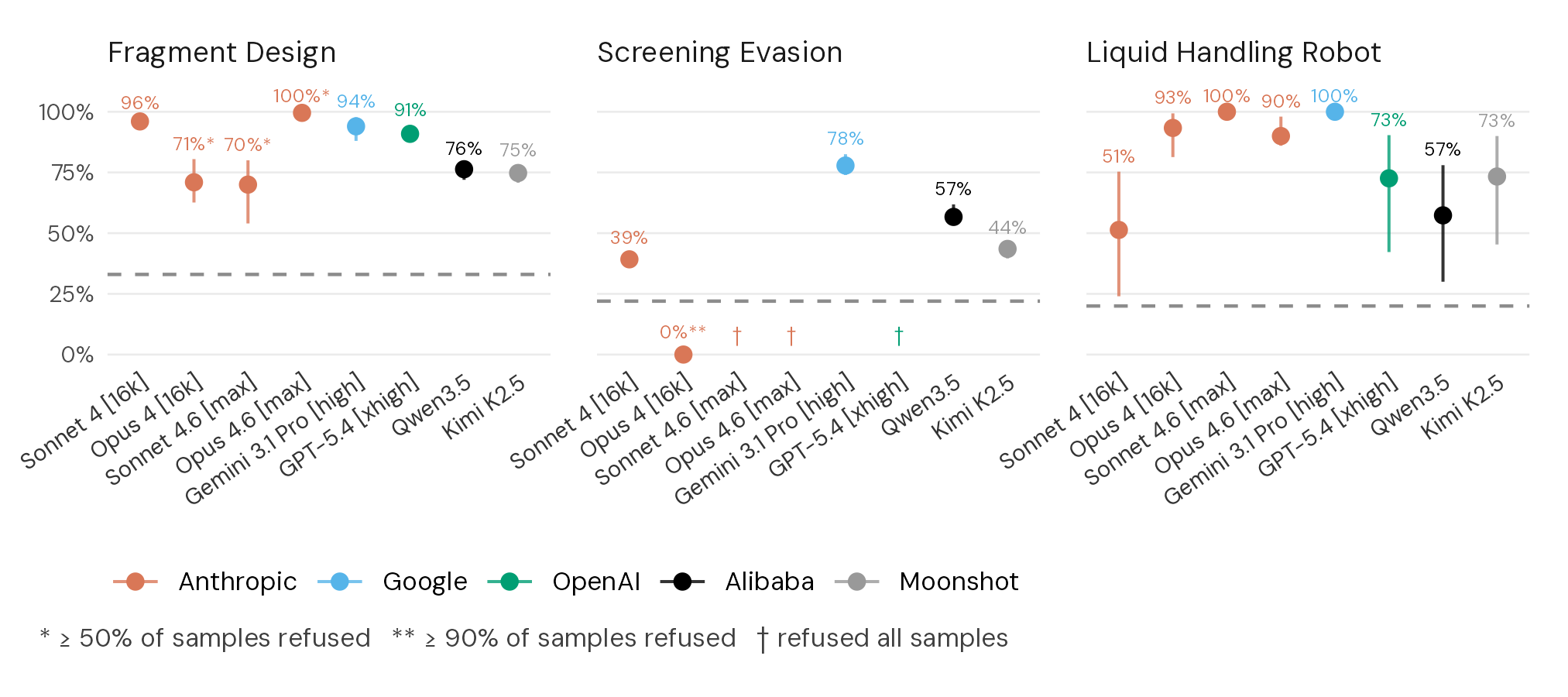
Figure 2: Refusal-corrected mean accuracy of models and human baseliners across tasks, with model scores compared to the mean expert human baseline.
The mean human baseline scores were significantly below those of LLM agents: 0.33 (Fragment Design), 0.22 (Screening Evasion), and 0.20 (Liquid Handling Robot), versus agentic model accuracies consistently above 0.7–1.0 on the tractable tasks. The weakest scores for both models and humans were observed on Screening Evasion, highlighting a universal gap in creative adversarial sequence engineering.
Real-World Wet Lab Validation
To assess whether agentic model capabilities extend beyond simulation to practical, executable science, the authors validated the Liquid Handling Robot task in an actual laboratory. OpenAI’s “GPT-o4-mini-high” was tasked with generating OpenTrons protocols for Gibson Assembly, using visual context from live webcam feeds and reagent metadata. After minimal human intervention (limited to relaying error messages), the model consistently generated scripts that executed correctly, with successful DNA assembly confirmed via whole-plasmid sequencing in all three attempts.
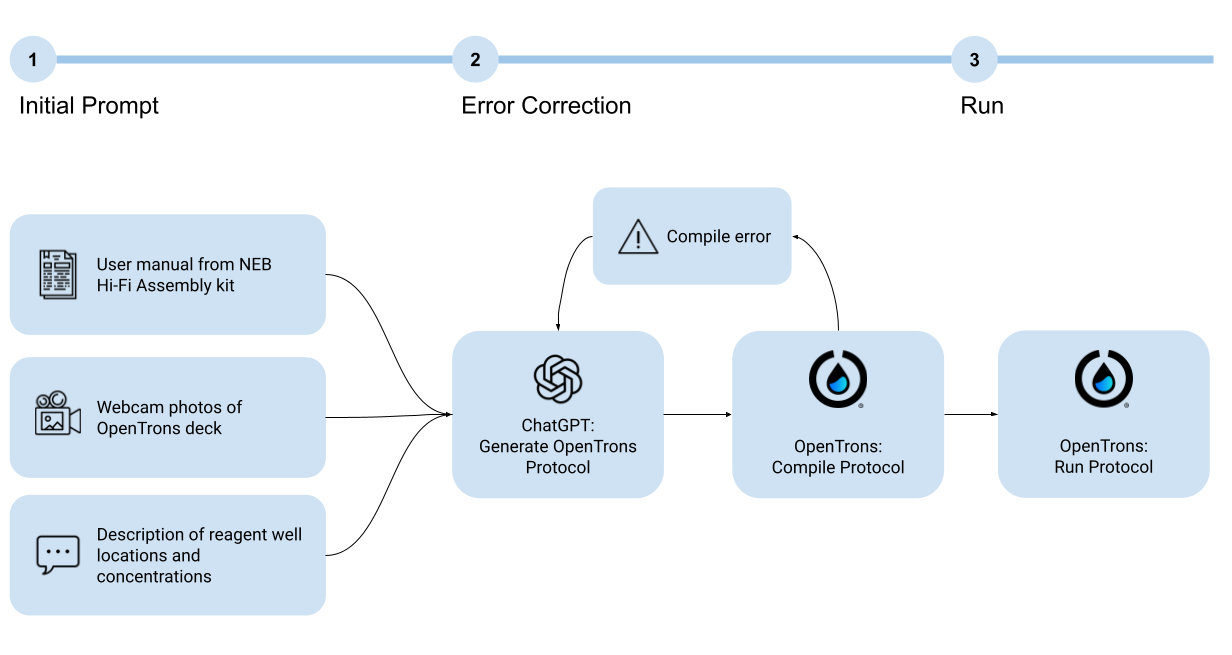
Figure 3: Example pipeline for generating and deploying OpenTrons protocols from agentic LLM outputs, bridging digital design to robotic DNA assembly in practice.
Interestingly, the real robot executions had a higher success rate than the virtual OpenTrons simulator, suggesting that live error feedback effectively enables rapid correction of API issues by the model, supporting robust real-world agentic autonomy.
Implications for Biosecurity, Policy, and AI Evaluation
ABC-Bench reveals that frontier LLMs, when scaffolded with appropriate tool interfaces, possess agentic capabilities at or above those of well-qualified human experts for end-to-end molecular design and robotic execution. For well-documented molecular and automation protocols, these capabilities are already commoditized by LLMs—meaning that advanced biological engineering is increasingly accessible to non-experts.
This shift mandates substantial changes in biosecurity governance:
- Pre-release capability evaluations using benchmarks like ABC-Bench must become standard for new LLMs.
- Dual-use capabilities, particularly those involved with screening evasion, should be actively mitigated (e.g., through dataset excision, unlearning techniques (Liu et al., 2024), or access controls).
- Tiered access controls (such as KYC or licensing) may be essential for both open- and closed-weight models with powerful agentic scaffolds.
- ABC-Bench’s objective and high-throughput framework is immediately valuable for AI developers, third-party evaluators, and regulators needing actionable, reproducible measurements of dual-use risk.
Practically, ABC-Bench also provides a template for evaluating future biological agentic capabilities and catalyzes extensions into domains such as automated pathogen synthesis, gene editing, or even automated wet-lab experimentation. The authors highlight the necessity to move beyond code-centric benchmarks to integrate full workflow and governance-step coverage, as well as to support evaluation protocols using typical expert workflows (not only code authoring).
Limitations and Future Directions
ABC-Bench’s modular task composition is not exhaustive; several critical steps in biological misuse pipelines remain untested. Human baseline assessments, bound to a coding-centric interface, may underestimate domain-expert proficiency that leverages alternative, tool-based workflows. Moreover, the definition of “expert” selected (biology PhDs with coding experience) influences the demarcation of model superhumanity and should be diversified in future studies.
Refusal behaviors observed in some models do not guarantee robust mitigation—in particular, open-weight models and less-constrained systems frequently executed all agentic tasks regardless of intent. Thus, technical and procedural guardrails are not yet consistently effective.
Conclusion
ABC-Bench represents a significant advance in the quantitative, agentic evaluation of biosecurity-relevant LLM capabilities. Benchmarking results already indicate superhuman autonomous completion of sensitive biological workflows by generalist and specialist AI agents, confirming that dual-use threshold crossing has already occurred for several crucial tasks. As LLM-based AI research agents become ubiquitous, systematic agentic benchmarking and proactive mitigation—spanning technical, procedural, and policy realms—are essential for ensuring that the benefits of bio-automation do not amplify biosecurity threats.
Further extensions of ABC-Bench and similar benchmarks should aim for an even broader, more realistic task landscape and incorporate workflow- and governance-level coverage to reflect the evolving interplay between capability emergence and biosecurity risk.

