- The paper demonstrates gravitational superfluorescence as axion cloud transitions trigger self-amplified gravitational-wave pulses.
- Analytical and numerical simulations reveal that nonlinear feedback produces logistic population transfer and a universal coherence envelope.
- The study outlines pulse morphology and high SNR prospects, highlighting promising detection with mHz–decHz gravitational wave detectors.
Gravitational Superfluorescence from Superradiant Axion Clouds
Theoretical Framework: Gravitational Atoms and Feedback Dynamics
Superradiance in ultralight bosonic fields around rotating black holes (BHs) leads to the growth of macroscopic boson clouds, whose dynamics and gravitational-wave (GW) signatures depend sensitively on quantum transitions between discrete bound levels. This paper investigates the phenomenon of gravitational superfluorescence in this context, wherein self-stimulated, cooperative emission of gravitational radiation is triggered by transitions between states in the axion cloud, paralleling superfluorescence in extended two-level atomic systems.
The system is described by a non-relativistic scalar field Φ around a Kerr BH, with the bound-state spectrum treated hydrogenically. The scalar cloud can be viewed as a two-level quantum system comprising an initial superradiant-dominated "upper" state ∣1⟩ and a lower state ∣2⟩, between which transitions are mediated by GW quadrupolar coupling. Crucially, the tensor interaction responsible for these transitions is seeded by incident GW radiation but, due to feedback, rapidly becomes dominated by the self-generated, coherently amplified quadrupole moment of the cloud itself.
The two-level description is formulated by coupling the atomic population amplitudes to the retarded, self-sourced GW field, retaining only the relevant (slowly rotating) terms via the rotating-wave approximation. The resulting population transfer equations reveal that the imaginary part of the near-zone retarded field provides the only true gain in the feedback loop, directly driving the nonlinear population avalanche from upper to lower state. The envelope and timescale of the process are analytically derived and validated through direct numerical simulation.
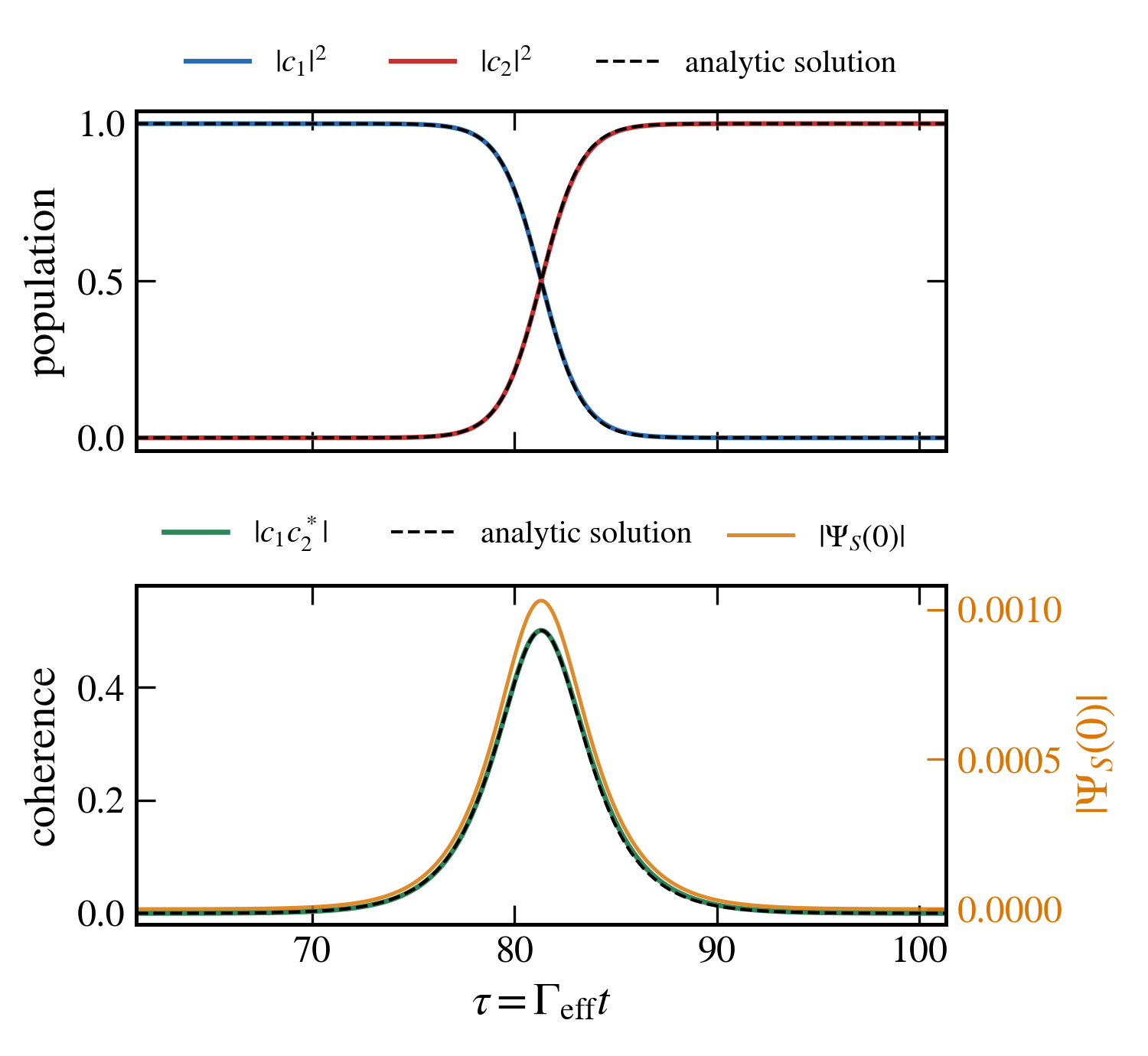
Figure 1: Numerical validation of the self-stimulated dynamics for the 211→21−1 transition, showing population transfer and peak coherence envelope driven by self-field feedback.
Self-Stimulated Cooperative Emission and Avalanche Dynamics
The core result is the emergence of a logistic population transfer governed by a self-limited, avalanche-like amplification process:
n2(t)=21[1+tanh2tpt−tD]
where n2=∣c2∣2 is the lower-level population, tp=Γeff−1 is the characteristic transition timescale determined by the feedback-induced gain, and tD is set by the seed and detuning. The atomic coherence, responsible for sourcing the GW quadrupole, follows a sech envelope aligned with the maximal cooperative emission. The entire process, after ignition by an initial seed, is dominated by nonlinear self-feedback, independent of the external driving phase or detuning, a behavior robustly corroborated via fully coupled simulations.
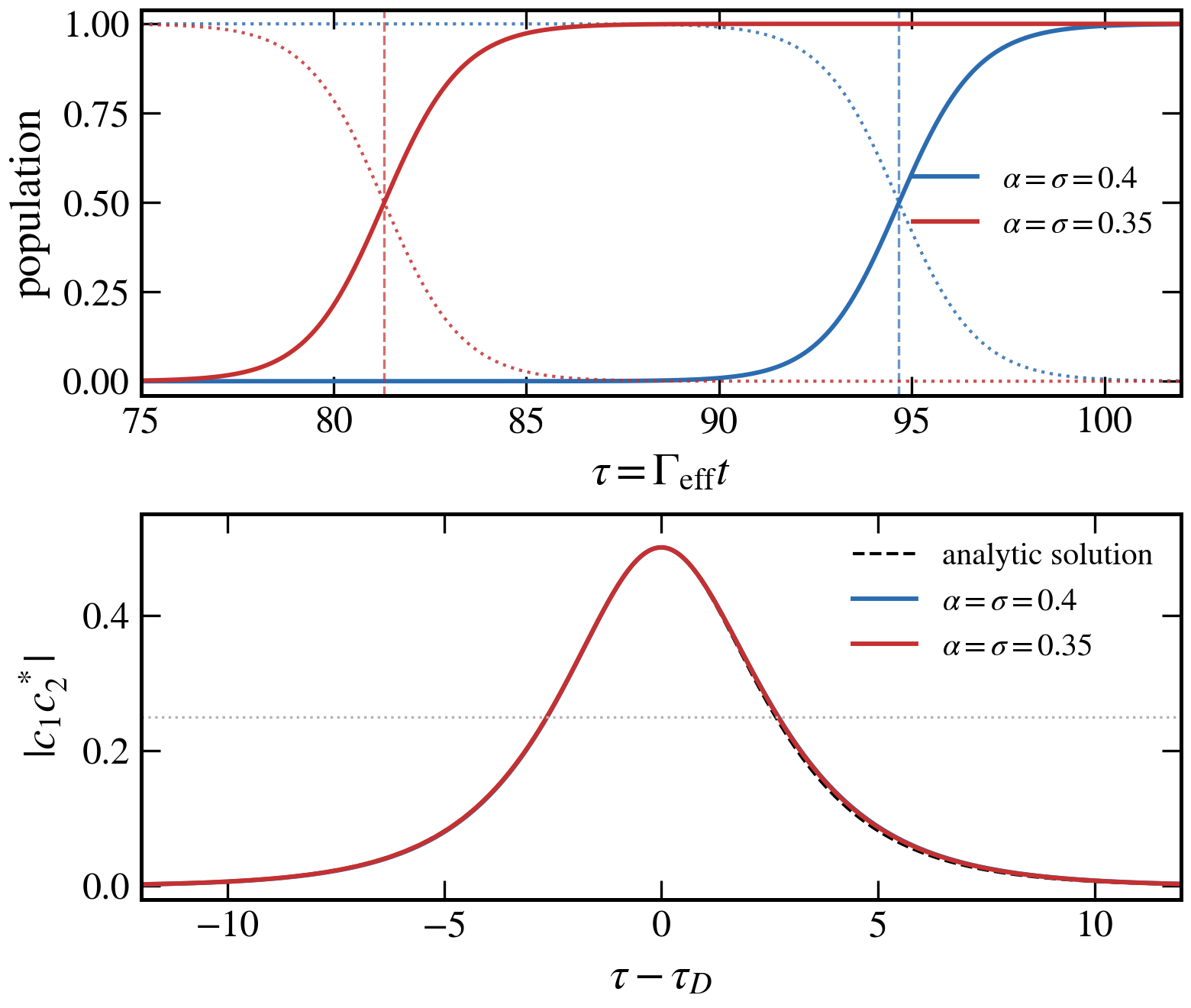
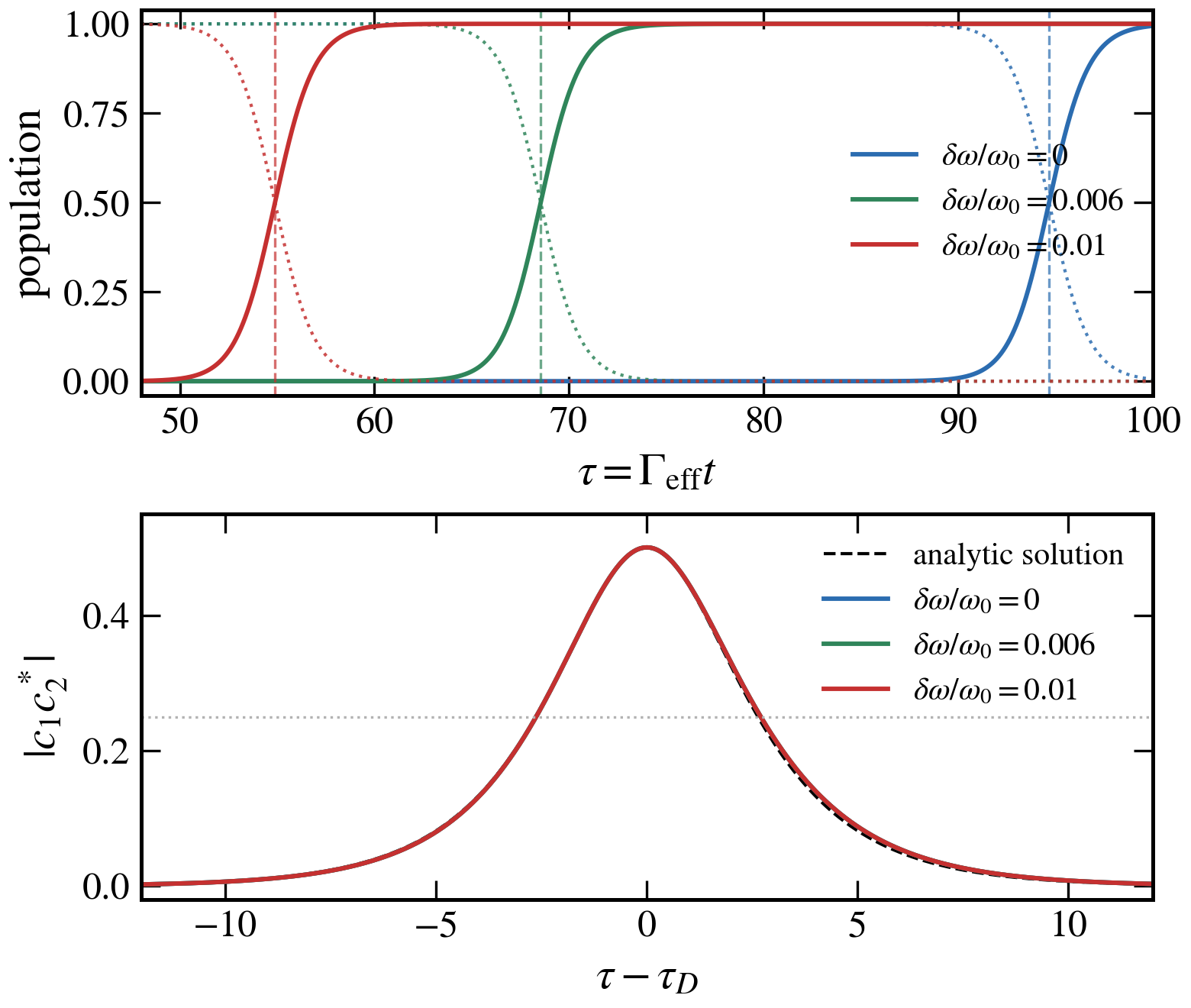
Figure 2: Simulation results for varying coupling and detuning, showing universal logistic coherence envelope independent of ignition delay.
This framework is differentiated from earlier boson cloud studies that focused on externally-driven transitions (e.g., by companion tides in binaries) and from stationary stimulated emission scenarios. The explicit cooperative, self-stimulated nature of the avalanche creates transient GW signals with a unique pulse morphology not present in continuously driven or spontaneously radiating systems.
Gravitational Wave Pulse: Morphology and Detection Prospects
The self-stimulated transfer results in a GW pulse with well-defined features; specifically, a quasi-monochromatic carrier modulated by the logistic coherence envelope:
$h_+(t)\simeq-h_0\frac{1+\cos^2\iota}{2}\, \sech\!\left[\frac{t-t_D}{2t_p}\right]\cos(\omega_0 t)$
∣1⟩0
with amplitude ∣1⟩1 and transition frequency ∣1⟩2 set by atomic state parameters. The pulse width (∣1⟩3) and bandwidth are determined solely by the feedback gain ∣1⟩4.
For specific transitions within typical superradiant cloud evolution ("B": ∣1⟩5 and "C": ∣1⟩6, with upper-level cloud dominance across the BH superradiant history), estimates at Galactic distances (∣1⟩7) are provided spanning black hole and axion mass ranges. Notably, the resulting SNR, computed via matched filtering and averaged over inclination, can become substantial in the active high-coupling regime (∣1⟩8), especially for near-future millihertz and decihertz GW detectors.
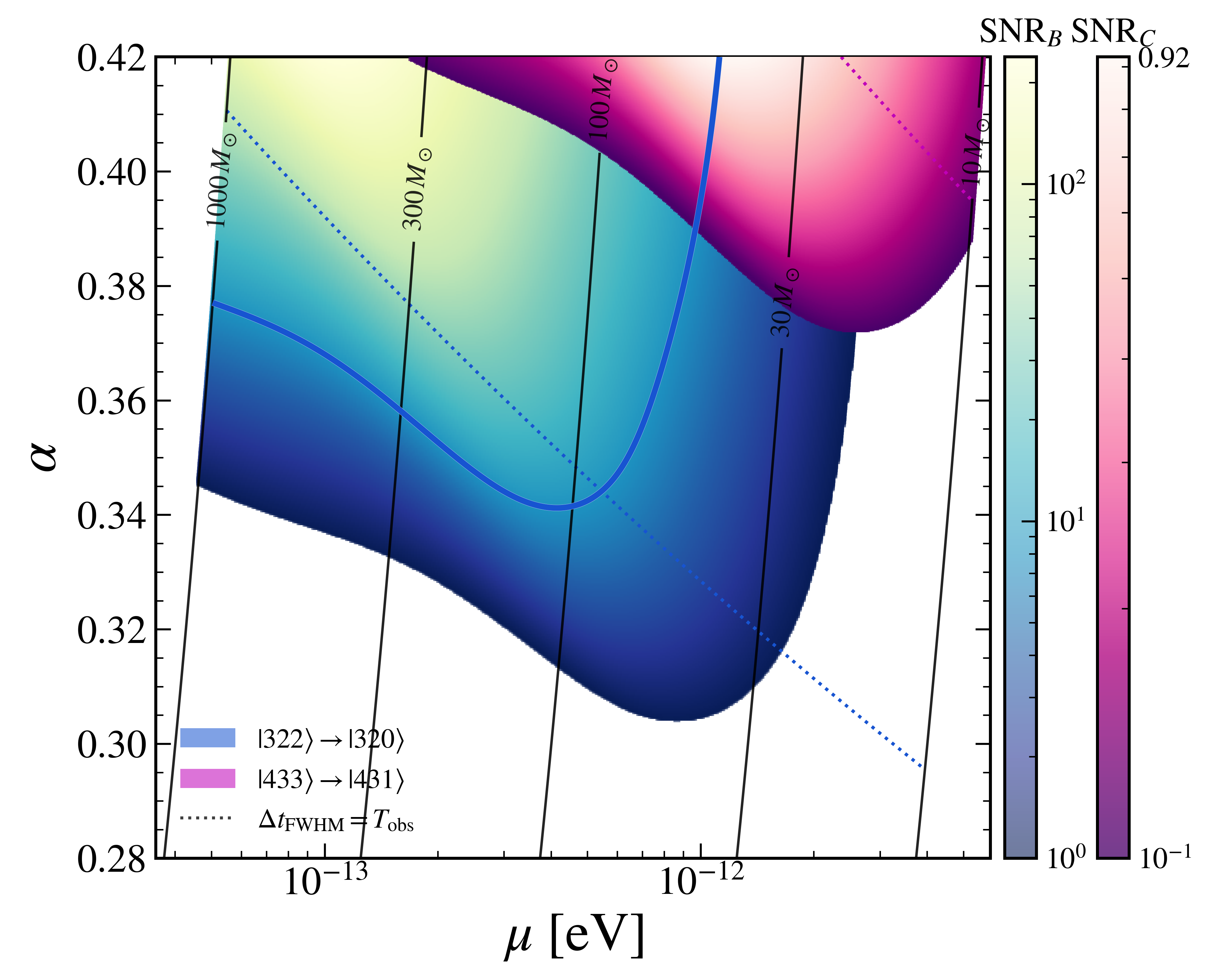
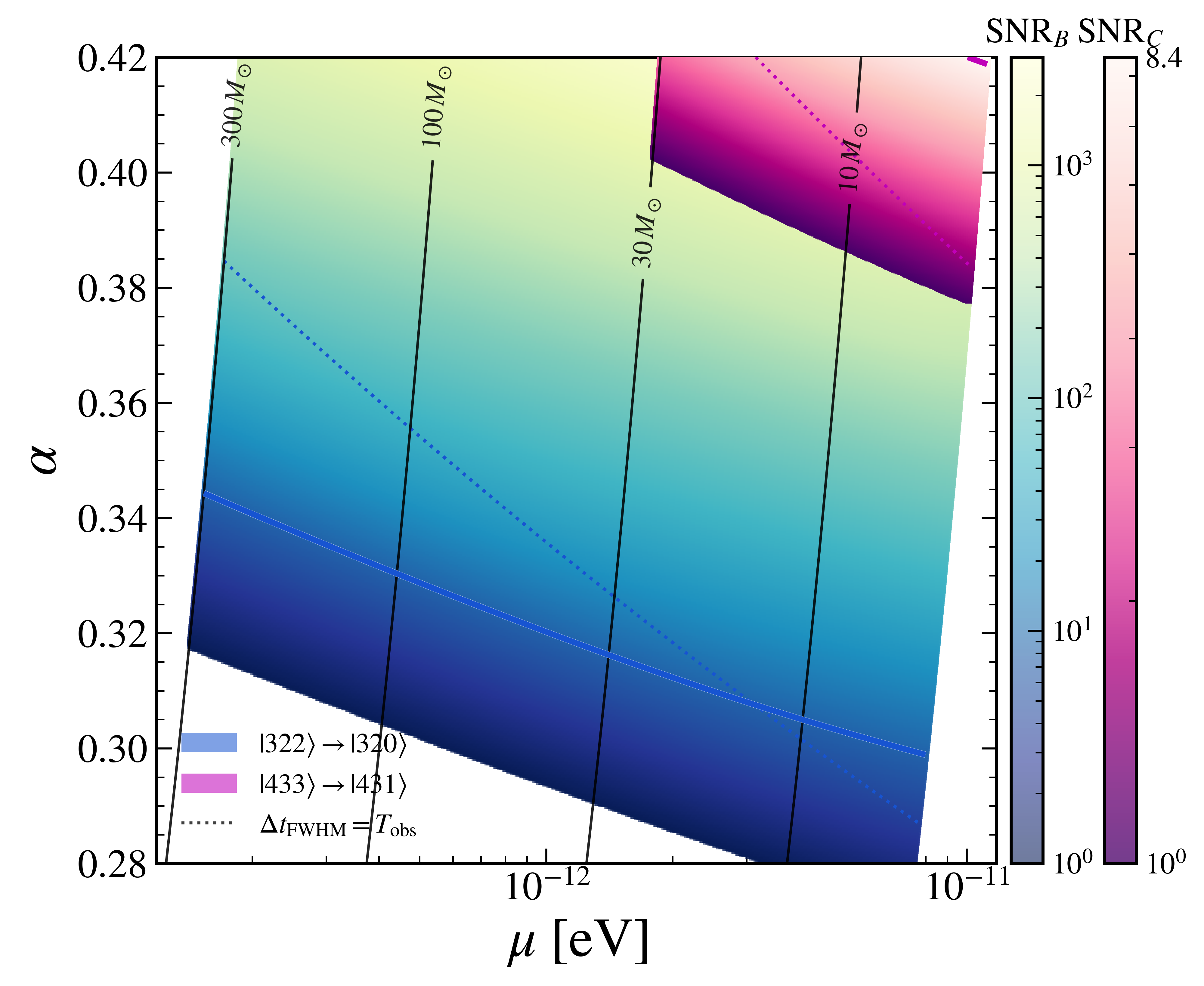
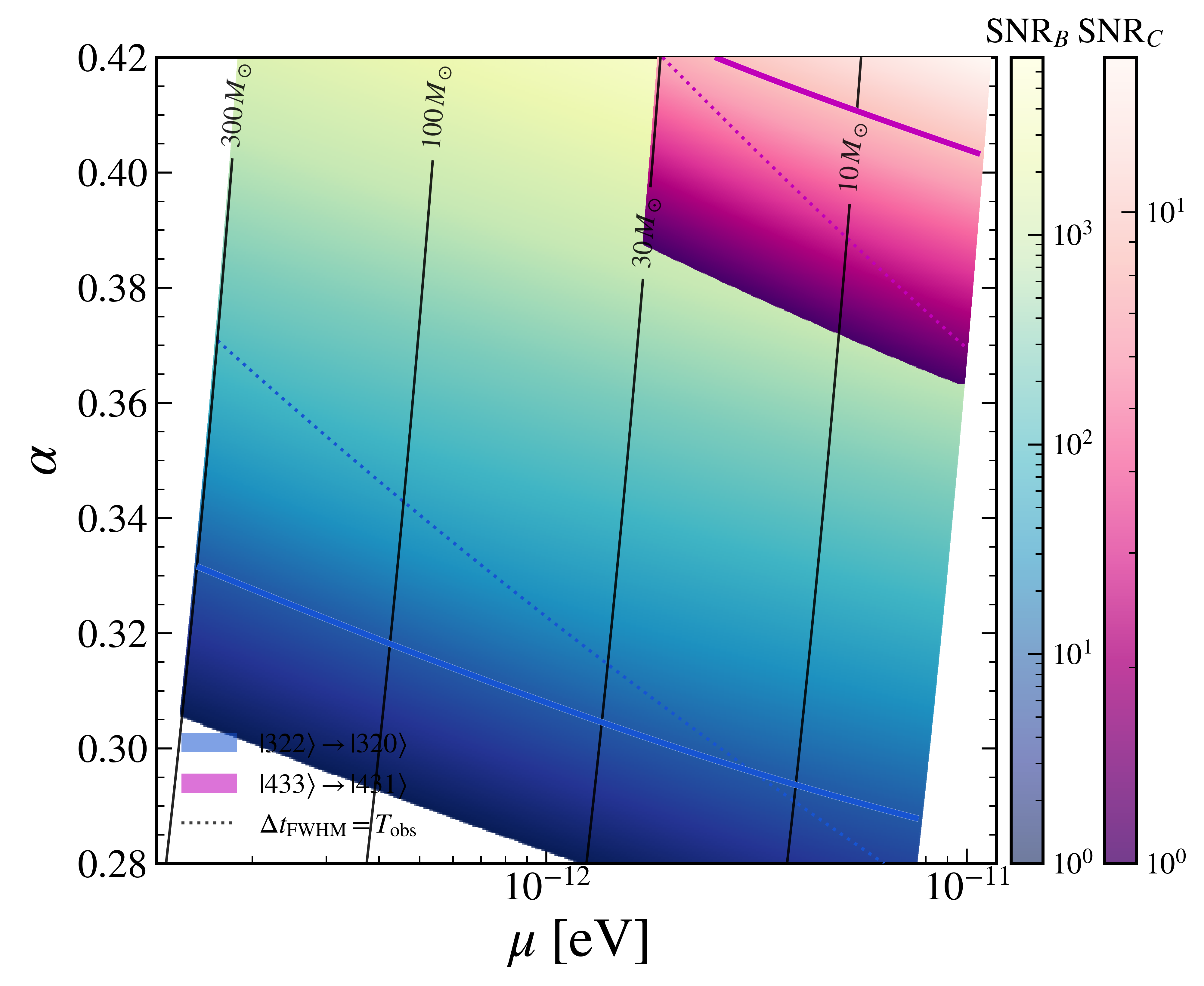
Figure 3: Conditional SNR for self-stimulated GW pulses for LISA, DECIGO, and BBO, with detectable regions for dominant transition channels.
The analysis demonstrates that the characteristic pulse morphology—set intrinsically by the self-stimulation timescale—remains robust against the specifics of the seeding GW. The parameter space scan delineates detectable targets for LISA, DECIGO, and BBO, identifying that the decihertz band offers optimal prospects, with peak SNR values exceeding several thousand for favorable Galactic sources.
Implications and Outlook
This work establishes gravitational superfluorescence as a theoretically robust, self-stimulated cooperative emission process in the axion cloud/BH system with clear, unique GW signatures. The main implications are:
- Observability: The induced gravitational pulses are transient, characterized by a well-defined envelope width (not a continuous or exponentially damped monochromatic signal). This morphology is directly controlled by cloud and BH parameters and serves as a discriminant for superradiant bosonic clouds versus other GW transients.
- Dark Sector Probes: The predicted signals exploit the collective quantum properties of the ultralight dark sector, enabling observational constraints or possible discovery of axion-like particles through their impact on GW data. Detection of such pulses would constitute strong evidence for macroscopic quantum phenomena in gravity-dominated, astrophysical environments.
- Astrophysical Implications: Rapid depletion of superradiant clouds via cooperative emission may affect predictions for the black hole spin evolution and the population statistics of GW signals from compact object binaries embedded in boson clouds.
The theoretical analysis further demonstrates that, unlike electromagnetic superfluorescence, the gravitational atom is in a deeply "single-mode" limit (∣1⟩9), precluding pulse trains or spatial reabsorption effects. The cloud undergoes a collective, global response without spatially delayed ringing.
Conclusion
This paper rigorously formulates and numerically validates the mechanism of gravitational superfluorescence in superradiant axion clouds around rotating black holes. The self-stimulated emission, triggered by a weak GW seed and realized through retarded self-field feedback, generates a single, quasi-monochromatic GW pulse characterized by a universal envelope set by the cooperative nonlinear avalanche. Strong SNR prospects exist for mHz-decHz GW detectors aiming at Galactic sources, concretely opening a new observational avenue for probing the properties of ultralight boson clouds and fundamental physics in the strong-gravity regime.

