- The paper identifies platform sorting as a systemic driver of ideological fragmentation across multiple social media platforms during recent US presidential election cycles.
- It employs normalized engagement metrics and null models to reveal statistically significant biases and selective amplification of ideologically aligned content.
- Findings imply that local moderation strategies may be insufficient, as echo-platform effects require ecosystem-level interventions to curb social media polarization.
Introduction
"Platform Sorting Drives Ideological Fragmentation in the Social Media Ecosystem" (2606.10575) provides a rigorous empirical analysis of political information flows across major social media platforms, situating the discourse on polarization within a systemic, ecosystemic framework. While prior studies have characterized ideological fragmentation mainly as localized phenomena (e.g., within-platform echo chambers), this study articulates and operationalizes the concept of platform sorting—the systemic redistribution of ideological communities across entire platforms. The paper focuses on US presidential election cycles of 2020 and 2024, performing unified cross-platform, longitudinal analyses on Facebook, Reddit, YouTube, Twitter/X, Bluesky, and Truth Social, while mapping content and engagement patterns to Media Bias/Fact Check (MBFC) political and factual labels.
Methodological Framework
The core methodological apparatus comprises data collection of shared external news URLs on each platform, cross-referenced with MBFC's domain-level political bias and reliability labels. The analysis is performed on persistent, comparable data windows for longitudinal platforms (Facebook, Reddit, Twitter/X, YouTube) and in 2024 for newer platforms (Bluesky, Truth Social). Engagement metrics are normalized platform-wise, allowing for meaningful cross-platform contrasts. Null models constructed via permutation-based label reshuffling provide significance benchmarks for engagement allocation.
Patterns of Content Circulation and Ideological Distribution
The study demonstrates robust, persistent ideological asymmetries in news sharing behaviors across platforms, with highly distinctive platform-level ideological "diets." Facebook and YouTube show some shifts toward centrist content from 2020 to 2024, but generally, platforms retain stable and distinctive ideological compositions. Notably, Bluesky emerges as a strongly left-leaning environment, while Truth Social consolidates far-right sharing patterns. Twitter/X exhibits a substantial reduction of left-leaning sources and increased right-leaning content from 2020 to 2024. With minimal evidence of convergence toward neutrality—with the possible exception of Facebook—the systemic redistribution of ideological alignments is evident.
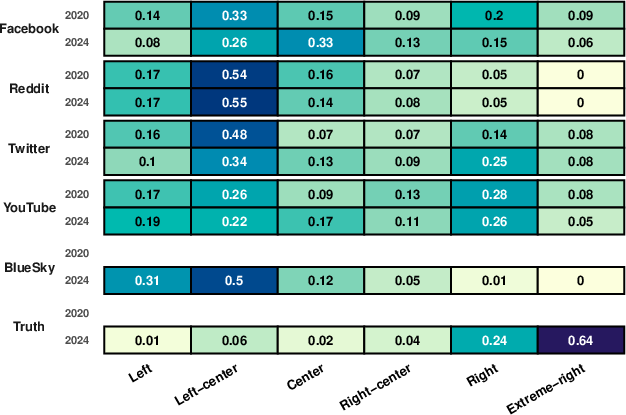
Figure 1: Fraction of shared URLs by political leaning across platforms, evidencing persistent and distinct ideological bias in news sharing patterns.
Beyond basic circulation statistics, platforms exhibit preferential allocation of user engagement not proportional to content availability. Engagement allocation ratios, compared against null models, reveal consistent platform-specific amplification of ideologically aligned sources. Centrist sources are consistently under-engaged, while engagement—especially in the case of Reddit (left) and Facebook (right) in 2024—skews toward platform-congruent polar ideological content. Engagement patterns also reflect selectivity for source reliability or lack thereof: Bluesky allocates negligible engagement to questionable sources, while on Truth Social, questionable sources receive a disproportionate share.
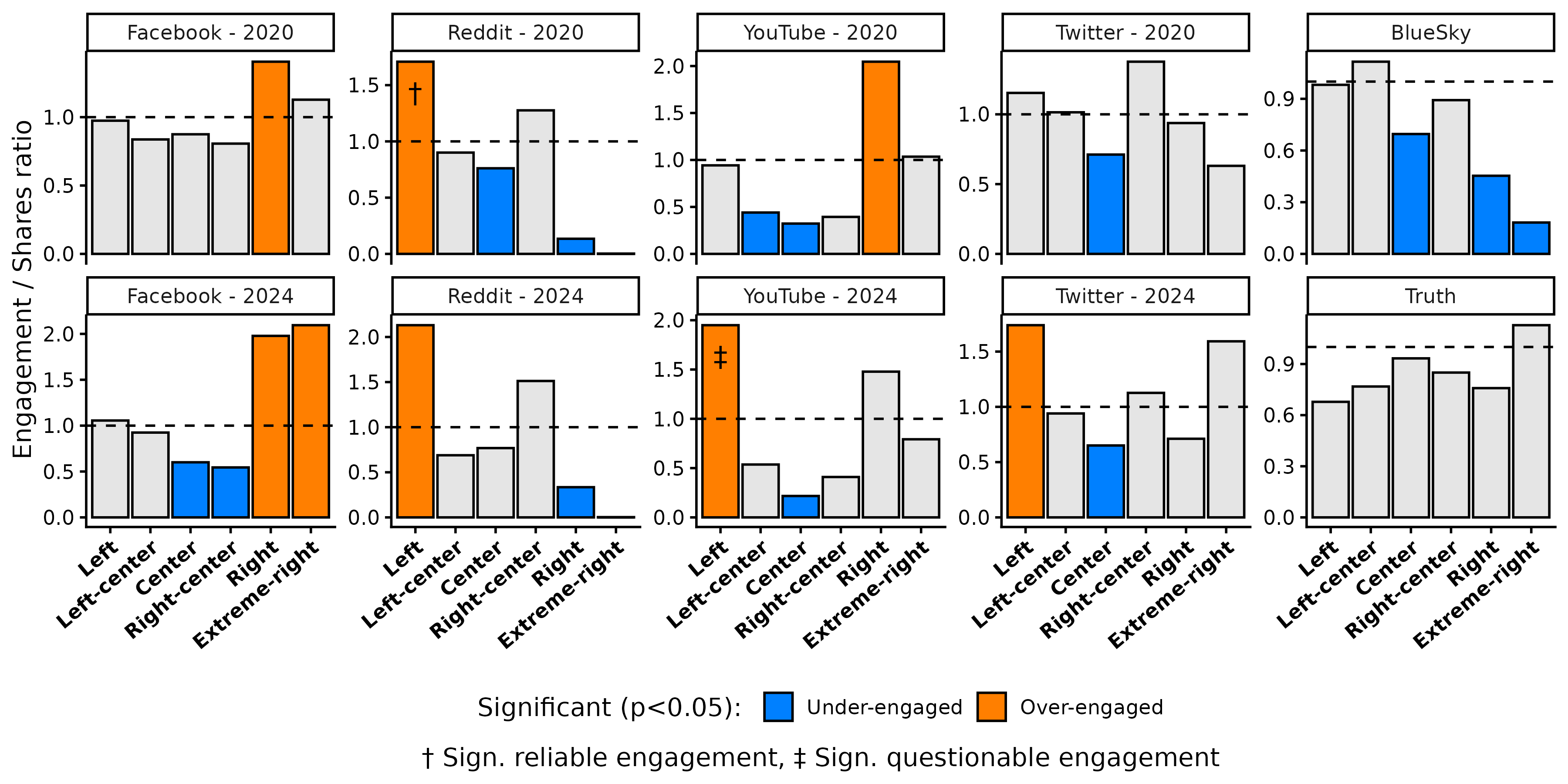
Figure 2: Statistically significant deviations in engagement-to-circulation ratios across platforms and leanings, exposing platform-specific patterns of over- and under-engagement.
Engagement Similarity: Ecosystem-Level Redistribution
Cosine similarity analyses of engagement distributions over top news domains reveal increasing specialization and separation of platforms over time, with high self-similarity but declining cross-platform similarity. Notably, in 2024, Twitter's engagement pattern is most similar to Bluesky, indicative of migratory or sorting effects. Truth Social and Bluesky clearly partition the ecosystem into far-right and left-leaning engagement clusters, respectively, while Facebook and Reddit display persistent engagement structures. Overall, the network structure of attention further evidences ideological clustering at the platform, not merely at the within-platform community, level.
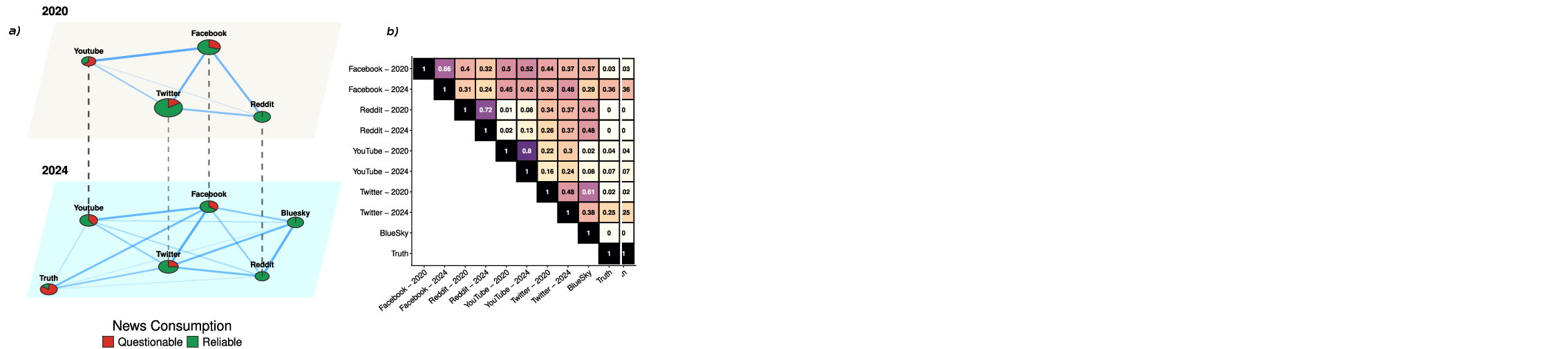
Figure 3: Multiplex network of engagement similarity based on top engaged domains, illustrating distinct, persistent platform-level clusters and the redistribution of engagement across the ecosystem.
User Ideological Profiles and Sorting Dynamics
User-level ideological distributions, derived from individual sharing histories, further substantiate consistent, pronounced platform-level asymmetries. Bluesky's user base is overwhelmingly left-leaning; Truth Social is dominated by far-right users. In platforms with longitudinal data, user-level ideological shift distributions (as measured by Jensen–Shannon divergence) demonstrate only mild within-platform drift, with Twitter showing the greatest bimodalization. Importantly, the aggregate US political spectrum once present within a single platform (Twitter 2020) now appears bifurcated across multiple platforms (Twitter 2024 and Bluesky).
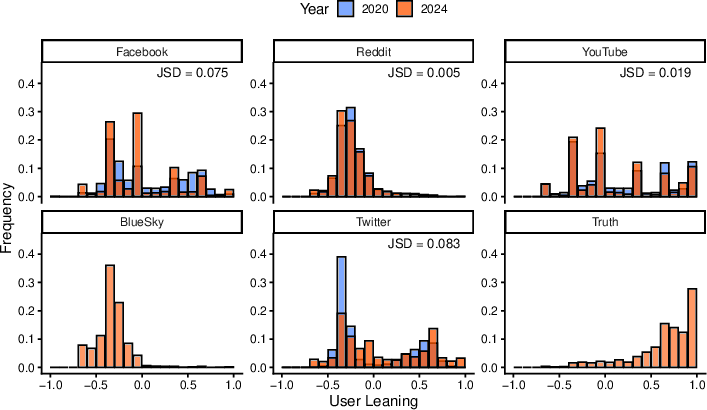
Figure 4: Longitudinal comparison of user ideological leaning distributions, indicating platform-level stability with moderate exceptions (Twitter).
Longitudinal User Stability
A critical analysis concerns the evolution of persistent users (active in both 2020 and 2024) on Twitter. The empirical distributions of per-user ideological drift display increased within-group dispersion but no systematic tendency toward ideological reversal. Null model comparisons reveal significantly higher stability within ideological groups than would be expected by random assignment, reinforcing the thesis that observed aggregate stability is not an artifact of population churn.
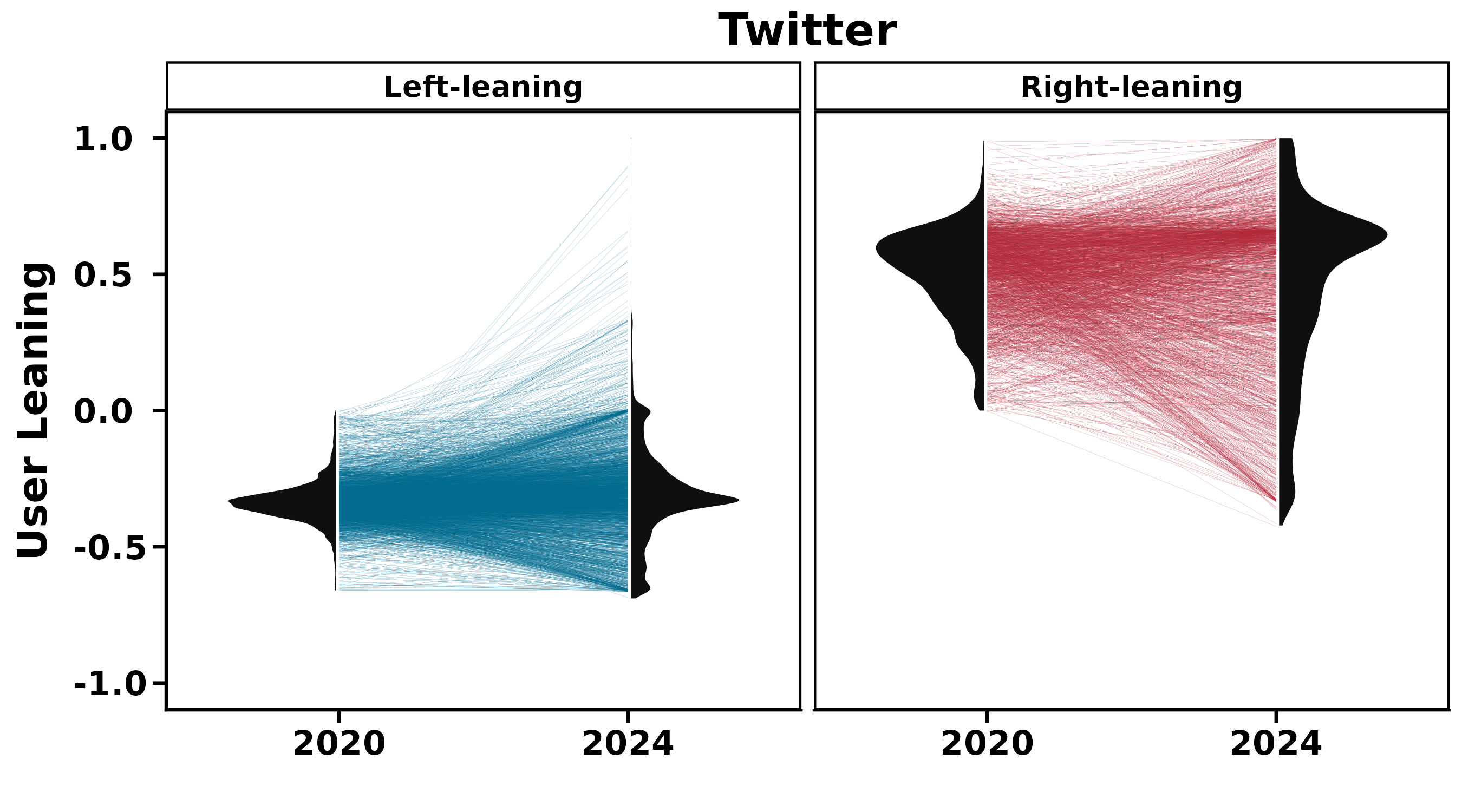
Figure 5: Empirical distribution of user-level ideological shifts among persistent Twitter users, indicating robust within-group stability and increasing heterogeneity.
Implications and Perspectives
Practical implications: The results challenge the efficacy of platform-centric interventions (e.g., content moderation or depolarization algorithms) for reducing ideological fragmentation at scale. Local reductions in platform polarization may be offset by migratory dynamics, as users self-select into ideologically consonant platforms. Regulatory and measurement frameworks must therefore account for ecosystem-level redistribution when assessing risks of social media-induced polarization.
Theoretical implications: The articulation of "echo-platforms" as emergent systemic attractors reframes polarization as an outcome of large-scale, selective-affinity sorting, rather than a problem resolvable within the confines of single-platform community structures. This distinction has consequences for political communication theory and computational social science, demanding new approaches for modeling cross-platform ideological migration and persistence.
Future development: As AI-driven personalization and recommender systems further tailor information flows, the automation of content curation is likely to reinforce platform-driven ideological sorting and amplification. Simulations and experimental integration of agent-based models, as well as tracking of longitudinal migrations in response to exogenous platform-level shocks (policy, moderation, ownership change), will be needed to further delineate causality and adaptive strategies for intervention.
Conclusion
This study establishes ideological fragmentation as a structural property of the social media ecosystem, driven by persistent platform sorting dynamics covering both content and users. Ideological majorities and selective amplification at the platform level remain robust over multiple election cycles and amid the emergence of new digital spaces. Echo-platforms, not merely echo chambers, are now the dominant organizational feature of online ideological communication, highlighting the limitations of within-platform moderation as a solution to polarization. Anticipating the accelerating role of algorithmic mediation, future research and policies must adopt a macroecological, system-wide perspective to meaningfully address digital fragmentation and its impacts.

