- The paper reveals that ideological discrepancy between publishers and news content significantly alters audience engagement, consensus, and toxicity metrics on Facebook.
- The study employs a reaction-centered analytical framework with GLMM modeling and zero-shot topic classification to quantify bias and measure toxicity.
- The findings challenge simple filter-bubble narratives by showing that both highly aligned and mismatched biases yield non-linear effects on audience reaction and consensus.
Ideological Discrepancy and Audience Engagement in Brazilian Facebook Political News
Analytical Framework and Objectives
The paper investigates how ideological discrepancy between publishers and news content influences audience engagement and consensus in Facebook posts during Brazil's 2018 presidential election (2605.01180). The study introduces a reaction-centered analytical framework that quantifies publisher bias (bp), content bias (bc), and their absolute difference, Bias Discrepancy (Δb), to operationalize ideological divergence. Audience engagement is modeled through three principal metrics: Reaction Score (RS) for emotional valence, Consensus Index (CI) for agreement in reaction polarity, and toxicity (Tox) as the presence of hostile language in post text.
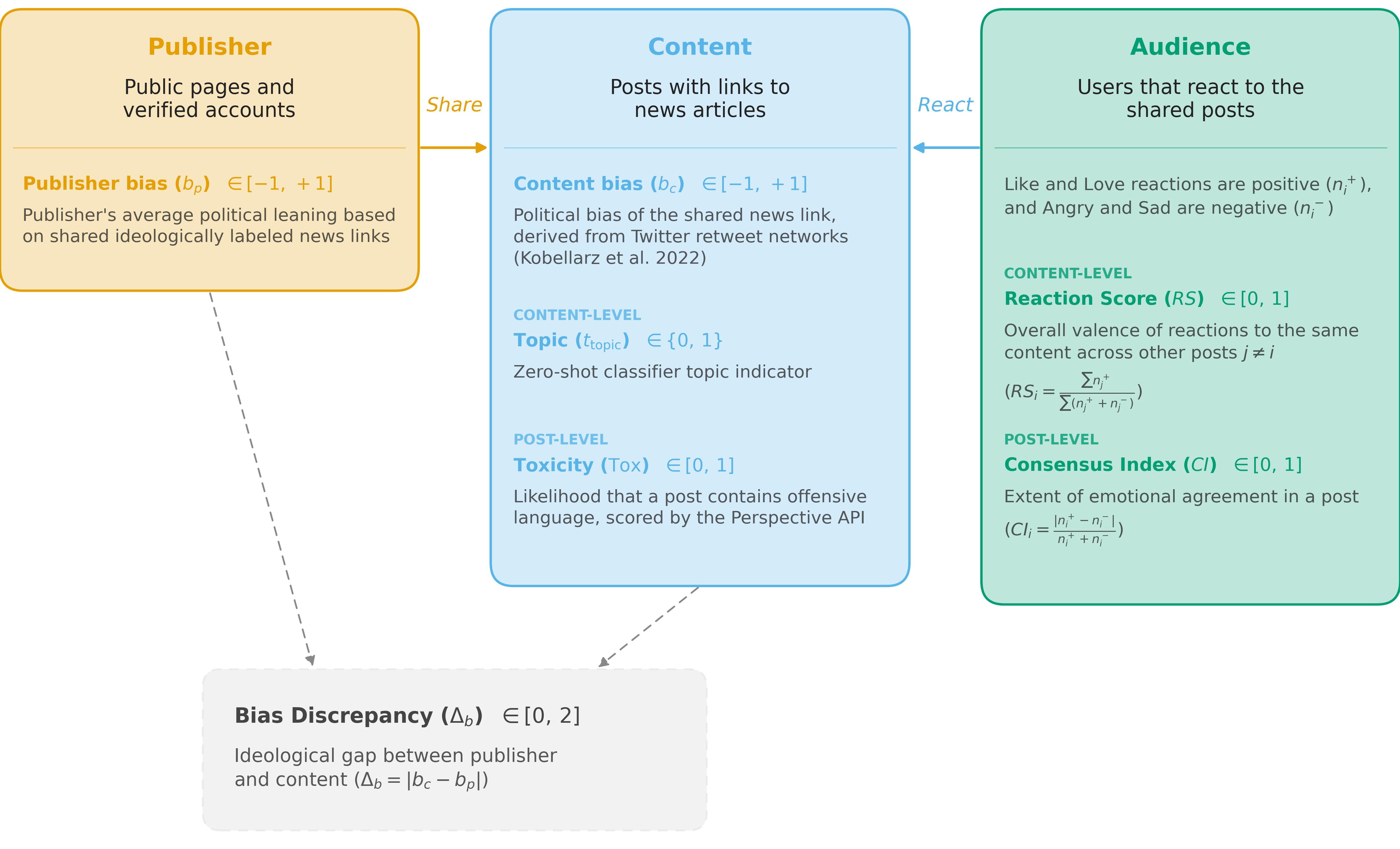
Figure 1: Conceptual model depicting the relationships among publishers, news articles, audience reactions, and the key analytical variables including ideological alignment and emotional engagement.
The dataset comprises 4,584 Facebook posts referencing 2,317 unique political news links, with publisher and content bias scores computed using content-interaction heuristics and weighted polarity from Twitter retweet networks. Content toxicity is measured using Google’s Perspective API, and topic classification is performed with mDeBERTa-v3-base zero-shot modeling. A Generalized Linear Mixed Model (GLMM) with Beta-distributed CI is employed to capture fixed effects of ideological discrepancy, toxicity, emotional valence, topical content, and random effects due to publisher/content-specific heterogeneity.
Dataset and Topic Characterization
The distribution of political orientation shows a pronounced skew toward left-leaning content and publishers: 52.8% of shared news and 54.5% of publishers are categorized as left, while right-leaning entities are underrepresented. Audience reactions are overwhelmingly positive (RS skewed toward 1.0), and consensus is concentrated near unity, indicating predominantly homogeneous reaction patterns; toxicity is low on average but exhibits long-tailed heterogeneity.
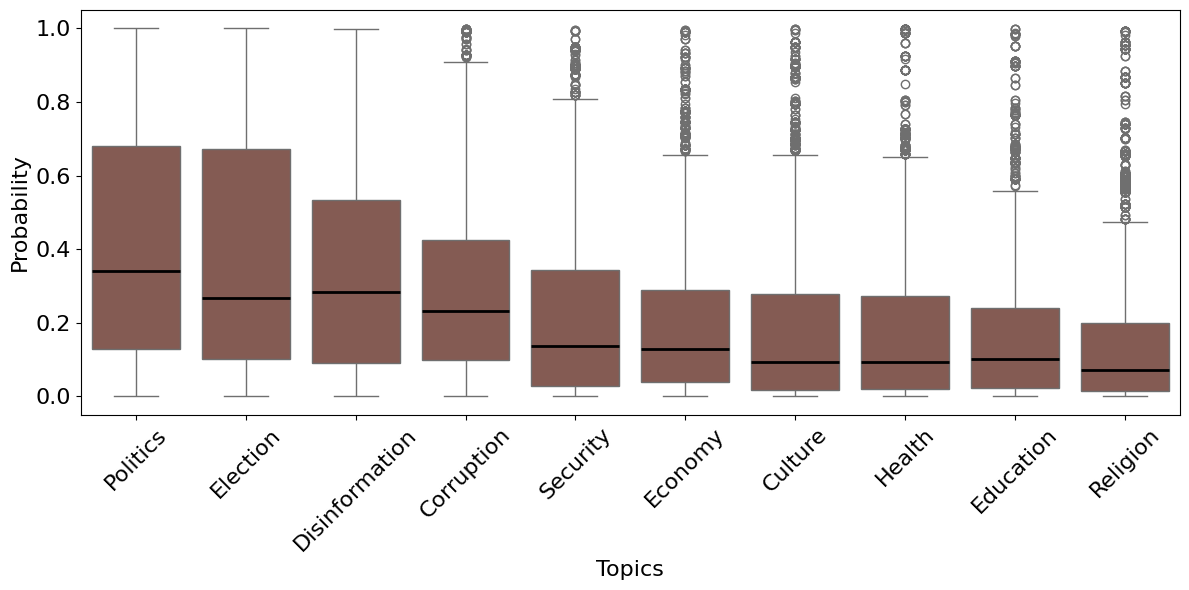
Figure 2: Boxplots of predicted topic probabilities reveal the predominance of politics and election themes and variability across individual posts and topics.
Topical analysis demonstrates elevated presence for political and election content, with education and religion less represented but notable in high-probability outliers. The zero-shot classifier selection further shows optimal weighted F1 performance for mDeBERTa-v3-base (0.825).
Ideological Alignment, Discrepancy, and Engagement Dynamics
Statistical analyses reveal that posts by left-leaning publishers attract lower Reaction Scores and audience consensus and exhibit higher toxicity relative to center and right-aligned counterparts. Right-leaning content and publishers are associated with higher consensus and more positive reactions.
Reaction Score varies non-monotonically with ideological discrepancy. Highly aligned publisher-content pairs ("Very Low" Δb) display unexpectedly lower RS, potentially due to intense partisanship eliciting polarized reactions. Consensus Index declines at both extremes of Δb—for very high mismatch and very high alignment—indicating fragmentation under both conditions. Toxicity escalates predominantly in the "Very High" discrepancy quartile, but remains relatively constant elsewhere.
Statistical Modeling: Factors Associated with Consensus
GLMM modeling of CI identifies RS (bc0) as the most robust predictor of audience consensus. Publisher and content biases (bc1, bc2) are positively correlated with consensus, favoring right-leaning orientation. Ideological discrepancy (bc3) and toxicity (bc4) have negative associations (bc5 and bc6 respectively, both bc7). Among topical categories, education increases consensus, while health content decreases it.
Random effects analysis (Figure 3) reveals publisher-level heterogeneity in consensus: major news outlets function as bubble reachers with below-average consensus, while niche partisan publishers (e.g., Bolsonaro’s official page) generate higher internal agreement. Notably, a strong positive correlation between baseline consensus and sensitivity to toxicity (bc8) indicates that in highly cohesive partisan communities, toxicity can coincide with elevated in-group consensus.
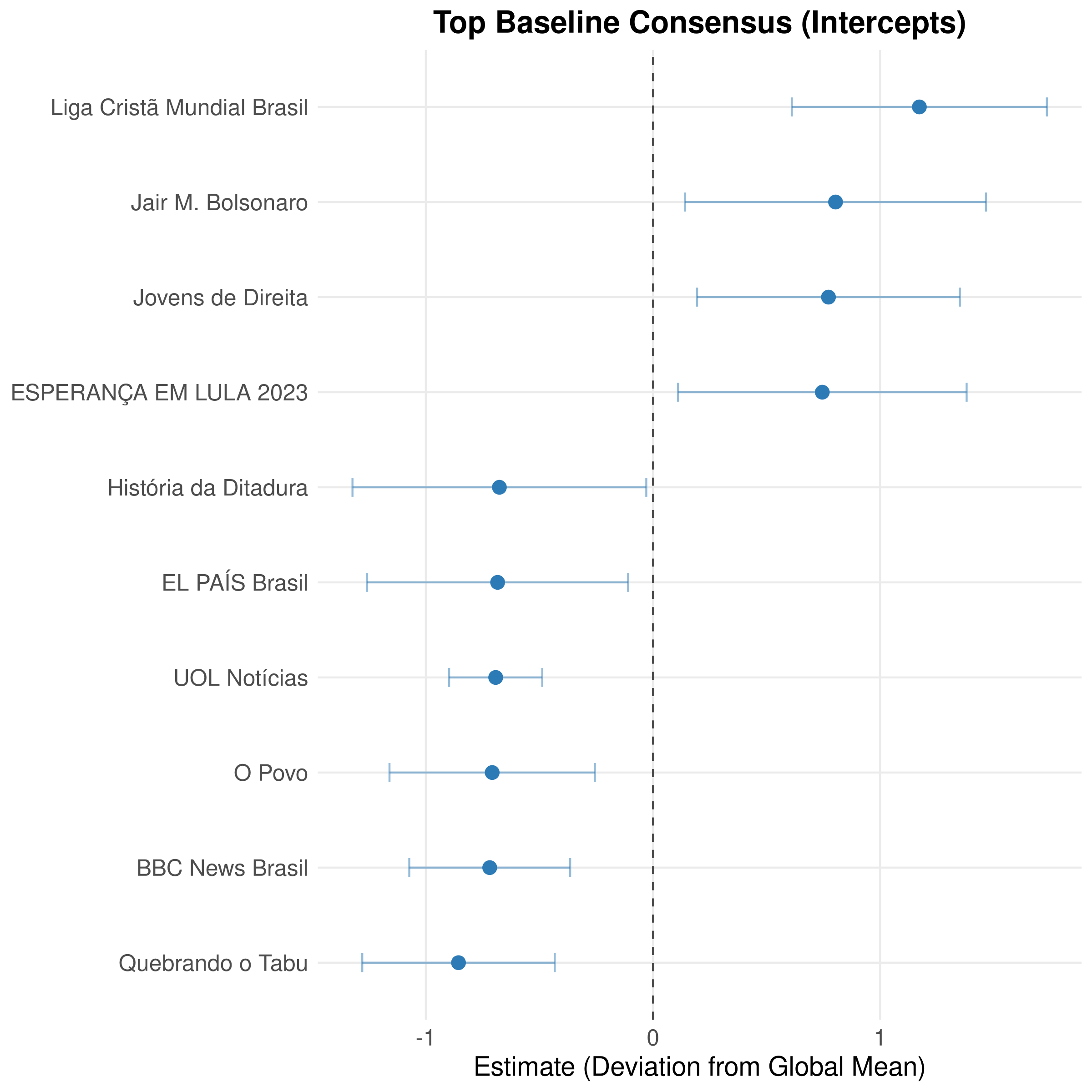
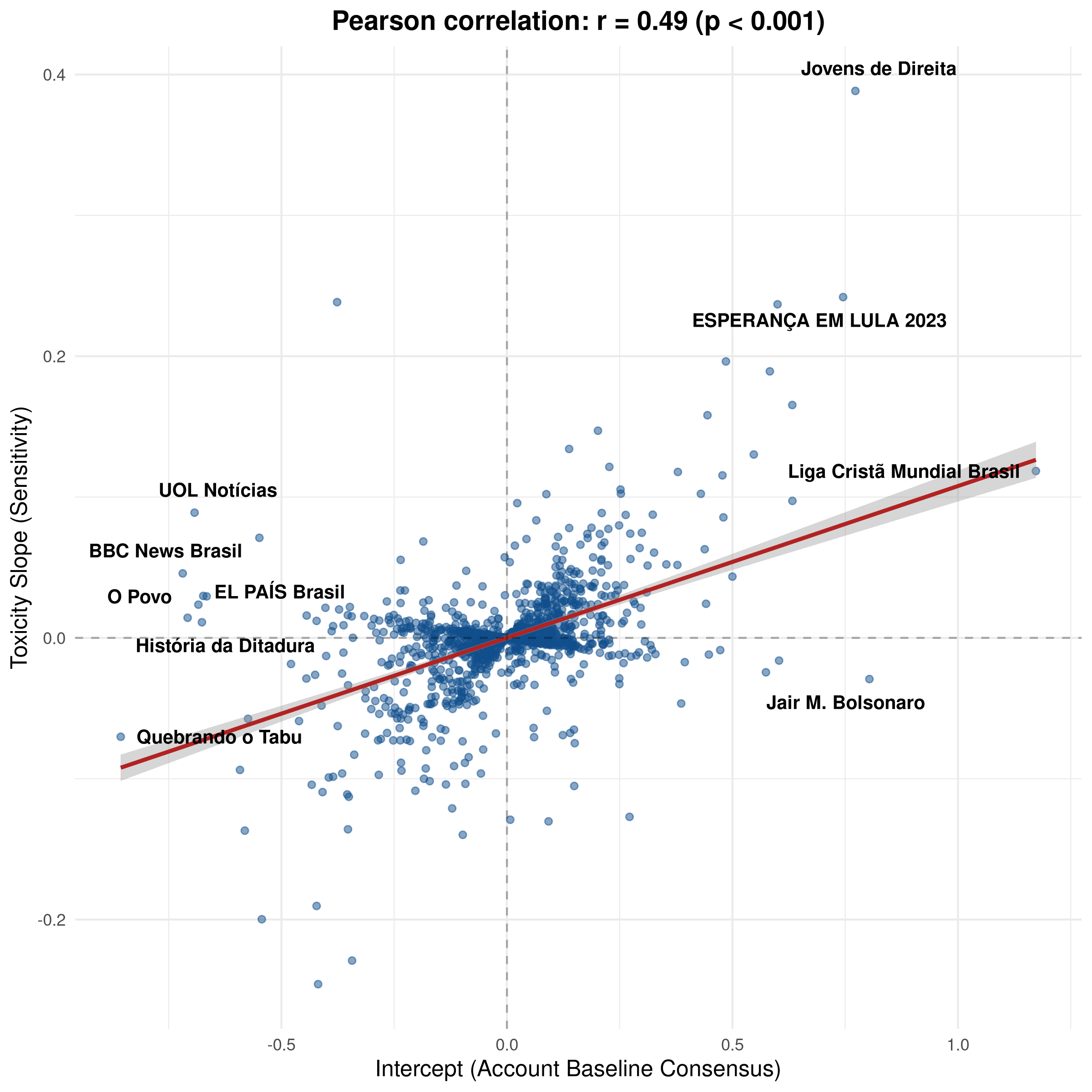
Figure 3: Top random effect scores by publisher highlight strong internal consensus among partisan publishers and fragmentation in mainstream outlets.
Methodological And Measurement Considerations
The operationalization of content and publisher bias via Twitter-based heuristics is platform-agnostic and validated through synthetic null models but may introduce cross-platform artifacts. Toxicity scoring is performed directly in Portuguese to mitigate translation bias inherent in Perspective API’s cross-lingual detection, though this remains an imperfect proxy for political incivility. The GLMM beta regression model manages bounded dependent variable behavior, with careful boundary correction and cross-classified random effects capturing publisher/content-level dependencies.
Implications and Speculation
The findings contribute to the literature on affective polarization and echo chambers by demonstrating that ideological discrepancy is associated not only with polarization but with nonlinear engagement patterns. Consensus can be diminished under both highly aligned and highly mismatched publisher-content pairs, contradicting simple filter-bubble narratives. In highly cohesive, partisan communities, toxicity emerges as a signal of in-group alignment rather than fragmentation, supporting social identity-driven models of political engagement.
These nuanced dynamics emphasize the need for context-sensitive modeling of online political discourse. Measurement tools for toxicity must be validated across linguistic and cultural boundaries. The methodological approach can be extended to other platforms, contexts, and election cycles, supporting comparative computational social science.
Further research should integrate context-aware toxicity detection models, probe causal mechanisms for nonlinear consensus patterns, and expand sample representation across the ideological spectrum. Such extensions would bolster understanding of how algorithmic curation, publisher behavior, and content framing interact to modulate affective polarization, incivility, and collective engagement.
Conclusion
The study systematically demonstrates that ideological discrepancy between publishers and news content is intricately linked to engagement dynamics, consensus, and toxicity on Facebook in the Brazilian presidential context. Consensus and emotional valence vary nonlinearly with ideological alignment, and toxicity spikes at extreme divergence. Certain highly partisan publishers exhibit robust in-group agreement even in the presence of elevated toxicity. These results inform theoretical models of polarization and practical challenges in online moderation and political communication analytics, suggesting that platform affordances and community structure intricately shape the quality and cohesion of online public sphere interactions.

