- The paper reveals that online interactions consistently follow heavy-tailed distributions, with a minority of users capturing most engagement as shown by KL-divergence and log-Gini metrics.
- It employs cross-platform longitudinal analysis and robust statistical tests to highlight the stability and persistence of interaction inequality over time.
- The study implies that conventional algorithmic interventions may be insufficient to counteract entrenched digital attention biases, challenging fair participation online.
Introduction
The distribution of user interactions on social media platforms consistently exhibits extreme heterogeneity. The phenomenon where a small subset of users attracts the majority of attention, engagement, or content production, while the vast majority remains peripheral, is recognized but insufficiently explored in terms of persistence and root causes. This paper, "Persistent Structural Inequality of Online Interactions Across Platforms" (2605.30996), provides a systematic, multi-platform longitudinal analysis to interrogate whether inequality in online engagement is an incidental feature of specific systems or a general structural constraint across digital platforms.
Datasets and Methodology
A broad cross-section of mainstream and alternative social media platforms—X (formerly Twitter), YouTube, and Gab—forms the empirical foundation. Each dataset encompasses millions to hundreds of millions of posts, spanning topical focuses from current events to entertainment, and heterogeneous governance models. Both active (posting) and passive (likes, comments) interaction types are considered, with data aggregated into non-overlapping time windows to allow for temporal dynamics assessment.
A suite of complementary metrics was used to dissect inequality and concentration:
- KL-Divergence Model Comparison: Ratio of Kullback–Leibler divergences to distinguish power-law from exponential behavior.
- Inverse Coefficient of Variation (ICV): Quantifies tail dominance, with values ≪1 indicating heavy-tailed, highly dispersed distributions.
- Log-Transformed Gini Index: Addresses metric saturation issues in heavy-tailed data, robustly quantifying concentration.
Time series statistical tests (Mann–Kendall) evaluate monotonic trends in these inequality indices.
Empirical Results
Stability and Baseline User Activity
User activity rates (posts per user) demonstrate marked temporal stability across platforms. Only select YouTube datasets show systematic increases, likely reflecting platform maturation rather than behavioral volatility.
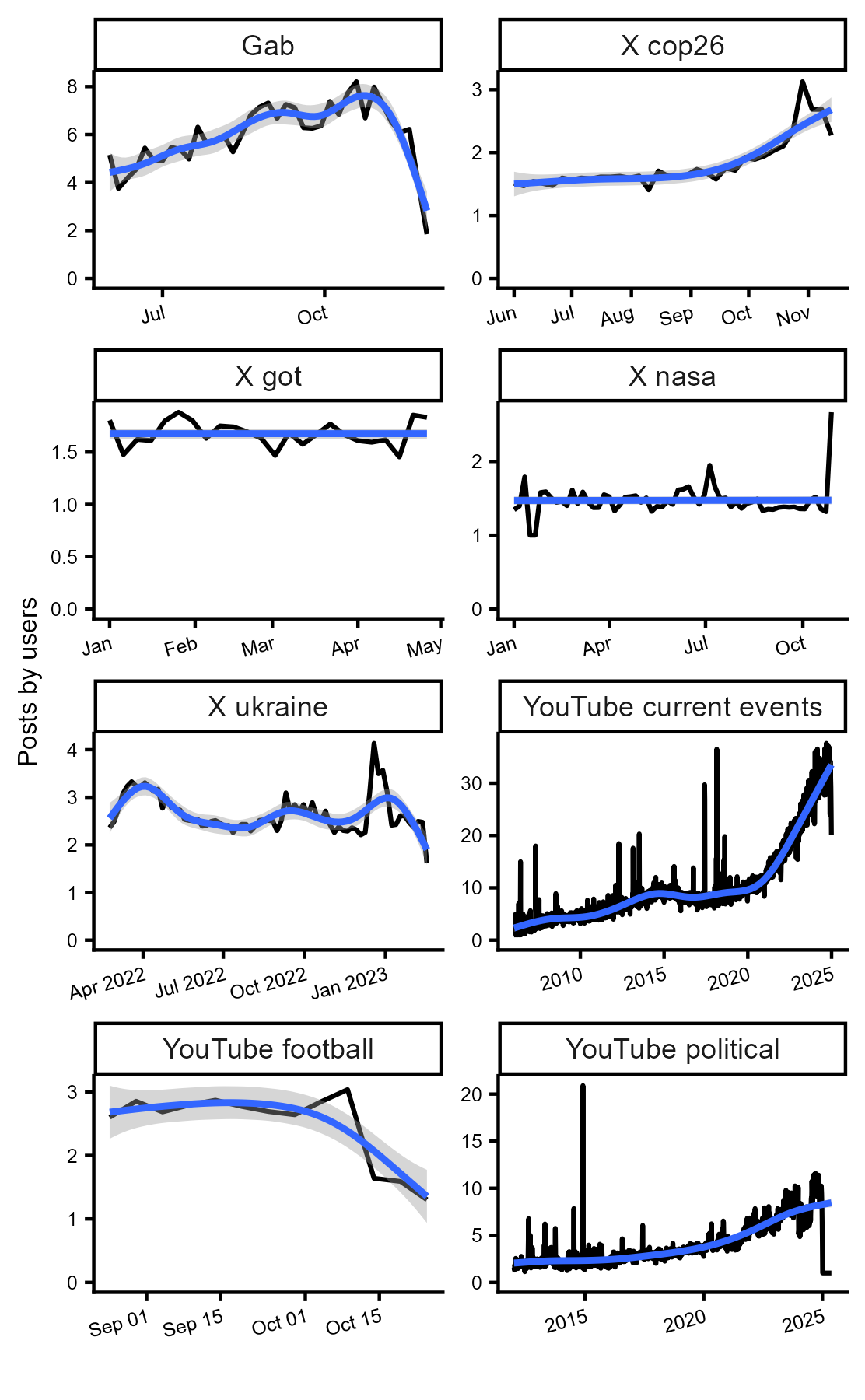
Figure 1: Average number of posts per user remains remarkably stable over time, except for substantial growth in YouTube's current events and political datasets.
Distributional Shape: Power-Law Dominance
Across all platforms and interaction types, interaction distributions consistently remain closer to power-law than exponential forms—demonstrated by divergence ratios persistently below one. The distinction between active and passive behaviors is minor; both exhibit nearly identical heavy-tailed structure, suggesting platform-level regularities rather than artifact-specific outliers.
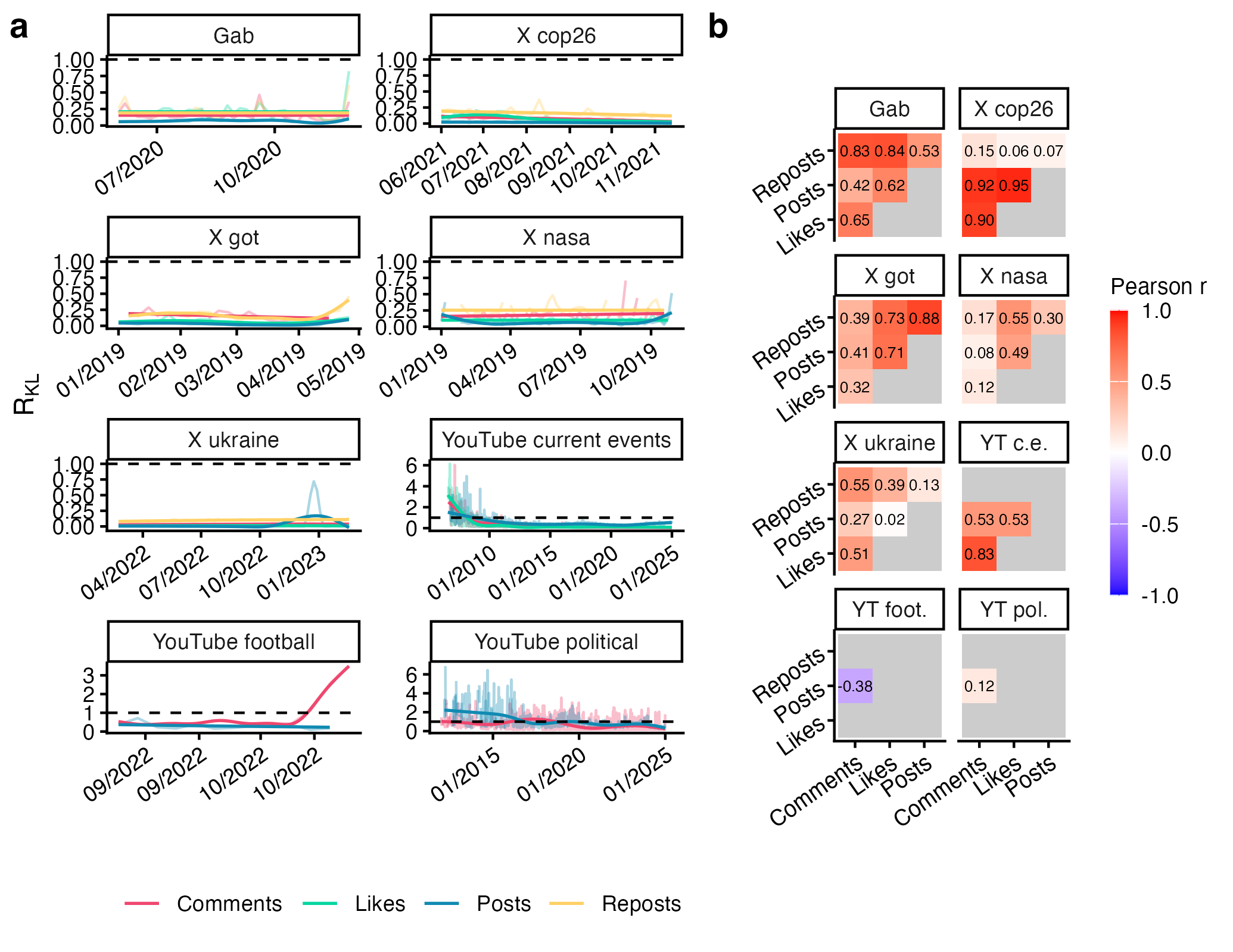
Figure 2: Empirical distribution shapes remain systematically closer to power-law than exponential, confirmed by divergence ratios and cross-metric correlations.
Longitudinally, while some datasets (notably X COP26) show statistically significant evolution toward increasing heavy-tailedness, others (including X Ukraine) display either stable or slightly decreasing power-law adherence for some passive engagement metrics—indicating context-specific but bounded temporal drift.
Tail Dominance: Inverse Coefficient of Variation
The inverse coefficient of variation (ICV) almost universally remains below unity. This robustly signals that interaction distributions possess long tails, with a minority of users responsible for disproportionate shares of visibility and engagement. Dispersion—indicative of tail dominance—remains temporally stable, with Mann–Kendall statistics generally near zero.
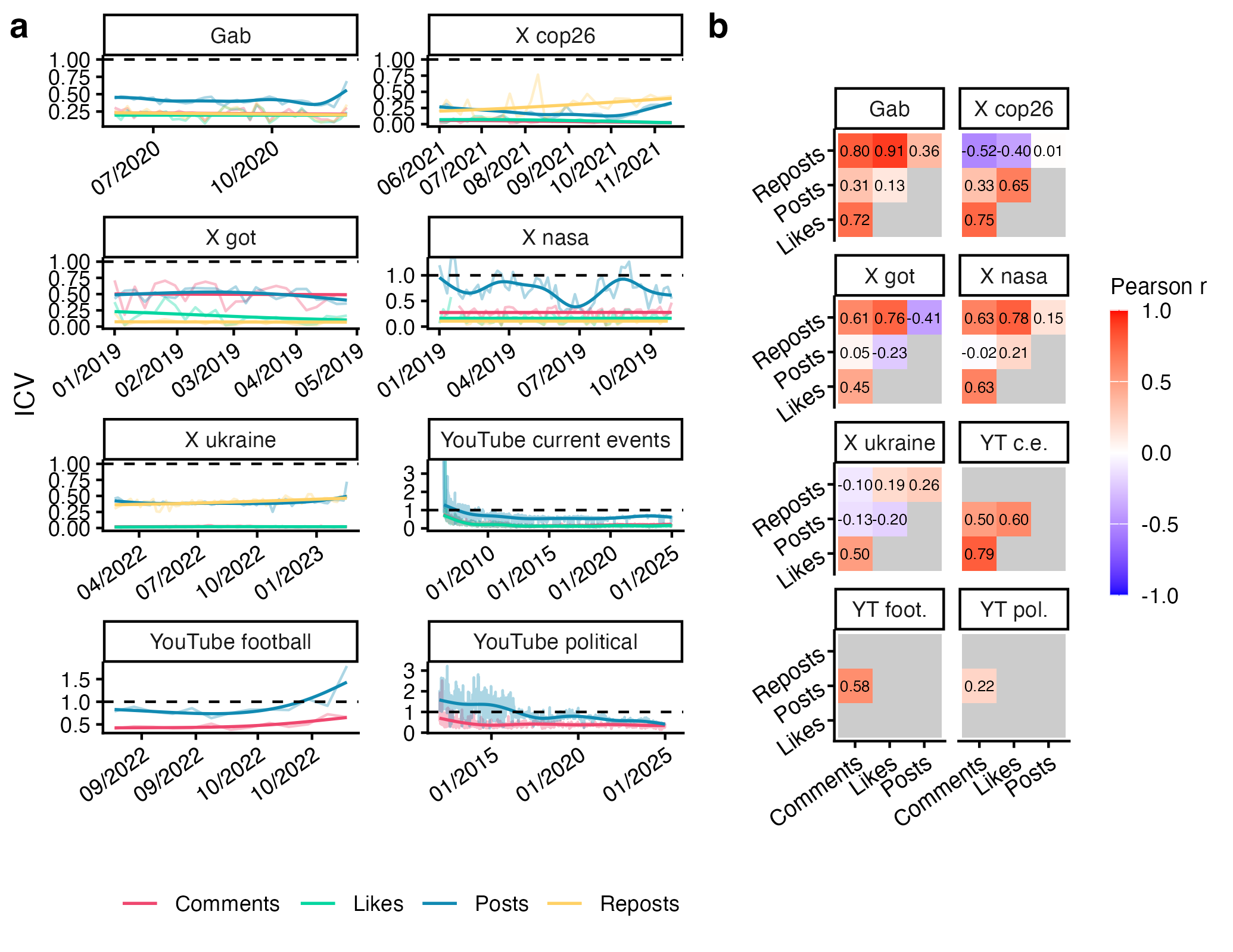
Figure 3: ICV is consistently less than 1 for most interaction types, confirming sustained heavy-tailedness and extreme user-level dispersion.
The Gini index, even after log transformation to counterbalance scale effects, remains near saturation (∼1) across platforms and interaction modes. This explicitly refutes the hypothesis that extreme inequality is driven by transient outlier events; instead, concentration is an enduring, platform-specific property.
Within-platforms, topical or community divergence has negligible effect on concentration, underscoring the role of platform affordances and visibility mechanisms over local user behaviors or thematic focus.
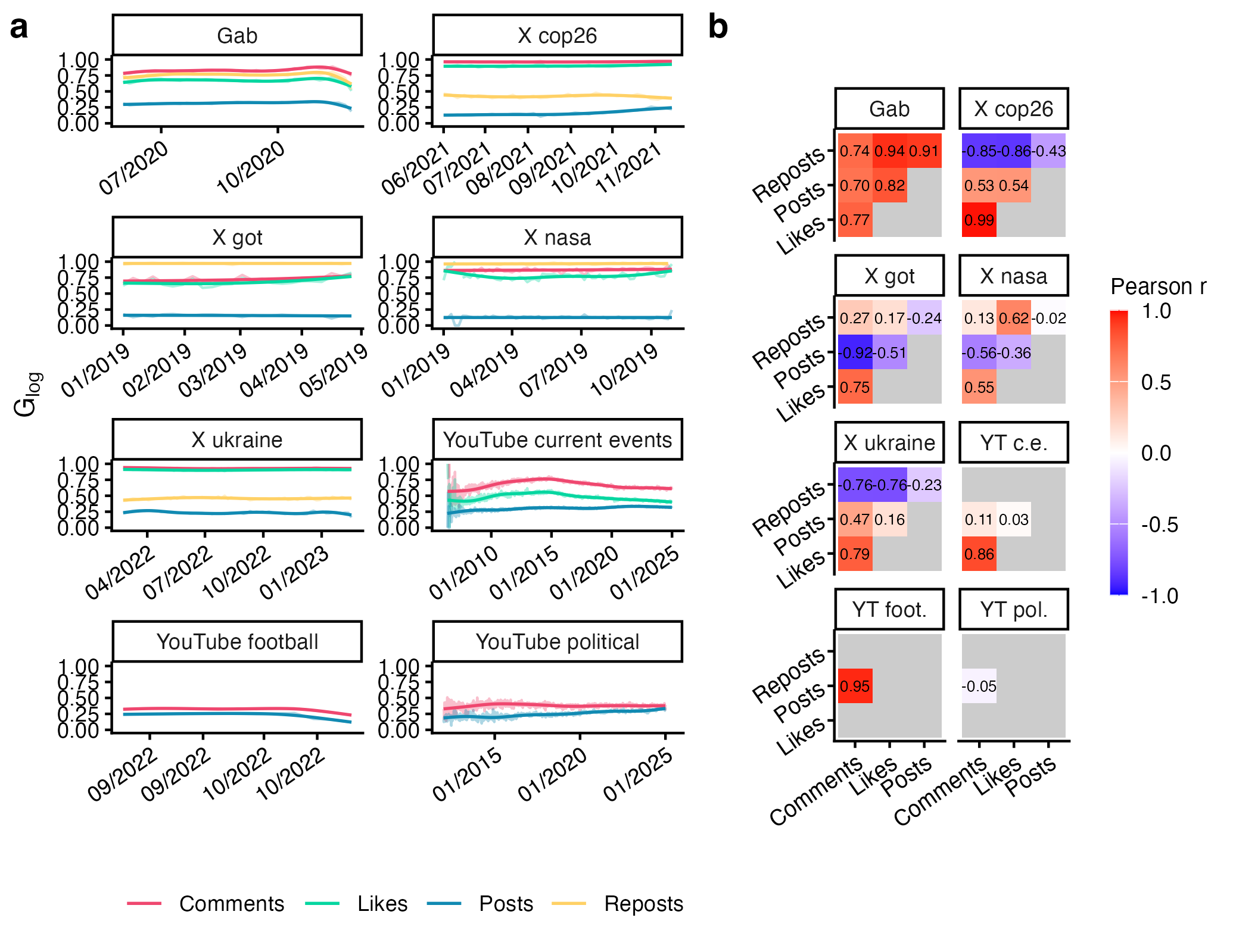
Figure 4: Log-Gini index reveals consistently high concentration of interaction, with platform-internal consistency regardless of topical focus.
Temporal evolution of Gini coefficients is muted; notable increases in inequality are observed in X COP26 and YouTube political/current events datasets, yet absolute concentration remains an enduring feature rather than an evolutionary trend.
Theoretical and Practical Implications
The persistence and cross-contextual regularity of these distributions indicate that structural inequality in online interaction is not a contingent outcome of recommender design, content virality, or any specific governance regime. Rather, these findings suggest that platform-mediated attention architectures naturally induce and preserve extreme concentration, imposing hard boundaries on egalitarian participation and visibility.
Algorithmic interventions, such as surfacing marginalized voices or suppressing highly visible ones, are likely to be systemically undermined by these underlying structural attractors—unless they fundamentally alter the architecture of attention allocation. Practically, this has implications for moderation, counter-disinformation strategies, and the design of participatory digital governance, all of which are constrained by the natural compression of attention toward privileged users.
For future AI developments, especially in the context of user modeling, ranking, and fairness-bias correction in recommender systems, these results caution against overemphasis on surface-level interventions. Persistent concentration signals that any operationalization of fairness or democratization in digital attention economy must grapple with the limits imposed by heavy-tail-driven dynamics.
Conclusion
This work delivers a formal, quantitative demonstration of persistent, cross-platform structural inequality in online user interactions. Power-law scaling, stable heavy-tailedness, and high concentration are systematic, resilient to platform change, topical context, or temporal drift. Inequality is not an artifact nor a transient phenomenon, but a structural product of digital social systems—with significant constraints for both theoretical understanding and the practical governance of online spaces.

