- The paper proposes SIDInspector, a mapping-first diagnostic tool that identifies aliasing, tail allocation, and other mapping issues in SID-tokenizer artifacts.
- It establishes rigorous validation gates and a suite of probes—covering utilization, aliasing, and prefix alignment—to ensure artifact consistency prior to retraining.
- Empirical results show that achieving zero aliasing does not guarantee behavioral alignment, underscoring the need for pretraining artifact diagnostics.
SIDInspector: Diagnosing and Profiling Semantic-ID Tokenizer Artifacts
Motivation and Context
The increasing adoption of Semantic-ID (SID) tokenizers as reusable artifacts in generative recommendation pipelines has established new challenges at the artifact-inspection layer. With SID mappings exported as address spaces for generator models, practitioners now face significant engineering and diagnostic questions that cannot be resolved by leaderboard scores alone. Common issues such as address space coverage gaps, full-code aliasing, inadequate tail allocation, and behaviorally weak prefix groupings are often only detected after downstream generator training, resulting in substantial resource waste and reproducibility bottlenecks.
Existing tools and benchmarks inadequately address the need to systematically interrogate and validate exported SID-tokenizer mappings. SIDInspector directly addresses this artifact-layer diagnostic requirement, introducing a mapping-first, extensible resource for probing SID-tokenizer mappings prior to recommender retraining.
SIDInspector Design and Architecture
SIDInspector defines a lightweight yet rigorous adapter contract for extracting SID assignments, with optional metadata and interaction logs, from arbitrary tokenizer artifacts. Every new tokenizer implementation is normalized into a homogeneous table of stable item keys and per-level SID tokens. This mapping-centric approach abstracts away downstream recommender specifics, enabling focused analysis of the address space artifact itself.
The processing pipeline, as depicted below, integrates mandatory validation gates before any diagnostic probe is run.
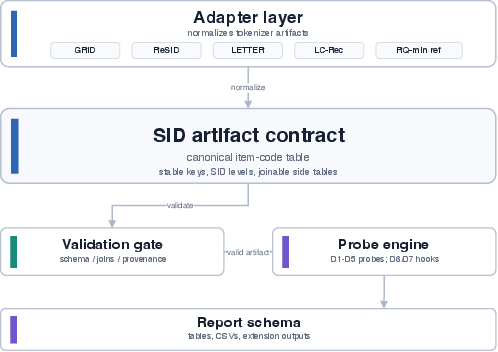
Figure 1: SIDInspector architecture encapsulates adapter normalization, contract validation, and mapping-level probes, producing diagnostic reports independently of downstream training or leaderboard evaluation.
Adapter outputs must satisfy key uniqueness, depth consistency, and joinability. Once validated, SIDInspector provides a unified interface for D1--D5 mapping-level diagnostic probes, with extensibility provisions for temporal churn (D6) and generator-trace analysis (D7). This model enforces rigorous preconditions and enables consistent artifact profiling across heterogeneous implementations.
Diagnostic Probes and Evaluation Protocol
SIDInspector centers on five core mapping-level probes:
- D1 (Utilization): Assesses per-level code usage, prefix cardinality, imbalance, and detection of dead/underused codes.
- D2 (Aliasing): Measures both full-code and prefix aliasing rates, quantifying the fraction of items sharing the same SID. This is critical for understanding addressability and potential collision artifacts at the mapping stage.
- D3 (Neighborhood Alignment): Quantifies the alignment between SID-tokenizer prefixes and behavioral co-occurrence neighborhoods, leveraging actual user-item interaction logs to compute top-k co-occurrence recovery at each prefix level.
- D4 (Popularity Allocation): Profiles head, mid, and tail items' allocation of SID capacity, with a particular emphasis on tail compression effects induced by codebook design.
- D5 (Structural Cost): Reports token sequence lengths, prefix fan-out, trie expansion, and other structural costs relevant for serving and decoding overhead in online recommender architectures.
Extension probes support advanced diagnostic settings:
- D6 (Temporal Churn): Captures mapping changes and stability across tokenizer refreshes, key for drift-aware production settings.
- D7 (Generation Traces): Enables inspection of generator outputs for invalid paths, entropy, and duplication once beam traces are available.
This probe suite enables the decoupling of implementation-specific factors and focuses on fundamental properties of the exported mapping.
Empirical Findings and Numerical Results
Core evidence is built around a fixed-item diagnostic contrast on a 23,742-item Musical domain, comparing GRID-style RQ-KMeans tokenization with ReSID/GAOQ and structural controls. The analysis yields several critical, numerically robust findings:
- Full-code aliasing: GRID-style feature-text export exposes only 3,749 unique codes with a catastrophic aliasing rate of 0.977, whereas the ReSID/GAOQ mapping is entirely alias-free (0.000).
- Prefix co-occurrence alignment: Deterministic category-prefix mapping achieves the strongest Level-1 co-occurrence recall (D3-L1: 0.447), outstripping both learned ReSID (0.154) and GRID (0.055–0.080), illustrating that learned item-unique addressability does not guarantee behaviorally meaningful grouping.
- Tail capacity: GRID-style mapping provides only 37% tail unique-SID allocation, while ReSID/GAOQ and category-prefix controls reach 100%.
- Capacity ablation: Increasing GRID capacity reduces aliasing (to 0.779) but does not eliminate the gap with ReSID's item-unique mapping, underlining the interplay of codebook size and addressability.
Cross-domain and artifact-portability probes establish the robustness of these diagnostics: released LETTER and LC-Rec item-index artifacts exhibit analogous validation and probe profiles, confirming that SIDInspector generalizes to both controlled and externally released mappings.
Mechanism-probe calibrations further validate the discriminative power of SIDInspector probes. For instance, controlled aliasing stressors (hash vs. co-occurrence) reveal a 1.19x vs. 3.86x baseline shift in D2, while popularity-induced budget probes shift D1/D4 from perfect head coverage (1.000) to near-zero tail allocation (0.028).
Theoretical and Practical Implications
SIDInspector's central claim—that addressability and behavioral prefix alignment must be treated as analytically and practically distinct artifact properties—has significant implications. The presence of item-unique codes (zero aliasing) does not inherently confer behaviorally meaningful or collaborative grouping at the prefix level. Moreover, capacity scaling, while useful, is not a panacea for prefix-alignment failures.
By foregrounding these artifact-linked diagnostics, SIDInspector reframes SID-tokenizer evaluation as a pretraining, engineering resource allocation problem. Practitioners are equipped to triage, reject, or debug SID exports before incurring model training and serving costs. The tool establishes a foundation for more reproducible, interpretable, and artifact-aware evaluation practices in generative recommender systems, aligning with recent calls in the literature for rigorous and reproducible resource benchmarks.
The separation of D2 (aliasing) and D3 (prefix alignment) metrics recasts how SID-tokenizer advances should be reported: an export should be evaluated for both mapping uniqueness and co-occurrence structure, rather than only downstream ranking metrics.
Future Prospects
Potential extensions of SIDInspector include:
- Incorporation of causal harm validation for mapping-level collisions, as called for by recent SID reliability studies.
- Broader adapter coverage for new tokenization paradigms such as variable-length, multimodal, and drift-aware SID assignments.
- Enhanced generator-output diagnostics and unified search/recommendation artifact checks.
- Deeper cross-domain and multilingual artifact inspection, aligning with emerging joint semantic-ID approaches in LLM-powered search and recommendation.
The implementation of cooperative adapters and reproducibility matrices encourages rapid integration by both academic and industrial stakeholders, facilitating widespread adoption of artifact-centric diagnostic methodology.
Conclusion
SIDInspector provides a diagnostic, mapping-first resource for rigorous analysis of SID-tokenizer artifacts in generative recommendation. By enforcing a normalized validation and probe interface, it enables researchers and practitioners to inspect address space utilization, aliasing, behavioral alignment, popularity allocation, and structural cost before downstream retraining. Empirical results highlight that learned item-unique addressability and behavioral prefix alignment are distinct, supporting the argument that both must be inspected to ensure robust, generalizable recommender system performance. SIDInspector thus defines a new baseline for pretraining and diagnostic best practices in the era of generative recommendation architectures.