Topological Neural Operators
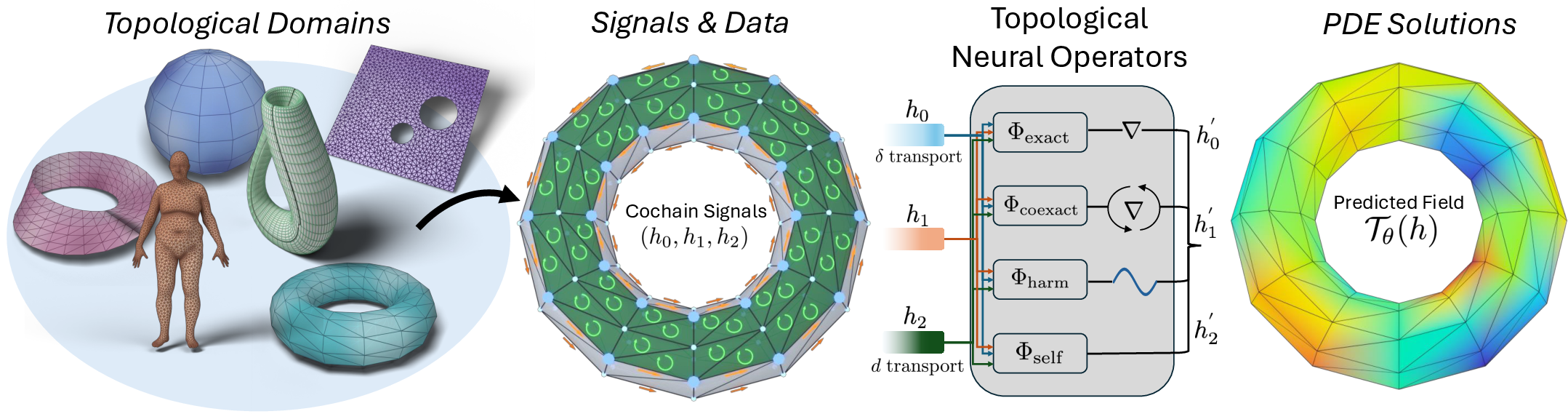
Abstract: We introduce Topological Neural Operators (TNOs), a principled framework for operator learning on cell complexes that lifts neural operators (NOs) from functions on points and/or edges to topological domains. TNOs represent data as features defined on cells of varying dimension and model their interactions through Discrete Exterior Calculus, enabling explicit cross-dimensional coupling via gradient-, curl-, and divergence-type operators. The key design principle is to decouple where information flows, as governed by fixed topological operators, from how it is transformed (which is learned), yielding models that respect the geometric support of physical quantities and expose conservation and compatibility structure. We further propose Hierarchical TNOs (HTNOs), which incorporate learned coarse complexes to propagate long-range and topology-dependent information. Our framework subsumes existing NOs as a special case, providing a unified perspective on operator learning across discretizations. Across a range of PDE benchmarks, including irregular-geometry flow problems, TNOs and HTNOs improve accuracy; controlled studies further isolate the benefits of native higher-rank and topological structure. Project page: https://circle-group.github.io/research/TNO
Paper Prompts
Sign up for free to create and run prompts on this paper using GPT-5.
Top Community Prompts
Explain it Like I'm 14
A simple explanation of “Topological Neural Operators”
What is this paper about?
This paper introduces a new way for AI to learn and predict how physical systems behave. Many real-world things—like how heat spreads, how air flows around a wing, or how electricity moves—are described by math rules called PDEs (partial differential equations). Solving these exactly can be slow. Neural operators are AI models that learn to predict the whole solution of a PDE much faster.
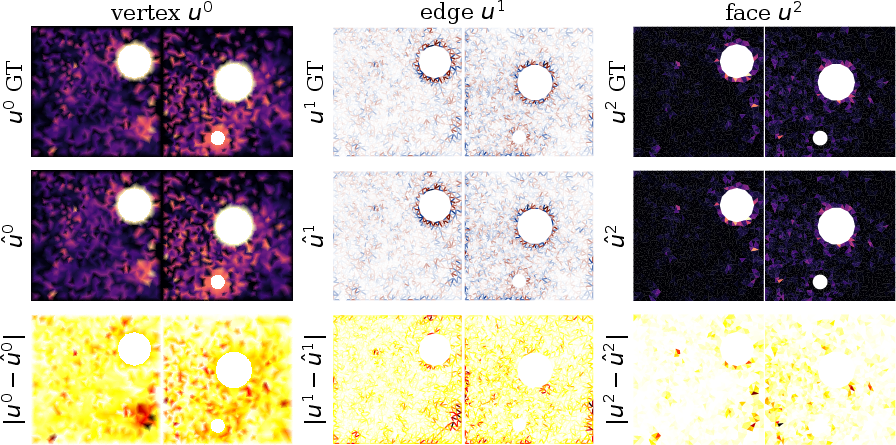
Most current models treat everything as values on points only (like dots on a grid). But in physics, different quantities naturally “live” on different shapes:
- Values like temperature belong at points (vertices).
- Circulations like the twist of a flow belong on lines (edges).
- Fluxes like how much flows through a surface belong on faces.
- Densities like charge can belong inside volumes.
The authors build Topological Neural Operators (TNOs), which respect this structure. TNOs place information not just on points, but also on edges, faces, and volumes—and they use built-in math rules about how these parts connect. This helps the model follow physical laws more naturally.
What questions does the paper ask?
In plain terms, the paper asks:
- Can we make neural operators that understand the “shape” and connections of space (topology), not just points?
- Can these models move information in physically correct ways (like gradients, curls, and divergence), while still learning how to transform it?
- Will this make predictions more accurate and trustworthy for complex physics, even on irregular shapes and meshes?
- Can this be done in a way that works across different resolutions and meshes without retraining?
How does their approach work?
Think of a city:
- Vertices are intersections.
- Edges are roads.
- Faces are city blocks.
- Volumes are buildings.
Physics is like traffic and water flow in the city. Some information belongs at intersections (like elevation), some on roads (traffic flow), some across blocks (water passing through a surface), and some inside buildings (air pressure).
TNOs do two things:
- They separate where information can flow from how it is changed.
- Where it flows is fixed by the city’s map—the topology (who touches whom).
- How it is changed is learned by the AI (the “policy” for mixing and updating information).
- They use simple, universal “traffic rules” from discrete exterior calculus (DEC):
- Gradient: change from point to point (like slope from one intersection to the next).
- Curl: how much something swirls around (like traffic going around a block).
- Divergence: how much flows in or out of a region (like water entering or leaving a block).
These rules move information between points, edges, and faces in consistent ways. Because the rules are built in, the model tends to respect physical laws (like “the boundary of a boundary is empty,” which ensures certain conservation properties).
They also build a hierarchical version (HTNO):
- Imagine zooming out to a city’s districts and highways. HTNOs learn coarse versions of the map so they can send information over long distances efficiently, while still following the same rules.
One more neat point: if you only keep information on points (vertices), TNOs become standard neural operators like FNO or GNO. So TNOs are a general framework that includes older methods as special cases.
What did they find, and why does it matter?
In tests on many physics problems, TNOs (and HTNOs) were more accurate and often more physically consistent than other methods:
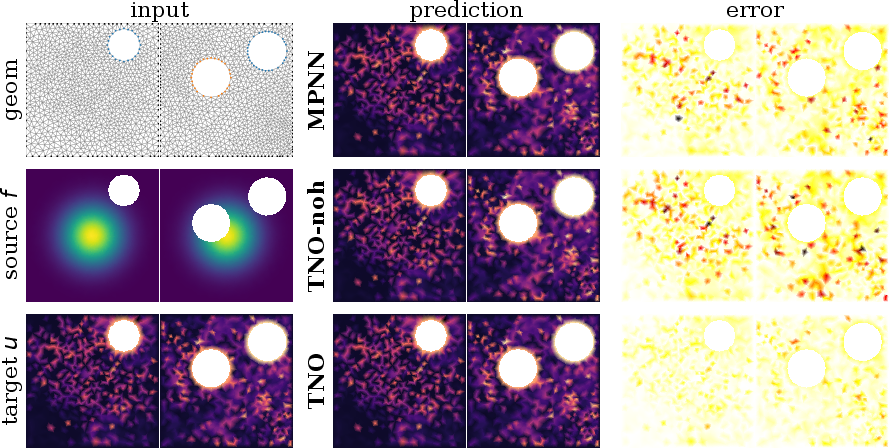
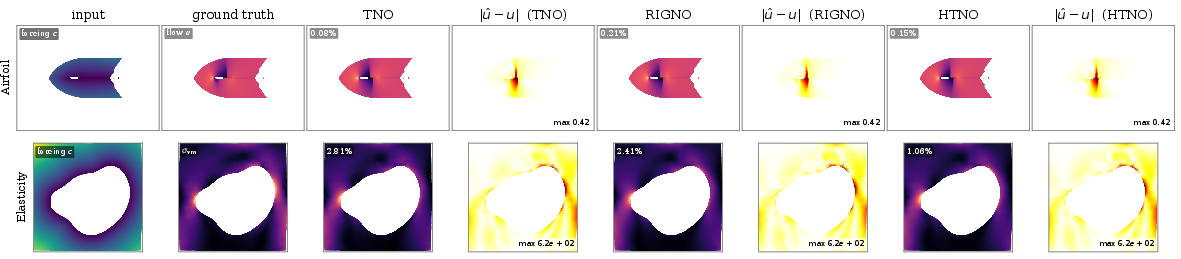
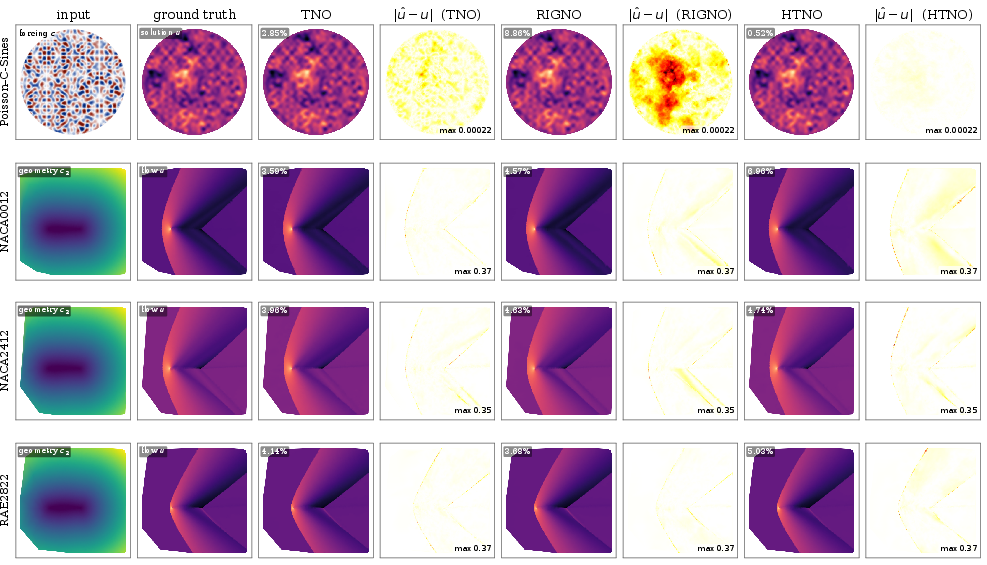
- Steady problems like Poisson, elasticity, and airfoil flow on irregular meshes: TNOs/HTNOs matched or beat strong baselines.
- Large 3D wing surfaces (EmmiWing): HTNO was best overall among compared models.
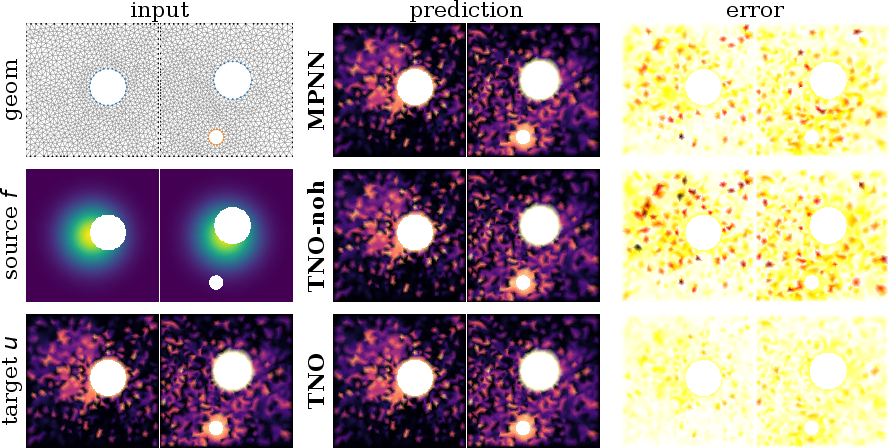
- A controlled test (anisotropic Darcy flow) showed that feeding the model information at its “natural home” (e.g., face-level directions for material orientation) clearly helps. If you “squash” that info onto points, you lose important details. TNOs can use this higher-rank information natively.
- Ablation studies showed that two ingredients matter:
- Using built-in “topological channels” (especially a harmonic part that captures global, loop-like effects).
- Using sheaf-like transport (a way to let local rules carry richer information along connections).
- Together, these improve accuracy, especially when flows have swirl/rotation.
Why it matters:
- Better accuracy and generalization on complex shapes and meshes.
- More faithful to physical laws (e.g., conservation), because the math structure is baked in.
- Works across different resolutions and discretizations, which is important for real engineering pipelines.
- Unifies many operator-learning methods in one framework.
What’s the big picture impact?
This approach moves neural PDE solvers closer to how scientists and engineers already think about physics: different quantities belong on different geometric parts, and their interactions follow specific rules. TNOs:
- Could become faster, more reliable surrogates for simulations in design and control (like airplanes, wind farms, electronics).
- Make it easier to model multi-physics systems where different fields interact (like electromagnetism and fluid flow together).
- Provide a foundation to build bigger, more general “scientific foundation models” that learn across many domains and geometries.
The authors also note limits and next steps:
- Scaling to dynamic or very large domains.
- Mathematical guarantees (approximation, stability) for these models.
- Extending to more complicated settings: evolving shapes, inverse problems, and symmetry-aware systems.
In short, TNOs teach neural operators to “respect the map,” not just the dots—leading to smarter, more physically grounded predictions.
Knowledge Gaps
Knowledge gaps, limitations, and open questions
The paper proposes Topological Neural Operators (TNOs) and HTNOs but leaves several aspects unresolved. Future research could address the following points:
- Theory of approximation and stability: absence of universal approximation, stability, and convergence results for cochain-valued operator classes under mesh refinement; need FEEC-style error estimates and generalization bounds for TNOs.
- Discretization transfer (P3): no formal guarantees or quantitative studies of cross-resolution consistency; develop commuting prolongation/restriction maps with error decay analysis and test transfer across systematically refined meshes.
- Hodge star construction and sensitivity: impact of choices of (diagonal vs. full, primal vs. dual) and mesh quality (anisotropy, skewness) on accuracy and stability is unquantified; need robust Hodge estimators for irregular meshes and combinatorial complexes without embedded geometry.
- Computational cost of harmonic channels: computing/projection to scales poorly on large meshes; evaluate randomized/iterative nullspace methods, localized harmonic bases, and their accuracy–cost trade-offs.
- Conservation and DEC identities with learned transport: copresheaf (learned fiber maps) may violate and conservation; design constraints/regularizers ensuring exactness, coexactness, and DEC compatibility under learning.
- HTNO coarsening fidelity: learned partitions generally do not commute with ; methods to learn or enforce commuting transfers () and consistent coarse Hodge stars are needed; analyze conservation loss and multigrid efficiency.
- Boundary conditions: lack of systematic treatment of essential vs. natural BCs (trace operators, boundary Hodge stars), generalization to mixed/variable BCs, and boundary-layer error analysis/training losses.
- Missing time-dependent, multi-degree benchmarks: despite motivation (Maxwell, vorticity–velocity), experiments are steady-state/surface-centric; build datasets and protocols for transient, coupled multi-rank PDEs and measure constraint preservation over time.
- Quantifying physical consistency: no explicit metrics for divergence-free, curl-free, or flux-balance errors; develop diagnostics and training objectives that enforce/measure exact, coexact, and harmonic components in outputs.
- Orientation robustness: learned mixing may be sensitive to cell orientation/sign conventions; explore orientation-invariant parameterizations or augmentation ensuring invariance to mesh-dependent sign flips.
- Topology variation across samples: handling changes in Betti numbers (harmonic dimension), alignment of harmonic subspaces between meshes, and training stability with varying topology remain open.
- Applicability beyond manifolds: extension to non-manifold, mixed-dimensional, or higher-dimensional complexes (and corresponding DEC/Hodge definitions) is not addressed.
- Noisy/partial observations and uncertainty: robustness to measurement noise, partial inputs, irregular sampling, and calibrated predictive uncertainty for scientific use are unexplored.
- Baseline coverage: comparisons to other cellular/simplicial operators (e.g., HodgeNet, simplicial/cellular message passing, CW networks, FEEC-inspired GDL) and physics-informed NOs are limited; deeper ablations isolating cross-rank vs. same-rank depth are needed.
- Training efficiency and scaling: memory/time overhead of assembling/applying block DEC operators and computing harmonic bases on large meshes; need sparse–GPU kernels, preconditioners, and multi-GPU scaling analyses vs. FNO/GNO.
- Rank/channel design: practical guidelines for which cochain degrees to include per PDE, risks of over/under-specification, and mechanisms to automatically select relevant ranks.
- Adaptive/dynamic meshes and evolving domains: algorithms for online refinement/coarsening and topology changes while preserving DEC structure and shared weights.
- Gauge and symmetry equivariance: concrete constructions for gauge-invariant/equivariant TNOs (e.g., electromagnetism) and Euclidean/SE(3) equivariance; quantify trade-offs with expressivity.
- Inverse problems: parameter identification and coefficient inference with TNOs, differentiability through DEC operators, identifiability, and regularization strategies.
- Volumetric PDEs: limited evaluation on true 3D volumetric problems using 2- and 3-cochains (e.g., subsurface flow, solid mechanics, full Maxwell); need volumetric datasets and studies.
- Mesh-quality dependence: effect of anisotropy, aspect ratio, and degeneracy on conditioning of , , and training stability; assess remedies (mass lumping, smoothing).
- Data efficiency and scaling laws: how performance scales with dataset size, resolution, and number of ranks; sample complexity for learning cross-degree couplings.
- Hybridization with classical solvers: using TNO blocks as multigrid smoothers, coarse-grid corrections, or preconditioners; certified accuracy via coupling with FEEC solvers.
- Reproducibility/implementation specifics: clearer guidance on constructing complexes (RCC vs. CC), orientation/BC handling, Hodge choices, and public artifacts validating discretization transfer and hierarchy construction.
- Shock/capture regimes: for compressible flows, accuracy near discontinuities/shocks and resilience to regime shifts (e.g., transonic–supersonic) are not dissected; develop shock-aware losses and evaluations.
Practical Applications
Immediate Applications
Below are concrete, deployable uses that can be implemented with today’s simulation data, meshing tools, and standard ML infrastructure. Each item includes sectors, possible tools/products/workflows, and feasibility assumptions.
- Aerospace CFD surrogates for airfoils and wings
- Description: TNO/HTNO provide faster, mesh-agnostic surrogates for steady compressible airflow (sub/trans/supersonic) on variable geometries, preserving cross-dimensional physics and improving accuracy on irregular surface meshes.
- Sectors: Aerospace, Automotive, Energy (wind), Software (CAE).
- Tools/workflows: Plugins for OpenFOAM, SU2, Ansys Fluent; CAD-integrated rapid what-if analysis (CATIA/SolidWorks); HTNO inference on wing-surface meshes; batch screening in design-of-experiments.
- Assumptions/dependencies: Availability of high-fidelity CFD data for training; well-conditioned surface/volume cell complexes and Hodge stars; operating conditions similar to training regime; validation for safety-critical use.
- Structural mechanics and elasticity surrogates
- Description: Replace slow finite-element solves for static deformations with TNOs that maintain compatibility constraints (e.g., via Hodge Laplacians), improving fidelity on irregular meshes.
- Sectors: Civil/Mechanical Engineering, Manufacturing, CAE Software.
- Tools/workflows: Surrogate solver nodes inside FEA pipelines (Ansys Mechanical, Abaqus, COMSOL); lightweight pre- and post-processing using DEC-based operators; rapid topology/shape iterations in CAD.
- Assumptions/dependencies: Training data from trusted solvers; robust boundary condition handling; consistent material parameter ranges; mesh-quality checks.
- Heat conduction and diffusion surrogates (Poisson-type)
- Description: Accelerate Poisson solves (e.g., temperature, potential) on complex geometries; consistent across discretizations and resolutions.
- Sectors: Electronics cooling, Building engineering, Energy systems, Education.
- Tools/workflows: Embedded TNO modules in COMSOL/Multiphysics; parameter sweeps for layout and boundary conditions; educational labs to demonstrate DEC-based operators.
- Assumptions/dependencies: Adequate coverage of geometric/BC variability in training; DEC-compatible discretizations; monitoring out-of-distribution (OOD) cases.
- Groundwater and porous media (anisotropic Darcy) with native higher-rank inputs
- Description: HTNO leverages face-supported tensor fields (e.g., anisotropic permeability) without lossy projection to nodes, improving predictions where orientation is face-local.
- Sectors: Environmental Engineering, Energy (reservoirs), Water Utilities.
- Tools/workflows: Integration with MODFLOW/COMSOL workflows; mesh preprocessing to compute Hodge stars; scenario planning for barrier placement or remediation.
- Assumptions/dependencies: Access to per-cell anisotropy fields; representative training simulations; reliable mesh generation in complex geology.
- Large-scale surface aerodynamics on meshes (e.g., EmmiWing)
- Description: Real-time/near-real-time inference of surface pressure and shear on large 3D wing surfaces using HTNO’s hierarchy for long-range interactions.
- Sectors: Aerospace, UAVs, Sports engineering.
- Tools/workflows: GPU inference services; integration with flight-test digital twins; design iteration loops for shape refinement.
- Assumptions/dependencies: High-quality surface meshing; sufficient training coverage of wings/conditions; memory-efficient Hodge operations.
- Multi-physics coupling prototype models (e.g., Maxwell, Darcy–pressure/flux systems)
- Description: Use cross-rank coupling (d, δ) to model interactions between fields of different geometric types (potentials, circulations, fluxes), as in electromagnetics or fluid–structure pre-studies.
- Sectors: Electronics/EMC, Energy (EM induction), Robotics (soft actuators).
- Tools/workflows: Coprocessing TNO blocks in EM solvers (CST/HFSS) for speed-ups; rapid sensitivity studies for antenna placement and shielding.
- Assumptions/dependencies: Labeled multi-field training data; correct encoding of boundary traces and material heterogeneity; stability checks near resonances.
- Mesh-agnostic, resolution-transferable surrogates for irregular geometries
- Description: Train once and deploy across meshes using DEC-driven operators; reduce re-training burden when CAD changes topology/resolution.
- Sectors: CAE Software, Digital Twins, Education.
- Tools/workflows: TNO “operator packs” distributed with mesh-to-operator adaptors; cochain-based data schemas for simulation pipelines.
- Assumptions/dependencies: Commuting, stable discretizations (or acceptable approximations); consistent feature normalization across meshes.
- Hierarchical acceleration for long-range effects (HTNO)
- Description: Propagate global/topology-dependent information via learned coarse complexes for faster convergence on large domains.
- Sectors: HPC, CAE, Cloud simulation services.
- Tools/workflows: V-cycle-inspired HTNO inference nodes; cluster-friendly batch serving with coarse-grained caches; multi-GPU pipelines.
- Assumptions/dependencies: Coarsening that approximately commutes with coboundary; scalable memory layout for multilevel Hodge stars; profiling to avoid communication bottlenecks.
- Topology-aware uncertainty screening in design
- Description: Use harmonic/coexact/exact channels to flag topology-sensitive regimes (e.g., holes, cycles, harmonic modes) where surrogates may be more/less reliable.
- Sectors: Aerospace, Civil, Medical Devices (fluid flow), QA.
- Tools/workflows: Reliability dashboards within CAE; auto-detection of topological features; guardrails for extrapolation.
- Assumptions/dependencies: Reliable computation of Betti numbers/harmonic bases; calibrated thresholds relating topology signatures to error.
- Sensor-to-field estimation on irregular networks
- Description: Map sparse measurements (e.g., edge fluxes, face circulations) to full fields using cochain-aware operators for data assimilation.
- Sectors: Smart Grids, Water Networks, Industrial IoT, Environmental Monitoring.
- Tools/workflows: Real-time estimation services; integration with SCADA; edge/face assignment of sensor modalities; missing-data imputation.
- Assumptions/dependencies: Accurate sensor-to-cell mapping; training with representative noise models; handling of boundary condition uncertainty.
- Educational tooling for discrete exterior calculus and physics-informed ML
- Description: Use TNO layers to teach DEC (gradient/curl/divergence on complexes) with interactive labs.
- Sectors: Academia, EdTech.
- Tools/workflows: JAX/PyTorch modules; notebooks demonstrating Hodge decomposition; visualization of exact/coexact/harmonic components.
- Assumptions/dependencies: Availability of example complexes and PDE datasets; GPU access for classroom demonstrations.
- Faster what-if analysis in CAD/CAE platforms
- Description: Designers explore geometry/BC tweaks with near-real-time PDE feedback using TNO surrogates that respect conservation/compatibility.
- Sectors: Manufacturing, Product Design, Consumer Electronics (thermal), Architecture.
- Tools/workflows: CAD plugins with TNO backends; on-device inference for smaller models; batch overnight retraining with updated design libraries.
- Assumptions/dependencies: Seamless conversion from CAD to cell complexes; automated Hodge-star computation; quality control for outliers.
Long-Term Applications
These opportunities require further research, scaling, or development (e.g., richer datasets, stronger guarantees, integration with certification workflows, or extension to dynamic/adaptive domains).
- Real-time multi-physics digital twins with certified constraints
- Description: TNO-based surrogates for coupled domains (fluid–structure–thermal–EM) that retain conservation/compatibility, enabling high-fidelity twins for complex assets.
- Sectors: Aerospace, Energy (turbomachinery), Smart Cities.
- Tools/workflows: Federated twin architectures; streaming assimilation; certified guardrails using topology-aware invariants.
- Assumptions/dependencies: Robust generalization across operating envelopes; certification-grade validation; continual-learning infrastructure.
- Adaptive and evolving-geometry simulation (moving boundaries, fracture, morphing)
- Description: Extend TNOs to dynamic complexes and evolving manifolds with on-the-fly recomputation of DEC operators and consistent transfer.
- Sectors: Biomechanics, Soft robotics, Additive manufacturing, Geophysics.
- Tools/workflows: Online remeshing with incremental Hodge updates; adaptive HTNO refinements; sheaf-based transport learning.
- Assumptions/dependencies: Stable training under topological changes; efficient incremental factorization of Hodge operators; new datasets.
- PDE-constrained inverse design and topology optimization at scale
- Description: Use TNOs as fast, differentiable surrogates within gradient-based topology/shape optimization while preserving physical identities (e.g., div curl = 0).
- Sectors: Aerospace, Automotive, Electronics (thermal/EM), Materials.
- Tools/workflows: End-to-end differentiable CAD→TNO→objective pipelines; adjoint-free optimization; multi-objective screening.
- Assumptions/dependencies: Smooth surrogate gradients wrt geometry/BCs; robust mesh parameterizations; regularization for topological changes.
- Safety analytics and policy workflows using physics-informed surrogates
- Description: Rapid, topology-aware risk assessments (e.g., ventilation/contaminant spread, flood/groundwater scenarios, EM exposure) for permitting and standards.
- Sectors: Public Policy, Environmental Agencies, Standards Bodies.
- Tools/workflows: Decision-support dashboards; scenario ensembles on infrastructure meshes; uncertainty quantification with topology-aware priors.
- Assumptions/dependencies: Transparent documentation of surrogate limits; alignment with regulatory validation protocols; stakeholder training.
- Power grids and energy networks: cochain-native flow/pressure/EM surrogates
- Description: Model fluxes and potentials on edges/faces/volumes for AC/DC grids, district heating, gas networks with better constraint preservation.
- Sectors: Energy & Utilities.
- Tools/workflows: Grid planning and contingency analysis; fast N-1 screening; cyber-physical anomaly detection.
- Assumptions/dependencies: High-quality network topology and parameters; integration with EMS/DMS; robust handling of contingencies/OOD events.
- Weather and environmental modeling on unstructured meshes
- Description: Surrogate components for limited-area weather, ocean/estuary models leveraging cross-rank coupling and hierarchical propagation.
- Sectors: Climate Services, Insurance, Agriculture.
- Tools/workflows: Coupled TNO blocks as fast physics in hybrid models; ensemble forecasting acceleration; coastal risk modeling.
- Assumptions/dependencies: Massive training datasets; stable coupling with existing solvers; careful handling of stiff processes.
- Real-time on-device simulation for AR/VR and robotics
- Description: Lightweight TNOs for stable fluid/soft-body/EM approximations on embedded hardware, preserving key invariants for believable interaction.
- Sectors: Gaming, XR, Robotics.
- Tools/workflows: Distilled/mobile TNO libraries; precomputed Hodge stars for canonical device meshes; latency-aware schedulers.
- Assumptions/dependencies: Aggressive model compression without breaking topological structure; device-optimized DEC kernels.
- Gauge-/symmetry-equivariant operator families
- Description: Extend TNOs with gauge or symmetry equivariance to better model EM, quantum-inspired, or materials systems.
- Sectors: Electronics/Photonics, Materials, Fundamental Sciences.
- Tools/workflows: Equivariant layer libraries for cochains; benchmark suites; certification of invariances.
- Assumptions/dependencies: Mathematical advances in equivariant DEC; datasets with explicit symmetry/gauge structure.
- Foundation models for scientific operators across discretizations
- Description: Pretrain TNOs/HTNOs on broad PDE families and geometries to create reusable “operator backbones” transferable to new tasks.
- Sectors: Scientific Computing, CAE Platforms, Cloud ML.
- Tools/workflows: Large-scale multi-physics pretraining; task adapters; mesh-agnostic APIs for cochain data.
- Assumptions/dependencies: Curated cross-domain datasets; scalable training on HPC; standardized cochain data formats.
- Topology-aware uncertainty quantification and verification
- Description: UQ methods that exploit Hodge decomposition to separate exact/coexact/harmonic uncertainties for better error bars and verification.
- Sectors: Safety-Critical Engineering, Insurance/Finance (risk), Public Policy.
- Tools/workflows: Bayesian layers atop TNOs; diagnostic metrics by topological channel; verification test suites.
- Assumptions/dependencies: Statistical models compatible with cochain structure; calibration datasets; acceptance by regulatory bodies.
- Data assimilation with heterogeneous sensors (edge/face/volume)
- Description: Incorporate measurements that naturally live on edges/faces (flux, circulation) for improved reconstructions in networks and fields.
- Sectors: Smart Infrastructure, Environmental Monitoring, Industrial IoT.
- Tools/workflows: Sensor-to-cell mapping services; spatiotopological fusion pipelines; streaming inference.
- Assumptions/dependencies: Standardization of sensor metadata to cochain indices; robust handling of noise and sparsity; edge computing support.
- Integration with adaptive and multigrid solvers for hybrid inference
- Description: TNO blocks as learned smoothers or coarse-grid correctors in classical multigrid for faster convergence.
- Sectors: HPC, CAE Software.
- Tools/workflows: Hybrid solver APIs; runtime selection between learned and classical components; profiling/auto-tuning.
- Assumptions/dependencies: Stability analyses for mixed learned–classical cycles; portability across hardware; maintenance of solver guarantees.
Notes on Cross-Cutting Dependencies
- Data: High-fidelity PDE solutions or experimental data covering relevant parameter ranges, boundaries, and geometries.
- Discretization: Ability to construct cell complexes and compute robust Hodge stars; mesh quality and orientation conventions.
- Validity: Monitoring of distribution shift; incorporation of guardrails using topological diagnostics; domain-specific validation and certification.
- Compute: GPU/TPU resources for training; efficient sparse DEC kernels for inference; support for hierarchical coarsening.
- Integration: APIs to CAD/CAE and twin platforms; standardized cochain data formats; developer tooling (JAX/PyTorch modules).
Glossary
- Betti number: A topological invariant that counts the number of independent k-dimensional holes in a space, appearing as the dimension of the harmonic subspace in Hodge Decomposition. "where is the -th Betti number, counting independent -dimensional holes"
- boundary of a boundary is empty: A fundamental topological identity stating that applying the boundary operator twice yields zero, ensuring compatibility like curl(grad)=0 and div(curl)=0. "the boundary of a boundary is empty"
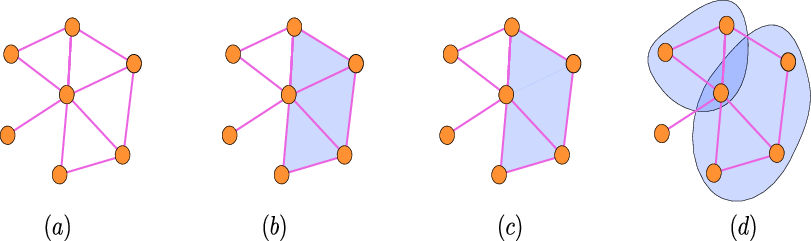
- cochain: An assignment of a value (or feature vector) to each cell of a given dimension in a cell complex, serving as the discrete analogue of differential forms. "A -cochain assigns a feature vector to each -cell;"
- coexact cochains: Cochains lying in the image of the codifferential; they are divergence-free components in the Hodge Decomposition. "coexact cochains are divergence-free"
- codifferential: The adjoint (with respect to the Hodge star metric) of the discrete exterior derivative that maps cochains down one degree. "the codifferential, mapping downward in degree:"
- Combinatorial Complexes: A generalization of cell complexes and hypergraphs that allows independent specification of cells at each rank. "In practice, we also use more flexible Combinatorial Complexes"
- commuting-diagram condition: A structural requirement (common in multilevel methods) that inter-level transfer maps commute with coboundary operators, preserving exactness across levels. "This is the analogue of the commuting-diagram condition in FEEC multigrid"
- copresheaf variant: An architectural variant where incidences carry learnable fiber maps, producing twisted versions of DEC operators while keeping incidence support fixed. "in the copresheaf variant \cite{hajij2025copresheaf} below, the incidence support remains fixed,"
- Darcy: A PDE model of flow through porous media that often couples scalar potentials with fluxes across ranks. "Darcy couples a 0-form with a 1-form"
- de Rham complex: A chain of spaces and exterior derivatives (or their discrete analogues) organizing fields by degree and their differential relationships. "The de~Rham complex gives a common discrete language for physical PDEs on bounded domains"
- diamond condition: A combinatorial property of regular cell complexes that enforces consistency of incidences and implies B_k B_{k+1}=0. "the diamond condition \cite{basak2010combinatorial,aschbacher1996combinatorial,savoy2022combinatorial} forces"
- Discrete Exterior Calculus: A framework for discretizing differential geometric operators (grad, curl, div) on meshes via incidence and Hodge structures. "model their interactions through Discrete Exterior Calculus"
- discrete exterior derivative: The coboundary operator dk that maps k-cochains to (k+1)-cochains via signed incidence (gradient/curl/divergence-of-dual in discrete form). "The discrete exterior derivative "
- FEEC (Finite Element Exterior Calculus): A numerical analysis framework ensuring structure-preserving discretizations of differential forms and operators. "in the FEEC sense"
- Fourier Neural Operators (FNOs): Neural operators that learn mappings between function spaces using spectral (Fourier) parameterizations and convolutions. "Fourier Neural Operators (FNOs)"
- GNO (Graph Neural Operator): A neural operator formulated on graphs that approximates integral kernels via graph-based quadrature/message passing. "the GNO update :"
- harmonic basis: A basis of the Laplacian’s kernel capturing topological modes, used as an explicit channel in the model. "The harmonic-basis channel resolves the spectral signature of the anisotropic operator, which vanilla message-passing cannot."
- harmonic cochains: Components lying in the kernel of the Hodge Laplacian, representing topologically constrained modes. "harmonic cochains are topologically constrained"
- Hierarchical TNOs (HTNOs): A multilevel extension of TNOs that propagates information across learned coarse complexes while preserving cochain structure. "We further propose Hierarchical TNOs (HTNOs)"
- Hodge Decomposition: An orthogonal decomposition of cochains into exact, coexact, and harmonic components with respect to the Hodge inner product. "Hodge Decomposition is central to our TNO"
- Hodge Laplacian: The operator Δ_k = δ{k+1}dk + d{k-1}δk acting on k-cochains, combining up/down couplings via derivative and codifferential. "yield the -Hodge Laplacian"
- Hodge star: A positive-definite, geometry-dependent operator (mass matrix) mapping between primal and dual cochains, defining the inner products and adjoints. "Equipping each with a positive-definite Hodge star"
- Maxwell equations: Fundamental PDEs of electromagnetism that couple fields across ranks (e.g., 1-forms and 2-forms) in the de Rham complex. "Maxwell equations couple a 1-form with a 2-form"
- Regular Cell Complex: A finite cell complex with a rank function and face relation satisfying the diamond condition, forming the combinatorial scaffold for DEC. "A regular cell complex is a finite set "
- sheaf transport: Learned transport along incidences using sheaf-like fiber maps, enabling flexible, topology-aware message passing. "Sheaf transport and the harmonic basis are synergistic"
- signed incidence matrix: The oriented adjacency matrix B_k between (k−1)- and k-cells that encodes incidences and orientations. "signed incidence matrix"
- Topological Neural Operators (TNOs): Operator-learning models on cell complexes that route interactions via fixed topological operators (DEC) while learning feature transformations. "We introduce Topological Neural Operators (TNOs)"
- topological neural network (TNN): A neural network realization of TNOs whose layers act on cochains and are built from DEC operators. "as a topological neural network (TNN)"
- V-cycle: A multigrid cycle that alternates smoothing on fine levels with coarse-grid corrections, here used in the hierarchical TNO. "as a learned -cycle for de Rham complexes"
Collections
Sign up for free to add this paper to one or more collections.