- The paper presents an invariant-based framework that leverages binary symplectic formalism and graph theory to classify Pauli-generated quantum dynamics.
- It employs frustration and commutator graphs alongside Lie algebra analysis to establish efficient, polynomial-time identification of dynamical classes and universality criteria.
- Its methods provide practical insights for designing variational quantum circuits, analyzing many-body models, and constructing symmetry-adapted benchmarking protocols.
Unified Invariant-Based Characterization of Pauli-Generated Quantum Dynamics
Introduction and Context
This paper, "From Pauli Strings to Quantum Dynamics: A Unified Characterization" (2606.09773), delivers a systematic, algorithmic, and physically-informed classification of quantum dynamics generated by sets of Pauli strings. The work synthesizes representation theory, Lie theory, graph-theoretic language (including frustration and commutator graphs), and symplectic geometry, producing an invariant-centric framework tailored for reachability, universality, and symmetry analysis in quantum systems.
Its contributions are motivated by critical tasks in variational quantum algorithms, quantum control, and restricted many-body models: identifying dynamical classes, designing trainable ansatz architectures, establishing universality, and enabling tractable simulation by exploiting invariant and symmetry structures.
Main Technical Framework
At its core, the paper demonstrates that for physically significant quantum systems—where dynamics are generated by a set $\pgens$ of independently-controllable Pauli strings—the algebraic, dynamical, and symmetry properties can be efficiently and completely characterized using:
- Binary symplectic formalism: Pauli strings are mapped to binary vectors, endowing the system with a symplectic structure that encodes commutation and anti-commutation relations.
- Frustration and commutator graphs: The anti-commutation structure of $\pgens$ is captured by the frustration graph, while the commutator graph describes how Pauli strings evolve under nested commutators with the generators, directly linking to reachability of operator dynamics.
- Pauli Lie algebras and transvection groups: The Lie algebra generated by $\pgens$ (under commutators) is bijectively associated (modulo its center) with the group of Clifford transvections generated by the same set, revealing a deep connection between reachable Pauli operator dynamics (via nested commutators) and the action of Clifford group elements.
- Invariant-based characterization: Constants of motion (the commutant), invariant bilinear and quadratic forms (related to anti-unitary symmetries), and free-fermionic structure (detectable via line-graph and forbidden-subgraph criteria) efficiently classify the allowed quantum dynamics. These invariants enable fast, scalable algorithms for group and orbit identification.
- Algorithmic polynomial-time identification: All classification tasks (Lie algebra type, group structure, Pauli orbits, universality) can be performed in time polynomial in the number of qubits and the number of generators, circumventing the typical exponential bottleneck.
This approach allows for a canonical partition of qubits into logical, phase, and uncontrollable subsystems, corresponding to universal degree of control, phase-only control, and degrees of freedom frozen by symmetries, respectively.
Strong Numerical and Structural Results
Several precise results and claims are established:
- Full classification theorems: For any connected generating set of Pauli strings, the generated Lie algebra, the corresponding Clifford subgroup, and the set of Pauli orbits (reachable operators) are classified up to isomorphism by symmetries and invariant bilinear forms, with explicit algorithms that scale as $\mathcal{O}((n+|\pgens|)^3)$. See Theorems 1 and 2 in the summary.
- Invariant-based universality criteria: The paper gives necessary and sufficient conditions for universality in architectures such as Parity Quantum Computing—notably, universality requires the existence of a Pauli string breaking a quadratic invariant, not just connectedness or completeness of the generating set (see Lemma on parity universality and associated table).
- Efficient orbit and subspace calculation: The size and structure of operator orbits and invariant subspaces are computable efficiently. In quasi-universal cases, each orbit always scales exponentially in the number of logical and phase qubits, while in the free-fermionic case, orbit size is determined by the Majorana length; rare polynomial-sized orbits correspond to special commutative or free-fermionic structures.
- Clifford 3-design property: Any Clifford subgroup generated by transvections associated with a Pauli Lie group forms an exact 3-design for the corresponding unitary group, but not a 4-design (see Theorems on transvection group design property).
Contradictory to common intuition, for some non-universal (non-semisimple) cases such as diagonal (IQP) circuits, the operator orbits can be exponentially large even though the Lie algebra dimension is only polynomial.
Graph-Theoretic and Algorithmic Innovations
- Frustration graph and forbidden subgraph criteria: The paper constructs local and global conditions (e.g., E6-free/forbidden subgraph criterion) for detecting free-fermionicity, enabling a dichotomy between quasi-universal and free-fermionic cases.
- Canonical generators and t-equivalence: It systematizes the reduction of arbitrary Pauli generating sets to canonical representatives via graph contractions and colorings, providing a direct mapping between graphical and algebraic invariants.
- Invariant-based rather than transformation-based algorithms: The methodology eschews reduction to canonical form (which can destroy instance-specific structure), instead favoring direct computation of invariants, thus preserving physical relevance and compatibility with batched or related problem instances.
Applications and Implications
The methodology is illustrated across paradigmatic examples:
- Variational quantum circuits: The framework clarifies when hardware-efficient or QAOA-type ansatzes exhibit universal, orthogonal, or symplectic control over logical subspaces, and when extra symmetries or graph topologies restrict computational power.
- IQP and diagonal circuits: Despite being highly non-universal, 2-local diagonal circuits realize full orbits matching those of universal diagonal gates; their dynamics are captured precisely by the orbit structure, which cannot be recovered by Lie-algebraic commutant analysis alone.
- Restricted models and “one clean qubit” models: The exponential scaling of operator orbits in models with many commuting symmetries (but few logical qubits) is rigorously explained, pointing to subtleties in classical simulability and the determination of quantum advantage.
- Symmetry analysis in many-body physics: The framework efficiently reproduces the algebraic and anti-unitary symmetry classification for local Hamiltonians, ranging from Ising and XY chains to exotic “free fermions in disguise” models, with boundary-condition dependencies encapsulated in local matching graphs.
- Random circuits and t-designs: The identification of Clifford transvection groups as 3-designs (but not 4) provides a practical route for constructing efficient symmetry-adapted benchmarking ensembles, with direct consequences for randomized benchmarking and Haar-randomness approximation in symmetry-constrained devices.
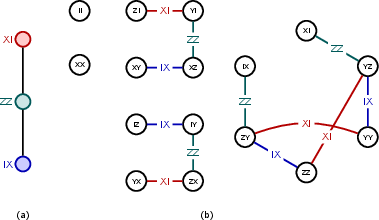
Figure 1: The graph-theoretic formalism: (a) frustration graph of two-qubit generating set; (b) commutator graph showing nested evolution induced by Pauli generators.
Visual Partitioning: Logical/Phase/Uncontrollable Qubits
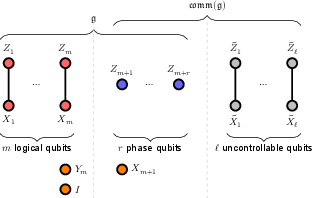
Figure 2: Canonical partition of qubits into logical (maximal controllability), phase (phase-only controllability), and uncontrollable qubits, determined by invariant symmetries and forms.
Ansätze Topology Illustration
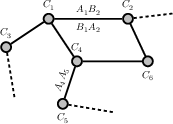
Figure 3: Swap-symmetric 2-local ansatz on a connected graph, indicating vertex and edge operator assignment.
Implications and Future Directions
Theoretical significance: The unified graph-theoretic and invariant-based framework bridges combinatorial, algebraic, and operator-theoretic perspectives. It enables scaling symmetry-based reasoning (often restricted to small systems) to physically relevant system sizes and arbitrary structured architectures. It clarifies when standard tools (commutants, Lie algebra classification) suffice, and when the explicit orbit structure must be computed to capture operator reachability.
Practical ramifications: The results provide direct algorithms for experimentalists and quantum information theorists seeking to certify or design universal (or restricted) quantum architectures, analyze trainability and barren plateaus, or construct efficient classical simulators exploiting symmetry and orbit restrictions. The explicit construction of t-designs in symmetry-adapted subspaces is particularly valuable for benchmarking and noise analysis.
Directions for further research include stabilization-orbit analysis under these restricted Clifford groups, generalization to qudit-valued systems (where similar transvection structures exist), and integration with resource theory perspectives to bridge the gap between algebraic and computational complexity.
Conclusion
This work establishes a rigorous, efficient, and physically transparent framework for classifying the dynamics generated by Pauli string Hamiltonians and circuits. By grounding the analysis in invariants—symmetries and graph-theoretic structures—it unlocks scalable algorithms for universality, symmetry, and orbit classification, with algorithmic performance independent of underlying Hilbert space dimension. The approach unifies disparate strands across quantum computation, control, and many-body theory, and its practical consequences for ansatz design, simulation, and benchmarking will inform ongoing developments in quantum technology (2606.09773).

