- The paper shows that combining two chaotic Hamiltonians with an intermediate random Pauli operation is sufficient to produce unitary k-designs in the thermodynamic limit.
- Analytical techniques and numerical simulations reveal that the ensemble's frame potential converges to the Haar value, with finite-time corrections decaying as 1/(δE T)².
- The protocol reduces experimental complexity by requiring only two chaotic evolutions, offering practical benefits for quantum simulation and benchmarking applications.
Introduction
The efficient generation of unitary k-designs is a central task in quantum information, providing ensembles whose statistical properties mimic those of the Haar-random unitary group up to the k-th moment. Unitary designs underpin randomized benchmarking, quantum state tomography, and analysis of scrambling and thermalization in quantum many-body systems. Conventional schemes for generating unitary designs typically leverage either structured quantum circuits or Hamiltonian evolutions: the former allows for optimal scaling of circuit depth with system size, while the latter is restricted by the constraints of available system control, especially in quantum simulation platforms. Recent results established that at least three distinct chaotic Hamiltonians are necessary for achieving k-designs via solely Hamiltonian evolution. This work demonstrates that by introducing a single intermediate random Pauli operation, two chaotic Hamiltonians suffice for realizing arbitrary unitary k-designs in the thermodynamic limit, thereby proposing a more accessible protocol for generating quantum randomness in many-body systems.
Protocol and Analytical Framework
The protocol considers a system of N qubits. The temporal ensemble is constructed as follows: the system undergoes evolution under a chaotic Hamiltonian H1 for a random time t1∈[0,T], followed by the application of a random global Pauli operator P=⊗i=1NPi (with Pi selected uniformly from {I,X,Y,Z}), and finally evolves under a second independent chaotic Hamiltonian k0 for a random time k1. The resulting ensemble is
k2
The central question is whether, in the limit of large k3 and long k4, this ensemble forms a unitary k5-design, as characterized by the k6-th frame potential k7.
This protocol leverages the fact that random Pauli operations independently form an exact unitary 1-design. For k8, the analysis proceeds via the evaluation of frame potentials in the limit of infinite Hilbert space dimension, employing a diagrammatic approach and invoking properties of the Pauli spectrum in chaotic systems. Notably, in the thermodynamic limit, contributions that involve the coincidence of Pauli operators k9 become exponentially suppressed, while all other contractions are shown, via universality of the Pauli spectrum, to vanish. Thus, the frame potential converges to the Haar value k0, demonstrating the emergent k1-design property.
Numerical Validation and Finite-Size Scaling
Explicit numerical studies were conducted for both Gaussian unitary ensemble (GUE) Hamiltonians and random spin models for moderate system sizes (k2, k3). The frame potentials up to k4 converge to theoretical Haar values as predicted, validating the protocol's efficacy for generating unitary designs even in small systems provided sufficiently long evolution times.
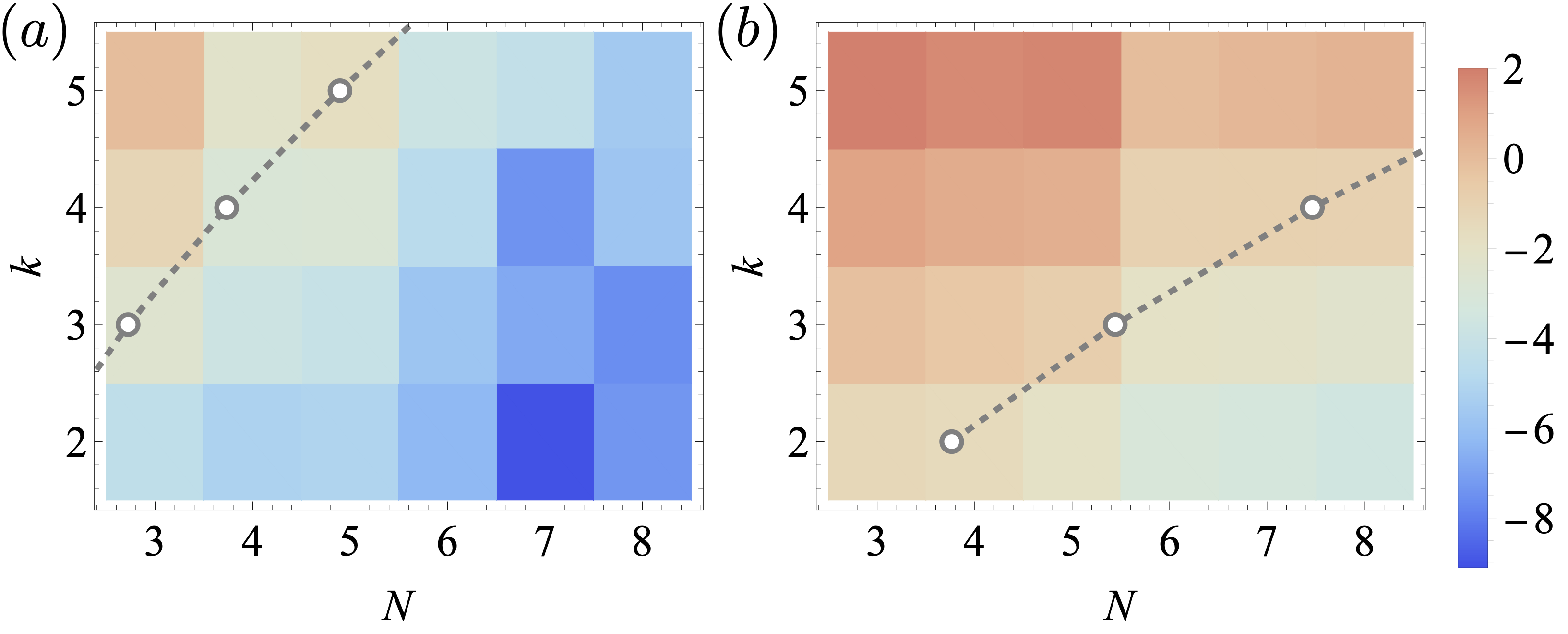
Figure 2: The numerical results for the finite-size corrections of the protocol, quantifying the convergence of k5 for various k6 and k7 under GUE Hamiltonians and different Pauli ensembles.
Finite-time corrections were found to decay as k8, where k9 is the many-body level spacing, revealing that critical timescales for approach to design behavior scale with the Hilbert space dimension for GUE Hamiltonians and inversely with the spectrum width for random spin models. Finite-size corrections due to the probability k0 of Pauli operator coincidences were analytically quantified and matched to numerical thresholds, exhibiting the expected exponential suppression with k1 for uniform Pauli ensembles.
Modification of the Pauli ensemble, e.g., restricting to k2/k3 strings, was also investigated. While the thermodynamic limit remains robust, the approach to the design property is significantly slower due to the increased likelihood of operator coincidences, which is particularly prohibitive for large k4, highlighting a sharp scaling barrier for finite system sizes as k5 increases.
Theoretical Implications and Extensions
The main result establishes that the insertion of a single random Pauli operation between two distinct long-time chaotic Hamiltonian evolutions suffices for the complete generation of unitary k6-designs, underpinned by the universal real Gaussian statistics of the Pauli spectrum in chaotic many-body systems. This is a distinct improvement over strictly Hamiltonian-based protocols, which require an additional independent evolution step. The mechanism leverages emergent randomness and non-stabilizerness (magic) as essential features of chaotic dynamics.
Pragmatically, this protocol is implementable with minimal additional control relative to pure quench protocols: global or local application of random Pauli gates is feasible in many contemporary quantum simulation and computation platforms. The result may be further generalized to protocols involving integrable intermediate steps or other classes of random Clifford operations, with the formalism extensible to ensembles supporting higher moments of the Haar measure.
Future Directions
Several open questions arise naturally:
- Generality to Clifford Operations: Replacement of Pauli operations with more general Clifford operations may allow even further protocol simplification; determining the minimal ingredients for design formation in this broader class is an open direction.
- Decoherence and Robustness: The analysis presumes unitary dynamics; inclusion of noise and environmental effects will be critical for experimental realizations.
- Optimizing for Fixed Resources: Determining trade-offs between system size, evolution time, and Pauli ensemble in resource-constrained experiments remains important for future study.
Conclusion
This work rigorously demonstrates that the combination of two chaotic Hamiltonian evolutions interspersed with a random Pauli operation is sufficient to dynamically generate unitary k7-designs in many-body qubit systems in the thermodynamic limit. Analytical arguments are rooted in the universal properties of chaotic eigenstate statistics, and numerical results confirm the analysis for accessible system sizes. These findings have significant practical relevance for quantum simulation and randomized benchmarking, and suggest clear avenues for further research into minimal and robust protocols for the dynamical generation of quantum pseudorandomness.