- The paper establishes closed-form throughput analysis comparing beamfocusing (BF) and caustic beamforming (CB) in near-field mobile communications.
- It reveals a trade-off between high instantaneous gain from BF and continuous temporal support of CB, with switching overhead critically affecting performance.
- Numerical evaluations confirm the analytical expressions, providing practical guidelines for optimal beamforming design in 6G/THz networks.
Introduction and Motivation
The advent of THz band communications and the proliferation of Extremely Large Antenna Arrays (ELAAs) are transitioning wireless systems into the near-field radiative regime, calling for new beamforming paradigms. In this context, precise spatial focusing (beamfocusing, BF) becomes possible, but mobility and the resultant ultra-narrow beamwidth necessitate frequent retargeting, incurring significant switching overhead and throughput degradation. Caustic Beamforming (CB), inspired by optical caustics (specifically Airy beams), offers continuous trajectory illumination by constructing a curved, self-bending intensity pattern. This eliminates overhead but spatially distributes the transmit power, reducing peak gain.
The paper establishes a rigorous analytical comparison between these paradigms for a mobile user traversing a parabolic trajectory, developing closed-form throughput expressions for both BF and CB and deriving the performance boundary in terms of switching overhead.
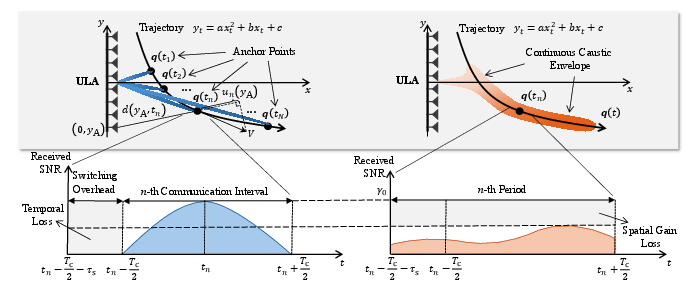
Figure 1: A schematic comparison of dynamic BF and static CB. The left side visualizes BF with discrete beam focusing along anchor points, while the right depicts a CB trajectory with continuous beam intensity enveloping the user path.
The considered setup involves a BS equipped with an M-element ULA on the y-axis, serving a mobile user moving at velocity V on a 2D parabolic trajectory. The near-field regime imposes a spherical wavefront model; thus, both spatial and distance domains become degrees of freedom when designing beamformers. The BF paradigm maintains temporal reconfigurability by focusing at discretized anchor points along the user's path, requiring periodic beam updates incurring switching overhead τs. In contrast, CB constructs a static, continuous beam along the entire trajectory through a one-time phase configuration, nullifying switching overhead but sacrificing concentrated gain.
The core distinction is thus a spatiotemporal trade-off: high instantaneous gain but temporal inefficiency (BF), versus continuous temporal support but reduced spatial gain (CB).
Beamfocusing (BF) Throughput
The analysis models the BF process as N sequential intervals of active communication (Tc) plus overhead (τs). The SNR varies unimodally within each interval due to misalignment from user movement. The closed-form throughput, incorporating a cubic penalty arising from spatial mismatch, is:
RBF≈Tc+τsR0Tc−CpαgeoV2Tc3
where R0 is the anchor-point-optimal rate, Cp is a penalty coefficient determined by mobility, and y0 encodes the effects of trajectory geometry and aperture.
Numerical evaluation in the paper confirms the tightness of this formulation compared to exact simulation.
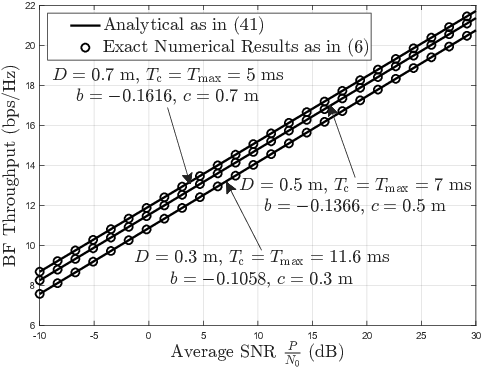
Figure 2: BF throughput as a function of reference SNR at different aperture sizes; theoretical and simulation results are indistinguishable, showing the validity of the analytic expression.
A critical insight is that the optimal dwell time y1 balances spatial defocusing (growing cubically with y2) against the overhead penalty (imposed by y3). This internal minimum is given by solving a cubic stationary equation in y4.
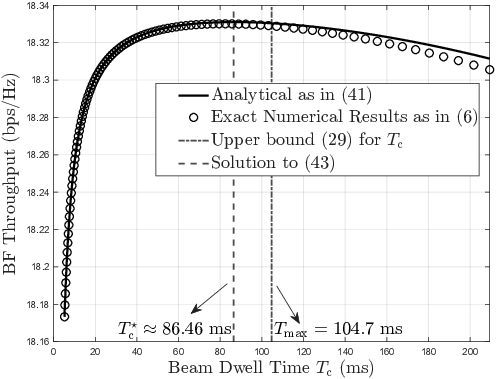
Figure 3: Achievable BF throughput as a function of dwell time y5, highlighting the unimodal behavior and illustrating the spatial-temporal trade-off.
CB employs an Airy beam phase distribution to synthesize a continuous, curved intensity envelope along the trajectory. Through a stationary phase approximation and paraxial simplification, the CB SNR at each spatial point is determined, leading to the closed-form throughput:
y6
where the auxiliary parameter y7 and y8 define the covered segment. This CB throughput is notably independent of the user speed—the time-agnostic continuous illumination is a fundamental differentiator.
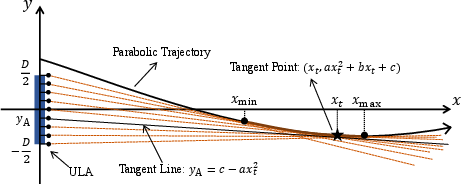
Figure 4: Geometric illustration of the CB configuration, showing the trajectory, beam tangency, and aperture relationship.
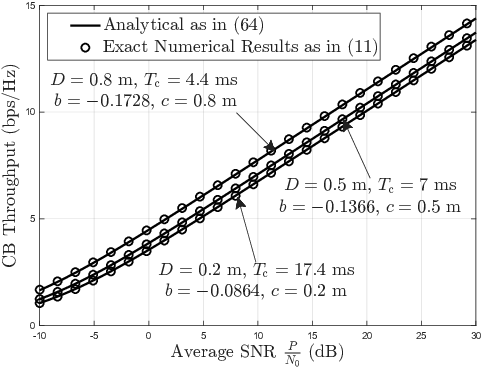
Figure 5: CB throughput versus reference SNR, again verifying analytical and numerical agreement.
Throughput Boundary and Switching Overhead Threshold
The explicit closed-form expressions allow the derivation of a critical switching overhead threshold y9 at which CB and BF attain identical throughput:
V0
If the system's actual switching overhead exceeds this threshold, CB is guaranteed superior. Detailed analysis uncovers:
- For increasing V1, the threshold is unimodal: a specific V2 maximizes the tolerable overhead.
- As the carrier frequency grows (i.e., V3), the switching overhead threshold asymptotically vanishes, as ultra-narrow beamwidths force tiny dwell times, making periodic BF unviable.
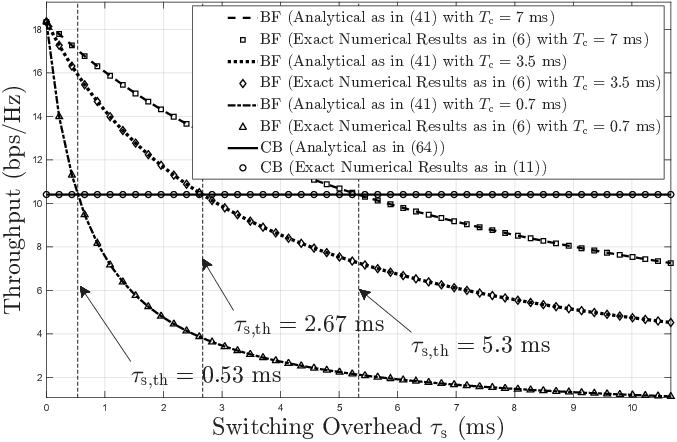
Figure 6: Throughput comparison versus switching overhead V4, with crossover points tightly matching theoretical thresholds.
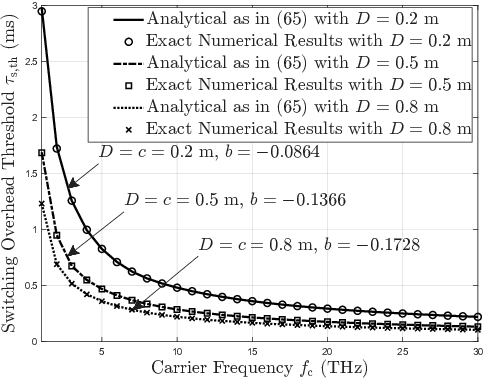
Figure 7: The switching overhead threshold V5 as a function of carrier frequency, demonstrating rapid decay towards zero at THz frequencies.
Practical and Theoretical Implications
The results highlight critical guidelines for next-generation near-field wireless systems:
- BF remains advantageous only when switching overhead is minimal and carrier frequencies are moderate. In high-mobility or very high-frequency regimes (THz), CB becomes categorically preferable.
- The expressions offer system designers a formulaic means to select optimal dwell times (for BF) and to judge, given system hardware and user trajectory, which beamforming paradigm is throughput optimal.
On a theoretical level, the analysis clarifies the precise impact of user mobility, switching protocol, and geometry on achievable rates—a significant step beyond previous feasibility or simulation-based explorations of Airy/caustic beams for wireless.
Future Directions
Future research includes:
- Extending analysis to more complex, non-parabolic user trajectories and environments with blockages; e.g., incorporating NLOS and multi-path effects.
- Integrating machine learning or adaptive trajectory planning for fully beam-management-free near-field systems.
- Evaluating trade-offs in multi-user or multi-beam contexts, investigating CB's potential in spatial multiplexing and robustness.
Conclusion
This work delivers a rigorous, quantitative framework for selecting between beamfocusing and caustic beamforming in the near-field, high-frequency, mobile setting. By providing closed-form throughput expressions and highlighting fundamental trade-offs dictated by hardware and trajectory, it positions caustic (Airy) beamforming as the inevitable choice in ultra-high-frequency, high-mobility conditions where switching overheads are non-negligible. This paradigm shift carries profound implications for the architecture of future 6G/THz networks and beam management protocols.
Reference: "Throughput Analysis for Near-Field Mobile Communications: Beamfocusing or Caustic Beamforming?" (2606.09652)

