- The paper introduces a pilot-free near-field beam tracking framework that combines polynomial motion modeling, MLE, and Thompson Sampling.
- It employs a multivariate Gaussian posterior with Fisher Information Matrix-based uncertainty estimates to balance exploration and exploitation.
- The TS-based approach demonstrates robust spectral efficiency gains and outperforms EKF and coherence-time methods in dynamic mobile scenarios.
Efficient Near Field Beam Tracking via Thompson Sampling: Technical Summary and Analysis
Introduction and Motivation
The radiative near-field regime induced by Extremely Large Aperture Arrays (ELAAs) and mmWave/THz frequencies necessitates beamforming that jointly considers user angle and range, creating a high-dimensional tracking problem for mobile User Equipment (UE). Traditional far-field strategies, based on angular-only tracking and pilot-heavy beam management protocols, are insufficient in this new regime due to excessive pilot overhead and reduced spectral efficiency. This paper introduces a pilot-free, continuous beam tracking framework utilizing Thompson Sampling (TS) to address these challenges. The proposed approach models user motion with piecewise-polynomial dynamics, applies Maximum Likelihood Estimation (MLE) using payload symbols, and leverages Fisher Information Matrix (FIM)-based uncertainty estimation to inform TS-driven adaptive probing.
The channel is modeled for a MISO downlink with a uniform linear array (ULA) at the base station, incorporating both angle and range dependencies in the steering vector. The near-field channel model considers both Line-of-Sight (LoS) and static Non-Line-of-Sight (NLoS) scatterers, but tracking focuses on the LoS component for tractability and dominant propagation in mmWave/THz bands.
Local state evolution is captured as low-order polynomials for angle and range within a sliding observation window, enabling concise kinematic representation over short intervals. The MLE problem is formulated to estimate the polynomial coefficients by minimizing the negative log-likelihood over observed payload symbols, with feedback symbols strategically selected at uniform intervals to avoid trajectory aliasing. The optimization is solved using Adam with previous MLE results as initialization to exploit temporal continuity.
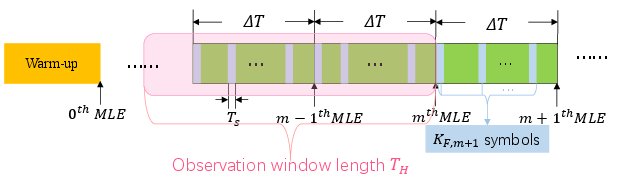
Figure 1: Proposed beam tracking protocol illustrating sliding window-based MLE estimation and TS-guided beam selection.
Beam Selection Methodology
Pure Exploitation Strategy
The baseline pure exploitation approach transmits exclusively along the predicted direction from the most recent MLE. While it preserves connectivity, the absence of exploration risks catastrophic track loss in the presence of estimation error or motion unpredictability, as no alternative directions are probed.
Thompson Sampling-Based Scheme
The TS-based scheme constructs a multivariate Gaussian posterior for the motion parameters, using the FIM for uncertainty quantification. In each payload transmission interval, TS samples from this posterior to select probing beams, facilitating online exploration of the trajectory space and robust adaptation to parameter estimation uncertainty. This protocol uses TS beams for feedback symbols and exploitation beams for non-feedback slots, thereby maximizing effective communication gain while continuously refining trajectory estimates.
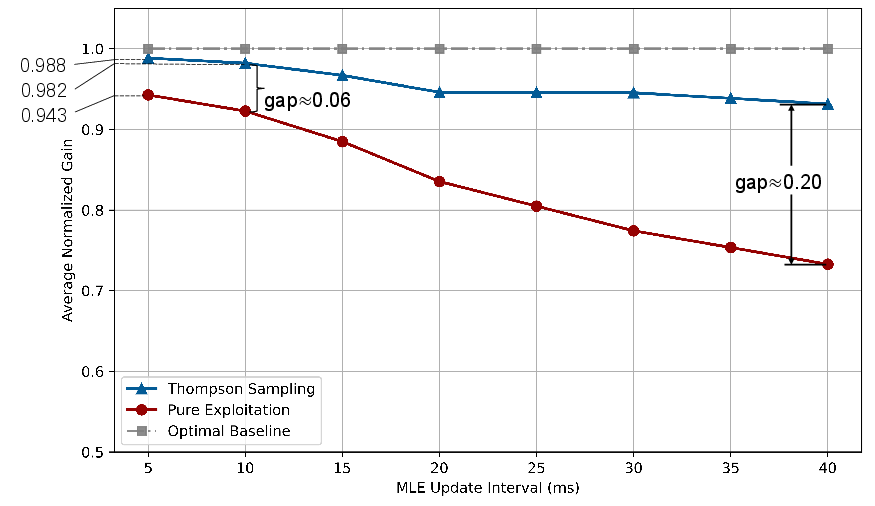
Figure 2: Tracking performance comparison of TS-based and pure exploitation schemes versus varying MLE update intervals.
The method is evaluated with a 256-element ULA at 73 GHz, simulating a mobile UE with non-uniform velocity. The TS-based method demonstrates strong resilience across varying MLE update intervals ΔT; for ΔT=5 ms, the average normalized beamforming gain approaches 0.988, nearly saturating the theoretical upper bound. As ΔT increases, TS retains notable performance margins over pure exploitation, with a gain difference of 0.20 at ΔT=40 ms, emphasizing the criticality of uncertainty-aware exploration for reliable tracking.
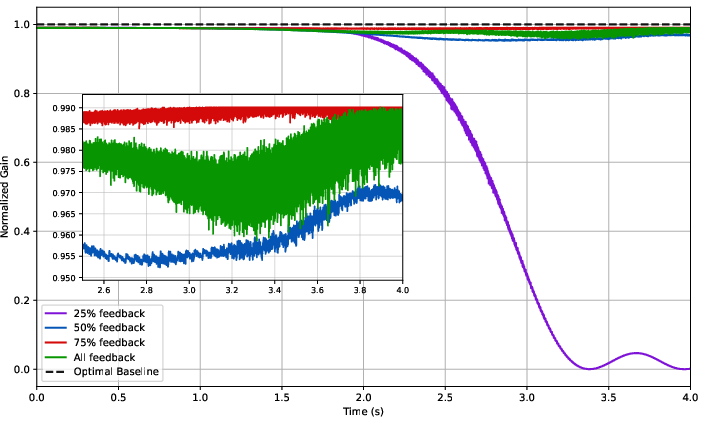
Figure 3: Tracking performance under different feedback symbol ratios, showing robustness with reduced feedback and improved stability at a 75% ratio.
Feedback overhead is analyzed via feedback-symbol ratios. The method maintains near-optimal normalized gain with only 50% feedback. Interestingly, a 75% feedback ratio can outperform the 100% strategy, as excessive TS-induced exploration may introduce unnecessary perturbations once the channel estimate converges, whereas partial exploitation stabilizes tracking.
The proposed method is benchmarked against an EKF-based algorithm and a coherence-time-driven scheme. TS-based tracking achieves the highest normalized gain and closest adherence to full-CSI performance, avoiding pilot-induced throughput collapses inherent to the baselines. EKF exhibits sharp losses during pilot intervals, while the coherence-time-based approach degrades gradually with dynamic motion.
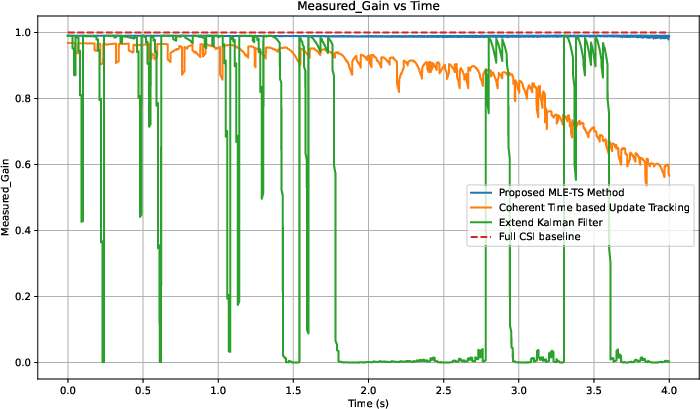
Figure 4: Normalized Gain versus Time for the proposed method and baselines, highlighting superior robustness and efficiency in beam tracking.
Implications and Future Directions
Practically, this framework eliminates dedicated pilot overhead, enhancing spectral efficiency for near-field 6G communications. Theoretically, it demonstrates that adaptive, uncertainty-aware Bayesian probing can robustly solve high-dimensional joint angle-range tracking with non-stationary motion. The robust empirical results suggest that TS-guided data beams are highly effective for continuous tracking in dynamic scenarios.
Potential future developments include extending the motion model to higher complexity polynomial or non-parametric forms, incorporating environment dynamics for NLoS components, and exploring distributed or federated tracking across multi-cell architectures. Integration with model-based or learning-based hybrid trackers could also refine posterior approximations and convergence behavior.
Conclusion
The paper presents a pilot-free near-field beam tracking protocol combining polynomial motion modeling, MLE, and Thompson Sampling. The approach balances exploration and exploitation using payload beams, eliminating spectral efficiency losses from traditional pilot protocols. Empirical results indicate robust tracking and superior spectral utilization versus EKF and coherence-time-driven baselines, supporting the applicability of uncertainty-aware adaptive methods to future 6G near-field mobility management.

