- The paper introduces a two-stage system that separates OCR transcription from lexicographic parsing for robust dictionary digitization.
- The paper demonstrates that LLMs outperform VLMs and conventional OCR in preserving markup and reading order across 30 languages.
- The paper provides actionable guidelines for cost-efficient, high-precision digitization using targeted prompt engineering and expert annotation.
MUDIDI: A Two-Stage Framework for Multilingual Dictionary Digitization with LLMs
Introduction and Motivation
This paper introduces MUDIDI, a novel two-stage system for digitizing multilingual dictionaries—an area critical for language documentation, linguistic research, and community-led language revitalization, yet one that remains hampered by a lack of robust, cross-script OCR and structured extraction. Legacy dictionaries in numerous scripts and complex typographic layouts have traditionally been inaccessible to computational analysis, especially for low-resource or endangered languages. MUDIDI addresses this by (1) decomposing the digitization process into OCR-focused transcription and lexicographic parsing, and (2) systematically benchmarking the capabilities of cutting-edge LLMs, vision-LLMs (VLMs), and conventional OCR on a curated, diverse dataset spanning 30 languages and scripts.
Framework Overview
MUDIDI operationalizes dictionary digitization as two distinct yet sequential modules:
- Stage 1: Page Transcription — The system produces a Unicode-compliant, faithful line-by-line transcription of dictionary pages, preserving typographic markup (bold, italics) and handling complex layouts, including multi-column text and language-specific glyphs.
- Stage 2: Lexicographic Parsing — The validated transcript and the corresponding image are parsed into structured dictionary entries, using the SIL Multidictionary Formatter (MDF) schema. Each entry is fielded (headword, gloss, part-of-speech, etc.) and output in a machine-readable, standardized format.
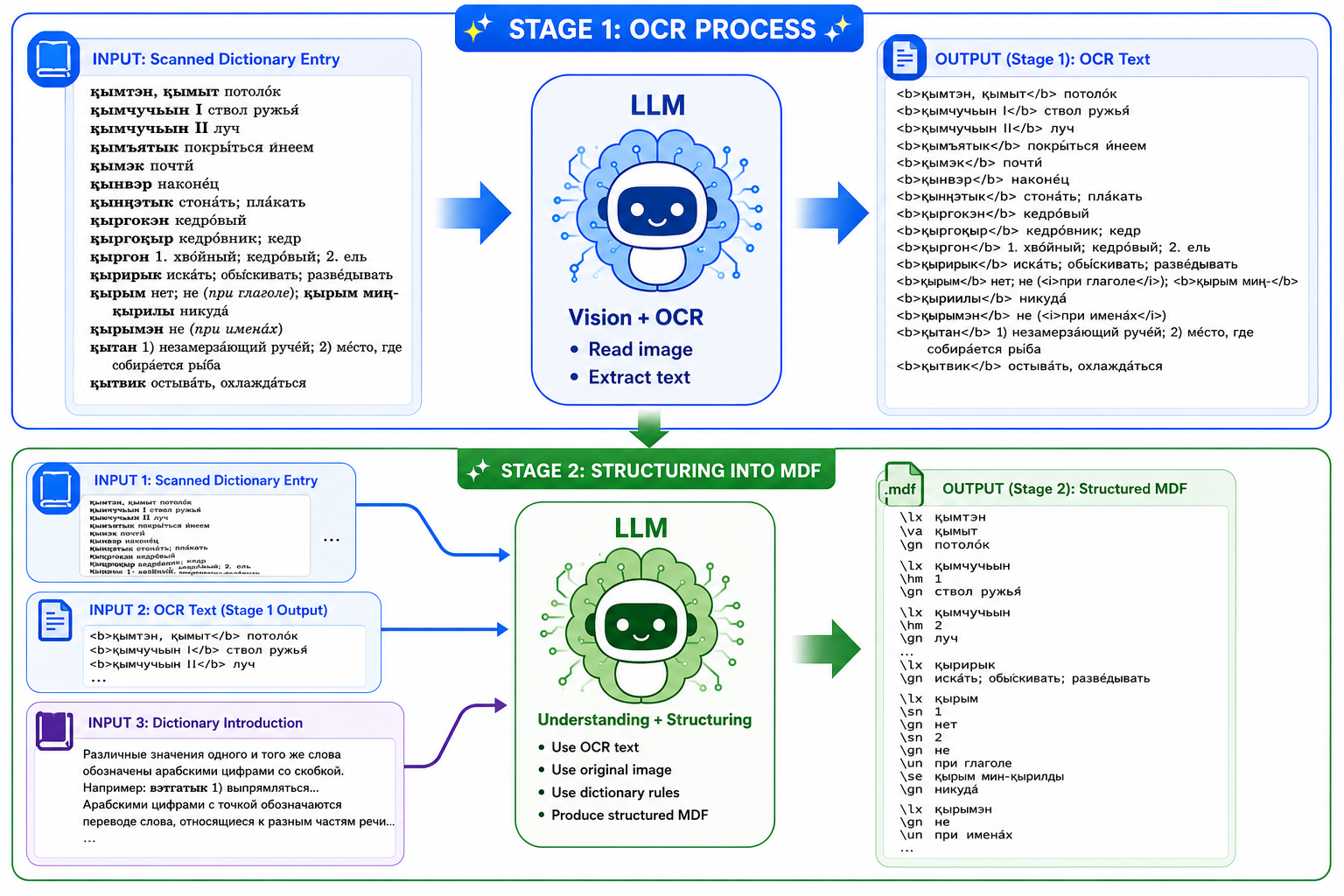
Figure 1: The two-stage dictionary digitization process: Stage 1 produces OCR with markup, Stage 2 segments and structures entries per MDF.
This architecture facilitates isolated and combined performance assessment, allowing for error attribution at the character recognition and structural parsing levels.
Dataset and Annotation Pipeline
The benchmark dataset comprises three pages each from 30 public-domain dictionaries, encompassing a typologically diverse sample—scripts include cuneiform, Bengali, Georgian, Khmer, Syriac, and multiple Latin, Cyrillic, and Arabic derivatives. For Stage 2, introductions and field-mapping conventions are annotated as additional context when available.
Annotation proceeds in two steps: silver-standard outputs from state-of-the-art models (Gemini 3.5-Flash or Gemini 3.1-Pro) are manually curated by language experts using tools such as Label Studio.
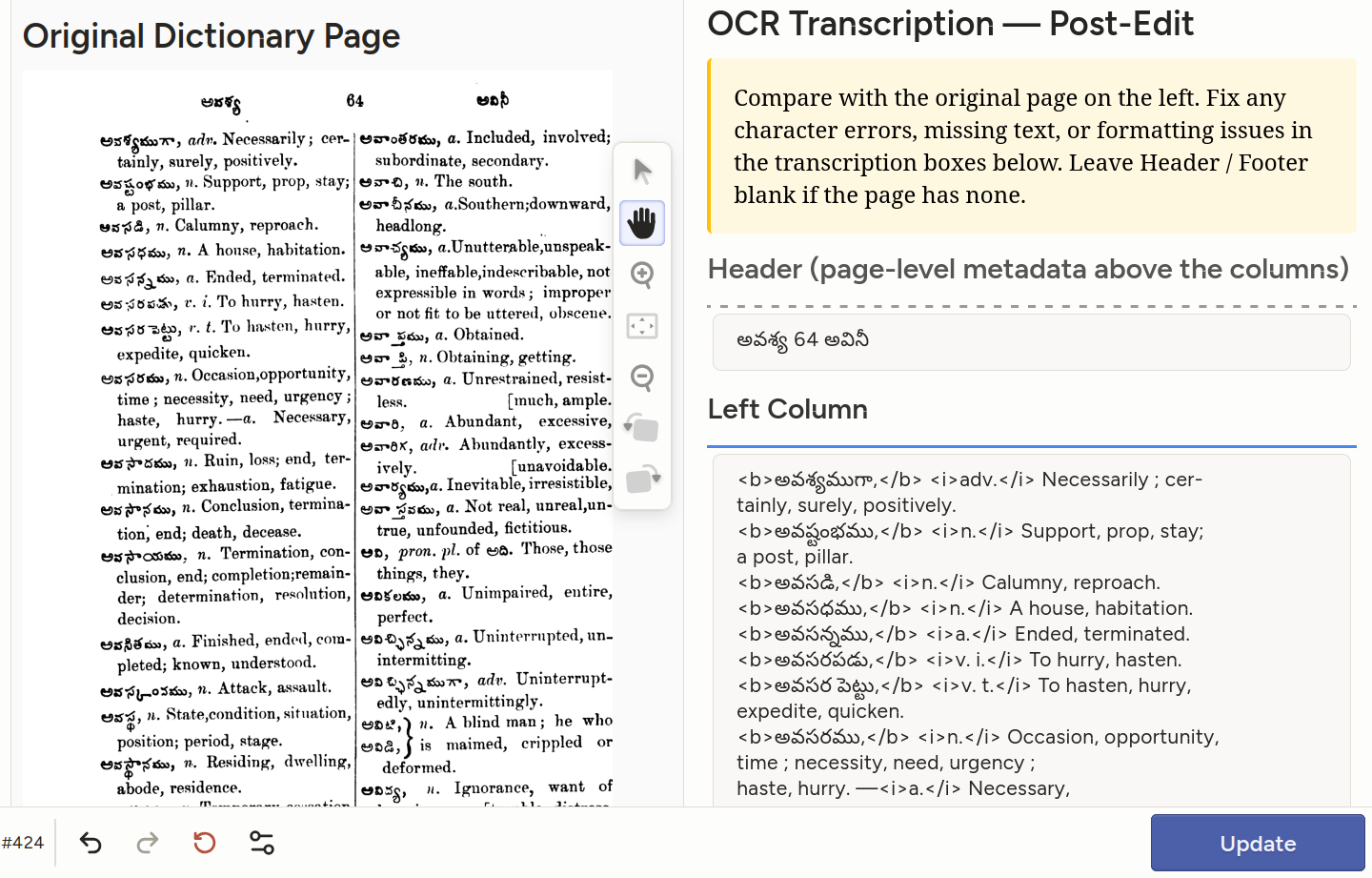
Figure 2: Label Studio annotation interface showing the dictionary scan and corrected, expert-edited transcription.
This workflow ensures both scalability and high-quality ground truth for benchmarking.
Experimental Results
Stage 1: OCR Accuracy and Markup Preservation
The study evaluates LLMs (Gemini, GPT-5.5, Claude Opus 4.7), VLMs (Qwen3-VL, MinerU2.5 Pro, PaddleOCR-VL-1.5), and conventional OCR systems (Mathpix, GLM-OCR) under various prompt configurations (with/without alphabet lists or OCR hints).
Key findings:
- General-purpose LLMs substantially outperform specialized VLMs and conventional OCR across most writing systems for both character recognition and markup retention.
- Gemini 3.1 Pro with alphabet input achieves the lowest aggregate error rates: Edit Distance 0.05, GCER 0.05, WER 0.14, Markup F1 0.64.
- Conventional OCR is reliable for high-resource Latin scripts but fails on complex or under-digitized scripts (Assyrian cuneiform, Syriac, Malay-Arabic, Thai).
- Markup and reading order are preserved robustly by LLMs, while OCR/VLMs frequently fail to retain emphasis or reading sequence.
Ablation studies:
- Supplying alphabet lists marginally improves transcription on unfamiliar scripts in certain configurations. The effect is model-dependent and can even degrade read-order in some cases.
- Incorporation of OCR hints (e.g., Mathpix output) yields inconsistent results and may anchor the model’s errors, especially with ambiguous glyphs.
Stage 2 isolates structural parsing by feeding human-validated transcripts to LLMs and VLMs, with varying prompt context (dictionary introduction pages, SIL MDF guidelines).
Key findings:
- LLMs achieve near-perfect entry detection and MDF field assignment on most page types and scripts, with optimal configurations yielding Entry Accuracy and MDF Field F1 ≥0.99.
- The inclusion of dictionary front matter (abbreviation keys, layout notes) and official MDF guidelines leads to consistent 3-6 F1 point gains in field assignment, particularly for Gemini 3.1 Pro and GPT-5.5. Gold-standard parse rules raise performance by an additional ~6 F1 points.
- MLMs/VLMs lag on complex scripts, but targeted prompt engineering and field-specific parse rule curation mitigate recurring errors.
Practical Recommendations and Model Cost
MUDIDI provides best-practice guidelines grounded in empirical results:
- Use Gemini 3 Flash or 3.1 Pro for transcription, balancing performance and cost according to language/script coverage.
- Alphabet conditioning should be adopted selectively, in response to observed hallucinations or misrecognition.
- Systematic errors (e.g., repeated glyph confusions) are amenable to dictionary-specific post-processing, obviating the need to retrain or re-transcribe.
- MDF guidelines and dictionary intros should always be provided during parsing for optimal field structure induction.
A comparative cost analysis demonstrates that high-accuracy digitization with LLMs is feasible at modest price per page, with open-weight VLMs (Qwen3-VL) and Gemini 3 Flash offering scalable, cost-efficient alternatives to premium LLM APIs.
Limitations and Future Directions
Significant unresolved issues include:
- Lack of language-specific error attribution in Stage 1, affecting interpretability for bilingual dictionaries.
- The pipeline decouples OCR and parsing, but error propagation from transcription to parsing is not thoroughly explored; integrated, direct-to-MDF approaches may warrant investigation.
- The role of markup in improving downstream parsing remains to be fully exploited.
There is also an urgent need for greater evaluation and adaptation for scripts and languages with little digital representation, such as historic cuneiform and extinct Arabic-based orthographies.
Implications and Prospects
The MUDIDI framework demonstrates the efficacy of modern LLMs—especially multimodal variants—in highly challenging, low-resource language digitization scenarios. The study substantiates that, with minimal prompt specialization and judicious annotation, high-precision, fine-grained lexicographic digitization is tractable even for scriptually or structurally complex dictionaries. This has immediate applicability for linguistics, archiving, and revitalization, and portends future research in direct multimodal parsing, robust field induction across typologically diverse resources, and sustainable, community-centric language technology development.
Conclusion
MUDIDI sets a new standard for multilingual dictionary digitization, combining rigorous, modular evaluation with practical, actionable recommendations. By releasing a high-quality benchmark and demonstrating the current state of multimodal language technology on truly multilingual and typographically diverse materials, the work substantially lowers the barrier for language documentation and computational lexicography. It illuminates both the promise and the present limitations of LLM/VLM technology in structured document understanding, suggesting fruitful directions for adaptive digitization pipelines and cross-linguistic information extraction systems.