- The paper presents a perturbation-based conformal prediction method that uses two FNO instances to derive spatially adaptive uncertainty scales.
- It demonstrates superior performance over traditional UQ approaches, achieving the narrowest conformal bands (e.g., half-width of 3.79 at α=0.04) while maintaining data efficiency.
- The framework’s agnostic design and spatial smoothing ensure reliable uncertainty quantification in complex, turbulent flow regions.
Introduction
The paper "Operator learning for the 2D incompressible Navier-Stokes equations: a conformal prediction approach in the data-scarce regime" (2606.08654) addresses uncertainty quantification (UQ) in neural operator surrogates, specifically for the 2D incompressible Navier–Stokes equations in the regime of limited training data. It recognizes the limitations of neural operators such as the Fourier Neural Operator (FNO) in quantifying predictive uncertainty, particularly for high-dimensional, spatiotemporal outputs typical in PDE modeling. The study develops a perturbation-based conformal predictive framework that delivers calibrated, spatially adaptive uncertainty bands for operator-valued predictions while maintaining sample efficiency under stringent label budgets.
Operator learning seeks to approximate the solution operator mapping initial condition sequences to future states in the 2D Navier–Stokes system. Neural operators provide efficient surrogates that decouple prediction cost from spatial or temporal resolution. However, pointwise predictions do not communicate structured epistemic uncertainty, especially across complicated, high-gradient flow regimes. Classical UQ strategies (e.g., MC Dropout, Laplace approximations, or auxiliary networks such as UQNO) either fail to provide spatial adaptivity, suffer from high variance, or impose a sample efficiency penalty by splitting data between model and uncertainty estimator.
Conformal prediction (CP), through split data calibration and distribution-free marginal coverage, has been adapted for operator-valued outputs. However, the informativeness and adaptivity of CP bands depend on the construction of the nonconformity score and, specifically, the choice of uncertainty scaling. Traditional approaches based on global or coordinate-wise residuals often yield non-adaptive, constant-width bands, which are suboptimal for spatially heterogeneous systems. Augmenting with a learned uncertainty network introduces modeling and data complexity.
The central methodological contribution is a perturbation-based conformal prediction protocol for operator learning with the following key features:
- Two instances of the base architecture (FNO) are trained: one on untouched data and another on labels perturbed with small Gaussian noise.
- The pointwise disagreement between these two operators at each spatiotemporal output coordinate is interpreted as a local uncertainty scale, regularized through spatial smoothing (typically, a 15×15 window) and a data-driven floor to prevent denominator degeneracy.
- A normalized maximum nonconformity score divides the absolute residual by this local scale, and conformal bands are obtained as simultaneous prediction intervals over the output grid.
This approach yields spatially adaptive uncertainty quantification that reflects the local instability of the learned surrogate: high uncertainty is assigned in regions that are sensitive to data noise, which typically coincide with physically complex or turbulent flow regions.
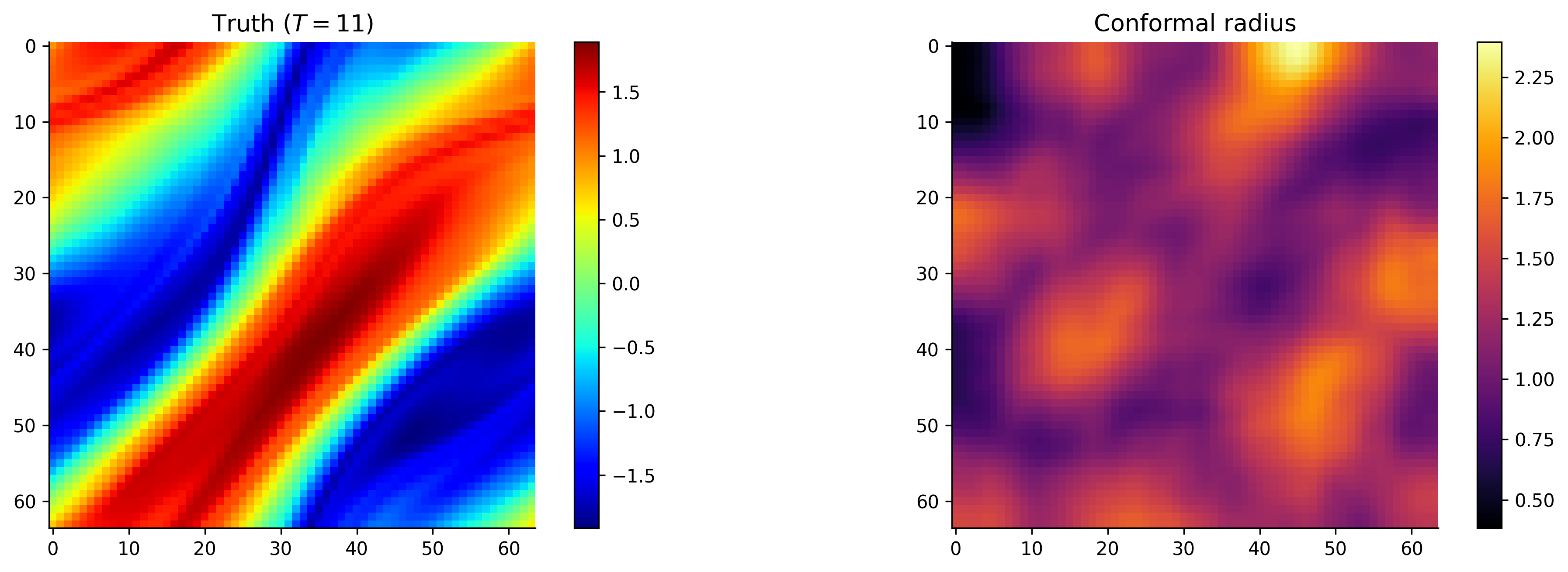
Figure 1: Qualitative perturbation-based uncertainty map showing high uncertainty localized near coherent flow structures, as captured by the disagreement between the FNOs.
Numerical Evaluation and Comparative Analysis
The framework is evaluated on the standard 2D incompressible Navier–Stokes vorticity benchmark, where prediction targets are future vorticity fields discretized on a 64×64 spatial grid and ten time frames, yielding over 40,000 output dimensions per sample. Experiments focus on the data-scarce regime, with all UQ baselines required to operate under matched or subdivided training label budgets.
Baseline comparisons include:
- MC Dropout (epistemic uncertainty from dropout at inference, high variance),
- Laplace approximation (last-layer Bayesian linearization for uncertainty),
- UQNO (auxiliary quantile regression neural operator trained on a data split),
- Unscaled CP (constant-radius bands).
Quantitative results demonstrate that the perturbation-based method produces the narrowest conformal bands among all baselines at equivalent coverage levels. For example, at miscoverage α=0.04, its average half-width is $3.79$, outperforming Laplace ($4.40$), MC Dropout ($8.53$), and UQNO ($16.78$) under identical label budgets. The approach thus delivers improved data efficiency and sharper fieldwise calibration. Empirical coverage closely matches theoretical targets, supporting the validity of the approach.
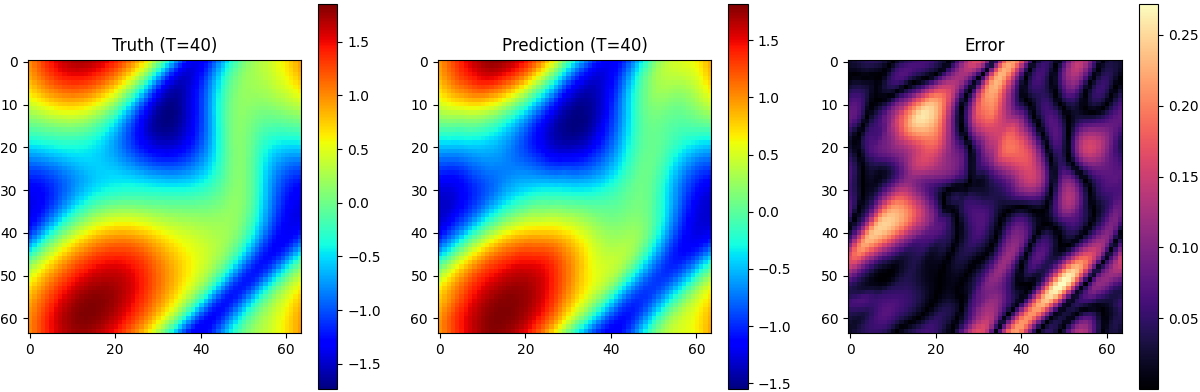
Figure 2: Base operator performance check: ground-truth, FNO prediction, and the localization of the absolute error for a representative vorticity field.
Ablation studies clarify the essential role of spatial smoothing: without it, isolated low-disagreement values result in extremely conservative bands due to the maximum-type calibration, while the stabilization floor is less critical. Sensitivity to the perturbation noise hyperparameter is moderate; effective performance is maintained across a significant range of noise scales.
Theoretical and Practical Implications
The method is both theoretically and architecturally agnostic. The construction only requires access to two regression surrogates and a pointwise discrepancy; it does not depend on the operator learning task per se or the specific neural architecture. This generality positions perturbation-based scaling as a desirable uncertainty proxy in structured high-dimensional regression tasks far beyond PDE surrogates.
Practically, the proposed framework enables operator learners to provide spatially structured, simultaneously valid uncertainty guarantees—an essential criterion in safety-critical and scientific computation settings where the cost of underestimating local uncertainty or over-allocating data to uncertainty modeling can be high.
Qualitative analyses support the claim that the method's conformal bands correlate with known flow complexity. The uncertainty expands near dynamically unstable regions—vortex cores, shear layers, and rapidly evolving interfaces—while contracting in smoother regions.
Future Directions
This perturbation-based approach lays groundwork for integrating uncertainty quantification into operator learning for a wide class of parametric PDEs and scientific ML pipelines. It provides a strong alternative to variance propagation, ensembles, or auxiliary uncertainty estimators, and could extend naturally to active learning, model selection, and scenario discovery tasks by leveraging the sensitivity structure encoded in the perturbation-derived scale. Further investigation into multi-level or multi-perturbation approaches, robustness to various data corruptions, and extensions to inverse and stochastic operator learning settings are warranted.
Conclusion
This work presents a sample-efficient, conformalized uncertainty quantification method for neural operator surrogates via perturbation-based scaling. The combination of split conformal prediction with a stability-motivated uncertainty measure ensures adaptive, valid, and efficient simultaneous coverage for operator-valued predictions under severe data constraints. The methodology is widely applicable for high-dimensional regression problems where quantifying spatially resolved epistemic uncertainty is essential (2606.08654).

