- The paper introduces a novel framework for scalable operator learning by integrating quantum orthogonal neural networks with conformal prediction for reliable, distribution-free uncertainty estimation.
- The method leverages Superposed Parameterized Quantum Circuits to achieve logarithmic scaling in qubit resources, attaining low relative L2 errors in synthetic operator learning tasks.
- Hybrid classical-quantum architectures effectively mitigate quantum noise in real-world power system dynamics, ensuring robust empirical coverage and enhancing practical deployment.
Framework Overview and Motivations
Conformalized Quantum DeepONet Ensembles introduce a resource-efficient framework for operator learning that targets two pervasive bottlenecks in scientific computing: the quadratic computational scaling of inference in classical neural operator architectures and unreliable uncertainty quantification in safety-critical domains. Utilizing Quantum Orthogonal Neural Networks (QOrthoNNs), the approach reduces operator inference complexity from O(n2) to O~(n), enabling the practical evaluation of operators on fine discretizations. The paper further integrates ensemble epistemic modeling with adaptive conformal prediction, delivering distribution-free coverage guarantees for uncertainty quantification. A critical innovation is the deployment of Superposed Parameterized Quantum Circuits (SPQCs), enabling simultaneous inference across an ensemble without linearly scaling qubit requirements.
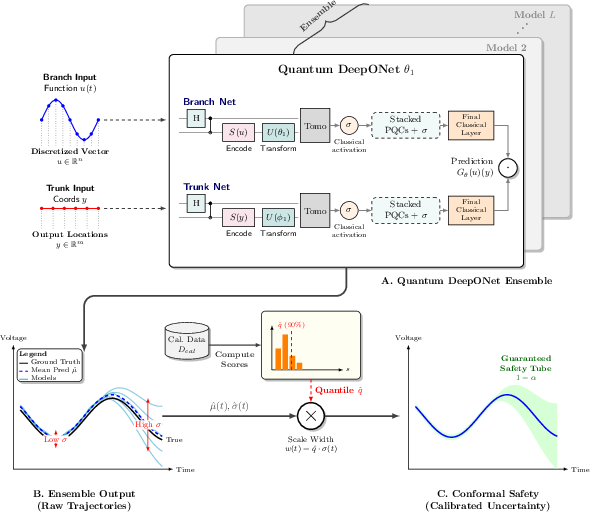
Figure 1: The conformalized quantum DeepONet ensemble framework integrates scalable quantum operator inference, quantum/classical hybrid and superposed ensembling, and conformal prediction calibration for rigorous uncertainty.
Quantum Operator Learning and Ensemble Strategies
Quantum DeepONet Architecture
DeepONet decomposes operator learning into branch and trunk sub-networks, representing input functions and spatial/temporal queries. Classical realizations suffer from O(n2) scaling due to dense layer multiplications. QOrthoNNs, implemented via parameterized Reconfigurable Beam Splitter (RBS) circuits, replace dense layers with orthogonal quantum transformations restricted to the unary subspace. This enables sub-quadratic complexity and facilitates pipelined operations that reduce circuit depth and measurement overhead.
Classical training is performed by optimizing the parameterized RBS rotation angles via automatic differentiation, guaranteeing mathematical orthogonality. This aligns eigenvalue magnitudes, preventing vanishing/exploding gradients and circumventing barren plateaus endemic to generic PQCs.
Ensemble Construction and Resource Optimization
Epistemic uncertainty requires predictive diversity, motivating the use of independent ensembles. Executing L parallel quantum models would scale qubit requirements as O(L⋅n); the framework mitigates this via two strategies:
- Hybrid Classical-Quantum Architecture: The branch or trunk network (whichever has lower evaluation frequency) is replaced by a classical network. This substitution eliminates dominant quantum noise and amortizes classical computational cost across large batch sizes, while retaining quantum acceleration for high-frequency evaluations.
- Superposed Parameterized Quantum Circuits (SPQCs): All L ensemble members are encoded in a single circuit using address qubits and controlled rotations, incurring only logarithmic spatial scaling (n+1+⌈log2(L)⌉ qubits per sub-network). SPQCs execute state preparation, unitary evolution, and measurement a single time for the whole ensemble, avoiding repeated preparation/readout.
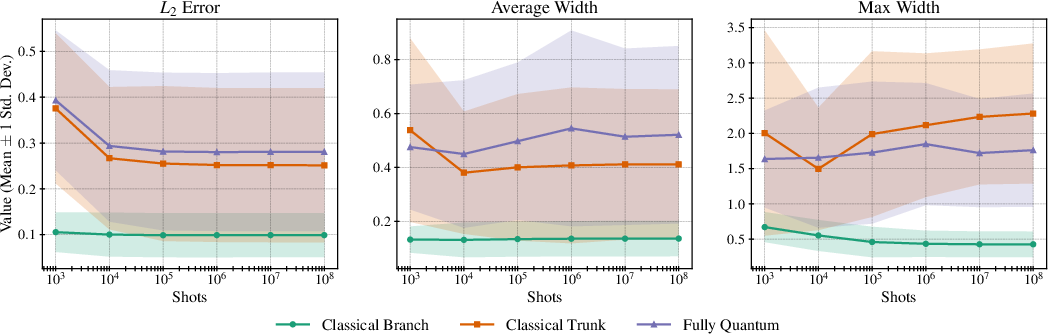
Figure 2: Hybrid classical-quantum architectures display varying performance based on where classical substitution occurs; classical branch yields the lowest hardware noise.
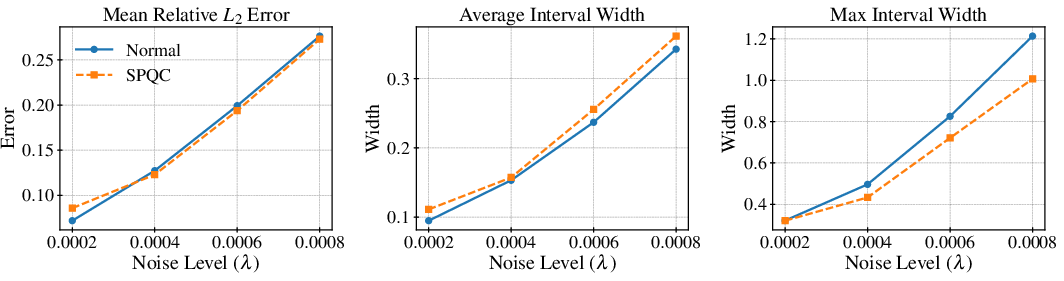
Figure 3: SPQC achieves identical performance and uncertainty calibration as standard ensembling, while dramatically reducing qubit requirements.
Distribution-Free Uncertainty Quantification
Adaptive conformal prediction calibrates ensemble predictions to arbitrary miscoverage rates (α), producing mathematically guaranteed prediction tubes. Nonconformity scores are computed by normalizing absolute errors by local ensemble standard deviation. Empirical quantiles from calibration data define prediction sets, ensuring strict coverage guarantees under the exchangeability assumption (i.e., calibration and test data drawn from the same distribution).
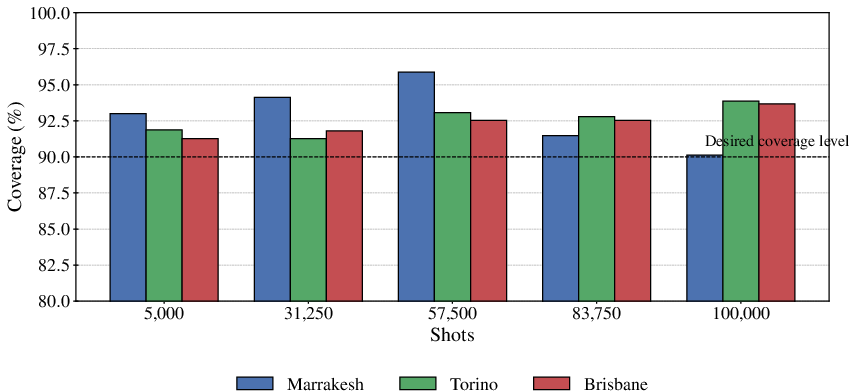
Figure 4: Conformal prediction maintains strict coverage guarantees (>90%) under hardware-calibrated noise on IBM quantum processors.
Empirical Validation: Synthetic and Real-world Tasks
Synthetic Operator Learning
The framework is validated on antiderivative and advection operators sampled from Gaussian random fields. Quantum DeepONet ensembles attain low relative L2 errors (<0.5% for antiderivative, <2.3% for advection) and empirical coverage rates matching theoretical targets for conformal prediction (90%).
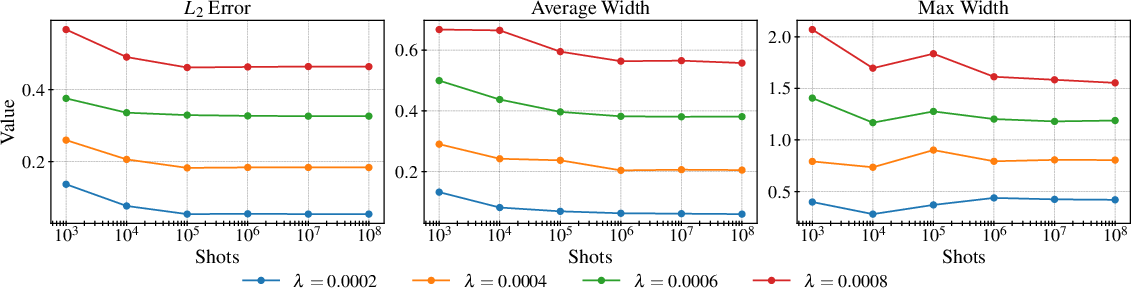
Figure 5: Higher shot counts and lower depolarizing noise yield improved prediction accuracy and uncertainty quantification in antiderivative operator learning.
Real-world Power System Dynamics
The methodology is extended to transient voltage and active power prediction tasks in power engineering settings:
- Offline Causal Operators: Modeling trajectories for forecasting and post-mortem analysis, quantum ensembles maintain robust accuracy and coverage under high-dimensional, oscillatory signals.
- Online Pointwise Operators: Sequential inference with sliding windows, notably violating the exchangeability assumption, nevertheless achieves empirical coverage comparable to batch protocols.
A counterintuitive observation is that, for shallow quantum circuits, increased depolarizing noise occasionally regularizes uncertainty bounds, improving empirical coverage and interval width.
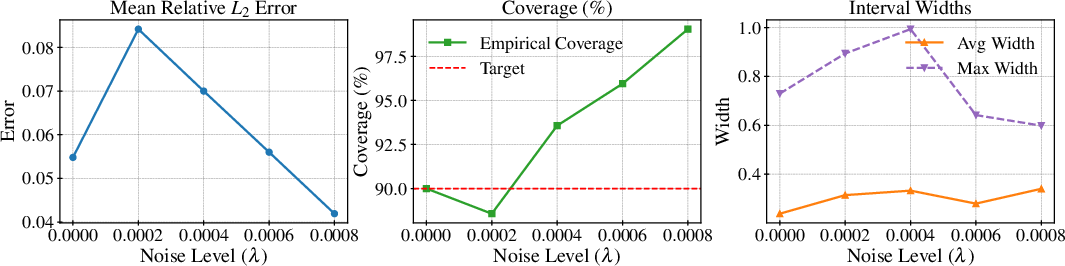
Figure 6: Depolarizing noise influences prediction error, coverage, and uncertainty width in online voltage prediction; higher noise sometimes improves these metrics.
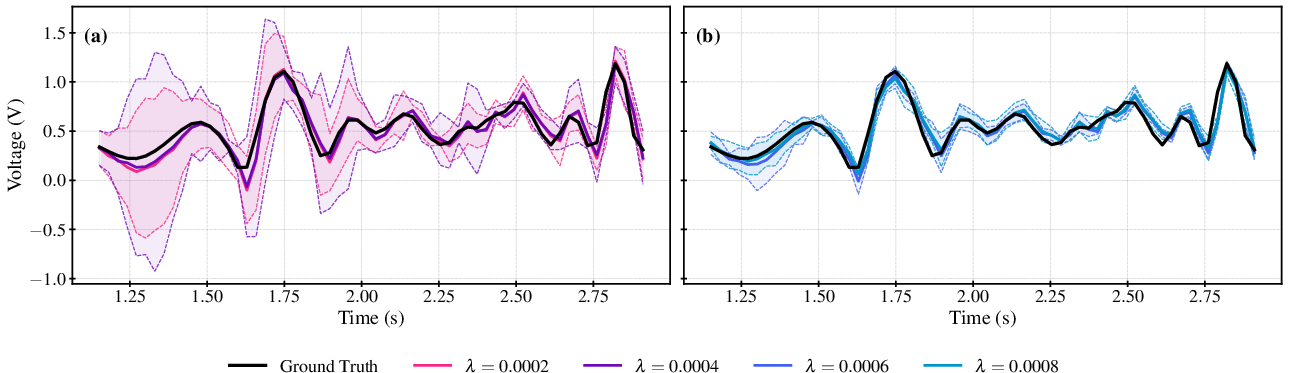
Figure 7: Conformal prediction tubes on high-variance samples depict mean predictions and calibrated uncertainty intervals, with interval width decreasing under higher noise for that sample.
Computational Efficiency and Noise Mitigation
Simulation feasibility is achieved by leveraging classical equivalents to quantum orthogonal transformations, and multinomial sampling of the density matrix is validated as accurately reflecting per-shot simulation outputs.
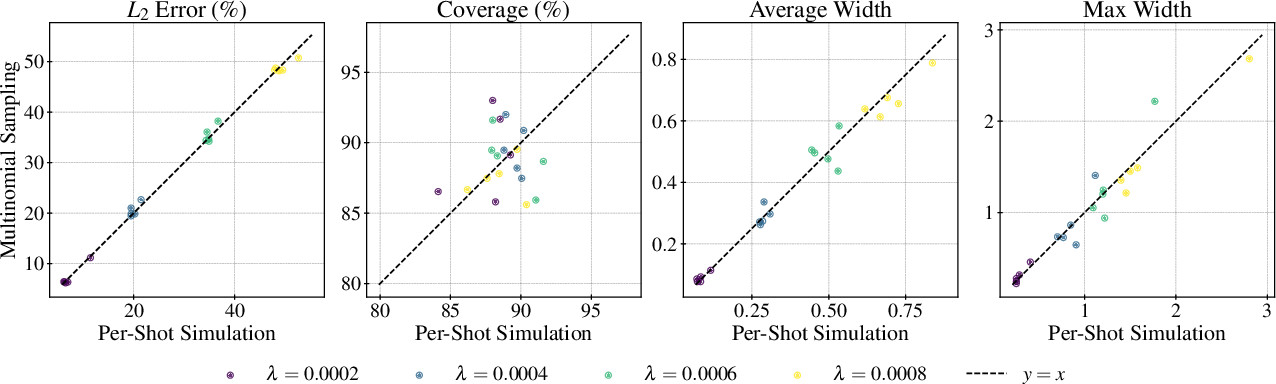
Figure 8: Multinomial sampling produces output distributions tightly correlated with full per-shot simulation, enabling efficient quantum circuit evaluation.
Post-selection during tomography discards measurement shots outside the unary subspace, systematically mitigates hardware errors, and enhances fidelity.
Implications and Future Directions
The approach establishes a realistic pathway for scalable uncertainty-aware quantum operator learning in scientific and safety-critical applications. Hybrid and SPQC architectures are viable strategies for reducing quantum resource overhead in ensemble epistemic modeling, with SPQC expected to dominate as hardware coherence improves.
Key theoretical implications include the possibility of exploiting quantum noise as a regularization mechanism for shallow circuits. The empirical coverage in non-exchangeable settings (online inference) motivates further adaptation of conformal methods to sequential data distributions (e.g., weighted or sequential conformal prediction).
Practical deployment remains limited by classical simulation bottlenecks for large circuits, but the maturation of quantum hardware will enable broader adoption. Transitioning to real-time, uncertainty-aware operator learning on quantum devices is a pivotal future goal.
Conclusion
Conformalized Quantum DeepONet Ensembles offer mathematically rigorous, computationally efficient, and hardware-scalable operator learning for dynamical systems, integrating quantum acceleration and distribution-free uncertainty quantification. The framework demonstrates validity under realistic quantum noise, resource-optimized ensembling, and robust empirical coverage across synthetic and real power system datasets. Future work will further refine temporal calibration protocols, investigate quantum noise regularization, and exploit logarithmic scaling in ensemble execution as quantum hardware advances.

