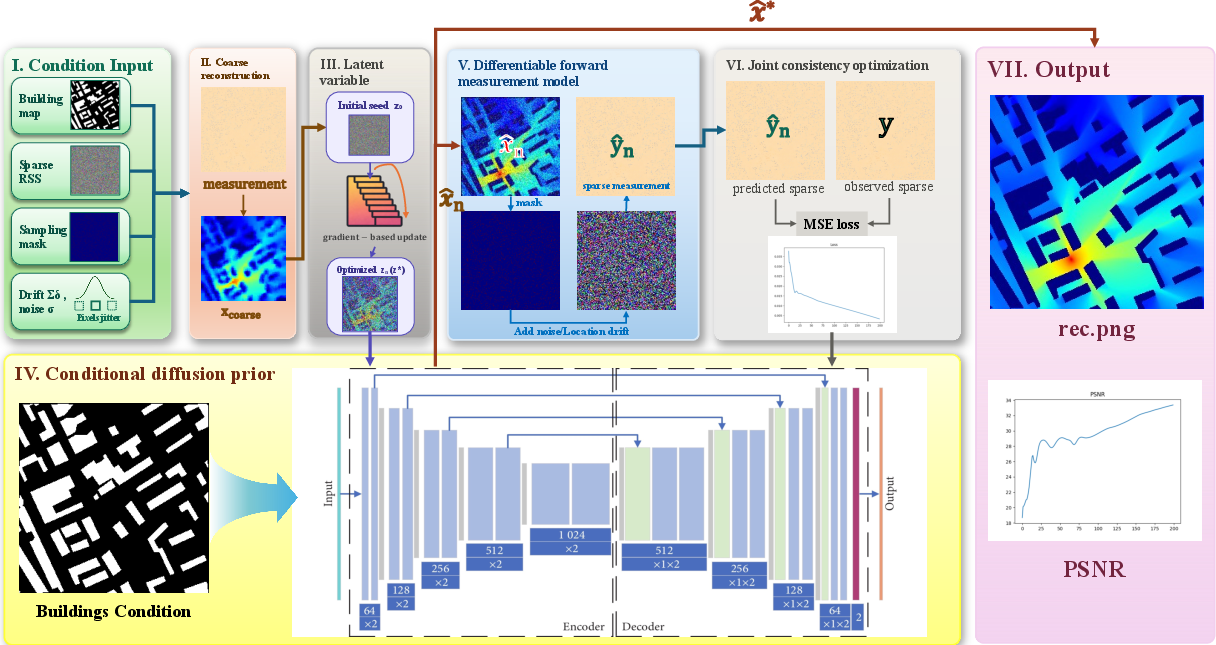
- The paper introduces a diffusion-based inversion method that accurately estimates radio maps despite extreme sparsity, noise, and location drift.
- It integrates a drift-marginalized, differentiable measurement operator with a generative diffusion prior, optimizing in latent space for robustness.
- Experimental results reveal significant PSNR and SSIM improvements over traditional baselines across various noise and drift conditions.
Differentiable Diffusion Inversion under Location Drift: RadioDiff-Inv2 for Sparse Noisy Radio Map Estimation
Radio map (RM) estimation is critical for environment-aware optimization in evolving 6G wireless networks, facilitating coverage planning, interference coordination, and proactive resource management. Contemporary RM construction increasingly relies on crowdsourced received signal strength (RSS) measurements, which are inherently sparse, noisy, and—crucially—affected by user-induced location drift. In this setting, the reported coordinates associated with RSS samples are often misaligned relative to true measurement locations due to privacy-preserving obfuscation and user mobility. Unlike amplitude noise, location drift induces structural uncertainty in the measurement operator itself by querying the RM at misregistered spatial locations. This compound uncertainty, especially when combined with low SNR and severe sparsity, renders the RM inversion problem dramatically ill-posed.
RadioDiff-Inv2 addresses this inverse problem via a generative, differentiable diffusion inversion scheme capable of explicit drift-marginalized inference from sparse, noisy, and spatially uncertain crowdsourced measurements.
Methodology: Diffusion Prior and Drift-aware Inversion
RadioDiff-Inv2 builds on recent advances in denoising diffusion probabilistic models (DDPMs) and their deterministic DDIM/ODE trajectories for image-like generative tasks. The core algorithmic pipeline (Figure 1) is as follows:
By optimizing the latent seed variable rather than the high-dimensional RM directly, the framework ensures that all reconstructions reside on the manifold induced by the diffusion prior, robustly regularizing against both noise and operator misregistration. The drift-marginalized measurement operator allows gradients to correctly propagate under uncertainty in the spatial coordinates.
Experimental Evaluation and Numerical Results
Quantitative and qualitative evaluation was conducted on challenging benchmarks derived from the RadioMapSeer dataset, comparing against Kriging, RadioUNet, RME-GAN, and the previous RadioDiff-Inv1. Metrics included PSNR, SSIM, LPIPS, and NMSE, and experiments systematically varied sampling density, SNR, and drift scale.
Key numerical findings:
- Strong performance under extreme sparsity and drift: At a sampling rate of kp=0.005 and Σδ=0.8, RadioDiff-Inv2 outperformed the best non-diffusion baseline by up to +18.92% in PSNR and +12.95% in SSIM.
- Robustness to SNR: Unlike all baselines—which degrade rapidly in low-SNR settings—RadioDiff-Inv2 maintained nearly constant PSNR (≈31.3 dB) as SNR decreased from $10$ to $0$ dB, with the gap widening to +91.89% over the nearest competitor at SNR=0.
- Stability under drift: As drift severity increased from Σδ=0.0 to Σδ=0.80, the method degrades gracefully, outperforming the best baseline by at least Σδ=0.81 PSNR and Σδ=0.82 SSIM across all regimes.
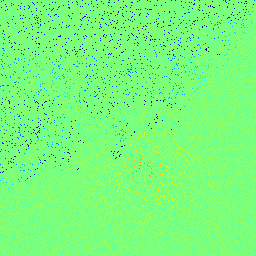
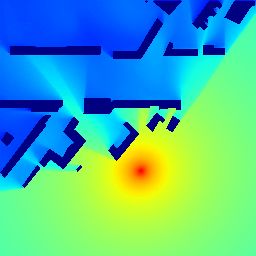
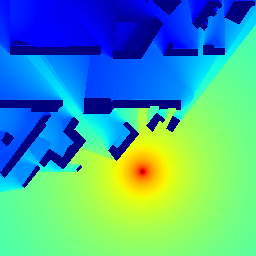
Figure 2: Visual comparison under Σδ=0.83, SNR = 5 dB, and Σδ=0.84, demonstrating structure-preserving reconstruction by RadioDiff-Inv2.
Figure 3: Visual comparison under SNR = 10 dB, Σδ=0.85, and Σδ=0.86; RadioDiff-Inv2 exhibits minimal drift artifacts.
Figure 4: Visual comparison under Σδ=0.87 (default sparsity and SNR). Drift-based bias is visible in all baselines except RadioDiff-Inv2.
The visual assessment highlights the method’s superiority in spatial coherence, edge preservation, and robustness to both noise and drift, effectively mitigating blurring and misalignment observed in all baselines.
Implications and Theoretical Insights
RadioDiff-Inv2’s integration of a forward diffusion prior with a differentiable, drift-marginalized likelihood operator constitutes a principled extension of generative model-based inversion for spatial sensing. The seed-space optimization restricts solutions to the high-likelihood region of the generative prior, strongly regularizing against both operator and amplitude uncertainty—a property that is particularly desirable for underdetermined inverse problems in high-noise wireless measurement settings.
Theoretically, the approach demonstrates the effectiveness of probabilistic generative modeling as an implicit regularizer in highly non-linear, operator-uncertain settings, suggesting generalizability to other inverse problems involving misregistration or latent measurement operators. The drift-marginalized loss function enables consistent inversion even in the presence of severe coordinate error, while avoiding the inefficiency and instability of posterior sampling approaches.
Practical Deployment and Future Directions
Practically, RadioDiff-Inv2 provides a path toward scalable, privacy-preserving RM estimation in 6G and beyond, eliminating the need for high-fidelity localization or dense infrastructure and maintaining robust performance amidst operator uncertainty. This directly impacts coverage engineering, interference management, and dynamic network optimization under realistic deployment constraints.
Potential extensions include:
- 3D and Multi-Path Propagation: Adapting the framework to three-dimensional urban models and incorporating explicit physics-informed priors for multi-path scenarios.
- Fast ODE Solvers: Accelerating inference by leveraging recent advances in ODE-based diffusion generation and adaptive step-size solvers.
- Joint Measurement and Operator Learning: Integrating simultaneous calibration of both measurement noise and drift parameters for settings with unknown system statistics.
Conclusion
RadioDiff-Inv2 establishes a new standard for robust, accurate, and efficient radio map estimation under extreme sparsity, high noise, and operator uncertainty by unifying a learned diffusion prior with a drift-marginalized, differentiable inversion mechanism. The strong experimental advantage, especially in the low-SNR regime, emphasizes the value of generative modeling and operator-aware inversion for next-generation wireless sensing and environment-aware network management.