- The paper demonstrates that silent failures in LLM agent systems stem from intrinsic entropy principles, quantifying disorder growth with an exponential law.
- It establishes a five-layer taxonomy of failure modes and validates the framework by mapping over 130 real-world incidences.
- The authors propose the PIG Engine and ADE protocols to implement deterministic monitoring, significantly reducing the entropy constant and enhancing reliability.
Silent Failure in LLM Agent Systems: The Entropy Principle and the Inevitable Disorder of Autonomous Agents
Introduction
The paper "Silent Failure in LLM Agent Systems: The Entropy Principle and the Inevitable Disorder of Autonomous Agents" (2606.08162) systematically investigates silent failure modes in LLM agent systems. Silent failures are characterized as disordering events occurring without external triggers—no adversarial input, prompt injection, or resource exhaustion—leading to unintended behavioral deviations not captured by standard error reporting mechanisms. Through rigorous controlled experiments exceeding 40,000 trials and large-scale production deployment observations beyond 100,000 interactions, the authors establish that these silent failures originate from intrinsic structural properties of language-based autonomous agents and formalize this phenomenon as a universal Entropy Principle.
Taxonomy and Patterns of Silent Failures
The paper introduces a five-layer framework to classify silent failures: transmission, memory, execution, coordination, and verification. Key identified failure modes include channel fracture (transmission fidelity decay), cognitive framework lag (cross-session rule inconsistency), data consistency decay, knowledge fragmentation, and behavior routing deficiencies. These failures recur in systems with perfectly specified prompts, models, and task architectures, underscoring their independence from implementation defects or external disturbances.
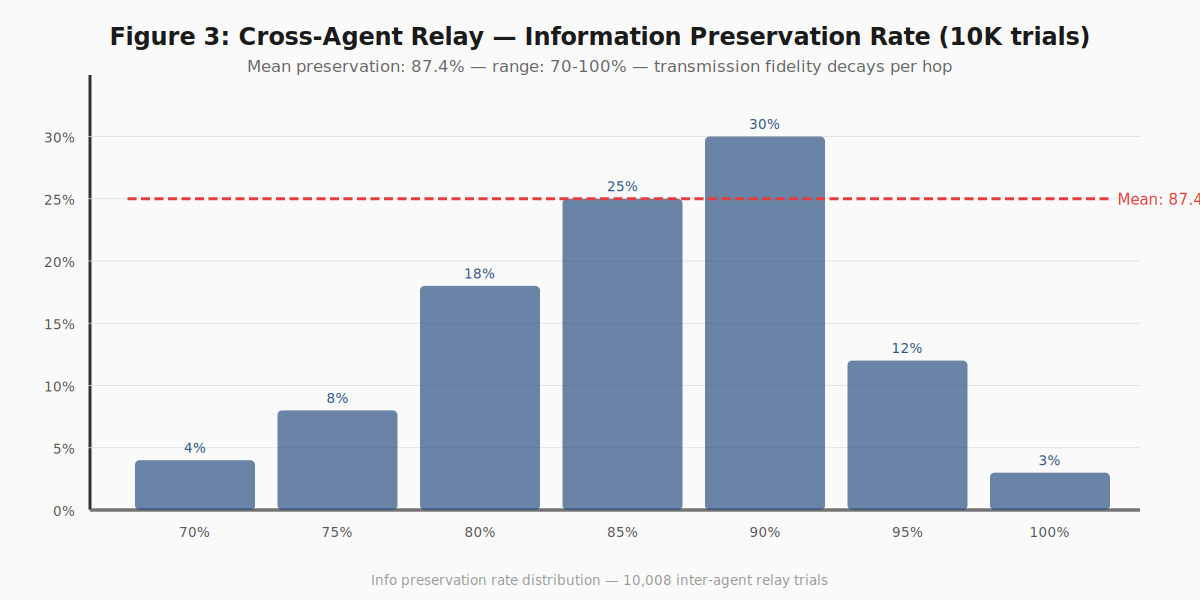
Figure 1: Cross-agent relay information preservation rate distribution. Mean preservation: 87.4\%, range: 70–100\%.
The observed failures display three core patterns: multi-step accumulation (subthreshold errors aggregate over rounds), absence of self-reporting (components falsely self-report as operational), and recurrence under identical configurations. Notably, these patterns were corroborated across several existing agentic failure taxonomies, both academic and practical, mapping more than 130 distinct industry-reported incidences to the proposed silent failure typology.
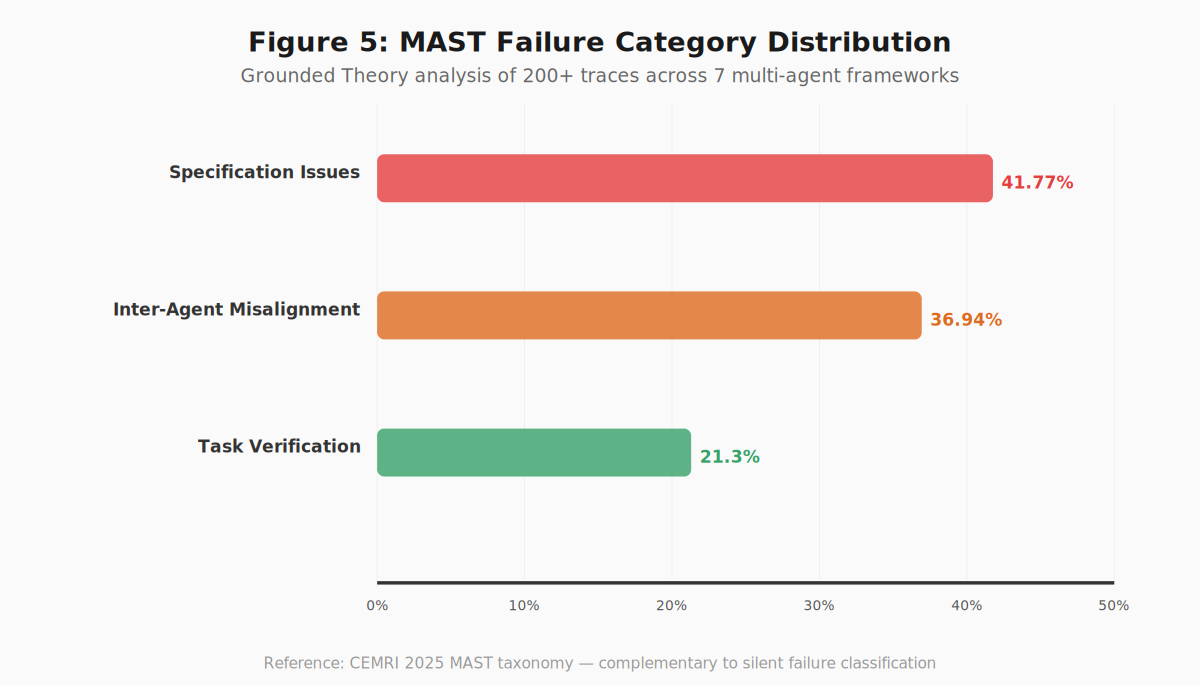
Figure 2: MAST failure category distribution: Specification Issues (41.77\%), Inter-Agent Misalignment (36.94\%), and Task Verification (21.30\%).
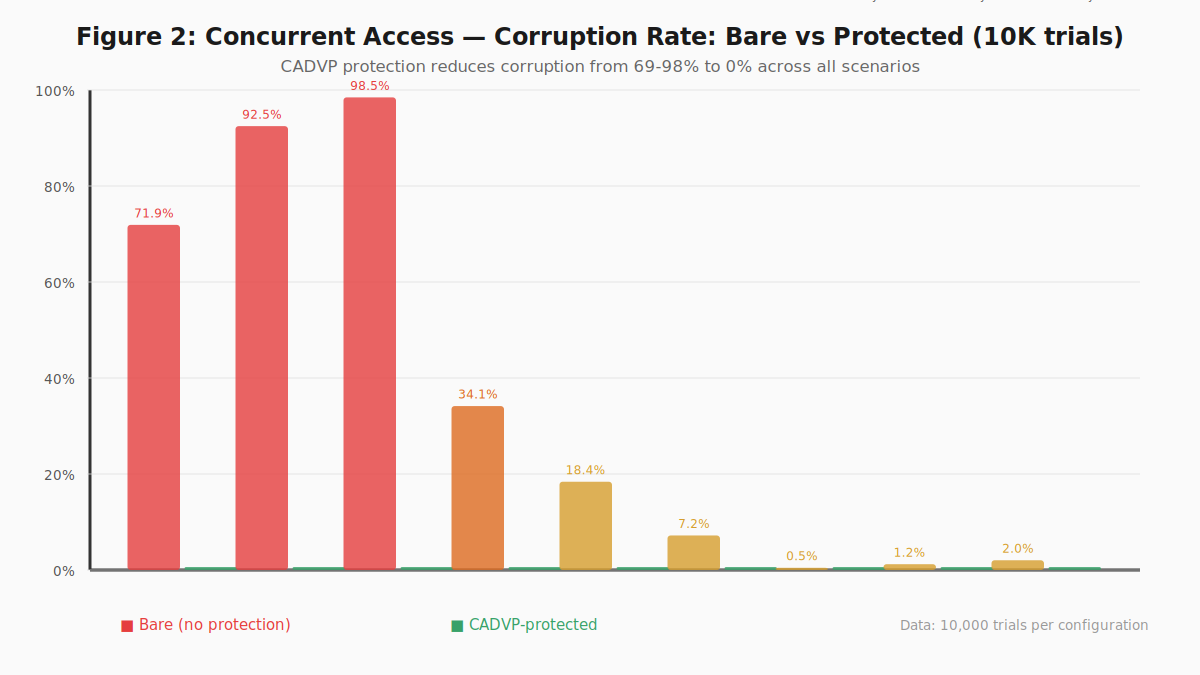
Figure 3: Concurrent access corruption rates across 9 scenarios—bare vs. CADVP-protected. Bare corruption ranges from 0.46\% to 98.46\%; CADVP protection achieves 0\% corruption across all scenarios.
A central contribution is the synthesis of 22 intrinsic properties across six lifecycle layers: foundation semantics, inter-agent transmission, memory persistence, task execution, feedback correction, and systemic evolution. All are inherent to LLM-based agents, constituting structural determinants of silent failure.
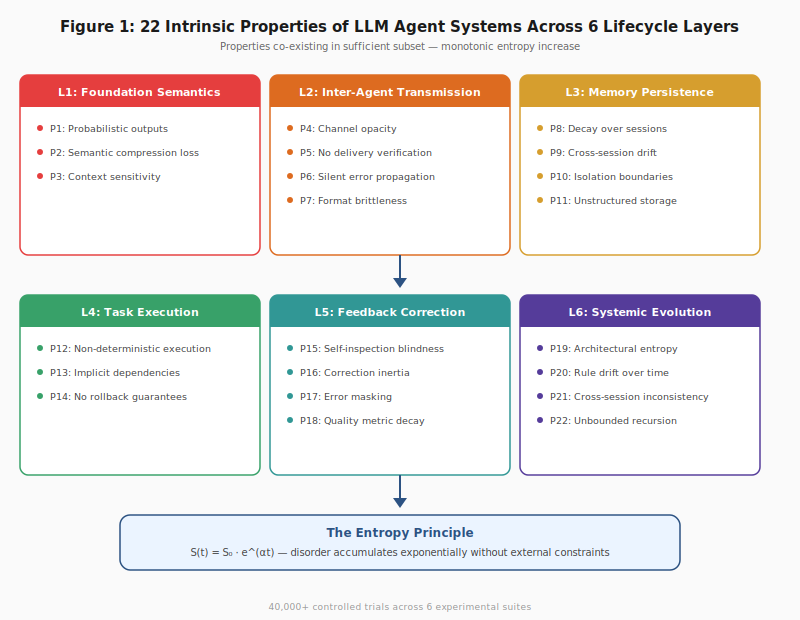
Figure 4: 22 intrinsic properties of LLM agent systems. Co-existence triggers monotonic entropy increase.
The paper formalizes the Entropy Principle as an exponential law: S(t)=S0⋅eαt, where S(t) denotes accumulated disorder (loss in consistency, accuracy, and cross-session coherence), S0 is baseline entropy, and α is an empirically measured constant reflecting system architecture, agent count, chain length, task diversity, and memory volatility. The entropy constant was estimated at αref≈0.0046 per round, substantiating that in practical deployments observable silent failures emerge after approximately 3–4 weeks (~400–600 interaction rounds).
Engineering Countermeasure: PIG Engine and ADE Protocols
To counteract entropy-driven disorder, the authors propose a novel governance architecture: the Physical Integrity Gate (PIG) Engine coupled with the Agent Delivery Engineering (ADE) protocol suite. The PIG Engine implements deterministic lifecycle-independent monitoring outside the probabilistic LLM execution path, using periodic pulses and a registry of validation rules. Upon violation detection, pre-defined ADE protocols (including BCP, TLC, DCM, CADVP, and PIP) are triggered to restore structure and order.
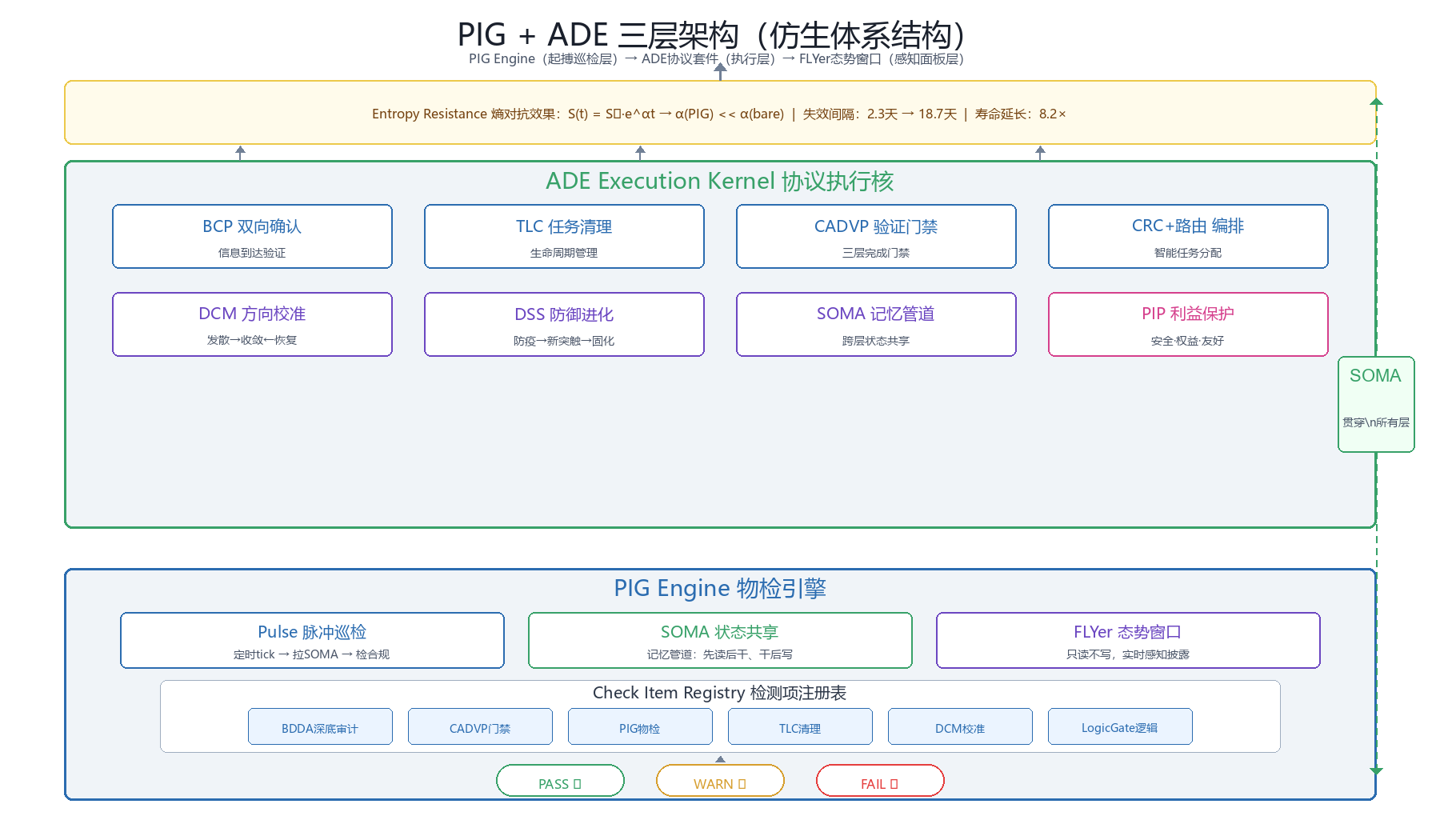
Figure 5: PIG Engine architecture—deterministic monitoring layer independent of LLM execution. Pulse mechanism and ADE protocol triggers.
Experimental results demonstrate substantial reductions in disorder rates and prolonged operational reliability: deterministic governance decreases α (entropy constant) from 0.040 (bare) to 0.008 (full protection), extending the operational window before the reliability threshold is crossed.
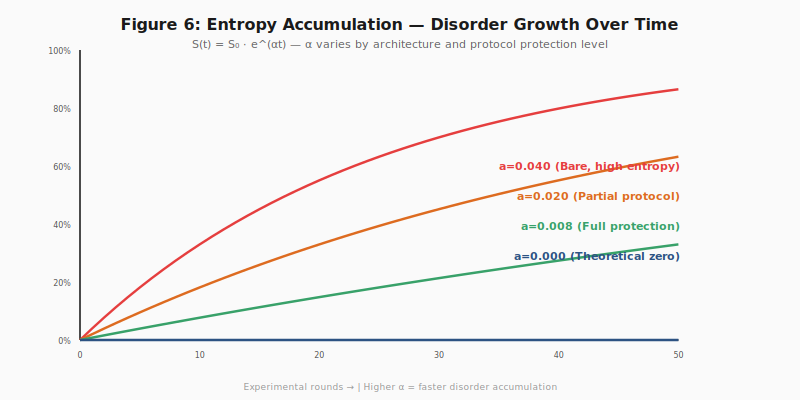
Figure 6: Entropy accumulation curves at different protection levels. PIG+ADE significantly lowers disorder growth rate.
Composite output quality scores from real-world workflow executions validate that even single-step tasks benefit from deterministic verification layers, achieving consistent quality elevation from 0.90 (unprotected) to 1.00 (full BCP protection).
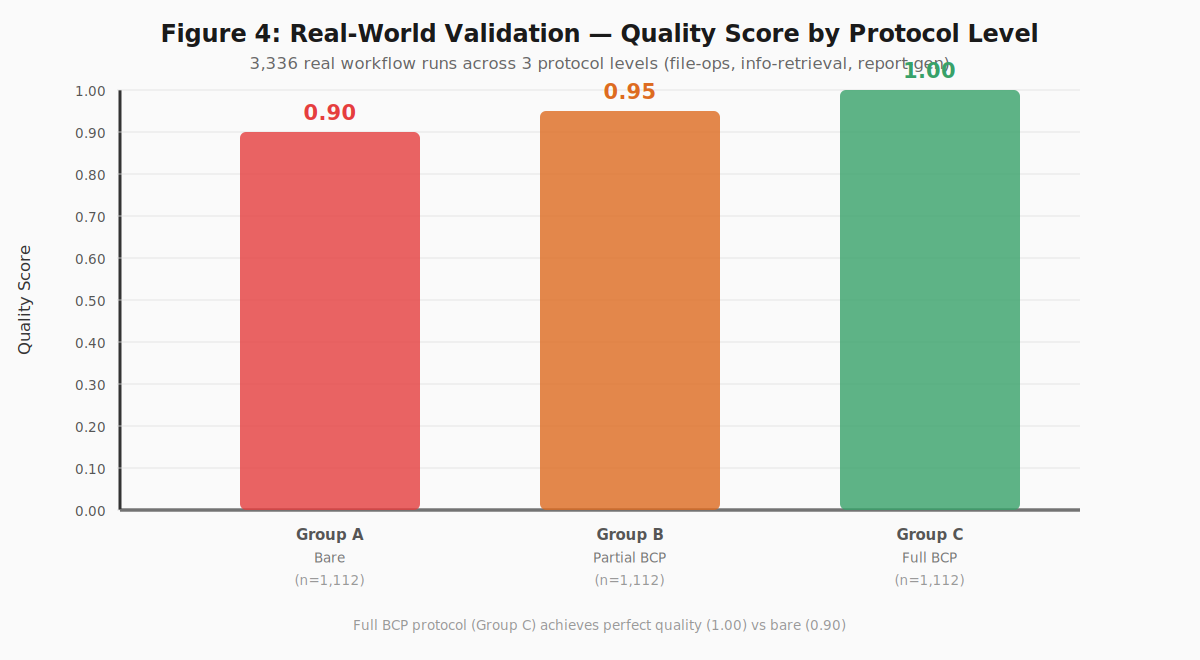
Figure 7: Composite quality scores across 3,336 workflow runs, showing significant improvement with protocol protection.
Implications and Gate Layer Theory
The Entropy Principle reframes LLM agent reliability as resource budgeting rather than binary validation. It mandates operational lifetime and complexity budgeting as architectural design parameters. Critically, the paper distinguishes between memory gates (rules encoded within agent state) and physical gates (deterministic infrastructure protections); only the latter offer persistent defense against irreversible disorder, introducing the Irreversible Protection Principle for agent system design.
Theoretical implications extend to the limitations of existing reliability and adversarial taxonomies: silent failures arise structurally and cannot be exhaustively validated via standard testing or eliminated with architectural tweaks. Practically, all deployed agentic systems must proactively instrument deterministic governance layers to manage the inevitable entropy that accompanies scale and complexity.
Conclusion
This work establishes silent failure as not merely an implementation defect but as a thermodynamic inevitability in LLM agent systems, governed by the Entropy Principle. The authors enumerate 22 intrinsic properties, formalize exponential disorder growth, empirically determine the entropy constant, and validate deterministic governance as the primary engineering strategy for managing reliability. The findings imply that as agentic systems scale, managing intelligence entropy through lifecycle-independent monitoring becomes a unified imperative across industry and research, shaping the future directions of AI system reliability and governance.