- The paper reveals that LLMs assign masculine pronouns in 40.6% of stories while feminine pronouns occur only 2.2%, highlighting a systemic bias.
- Methodology varied animal types, narrative settings, and temperature parameters across 23.8K stories to benchmark gender assignment against human responses.
- Implications suggest current neutrality protocols in LLMs erase feminine representation, calling for more robust, inclusive bias mitigation strategies.
Neutrality and Gender Representation in LLM-Generated Animal Stories
Introduction
"Neutrality Bites: Gender Representation in AI-Generated Animal Stories" (2606.07969) presents a rigorous analysis of gender assignment practices of state-of-the-art LLMs in narrative fiction, specifically focusing on stories featuring anthropomorphized animal protagonists. By examining 23.8K stories synthesized by six leading LLMs—GPT-4o, GPT-5.1, Claude Sonnet 4.5, Gemini-2.5 Flash, Mistral Medium 3.1, and OLMo3 7B—the authors provide evidence that attempts to foster “neutrality” in pronoun assignment and character description do not, in practice, yield equitable gender representation. Instead, models tend to erase feminine representation, and neutrality frequently co-occurs with strong masculine bias.
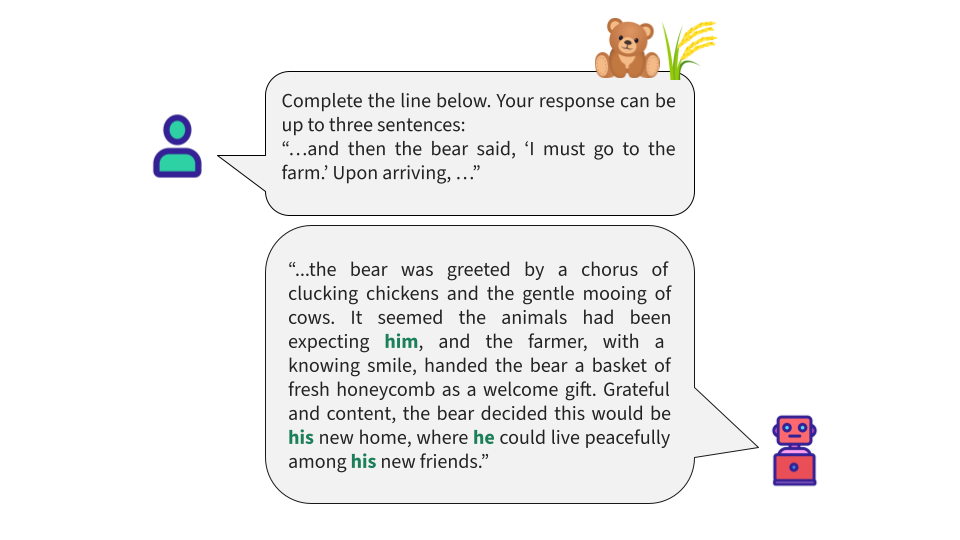
Figure 1: Example prompt and response from GPT-4o with 'bear', 'farm', and temperature 1.0 as parameters. The model assigned masculine pronouns to the protagonist.
This essay details the methodological framework, empirical results, and theoretical implications of the work, critically contextualizing its findings within contemporary debates on bias mitigation and representational harms in generative AI systems.
Methodology
The experimental protocol systematically varies the animal protagonist (bear, bird, cat, dog, mouse, pig, rabbit), narrative setting (farm, kitchen, river, store), and temperature parameters for each LLM, ensuring coverage over combinations known to interact with cultural stereotypes. Each prompt leverages a story-completion template positioned to elicit pronoun assignment decisions from LLMs, operationalizing coreference resolution to categorize pronouns into masculine (he/him), feminine (she/her), neutral (it/its/they/them), or “animal name” (no pronoun use).
For benchmarking, outputs are compared with human responses collected in a prior survey study using nearly identical prompts and animal categories, ensuring ecological validity of comparisons.
Empirical Results
Global Distribution and Pronoun Assignment
Across the dataset, models favor avoidance or neutralization strategies: 19% of stories deploy no gendered pronouns and 38.2% utilize generic neutral language (e.g., "it"/"its"). Importantly, when explicit gender assignment occurs, masculine characters are overwhelmingly dominant (40.6% overall), while feminine designations are nearly non-existent at 2.2%. By contrast, in the human baseline, approximately 13.4% of stories feature feminine pronouns, indicating models are six times less likely to generate feminine animal protagonists than average human writers.

Figure 2: Gender distribution in completions from 1327 human survey respondents, which demonstrate a substantially higher occurrence of explicit feminine assignment compared to all LLMs.
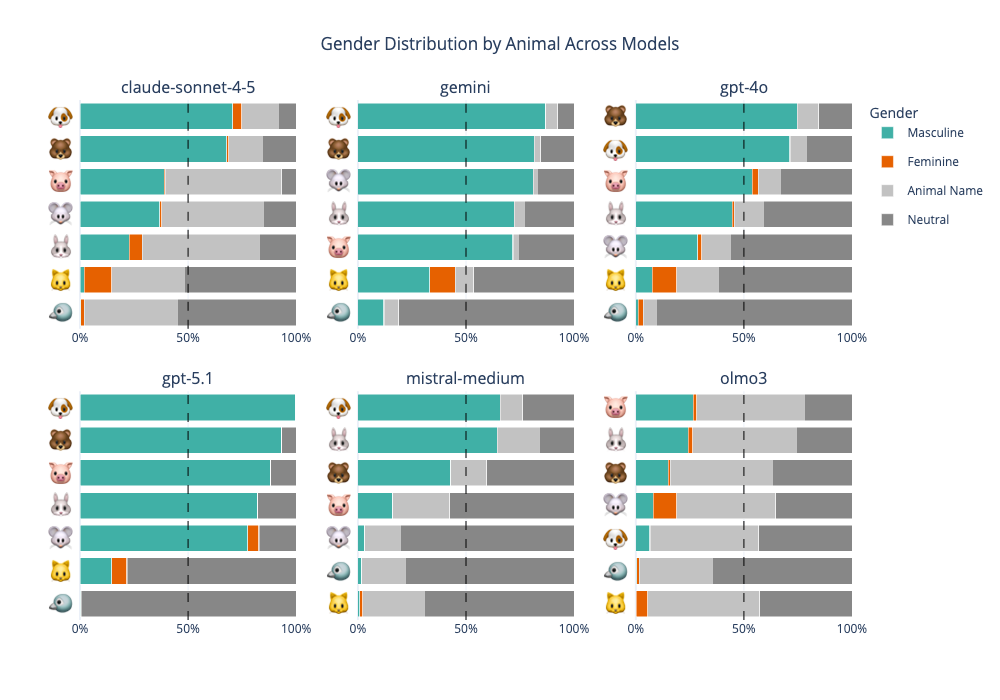
Figure 3: Pronoun assignment distribution from 23.8K LLM outputs: most assignments are neutral or avoided, but masculine assignment dramatically outweighs feminine.
Notably, the variance is model-dependent: for example, GPT-5.1 displays the most extreme masculine bias (65.2% of stories with masculine assignment), whereas OLMo3 and Mistral Medium tend toward avoidance or animal-name repetition, with minimal explicit gendering.
Impact of Neutrality: Erasure via Avoidance
The authors introduce the “neutrality bites” thesis: efforts to neutralize gender do not simply prevent bias—they systematically erase the visibility of feminine (and non-binary) characters, while masculine assignments persist in the residual set of gendered stories.
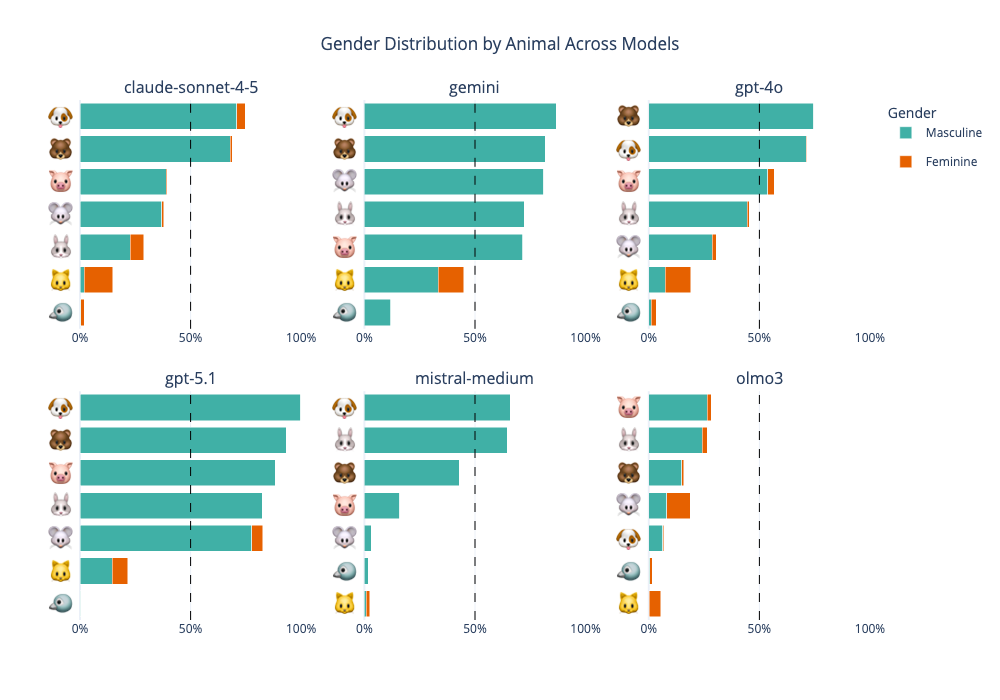
Figure 4: When neutral/animal-name assignments are excluded, masculine bias is even more pronounced: nearly all stories with explicit gendering yield masculine protagonists.
The neutrality mechanism does not produce parity, but instead depletes diversity by reducing the probability space in which non-masculine genders appear. In effect, “neutral” outputs compound the symbolic annihilation of marginalized genders.
Fine-Grained Analysis: Animal, Setting, and Temperature
LLMs’ gender assignment profiles reflect anthropomorphic stereotypes—cats exhibit the highest (albeit still minimal) feminine assignment, while animals like dogs, bears, and rabbits are overwhelmingly gendered masculine or left ambiguous. Narrative setting and temperature only minimally modulate the probability of feminine representation, with clear model-level idiosyncrasies but no scenario in which equitable parity is approached.
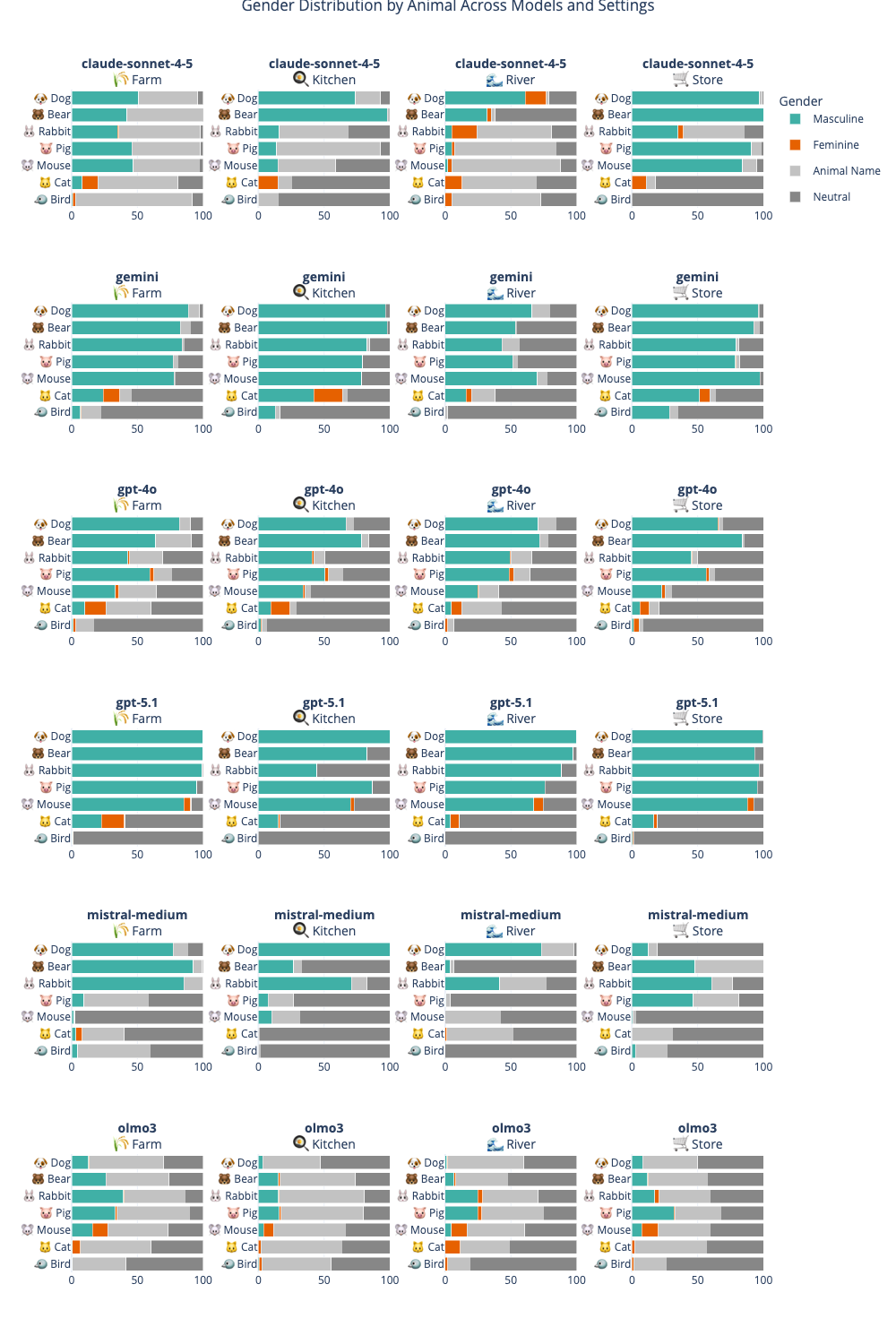
Figure 5: Gender assignment distribution across narrative settings; environment does not meaningfully increase feminine representation.

Figure 6: Temperature parameter tuning, intended to introduce randomness, does not significantly ameliorate representational disparities.
LLMs vs. Human Authors
Direct model-to-human comparison (matched for prompt and animal) reveals a statistically significant divergence: humans’ distributions of masculine/feminine/neutral assignment are distinctly more balanced, and importantly, the allocation of feminine protagonists is several-fold higher for humans across almost all animal categories.
Theoretical and Practical Implications
The results align with and extend the existing body of work on algorithmic gender and identity bias in generative models [sheng-etal-2019-woman, 10.1145/358(2269.36155)99, rooeinBiasedTalesCultural2025]. The empirical structure of the output space—where so-called neutrality operates as avoidance rather than true inclusive ambiguity—exposes a fundamental limitation in contemporary “bias mitigation” paradigms: the substitution of omission for genuine representational equity.
Static neutrality, as operationalized in current LLM alignment protocols, does not constitute an affirmative representational strategy and should not be viewed as an endpoint for fairness in NLG systems. Instead, it risks amplifying symbolic erasure, especially in high-impact genres like children's literature and pedagogically oriented fiction, where visibility of feminine and non-binary genders is normatively and developmentally consequential.
Furthermore, these findings highlight the brittleness of post-hoc alignment interventions: even across models ostensibly from the same organization, patterns of gender assignment can respond dramatically to relatively minor system-level or post-training changes, reinforcing calls for systematic, context-sensitive auditing beyond benchmarked settings [mickel2026more, watson-etal-2025-analyzing].
Directions for Future Research
The study foregrounds several critical paths for the field:
- Beyond Binary Neutrality: Mitigation protocols should aim for probabilistic parity not only between masculine and feminine categories, but across a full distributional spectrum including non-binary, trans, and culturally contingent genders.
- Intersection with Cultural Tropes: Future studies should address not only pronoun assignment but also qualitative aspects—narrative roles, agency, and stereotype propagation—assessing deeper forms of representational harm.
- Cross-linguistic Generalization: Mechanisms of grammatical gender and sociolinguistic expectations will vary dramatically in languages beyond English; system audits must encompass these axes.
Conclusion
This work empirically demonstrates that current alignment strategies premised on neutrality in generative LLMs disproportionately result in the erasure of feminine protagonists and do not meaningfully improve overall representational equity. Effective mitigation must move beyond avoidance and integrate strategies that explicitly distribute gendered subjectivity in ways that reflect both social diversity and the needs of marginalized or minoritized populations. The “neutrality bites” thesis is a caution for designers and auditors: the suppression of gender is not a neutral act, but a consequential socio-technical choice with cascading effects on the imaginary worlds LLMs produce and, by extension, the human worlds they influence.

