- The paper presents the TSLS likelihood ratio (TLR) test which provides uniformly valid inference under weak instruments and treatment effect heterogeneity.
- It demonstrates that common tests like AR, LM, and CLR fail under heterogeneous treatment effects, resulting in significant size distortions.
- The authors propose a two-step recentered testing procedure that aligns TSLS estimates as a weighted local average treatment effect for clearer causal interpretation.
Inference on the TSLS Estimand with Weak Instruments and Treatment Effect Heterogeneity
Motivation and Background
Identification and inference in overidentified instrumental variables (IV) models with weak instruments is a central problem in econometrics. Classical inference procedures, such as the Wald and t-test applied to two-stage least squares (TSLS), are known to be invalid when instruments are weak. Robust methods including the Anderson-Rubin (AR), Kleibergen-Moreira LM, and Conditional Likelihood Ratio (CLR) tests have been developed to address this, but their validity is restricted to models with constant treatment effects and/or a single instrument.
This paper, "Inference on the TSLS Estimand with Weak Instruments and Treatment Effect Heterogeneity" (2606.07871), identifies a critical gap: in the presence of heterogeneous treatment effects and multiple instruments, no inference procedure targeting the TSLS estimand remains valid and interpretable as a weighted average of local average treatment effects (LATE) under weak identification and standard limited-instrument asymptotics. The key contribution is the development and characterization of the TSLS likelihood ratio (TLR) statistic, which, combined with a specifically constructed two-step inference procedure, delivers uniformly valid inference for the TSLS estimand across weak to strong instrument regimes, accommodating heterogeneity in treatment response.
Theoretical Contributions
Failure of Classical Robust Tests
The paper shows that under heterogeneous treatment effects, standard weak-instrument robust procedures (AR, LM, CLR) fail to provide correct size when testing hypotheses about the TSLS estimand. Under constant treatment effects, these tests are valid because the AR restrictions (δ−β0γ=0) target the same null hypothesis as the TSLS coefficient. In the presence of heterogeneity, however, these restrictions involve overidentifying assumptions that are not required for interpretation of TSLS as a LATE-weighted average. Simulation evidence exhibits significant size distortion for AR, LM, and CLR as instrument strength grows in the presence of heterogeneity—these tests may grossly overreject (Figure 1).
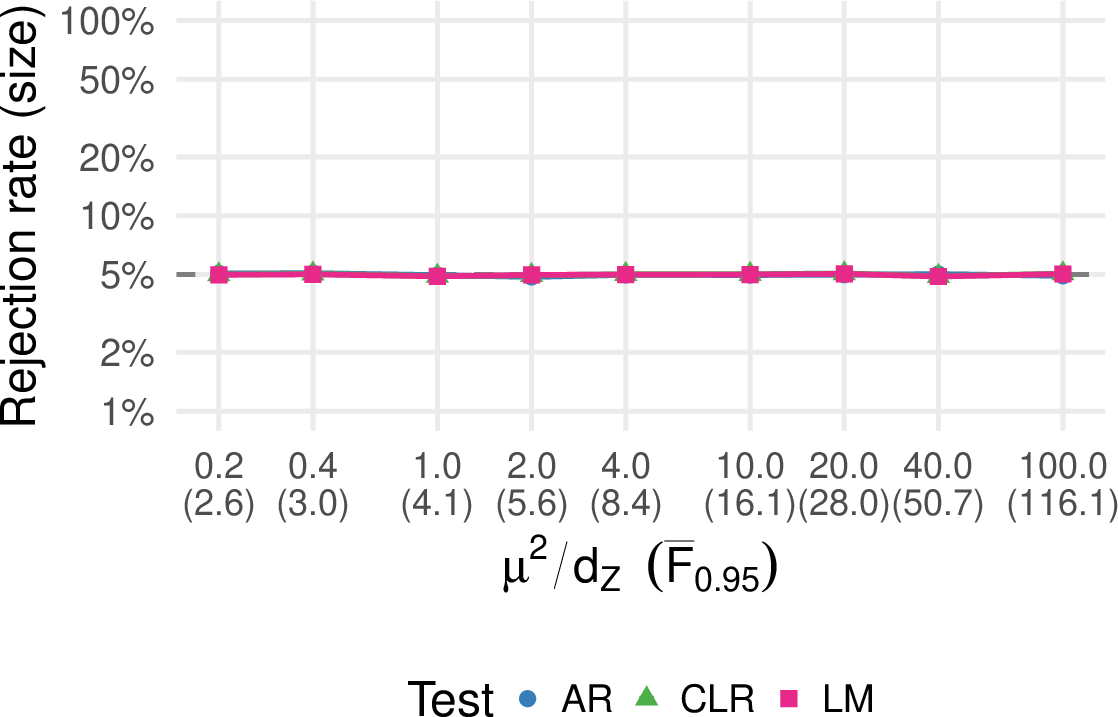
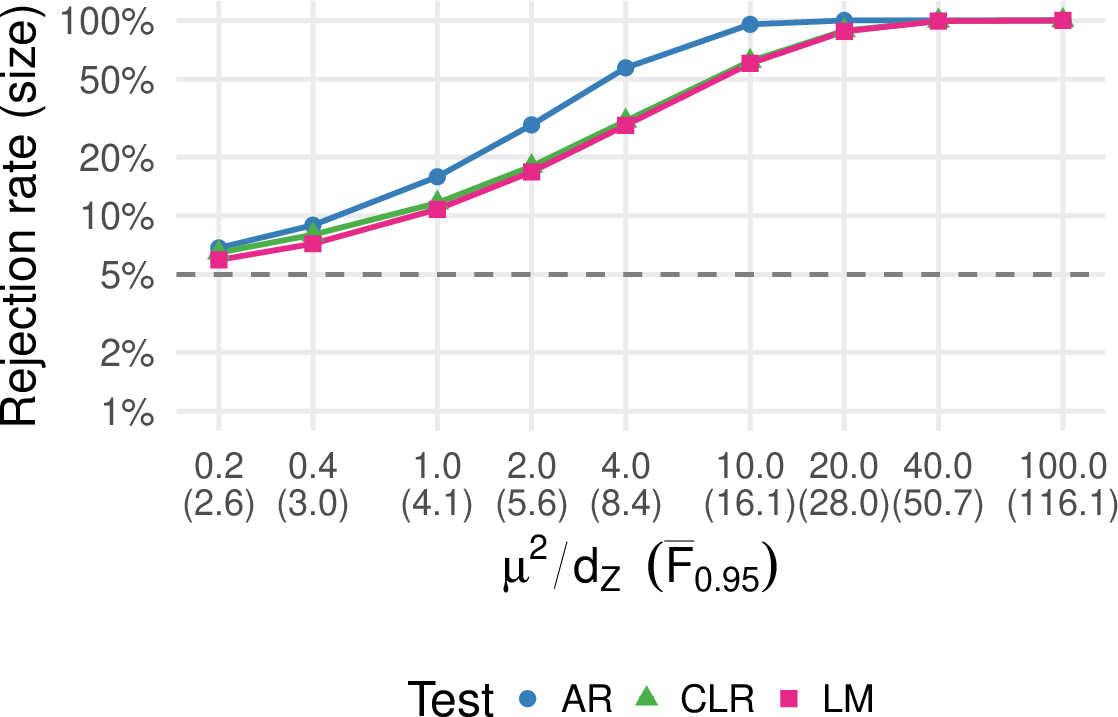
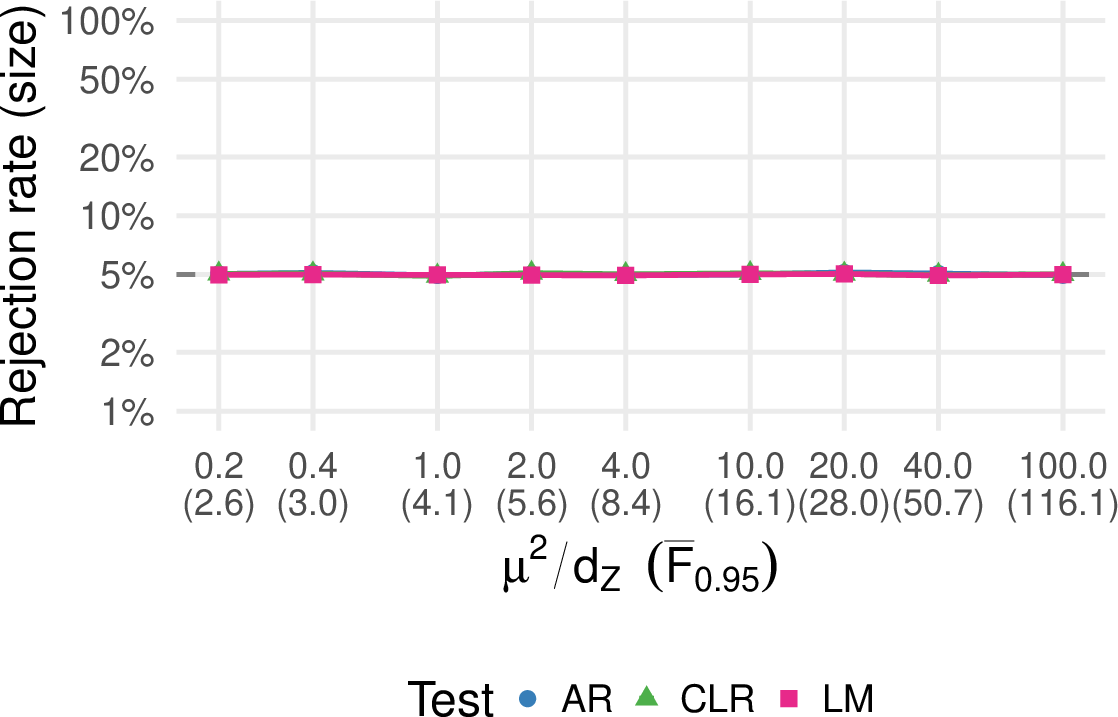
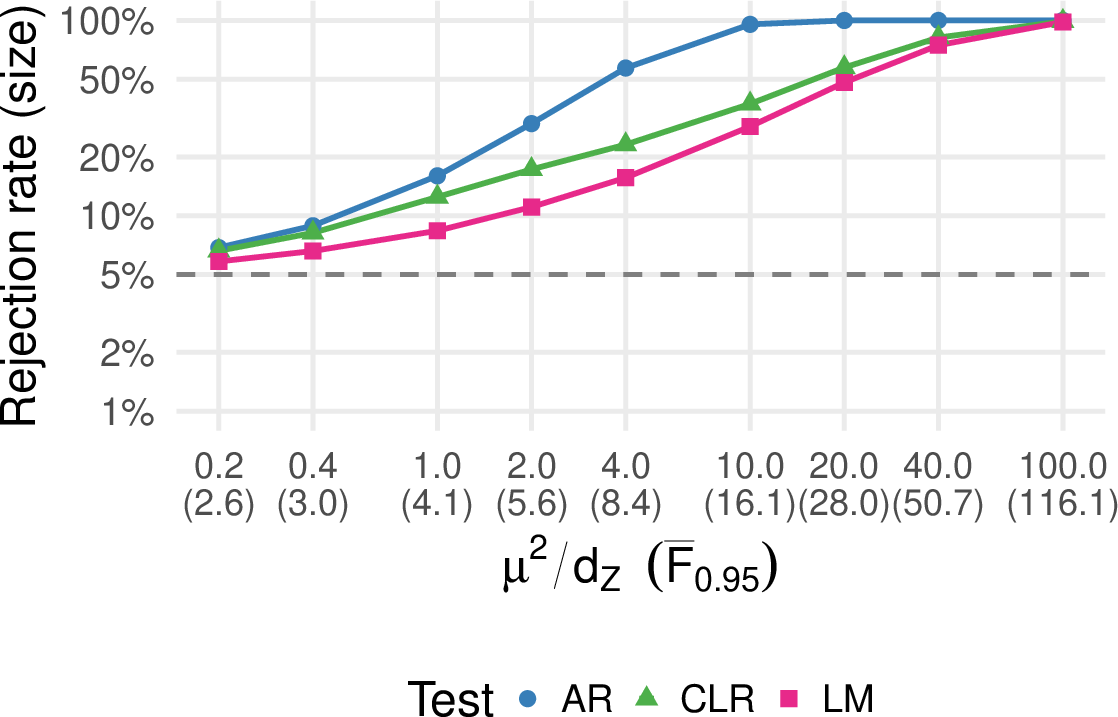
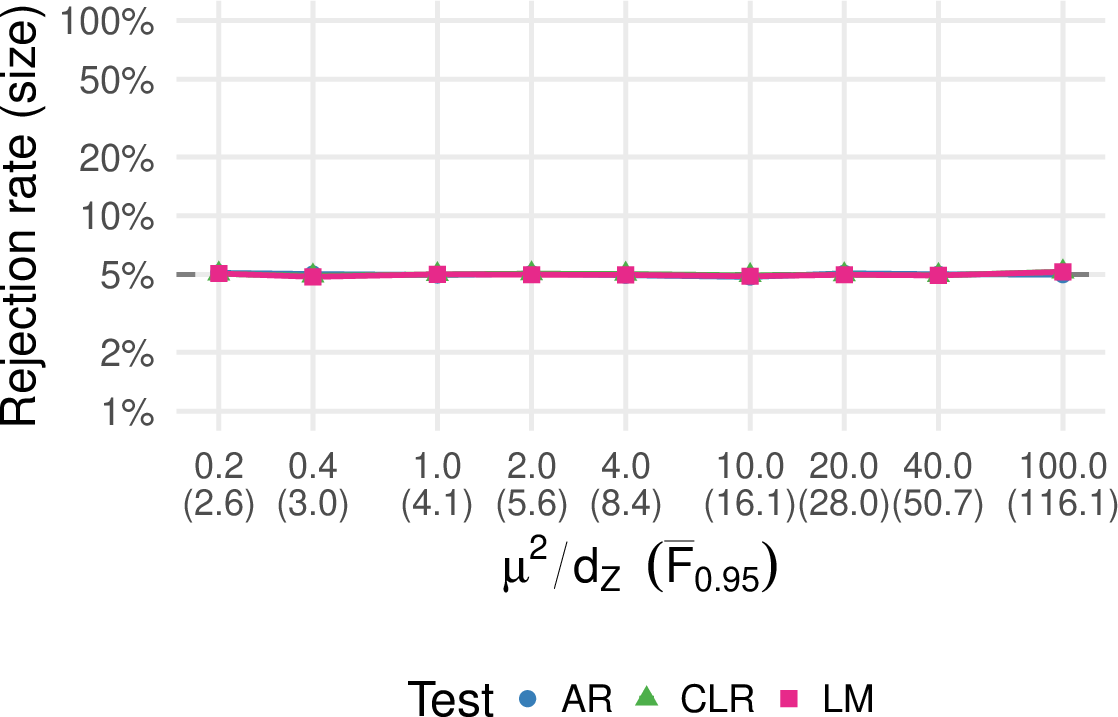
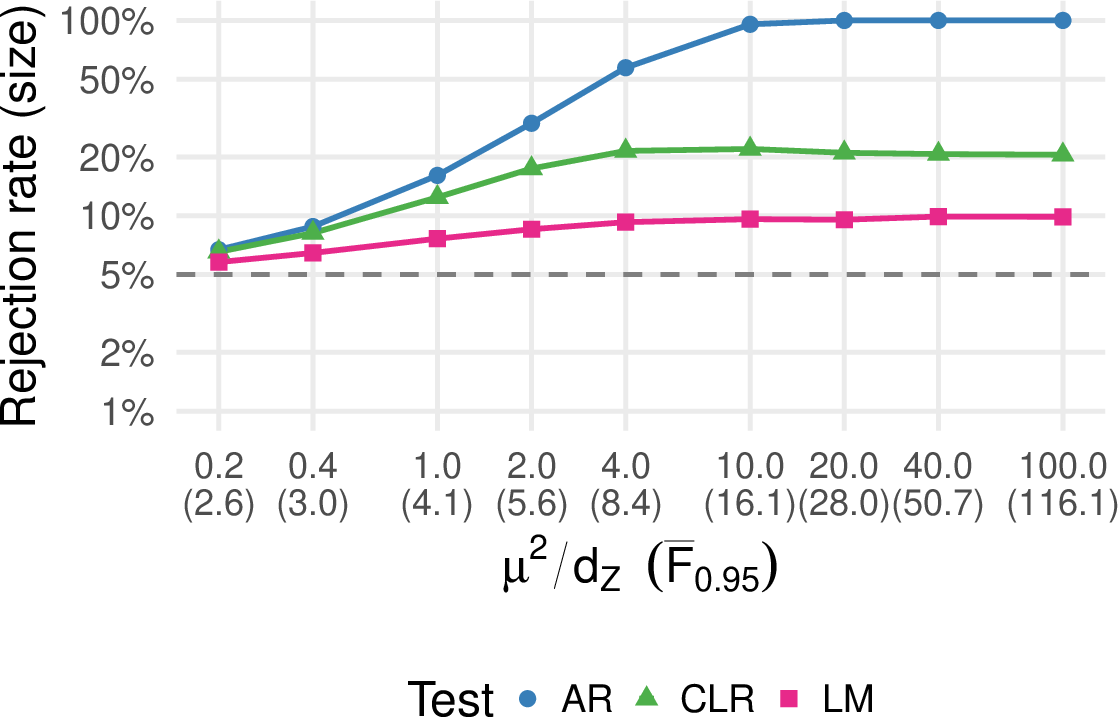
Figure 1: Size distortion of the AR, LM, and CLR tests for TSLS under heterogeneous treatment effects and varying instrument strength, measured via the concentration parameter.
The TSLS Likelihood Ratio (TLR) Statistic
To address these limitations, the TLR is derived by noting that the null hypothesis about the TSLS estimand can be recast as a quadratic restriction: the covariance between the reduced form and first-stage coefficient vectors, appropriately weighted, equals zero. Formally, the null can be rewritten as γ′ΣZZ(δ−β0γ)=0, a single restriction devoid of ancillary conditions like constant treatment effects.
Under non-degenerate asymptotics (joint normality of estimated reduced-form and first-stage coefficients), the TLR implements a likelihood ratio test subject to this quadratic constraint. The resulting optimization is a specific instance of the generalized trust region subproblem, solved with existing techniques; the test statistic admits a semi-closed form in terms of the eigendecomposition of the relevant covariance and restriction matrices.
The limiting distribution of the TLR statistic is shown to be asymptotically χ12 under strong instruments. Under weak identification, its distribution depends on two nuisance parameters: one reflecting the endogeneity (or difference between OLS and TSLS estimands) and another summarizing the instrument set’s identifying strength, akin to, but distinct from, the traditional concentration parameter.
The TLR is not pivotal under weak identification; its null distribution depends on nuisance parameters that cannot be estimated consistently. The paper constructs a recentered version (RTLR), subtracting the estimated mean bias of the test’s signed root, yielding an approximately unbiased procedure over much of the parameter space.
Uniformly valid inference is obtained via a two-step approach: first, construct a high-level confidence interval for the unestimable nuisance parameter using available statistics; second, maximize the test’s critical value over this interval. Drawing from the Berger-Boos methodology, this procedure maintains correct size in finite samples and is uniformly valid across the spectrum of instrument strengths. When the first-stage F-statistic is high (strong instruments), the two-step TLR becomes numerically equivalent to the Wald test, as demonstrated in simulated power curves. The paper shows in simulation that conservativeness due to this correction is minimal, particularly for the RTLR version (Figures 2–4).
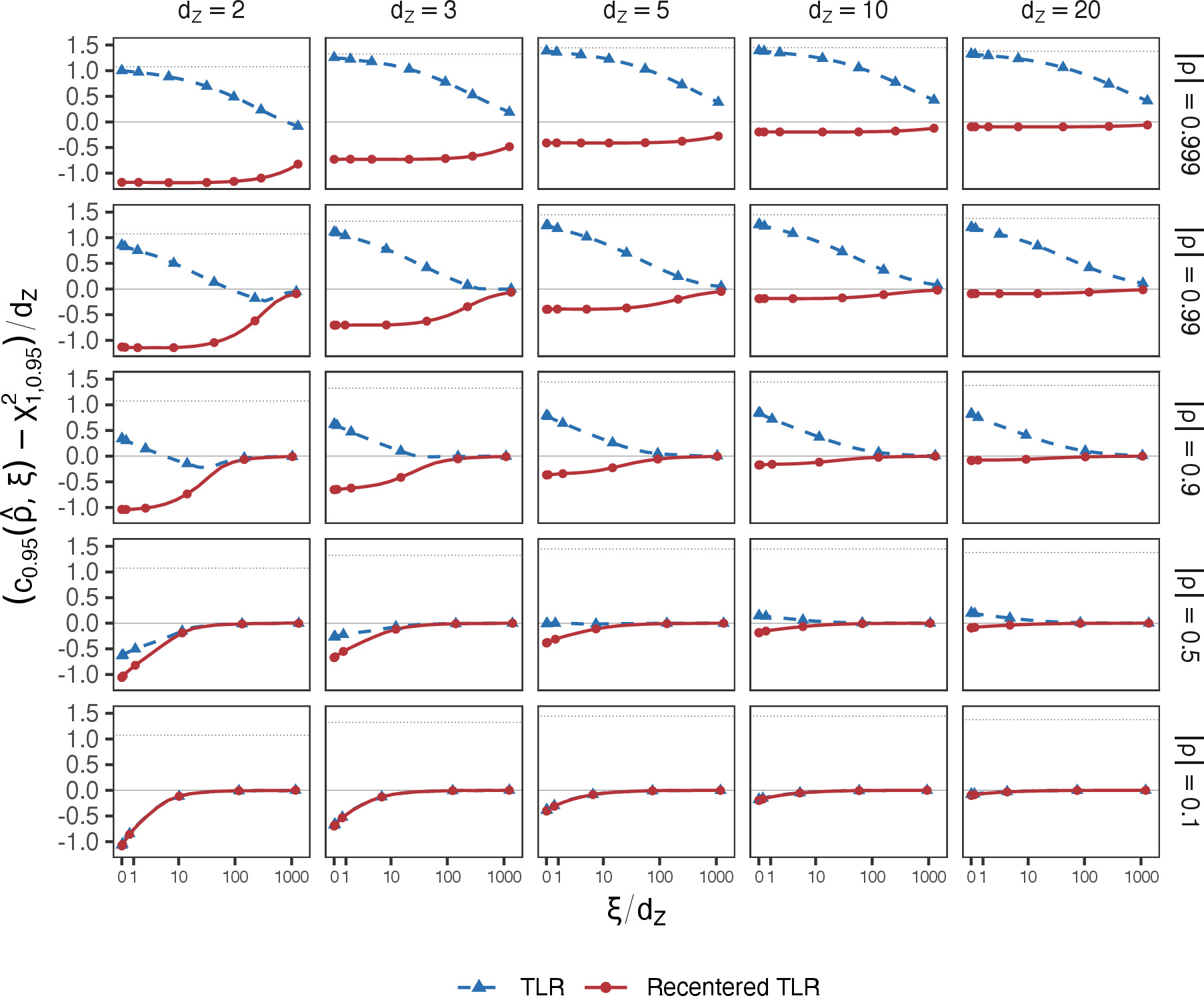
Figure 2: 95th quantiles of TLR and RTLR statistics by value of nuisance parameters and number of instruments, compared to the strong-instrument χ12 quantile.
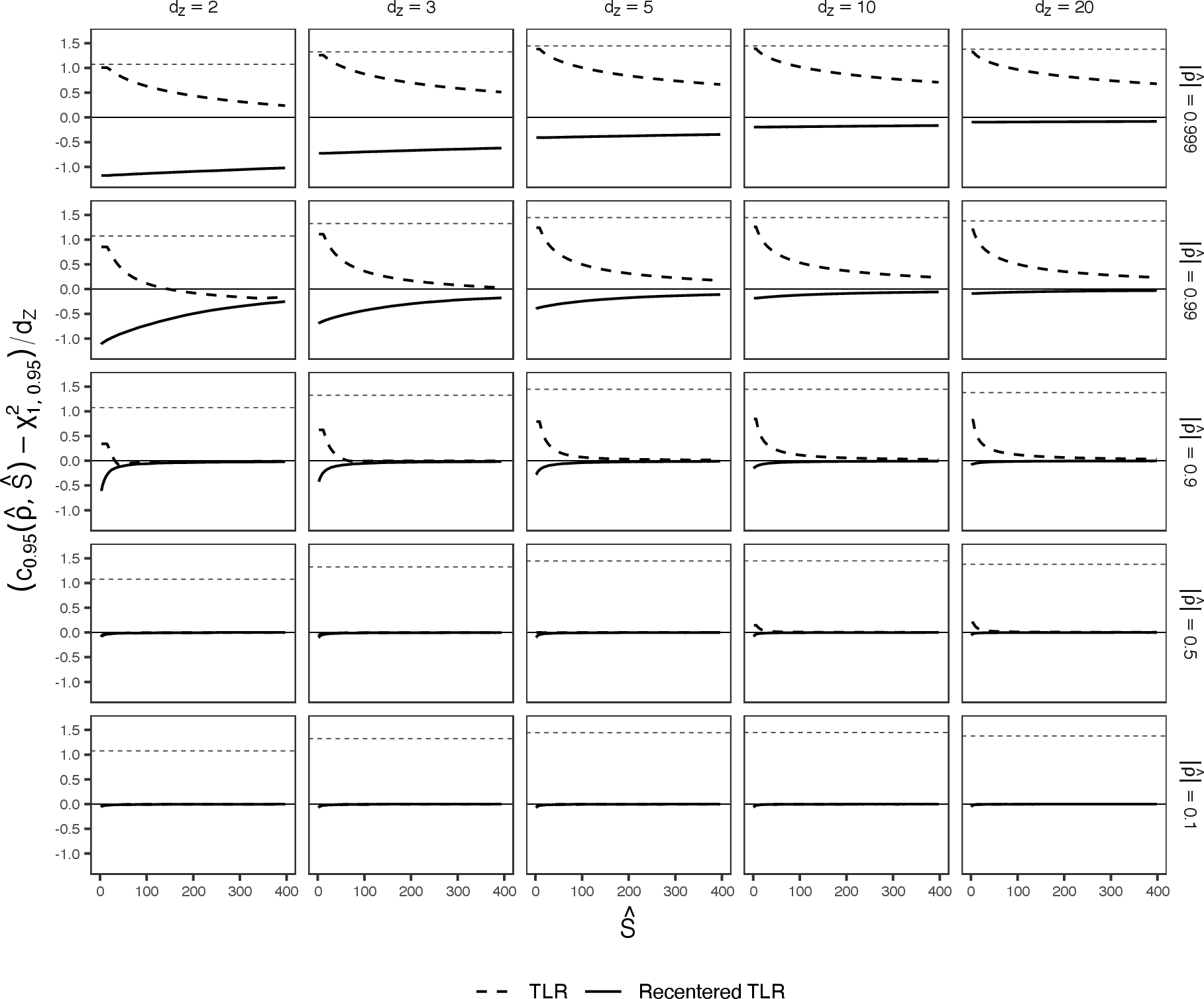
Figure 3: Conditional second-step critical values for TLR and RTLR at α=0.05, as a function of data-dependent parameters, showing rapid convergence to the strong-instrument limit with increasing identifying strength.
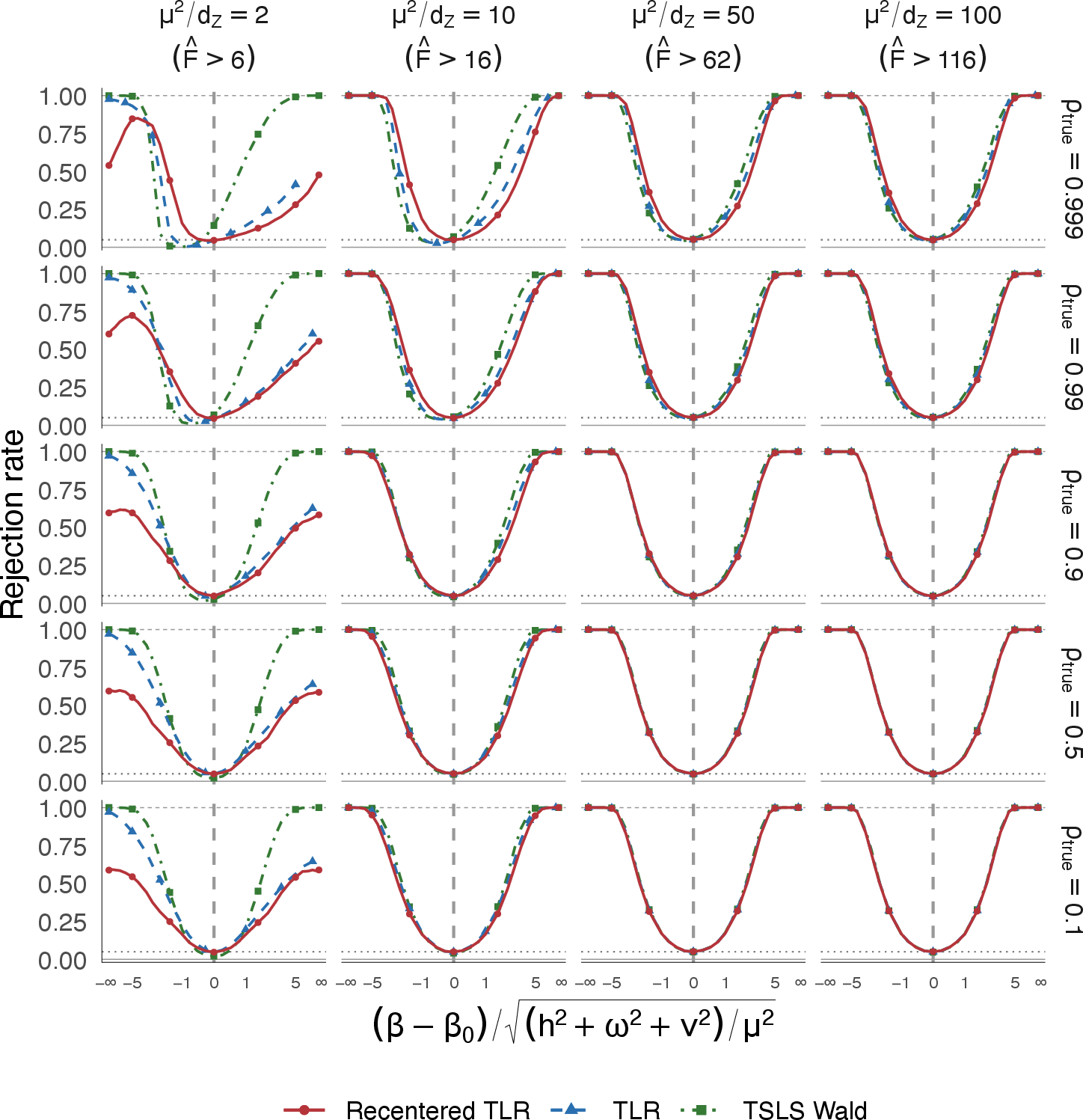
Figure 4: Simulated power functions for two-step TLR/RTLR and the Wald test, at various levels of endogeneity and instrument strength; RTLR closely tracks the (invalid) TSLS Wald test in strong-instrument regimes, while maintaining correct size under weak instruments.
Numerical Results and Key Findings
The simulations provide strong evidence for the theoretical arguments. Under heterogeneous effects and weak instruments, the AR/LM/CLR tests exhibit pronounced overrejection, increasingly so with greater instrument strength (Figure 1). In contrast, both TLR and especially RTLR attain correct size regardless of instrument strength, demonstrated across a grid of parameters.
When strength is high (ξ→∞), the TLR/RTLR tests are numerically indistinguishable from the Wald test, confirming desirable power properties. The power deficit of the valid two-step tests relative to the Wald arises only when instruments are weak and the identification region is wide—here, correct inference must recognize the potential for infinite-length confidence sets, consistent with impossibility results in weak IV. The RTLR scores particularly well, achieving near-unbiased behavior and avoiding excessive conservatism.
Practical and Theoretical Implications
This paper fundamentally clarifies the limits of current practice in inference for overidentified IV estimation under effect heterogeneity. It demonstrates that the prevalent use of AR/LM/CLR for weak IV settings is unjustified unless constant effects can be assumed, and that practitioners must shift to procedures that specifically target the TSLS estimand as a LATE-weighted average, even when treatment response is heterogeneous.
The TLR and its two-step recentered counterpart offer a rigorous path forward: robust, interpretable, and adaptable inference for TSLS, avoiding misinterpretation risks highlighted by the numerical results. The methods are relevant for empirical work in economics, political science, and related disciplines where IVs are frequently weak and treatment effect heterogeneity is the norm, particularly in “judge/leniency/examiner” designs.
Theoretically, the results inform future work on overidentified IV models, treatment heterogeneity, and inference in the presence of unestimable nuisance parameters. The generalized approach to constructing valid likelihood ratio statistics subject to quadratic constraints may find applications in other areas of econometrics and statistics.
Conclusion
"Inference on the TSLS Estimand with Weak Instruments and Treatment Effect Heterogeneity" (2606.07871) resolves long-standing issues in inference for overidentified IV models with treatment effect heterogeneity. The TSLS likelihood ratio framework, combined with two-step testing for nuisance parameters, provides uniformly valid inference on interpretable causal estimands, matches standard Wald results under strong identification, and avoids the pitfalls of conventional robustified IV tests. These advances meaningfully influence empirical practice and motivate further methodological innovation at the interface of weak identification and causal heterogeneity.

