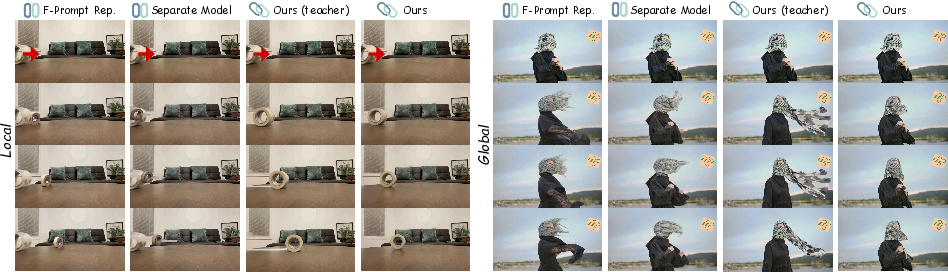
- The paper introduces StreamForce, which integrates a unified pixel-aligned force representation to enable causal and interactive video synthesis.
- The method achieves real-time generation at 16.6 FPS with highly accurate force adherence and kinematic realism, outperforming prior approaches.
- The framework exhibits emergent physical reasoning including mass, friction, and gravity effects, opening pathways for simulation and robotics applications.
Streaming Video Generation with Streaming Force Control: An Expert Analysis
The paper "Streaming Video Generation with Streaming Force Control" (2606.07508) proposes StreamForce, the first framework for streaming force-conditioned video generation that is both causal and interactive. The framework addresses two requirements unfulfilled by prior works: (1) physically meaningful, continuous force interaction in video generative models, and (2) real-time streaming synthesis compatible with user-imposed, temporally-varying force controls.
State-of-the-art diffusion-based video generators have achieved impressive visual and kinematic fidelity but do not provide mechanisms for continuous, physically grounded interaction during streaming synthesis. Previous approaches such as Force-Prompting separate global and local forces, lack temporal coherence under force updates, and operate non-causally. Trajectory-based control methods do not capture the causal and object-dependent effects that result from force application, such as mass- and friction-mediated variability. StreamForce resolves these deficits via a causal, unified model and a consolidated force representation.
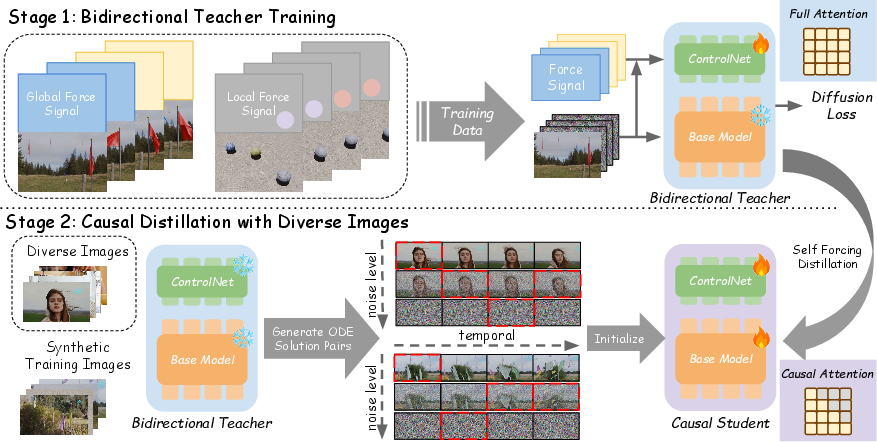
Figure 1: Overview of the StreamForce control pipeline, supporting unified local and global time-varying streaming force control.
Core Model and Unified Force Representation
StreamForce takes as input a single image and force trajectories (local or global, possibly time-varying), and autoregressively generates video frames consistent with the applied controls. The fundamental advances center on:
- Unified Pixel-Aligned Force Representation: Both global and local forces are encoded in a four-channel, pixel-aligned masked force map per frame, incorporating location, magnitude, and direction. Masks distinguish between global (full-frame) and local (region-based) application.
- Controllable Bidirectional Teacher and Causal Distillation Pipeline: Motion controllable priors are established in a bidirectional teacher network (modified Wan2.2 TI2V) augmented with a ControlNet force branch. Force-awareness and realistic dynamics are transferred to an autoregressive student via ODE-based initialization and Self-Forcing DMD distillation, guaranteeing both force-responsiveness and temporal causality.
The force dataset includes rich, dynamically-varying force supervision on synthetic (Blender) scenes, global and local settings, and change-of-force events, as well as a curated set of diverse real-world images with annotated forces for open-domain generalization.
Technical Results
Streaming Force-Controllable Video Synthesis
StreamForce is shown to produce real-time streaming video at up to 16.6 FPS (832×480) with 0.6s latency on a single H200 GPU. Ablations demonstrate that the unified force representation provides superior cross-type generalization and more consistent physical response than dual-headed or non-unified alternatives.
Perceptual and Physics-IQ Evaluation
Evaluation comprises both perceptual user studies and Physics-IQ metrics, with both global and local, static and dynamic (changing) force cases. Strong quantitative and qualitative gains are established:
- In force-changing scenarios, StreamForce achieves top human preference rates on force adherence (86.5% global; 80.4% local) and physicality (77.3%/64.6%), dominating prior methods.
- Physics-IQ benchmarks show a new SOTA total score (Global: 40.99, Local: 46.31), outperforming Force-Prompting and text-prompted baselines, especially in spatiotemporal IoU and motion error.
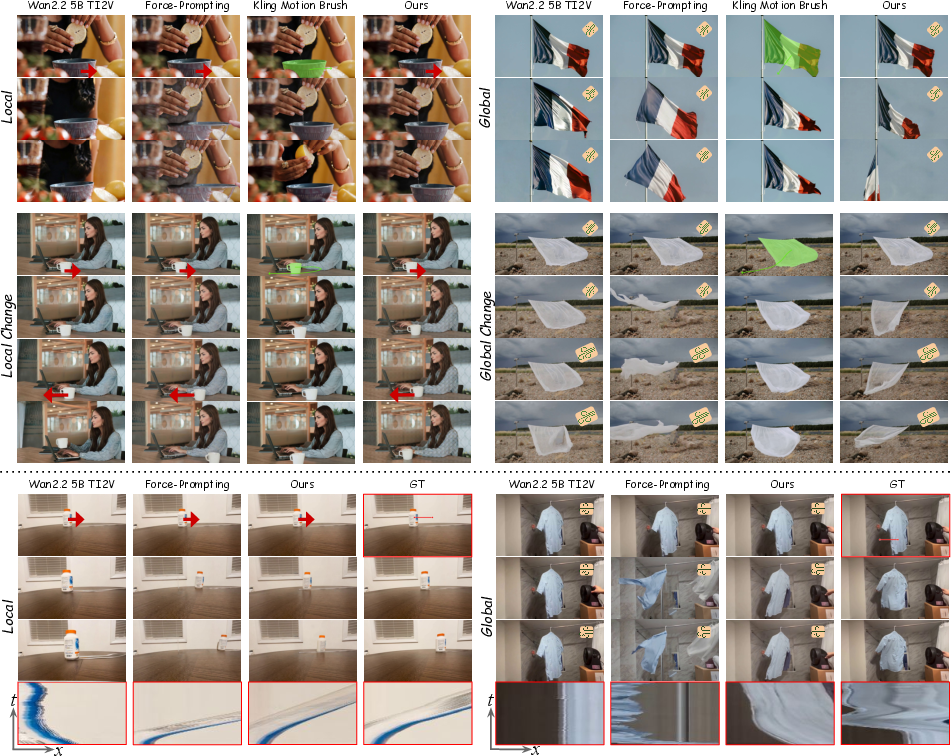
Figure 2: Visual comparison; StreamForce follows force controls with high photometric and kinematic realism across multiple cases.
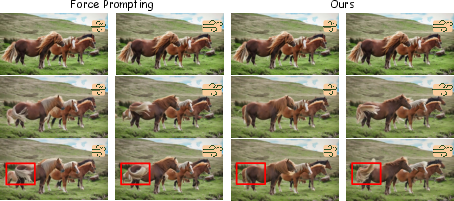
Figure 3: Magnitude response; StreamForce distinctly modulates motion according to force magnitude, unlike prior methods.
Emergent Physical Reasoning
StreamForce demonstrates key signs of emergent intuitive physics, not explicitly programmed:
- Mass-awareness: Heavier objects accelerate less under identical applied force.
- Friction: Identical forces yield shorter trajectories on surfaces annotated as "rough".
- Gravity: Rolling objects fall when reaching table edges, exhibiting plausible ballistic dynamics.
- Multi-force/Part-level Manipulation: Multiple simultaneous local forces result in physically consistent translation and rotation, as required in robotics manipulation.
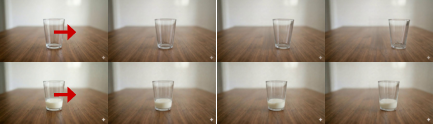
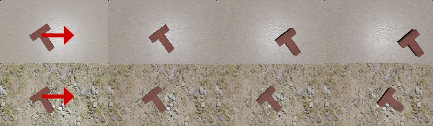
Figure 4: Demonstration of mass- and friction-awareness, showing differential motion in response to identical applied forces.

Figure 5: Object falling under gravity triggered by force-driven displacement.

Figure 6: T-pushing scenario showing multi-point control and coordinated translation/rotation.
Ablation Analyses
Ablations confirm:
Practical and Theoretical Implications
Practical
StreamForce enables robust, real-time, physically-grounded video generation steered interactively by force trajectories. Potential applications include video-based simulation, virtual training, robotics education, and online gaming environments requiring causal and interactive world models. The ability to impart both local and environment-scale force controls in open-domain imagery enables a new generation of controllable generative models.
Theoretical
From a research standpoint, StreamForce represents a key step toward integrating Newtonian physical priors into deep generative models via unified input parametrization and distillation. It also highlights architectural advances needed for truly interactive, online synthesis when classical bidirectional video diffusion is insufficient. Observed emergence of mass, friction, and gravity hints at the model's ability to internalize implicit physical "commonsense", although it still lacks explicit 3D or depth force control.
Future Directions
Ongoing limitations include absence of 3D/depth force components, modest treatment of deformable/non-rigid materials, and incomplete handling of complex object-object interactions and collisions. Extending force representations to three dimensions, incorporating richer physical simulation-based priors, expanding to more diverse force types (e.g., field forces, multi-body systems), and achieving higher-resolution generation with stronger generalization remain key challenges for theoretical and applied research.
Conclusion
StreamForce introduces a robust, causal, streaming video generator with unified force control, establishing strong new baselines for physical adherence and interactive video synthesis. The framework closes a crucial gap between photorealistic generative models and physically grounded, interactive world models, pointing toward future systems capable of richer and more authentic agent-environment interaction.